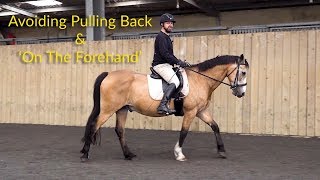
Mary Wanless explains why pulling back on a horse that dives onto the forehand makes things worse. Instead, keep your body angles steady, use your legs to engage the hindquarters, and control tempo from your seat. Groundwork and rein-and-stretch exercises teach the horse to rebalance.
It's really easy when a horse pulls or dives onto its forehand for the rider to pull back. And the problem with pulling back is it essentially changes your angles. So if we were to imagine there, there is a perfect place for your leg to be, your thigh to be, your body to be. If there's perfect angles for your body to be at your elbow to be out in front of you, for instance, which I find quite hard to do. If you pull back, you are going to change your angles. And this kind of thing could easily happen, or this kind of thing could easily happen where you end up leaning back and pulling. So pulling back compromises your position. It compromises your ability to ride the horse in the most balanced way possible. So that's. That's the reason why not to pull, apart from the fact that, you know, pulling is the least ethical kind of solution to rebalancing the horse. Okay, so when the horse pulls, what options do you have? Well, the first thing you're really trying to do when the horse pulls is to maintain your angles of your body, regardless of what the horse is trying to do to you. So that's the first thing you've got to do. So you are essentially reinforcing your position and refusing to be pulled, refusing to change your angles, refusing to get pulled out of place. The second thing you can do is think about what's happened to the horse's tempo. Has he sped up? Has he slowed down? Is he diving on you by slowing down? In which case, you might actually have to use your leg whilst maintaining your angles, and that will engage the hind end and possibly get the horse to come more up in front and lift its head and neck. If the horse is speeding off and diving onto its forehand and pulling you that way, well, you've got to get tempo control back through your. Through your seat, through your ability to control the speed you go from the bottom of the rise to the top and so on. And even sometimes, then as you get control of that tempo again, you might have to use your leg to get the hind legs to come underneath. The other thing you can do, which I really prefer, is to slow the horse down a little bit. It could be that you're going that little bit too fast for the horse to maintain its balance. And essentially he's pushing like crazy with a hind end, but it's just pushing the horse down onto the forehand. And then another thing you can do is to work on your groundwork so that the horse learns to stop from a light contact, to step back from a light contact and that you can practice slow walk, fast walk, slow walk, fast walk. And the horse learns to respond to the change of pressure in the bit and learns how to go from fast walk to bringing his weight back and so on. And while you fiddling around as the horse, the pony's gone out. So there's quite a few things you can do and quite a few things you need to think about. But more importantly than everything, is to try and maintain your angle that I don't go hollow back and let all my guts and weight travel onto his forehand. I have to stay back. And the other thing that we watch as well, and this isn't the case with you, Edward, this is not what Phyllis does, is to make sure that he doesn't go too deep like this with his head and neck. So you actually, you know, you've got to stay back. You might have to use your leg. You want to keep your hands carried. And, you know, there are lots and lots of different ways that you can, you know, get the horse to stay weight back. One of them, like I said, was tempo control. Another one is using the leg without letting the horse speed up. And that often raises the head and neck. And you can kind of see that, you know, he's. He would definitely want to drop his head and neck here. And I have to be a little bit careful that I don't overdo it right at the beginning of the session. You know, I want to give him a stretch. You know, just think about it. I'm saying to him, no, don't just drop your head to neck. I want you to carry your neck. And that actually requires muscles from the top. So we're going to do free walking along rein and stretch, which he's very good at.