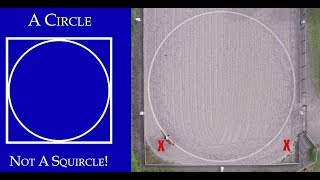
Peter Dove teaches how to ride a 20-meter circle in a 20x40 arena. A perfect circle touches the track, X, and the quarter lines. Most riders drift or fail to step cleanly off the track, but nailing the geometry builds balance and suppleness.
Welcome to this short tutorial on 20 meter circles for dressage by Peter Dove. Let's look first at the diagram of the arena from a judge's point of view. So C is at the bottom. In this case, the letters A, E, C and B mark quarter points around the arena with X at the center. The arena is 20 meters by 40 meters in size. F, K, M and H are six metres in from their respective ends. In the next diagram you can see I have marked the arena into quarter sections down the length. This diagram shows the horse path when going large, though more novice horses would not go quite so deep into the corners. The purpose is to demonstrate the clear difference between going large and performing a circle. Lets look at a perfect circle at a. When a 20 meter circle is drawn within a 20 meter square, it touches the edges of the square in four points and these really are only points. If you look closely at the start of the circle you can immediately see it comes away from the track. It goes nowhere near the corner and only next touches the track. And at the first quarter line, 10 meters away from the A end, it touches again at X and also at the quarter line at the other side of the arena. One thing to keep in mind is that the horse is continually turning and at no point simply drifting. So to summarize, assuming the left rein, you will need to be stepping smoothly away from the track at A. You will only then touch the track 4 metres after F. The next touch point is X. Be careful that you step away from x towards the 4 meter line before K. I say this because people tend to drift outwards even past the X marker after hitting the point at the X side of K. The next point is A. You must not allow your horse to drift into the corner. Remember you step onto the track slightly before A so that when your shoulders are at A, the whole of your horse will be on the track range ready to go large. Let's have a look at a typical circle I see all the time at A. Typically the rider goes into the corners a little, leaves the track sometime after F or K, and then drifts across the arena in a shallow circle and then proceeds to do a straight line then following the track around the arena to A. Moving back and forth between the two makes the difference clear. So why be so picky? Well, that is a question I have been asked and here are some of my reasons. Circles teach balance and suppleness, but only if they're performed well. A good friend of mine says you only get better at what you practice not what you think. You practice so allowing your horse to fall out and that's what you're getting better at. Only by attempting perfect circles can you know if your horse is deviating by falling in or falling out. Only then can you be sure your horse is developing real suppleness. Imagine perhaps that your horse is trotting on top of a narrow balance beam. You should be able to feel if your horse would fall off left or fall off right through his shoulders. Let's look at a 20 meter circle at E or B. The same ideas apply as before, but the touch points at B or E become even more critical. To get right, lets take a 20 meter circle at E on the left rein as an example. Firstly, make sure you step off the track at E and look to your next point at the halfway point between E and B. Make sure you are ready to touch the track at B. That is make sure you're not falling out away from that halfway point. Something which helps a lot is to practice which angle. You have to step away from the track at E to hit the right depth of circle and try to gauge the halfway line shown here on the diagram. Let's look at a typical circle I see. Usually the rider doesn't step off at E and ends up drifting. And then they hit the track a long way before B at the other side and realizing that they are doing a straight line, usually turn across and end up doing a shallow curve across the arena. Well, I hope this short tutorial has been somewhat helpful. We will be presenting some further tutorials with video footage of riders performing circles to illustrate some of the points. Thank you very much. My name is Peter Dove at East Soli EC 2000. Goodbye.