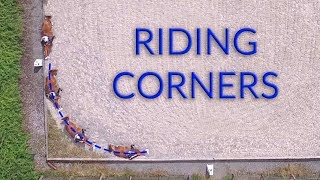
Mary Wanless explains how to ride corners as quarter circles to improve your horse's balance and control. Choose your radius based on gait, experience level, and whether you're indoors or out. Practice small circles to train balance before attempting turns.
It's really important to think of your corners as quarter circles. The idea of riding into a corner is a bad way of thinking about it. What you should do in a corner is choose the radius of the circle that you're going to use round the corner. You know, if you're walking, you should can do a smaller radiance than you can if you're cantering. You can do a smaller radius in trot if you're riding a grand prix horse, than if you're riding a horse that you've just backed and, and is a little bit all over the place. But it is important to choose the radius that you're doing and know, for instance, that even if you're riding the same horse, that the walk will be different to the trot, will be different to the canter, will be different to whether you're at home or, or whether you're out competing, depending on how stressed the horse is, depending on perhaps whether you're in an indoor arena or whether you're in an outdoor arena. So it might be that when you compete outside or in an outdoor arena with very small boards, that you give yourself a little bit of a bigger radius than you would at home. So there's a line here and there's a line there, and these lines are where you exit from the track, enter the track. And in a way, this is the key to understanding corners, in that at some point you step away from the track and you step back onto the track. If you're here on the track, you are now doing a quarter circle round like this, and then you join the track at this marker. Now, you may be doing something this kind of curve when you're cantering. If you're walking, perhaps you might start your curve there and finish it at this line. So you would continue in a straight line towards the corner, get to here, and then step round, step round, step round, and then continue straight. Practice. Every time you do this, you are practicing a turn, you are practicing a quarter of a circle, you are practicing balance through both shoulders of the horse. You are increasing your horse's balance. How small it is should make it a very slight challenge to you and the horse. The Fleck Carbon Composite Whip is the only schooling whip we use or recommend for both our ground and ridden work. It's beautifully light and balanced and can transmit energy without all the wiggle and wobble of normal whips. It takes only the slightest movement from the rider's hand and is stiff enough to allow for precision placement. Check it out on our online shop. We only sell products that we use personally in our day to day work. Members of dressage train TV get a full 15% off any of the products.