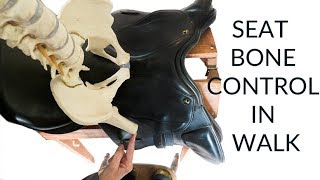
Mary Wanless teaches riders to control their seat bones at the walk by feeling alternating long-back muscle contractions with palpation checks. She shows how to progressively halve seat-bone movement using thigh stability, and explains that reduced rider motion may slow the horse's tempo without shortening stride.
See if you can cast your mind back when you last rode and walk. If you imagine my fists were your seat bones, are your seat bones moving forward and back together like this, or is one seat bone going forward, then the other seat bone, then the other seat bone. What should happen is that your seat bones move separately. Your left seat bone goes forward and in your right seat bone goes forward. And in another quick exercise I think I did this last week is if you put the fingers either side of your spine, very close to your spine and press in and then you walk, what you'll feel is one long back muscle contract and then the other long back muscle contract. The next question you should ask yourself, how much movement would you say is in each seat bone? People will describe it in lots of ways and usually with people that move around too much, I'll say to them, can you halve it? Can you halve it again? And you want to do that next time you're on your horse as well. Just think about sitting stiller, using the narrowness, the pinch, your thigh, your bearing down to stabilize and control how much the horse is moving your seat bones around and notice what happens to the horse. One of the things that people often say is, well, when I sit still, my horse slows down, as if that is particularly a bad thing. They're worried that, you know, they're causing the horse to slow down. And whilst this is true, the horse will. The horse's tempo will slow down. He doesn't actually have to get slower because he's starting to take longer strides. So if you find your horse slow down, don't stop sitting still, don't stop sort of, you know, you're still moving your seat bones. It's only a small amount. Use your leg to get the horse to walk on rather than start shoving and pushing more. The shoving and pushing is basically pushing the saddle into the horse's back, causing it to lengthen its underneath and march off. We're going to do a quick demonstration of something I want you all to do as homework. I want you to think about controlling your seat bones. And what I want you to do is to see if you can sit still enough and slow your seat bones down enough until the horse stops.