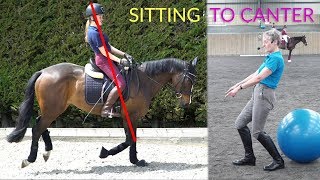
This is a recorded Dressage Training TV webinar by Mary Wanless explaining how to sit the canter. She describes canter biomechanics (three-beat sequence with a downbeat/upbeat and diagonal pair), common rider reactions (tipping/rocking, ‘polish the saddle’ pelvic timing) that can destabilize the horse, and coaching strategies to improve balance — notably shifting emphasis to beat one by weighting the hind leg and using a small pelvic-folding action rather than driving the tailbone into the saddle. The tone is practical, biomechanical instruction for riders aiming for better effectiveness and horse welfare.
So, hello there. I'm Mary Wanlis, your host for today. So I am the founder of the Ride of Biomechanics movement, author of the Ride with youh Mind books. I coach people to ride with more awareness, feel and skill so that they train and ride their horses more effectively. They know they're learning, they have more fun and the work they do is more ethical. So this is the last of our basic series. I did the sitting Trot webinar back in April. Peter's been doing most of them. So welcome to all of you here for canter. So canter is the four legged version of skipping. It has beat number one as the outside hind, beat number two, beat number three as the inside foreleg. Now if you were to try cantering in small circles, or let's say skipping in small circles. If I go to skip in a small circle, I'm going to go to the right. Skipping in a small circle with my right leg in advance here is pretty easy. Once I go to skip in a small circle and I have my left leg in advance, what tends to start happening is I start tangling my legs up and falling out on the circle. So this is what happens in counter canter if you're not well organized. And the challenge of counter canter is to keep balance and organization even while skipping with the outside leg leading, but also with its hind leg. Diagonal pair, front leg. We have the back end of the horse goes down. We're going to call that the downbeat. The diagonal pair where the horse is more horizontal and then the front leg comes down. Sorry, we're going to call that the downbeat. So you have one, two, here's the downbeat from which the horse pushes himself up and. And we get the upbeat and we get the hind leg on the ground. The front is up, the diagonal pair, the downbeat. The front is down. As the horse goes through the air and the hind leg comes down. The front is up. We have the diagonal pair. The front is down, it pushes off to bring the front up. Diagonal pair, front is down. Now, most of you have probably ridden the kind of horse that goes ka da boom, ka da boom, ka da boom, which is really difficult to deal with. And when you look at elite riders on advanced horses or even at a horse with a fairly good basic canter, you will see that the horse goes along pretty level. Yeah. Despite the potential of a ker duh boom and a dive down, the horse goes along pretty level. So one thing I often do if I'm watching horses in competition and Horses around me in lessons as well is look at the bottom of the saddle pad, if there's a square saddle pad rather than a saddle shaped saddle pad, and look at the bottom of the saddle pad and see how does that move? Does that stay level or does it have a tip and a rock to it? So riders have to deal with the tip and the rock and it makes them bump slightly differently. So whereas trot people, you know, often don't quite come down and they bump basically like this. When people go to canter, they bump like that. Well, you can see the ball might go out behind me and so might the horse. So some people's response to not being tipped is to go, you won't tip me, mate. You won't tip me forward. You won't tip me, you won't tip me. That's probably the majority of the population, while some of the rest of the population are going, oh, I'm tipping and bumping, I'm tipping and bumping, I'm tipping and bumping. And so we need to look at a couple of things. One is, can the rider keep the back of her butt down in the saddle in trot when people unsit? So if we say here's the horse and here's the rider, when people bump in trot, they bump level like that. When people bump in canter, they tend to bump this way. So this rider is only attached by her pubic bone. This rider is attached back to her seat bones and the back of her butt bumps up. This rider is attached back to her tailbone. Okay. Some riders are so determined they're going to stay attached at their tailbone that, that they end up going, beat one, beat two, beat three. And lots of people are taught this. So if you've been through Pony Club and at some point in time, you've been taught, polish the saddle with your bottom. This is what you've been taught. You've been taught to go, beat one, beat two, beat three. Beat one, beat two, beat three, beat one, beat two, beat three. There is a problem with this, though. By the time we get to beat three, if we go 1, 2, 3, 3, at this point in time, the horse's weight is already on that leading front leg. And you as rider are going, your shoulders are back behind your pelvis, your pelvis inevitably is behind your knee. And lines of force are going shoulders to pelvis to knee to the horse's front feet. And you are in big danger of really being the water skier to his motorboat. So the more you go 1 2, 3. The more likely he is to speed off with you, pull the rug out from under your feet, and kur da boom down onto that front leg with a really big tip and rock. So what the rider's unwittingly doing at that point is emphasizing that third beat of the stride, which is the downbeat of the weight down on the front leg. And the emphasis goes there, the emphasis goes there, the emphasis goes there, the emphasis goes there. What works better and what we teach is really trying to get the emphasis on beat number one. So what that means is instead of thinking of your pelvis going that way, you start to think of going, can you fold a little bit here? Fold a little bit here, fold a little bit here. So this is happening on beat number one. So I'm in a right rein position, as if my horse would circle that way around towards that long side. This would be the outside hind leg. And I'm saying to the horse, it's the back leg, weight the back leg, weight the back leg weight the back leg. And that's happening on beat number one. And can you attach your underneath to her from further back in your underneath? Ah, good girl. She could keep attaching your underneath to her from further back in your underneath. Be a box.