
Sitting Trot - Dressage Training
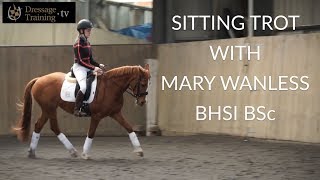
Mary Wanless teaches sitting trot by connecting horse biomechanics to rider position. Most riders wiggle through the middle with hollow-up, round-down patterns. Instead, she coaches a short, neutral sit from the hips, using live work with Millie to show how small shifts in thigh and seat change the horse's energy flow.
Questions this video answers
Mary Wanless
Addington Manor (UK)
Over 600 people
Moshe Feldenkrais (Feldenkrais Method)
So welcome to this webinar on sitting trot. Peter's handed you over to me for this one and I believe I do one with you in Canter. I'm back here in the UK in between two trips to the us. I came back four weeks ago, I think three or four weeks ago from teaching in the us. I'm back there again in another three weeks. And we also did a lecture demonstration last week at Addington Manor here in the UK. We had over 600 people there. That was a great success and a lot of fun to do and this is quiet by comparison. So welcome to all of you and I want to start with a wonderful quote from Moshe Feldenkrais. He is the originator of the Feldenkrais method. So if any of you were there at Addington, you may have done a Feldenkrais class lesson and awareness through movement session with my colleague Karen Major. And indeed we have some sessions on the website which I really recommend to you. And a wonderful quote from Moshe is that our aim in our teaching is to make the impossible possible, the possible easy and the easy elegant. Now, I love that. It virtually brings tears to my eyes actually to think of that, because people somehow think they should go from impossible to elegant in one go and they come down on themselves what they can't do and, you know, just think it should change like that. And I think trainers often think that people, people should be able to go from impossible to elegant in one go. And that's never going to happen. However skilled you are as a learner, however skilled I am as a coach, it's just not going to happen. We get to make the impossible possible and then over time we make the possible easy and over time we make the easy, elegant boxes. Oh, this is good. Really right now, this is quite good. The paradox right now is you're really pulling down, you're really compressing down and yet you are hung in a harness. So all of these energy blocks in the horse are going to make it difficult for the rider to have a trot that is sittable on. So lots of horses block energy somewhere here in the loins and that normally means they're not going that freely and everything gets a bit stuck and up, down. Sometimes there can be a block under the saddle that can give you something pretty weirdo to sit on. The block can easily be here in the area between the shoulder blades. Horses that aren't reaching into the rein somewhere, well, will have a block somewhere around the neck. And the poll, that's not necessarily going to make your sitting harder. But it means we don't have the archetypal dressage horse. We don't have that wonderful connection of energy. So we got all these places where the horse can block the circuit. And then the other thing is we really want that the hind faucets, as it were, are turned on enough that if we think of this energy like water going through a circuit, there's enough water going through the circuit that the blocks don't kind of put pay to the whole thing, you know, so we've got to have enough energy going through the circuit to try and wash those blocks away. So I often think of it like water through hoses, have the idea that if those hoses have been lying around in the garden all winter, they could be full of dead leaves and spiders and twigs and goodness knows what else. And if we can blast some water through them, we can clear the hoses. And we want to do that hose clearing work rising really, before you even think of going, sitting. And then we've got the places where the rider can block the circuit. So it could happen in her thighs from them being too tight in the wrong way. It could happen under her bum, it could happen in many places through her hand, wrist, elbow, shoulder, her back. So this circuit can get disorganized in an awful lot of ways. So here I am and I'm neutral. I spent years when I was training for my British Royal Society exams, I spent years cultivating my wiggle in the middle. Wiggle in the middle was how we were taught to sit the trot. And I'm just going to take apart wiggle in the middle a little bit. This is very often people's natural strategy and also still what people get taught, although you'll never see this in an elite rider. So what happens to some riders is they go hollow on the up and become neutral on the down. They hollow on the upper, they're pretty.
Neutral on the down.
They hollow on the up. They're pretty neutral on the down.
They hollow on the up, they're pretty neutral on the down.
Those will be the hollow backed riders. Then the round backed riders tend to be pretty neutral on the up and.
Round on the down, pretty neutral on the up and round on the down. Pretty neutral on the up, round on the down. Pretty neutral on the up, round on the down.
And if you really go to town on this, you're going to do half.
Hollow on the up, round on the down, hollow on the up, round on the down, hollow, up, round, down, hollow, up, round, down, hollow up, round, down, hollow, up, round, down, hollow, up, round, down.
And you can kind of hang in there like that, but you can't be really effective. What effective does is it keeps you short on the up and on the down. And it really has. It limits movement to the hip joint. So here we've got loads of vertebrae here moving, whereas when it's more right, the spine just stays stacked, you stay neutral, you stay short and come and halt over here. So, you know, most horses when they're in trot are just too unstuffed and noodly when you can match the forces, it requires your torso to have a firm solidness to it. And Millie actually got much more solid there in her best bits and clearly showed you noodly when she loses it. So what will you take away from this? If we take your work on both horses today, what will you take away from this? Okay, so. So this is on the pony that you feel connected to her back legs when you got it right. Okay. So you can suction her up more. And if you use your leg, you're still in place. That could be more of a drama on this one. Yes. So almost like the pull of the wave from is you going up with her in that stride. Yeah. Bit like the bounce along on the hippity hop that I was demonstrating while you were changing horses. Okay. I think you did really well. And actually, I saw Millie, what, Wednesday last week when we did this big demo. You were a lot more solid than you looked in the demo. Not being in front of 600 people helps, mind you, but I think pull down, pull away from were part of that. So within all of this, I hope there are some ideas that you can take with you. Remember, it takes time to make the impossible possible, the possible easy, and the easy elegant. Remember that you inevitably have to work your way through that catch 22. That until you sit right, the horse won't go right.
Right.
Till the horse goes right, you can't sit right. And you've seen a little bit of that with Millie talking about the two horses and also with the transition into trot on this horse. So I'm sorry, we've gone on rather long here, especially if you hung in through our abortive beginning when the sound wasn't working. Thank you for your patience and your time. I hope you have lots to go away and play with. And I believe I get back with you soon. I'm not quite sure when that is. Beginning of June, I believe. Take care. Until then, have fun.










