
Smooth Upward Transitions in Dressage
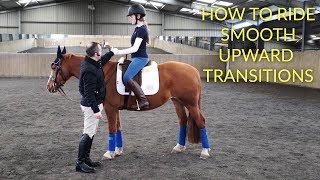
This content was created by Mary Wanless. This content was uploaded by Mary Wanless. This is a YouTube video titled "Smooth Upward Transitions in Dressage" created on July 28, 2018. It features a detailed instructional lesson by Peter Dove, an author and certified ride-with-your-mind coach, focusing on techniques for achieving smooth upward transitions in dressage riding. The content includes explanations of common mistakes riders make, corrections, and demonstrations with a horse named Tinker and a rider named Millie. The video is educational and aimed at improving riding skills, particularly transitions from walk to trot.
So welcome today's lesson, second lesson of today is going to be about transitions, both downward and upward transitions. We won't be covering the canta transition as that is going to be covered in the lesson dedicated to Cantor. My name is Peter Dove, I'm author of the book Master Dressage and I'm a certified ride with your mind coach. I'm hoping that from lesson two that you've had a chance to practice learning how to sit stiller, how to be more toned, how to engage your core and bear down. And hopefully some of you have practiced slowing your seat bones down in walk and feeling that the horse slows down as well. And some of you may have got to the point where you can just stop your seat from moving and the horse comes in to halt as well. Upward transitions should be very smooth that the horse remains with its back engaged and moves smoothly into the upward transition. You know, a lot of riders in upward transitions will make the mistake of what I call throwing the baby out with the bath water. So they'll use their legs and chivy the horse up into trot and the horse kind of in shock bursts up into trot and the head comes up and you know, it's often trot. And what they've done is kind of spoiled the transition by thinking of it as something that is instant. It's kind of almost the opposite of, you know, walk, halt or trot walk. The the transition from walk to trot and halt to walk should be nice and smooth. You know, if I'm watching as a judge and I and I'm looking to mark somebody, one of the things I'm looking to mark is that the horse pulls, pushes itself smoothly up into the transition and doesn't just go and sort of speed off. You also have to think about what it is you're trying to train your horse to do when you make an upward transition. You know, some horses are just lazy and do need to be more reactive from the leg and do need to learn to listen and do need to learn to power more through into the upward transition. But in general, when what you want the horse to learn to do is to engage its core and push itself up into the trot. And if you're too attacking or moving around or doing way too much to get the upper transition to happen, what can happen is the horse gets a bit shocked and kind of lengthens it's underneath and paddles off with its front legs and the head and neck comes up. So when I'm training a young horse or an inexperienced horse to how to move from walk to trot. I'd actually rather it take a little bit longer to make the transition, as long as everything else stayed really good, and that it would then learn the pattern to move up sometimes from upper transitions. The horse needs to learn the right pattern, and then it needs to get better and better and faster at the pattern. So, you know, if its pattern was to speed up by doing this, it now has to learn how to speed up by pushing and engaging its core. And that will take it some figuring out. And then you're saying to it, and trot on and still engage your core and so on. So let's quickly talk about the aids to go from walk to trot. They're the same from halt to walk. So we'll just use walk to trot and we'll use tinker to demonstrate walk to trot in a minute. It's first of all important that when you use the leg, like we talked about in the last lesson, that you use the lower leg in a kind of slightly slapping motion, like the. The leg shouldn't come back. The whole lower leg should just go like this. Now, I tend to use one to two taps with both legs to ask the horse to trot on. Some horses will just go from one aid and some horses two. I prefer to give two. That's just how I do it. And as I separate it out from an aid to just go faster within the pace, the other thing that needs to happen is that you're bearing down, your hands are out in front of you, and that when you apply your legs to ask the horse to trot on, nothing else gets involved in what's about to happen. Often I'll see riders making typical errors, such as the leg aid is incorrect, and they start doing this, which affects the rest of the body. The rider will start tipping forward in anticipation of the transition. They can often get left behind as the horse accelerates. They will often not have enough tone through the transition, and that's one of the reasons that they'll get left behind. So those are the typical mistakes in transition. So we're going to see if we can demonstrate a nice upward transition in a minute. Now Millie's just done stretching. Let us stretch all around the back of the camera and watch those wiggling legs. So Millie, even though we use Millie to demonstrate quite a lot, Millie isn't perfect. Millie has her own little issues. And one of the things I keep nagging Millie about is her wiggly legs. She would very easily get into a habit of Doing this and wiggling the lower leg. And she doesn't do this. There's none of that. There's no heels and strange things. But I'd often see the little legs doing this either side. And we're trying to break her of that habit. She's busy grinning over there, actually. Okay. And when you're ready, Millie. Good. That was nice. Well done. Okay. And we'll just come back. The very first thing you need to do is figure out what do you do right now? You know, it's impossible to make any progress until you figure out what it is that you currently do in your upward transition. So I'm going to run through a couple of typical mistakes people make in their upper transitions. And to give you some corrections for that, the very first thing that I see people do is to try and drive their horse into trot. This happens a lot. So the rider will lean back, they'll push with their seat in the saddle, and then they'll use the legs and often kind of start pushing with the seat as well. This can sometimes work for people, which is why so many people do it. But the reality is that you are pushing the saddle into the horse's back, causing it discomfort and causing it to lengthen its underneath and speed off like that. It's actually running away from your seat. So what you're going to have is a horse that will start to hollow, will start to lengthen its underneath, and you're going to be in a really bad shape. We do not teach driving with the seat. You know, I've just never, ever needed to think of driving with the seat for people that do lean back. First of all, you need to learn to keep sitting still. Just as we talked about in walk, if we're going to do a walk to trot transition, stay sitting still. Do not do anything extra with the seat to make the transition happen. If you're the kind of person that leans back, you're going to have to think of advancing your sternum forward so that you become upright. So get yourself videoed, get yourself someone stood there and get yourself to a point where you're upright. Hopefully you've got a mirror or your friend can tell you when you're upright. And you're going to have to work very hard at pushing your sternum forwards as you make the transition. Forward up into trot. The other thing that can help as well as to keep thinking of pushing the hands forward as if against resistance. So if you've got someone who can help you, you can get the rider to lift their hands up and put your hands in front of their hands like this to provide resistance and say, push against that resistance. So Millie is pushing her hands forward against my hand, and when I let go, you're saying, see if you can still keep that feeling as pushing the hands forward against resistance. This is really good for riders as well that tend to pull their tummies in and draw the hands back. So push the sternum forward against the resistance. Push the hands forward against resistance. If you're the type of rider that gets left behind or leans back in upward transitions, the way I describe it is imagine you have a plank stuck on the front of your body, a vertical plank. And your job is to keep your pubic bone, belly button, sternum pushed forwards up to that plank of wood. Okay. And actually, that's a really good diagnostic tool as well. So let's say you're the kind of rider that collapses. Well, you've taken your belly button away. If you're the kind of rider that leans back like this, then your sternum has come away from that vertical plank. As you make the transition, can you keep everything pushed forwards up to that vertical plank? If you're the kind of person that tips forwards, you know, then your belly button and your pubic bone have come back and away from it. It's really important to keep everything else the same and apply the legs to get the horse to trot on and the legs coming underneath like that. Sorry, sorry. Tinker. Tinker's just like, what are you doing? This isn't right. Do you want me to stop or not? Tinker's actually really, really good at demonstrating things going incorrectly, but we try to do it hardly ever because she'd learn too quickly, wouldn't she? Yeah, she learns the bad things really quickly. Okay. So if you get left behind, the plank is a really important aid for you in upward transitions. I often think of when I say to people, go forwards, up into trot with the horse. You know, make sure that you're ready to move forwards up into the trot. You can try this in your car or in your car, and you're sat upright with your back away. As you accelerate, you'll feel your body kind of doing this, wanting to go to the back of the seat. What tone does it require for you to have what bearing down? What snugness of your thigh do you need for that to happen? Again, that's. I mentioned the thigh as well. You know, when you're making an upward transition and you're asking the horse to trot on. Make sure that you know your thighs don't come away from the saddle and all the weight goes down into the back of your seat. As you start to use your legs, it's important that the weight stays evenly distributed over the entire sitting surface of your breeches and seat, as you ask with your leg. So again, the leg doing that rather than anything, which takes the thighs away. Frequently, people that use their heels end up taking the thigh away and then suddenly all the weights in the back of the horse's back and that could cause it to sort of hollow and speed away that way, or just not make the transition at all.










