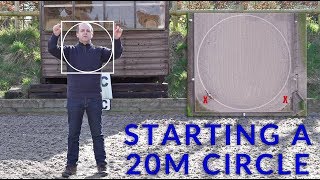
Mary Wanless gives step-by-step instruction for correctly starting a 20‑metre dressage circle: step off the track at A (not from F), aim to rejoin the track about 10 metres along (halfway between the arena end and letter B — near E when turning right), and treat each contact point as the apex of a curve to avoid drifting into a non‑uniform, flattened circle (which she dubs a "squircle"). She emphasizes the horse's foreleg making the first step onto the circle and that leaving the track too late (near F) yields a circle that is too flat. The chunk also contains a short promotional note recommending the Fleck Carbon Composite Whip and a 15% discount for Dressage Train TV members.
The other thing that's really important is that when you start your turn at A, sorry, your circle at A, that you're stepping off the track at A. That's really important. You should be coming to here. And the horse's foreleg makes that first step onto the circle important that you step off. If you don't, you're making the circle harder for your horse. It really is that simple. You're making it more difficult for yourself because the horse will come along here and suddenly you'll start to have to turn the horse, or maybe you wait till the corner and suddenly you have to turn the horse round onto the circle. It is more difficult. So it's a 20 meter circle and we know the arena is 20 by 40. So basically the point that you should touch next on the track is halfway between the end of the arena and the letter B. If we're going around in this direction, if we're going around to the right, it would be the letter E. Now this is where a lot of people go wrong. They think they should be leaving the track about F. I even remember being taught this, that, you know, you just follow the track round and about F. You start coming across the arena. It's completely false, completely wrong. The F marker is 6 meters in from the end, so it's too close to the end. And what you'll do is if you think of F in your calculations of doing a circle, you will end up making a circle which is too flat. So essentially you're four meters further in along from F. So I'm going to start walking the circle now and trying to describe to you how I think about the circle and how you take these ideas that we've been talking about. So we're on the balance beam, we're going to step off at A and we are aiming for 10 meters along. Now, I'm kind of lucky with this arena in the way that it's split out, that I know exactly where that is. But it's really important to realize that we are nowhere near at this point, the corner. You know, we're not going into the corner. You know, think back to that perfect picture of a perfect circle inside of a perfect square. It doesn't go into the corners. Circles that go into corners, I call them squircles. So we're coming round and we're going to hit the track about here. Now, this is the first time that I think I'll mention to you the idea of the apex of a curve. And basically what I'm saying is These points that you hit are the top part of a curve that you're doing. So in this case, if we think of a curve going from a half circle, going around from A all the way to X, this is the top point. And at every point that you get to think of it as an apex. And what I mean by an apex is when you get to it, you must realize that you need to be curving away from it towards your next marker. Frequently people drift so they come towards a marker. The horse steps on the track and this and as if by magnetic force, stays on the track for a bit and then kind of comes away again. You're creating a non uniform circle, a non uniform bend and making it more difficult for the horse. And in fact you're kind of, if you stay on the track or you allow drift, you're kind of showing the judge. The horse is on its outside shoulder stepping away from A. Yep, even then she could have stepped away a little bit better. Leaving the track, coming towards X, where she steps over that line nicely and is already moving away. And she's still turning, she's still turning, she's not quite on the track. And then steps back onto the track at A and then goes into the corner very nicely.
The Fleck Carbon Composite Whip is the only schooling whip we use or recommend for both our ground and ridden work. It's beautifully light and balanced and can transmit energy without all the wiggle and wobble of normal whips. It takes only the slightest movement from the rider's hand and is stiff enough to allow for precision placement. Check it out on our online shop. We only sell products that we use personally in our day to day work. Members of dressage train TV get a full 15% off any of the products.