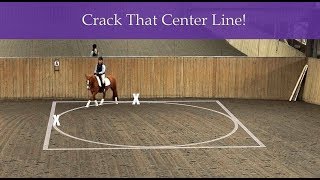
A YouTube instructional segment by Mary Wanless explaining how to plan and execute turns onto the center line in dressage. The speaker covers choosing a set-off distance from markers, visualizing the quarter-circle radius and approach angle, making step-by-step adjustments to keep the horse straight on the center line, and briefly mentions a recommended schooling whip product available in her shop.
When you make a turn up the center line at A, it's really important to know how far away from the marker you're going to start your turn. If you're thinking of it as a precise quarter circle, you should know where you're stepping off the track, and you should know where you're landing on the track. Really up the center lines are a fantastic place to put these markers in that I put. So, you know, I've got a marker align here and let's see how far away that is from a 1, 2, 3, 4, 5. So you're gonna go 1, 2, 3, 4,.5, and we're gonna put another line in. Okay. And that line goes over the center line. And it's sometimes useful as well to actually put a little cross there as well. And then you can kind of see where you've got to hit the track. Once you've found the radius and you know where you're starting from, you kind of need to know the angle at which you're coming away from the track. You know, if you were an advanced horse and you were starting, you know your curve here, you know you're coming off that track quite strongly to make the turn. If you're on a less advanced horse, if you're on a novice horse or if you're on a young horse, you know that you, you only have to gradually start making the turn around here to land yourself onto the center line. So it's how far away, what is the angle, how quickly do you turn away from the track? Once you know those two things, the rest is you get to this point that you've decided you're riding straight. You look at C, you begin your quarter circle, you keep looking at C and you make adjustments. You keep making sure that you step, every single step to the inside. You're turning, you're turning, you're turning, and you're focused at where C is, and you're making adjustments as you need to go. Because even if you get this perfectly right, the set off point, there's no guarantee your horse won't want to fall through one shoulder or the other. So you're always having to think about making the adjustments as you come round. If you think of turning like this, you will end up onto the center line straight, and then you can continue down. You know, one of the things you can do as you're coming around is to try and think of getting the letter C between the horse's ears. For instance, as you're trotting up the center line, the fleck Carbon Composite Whip is the only schooling whip we use or recommend for both our ground and ridden work. It's beautifully light and balanced and can transmit energy without all the wiggle and wobble of normal whips. It takes only the slightest movement from the rider's hand and is stiff enough to allow for precision placement. Check it out on our online shop. We only sell products that we use personally in our day to day work. Members of dressage train TV get a full 15% off any of the products.