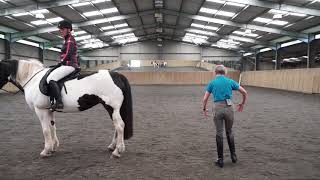
Mary Wanless teaches how to steer a horse by controlling the wither and front legs along a line, not just the nose. She diagnoses common faults like jackknifing and falling in, then offers rider alignment checks and exercises to redistribute weight and fix steering problems.
Okay, welcome, everybody. It's Mary Wanlis here. Welcome to our first webinar on steering straightness and sideways. And this is going to run for five months through the summer, as five different episodes after that baseline of being able to align your body, stabilize your center of gravity, match the forces of the horse's movement, get the wibble wobbles out of it. The next deals are how steering works. And. And I find it quite remarkable that actually many riders don't understand this and many riders don't know what a good turn would look like. So what's happening now is what a lot of people might consider was the horse making a good turn and the wither. Well, the nose is going really to the right on the inside of the circle and the wither is going really to the left. And what could happen here is the circle's getting bigger and bigger. And many riders, while this is happening, are actually congratulating themselves on their horse's bend. And they're kind of conned by the fact that they can see the horse's inside eye, which is what is often said as a measure of a good bend. But the bottom line is that Millie, at this point does not have control of the horse's wither, that the nose and the wither always go in opposite directions. And in the example we've just seen, the nose was going to the right, the wither was going to the left. The wither was acting like the hinge on what we in the UK would call an articulated lorry. And any of you listening in the US, and I'm not sure about Canada, would call an 18 wheeler. As a general principle, all our instincts when it comes to steering are wrong. And most people's tendency, the horse is falling out, it's instinctive to pull on the inside rein. The nose goes in more, the wither goes out more, the jackknife comes more profound. The horse is falling in. The first instinct is to pull on the outside rein. The nose goes out more, the wither goes in more. You, your problem becomes more profound. So the jackknife is very often the big steering problem, whether the horse falls out or falls in. When it falls out, it's almost always a jackknife when it falls in. There may be just more of a general drift that way rather than a real hinge at the wither. But our first thought in steering has to be how to steer the wither. Because when you try and steer the nose, the rest of the horse will not just go along behind it, you will Set up the jackknife. Let's say I'm the horse with my butt towards you here. The horse that is falling this way will have a lot of bulk over here and not much bulk over here. And whilst the horse and the rider would push against each other on this thigh, very often, there's not much underneath the rider's thigh here, and the rider's thigh is waving in the breeze because the rider isn't really against the horse, the horse isn't really against the rider. It's hard to be against the horse because there's not much horse to push against. But this side, they're pushing against each other like crazy. And things don't really change until the rider can actually go reposition the horse's ribcage underneath her, redistribute its weight and not be trying to steer a horse that's forever actually going bong in that direction. So the really effective fixes are actually a lot more sophisticated and a lot trickier for riders to get the hang of. But this will be a good route way in for any of you whose horse falls in to think of steering the horse's whither and front legs along an imaginary line. So in what's happening there, Milly's drawing the nose to the left, the wither goes to the right. The horse is falling out. It's making the circle bigger. If we had an imaginary line to ride along, it would be missing the imaginary line. In Chantal's case, where her horse falls in, she'd fall in of the imaginary line. So I want you to think about riding on an imaginary line. So if we could draw a circle, a 20 meter circle about the EB line and draw that circle with a can of paint so it's a line on the ground, the rider's aim will be to steer the horse's withers and front legs along the line with the nose and the neck ahead of the wither. So here's the questions we want you to be able to diagnose yourself with. First of all, doing this lean and rotate exercise in your chair gives you a pretty good idea. Then on the horse, are your chin and zipper over the mane, do they curve or lean to right or left? Would you have equal weight in each seat bone? And you want to think.