
Steering The Horse - Dressage Training
Mary Wanless (founder of Ride of Biomechanics) introduces steering problems in riding, arguing that common faults—especially the "jackknife" where the horse’s nose and wither misalign—are largely caused by rider biomechanics rather than innate horse behavior. She uses metaphors (wheelbarrow, articulated lorry/18-wheeler, bus) to explain how incorrect inside-rein pulling, rider rotation and C-shaped spinal curves, and uneven seat-bone loading cause loss of control. Wanless gives practical, body-centered corrections (regaining 50/50 seat-bone balance, hand/under-panel cues, chin/zipper alignment) and notes that groundwork can teach the horse correct stepping for turns.
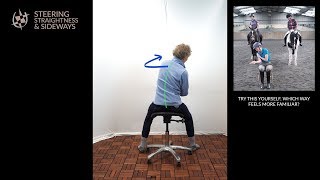
Hi, everybody. I'm Mary Wanlis, founder of the Ride of Biomechanics movement, author of the Ride with your mind books and DVDs. My mission in life is to coach people so that they learn to ride more skillfully, with more awareness and perception of how they influence their horse, so that they get better results, have more fun, and their riding and training becomes more ethical. This is a little introduction here to steering and some of my thoughts on steering and the interaction between the rider and the horse on the Generally, how to go round corners, make turns, side, side, plane. So for every rider, I think we could just say that our instinct is to pull on the inside rein. So the story goes. And I rather suspect, you know, this one. Here we go. I pull on this rein. In the process of pulling on this rein, my opposite hand goes forward. A gap is created for the horse to go out through his shoulder, and off he goes this way. And the more he goes this way, the more his nose is over here, his wither's over here. And if you make the mistake of pulling on the rein harder, then the horse disappears faster, following his wither rather than his nose. And I think there's not a rider in Earth that hasn't experienced that at times in quite dramatic ways. And so it becomes clear to all of us that this isn't a good strategy. But, you know, people just keep doing it. It's amazing, really, the way people just keep doing it. Because if you were steering a bicycle and you grabbed this handlebar of a bicycle, you'd only do that once because you would land on the ground and it would be very unpleasant. And if we thought of steering the horse like steering a wheelbarrow, which is actually a great metaphor whereby the reins are like the handles of the wheelbarrow, his nose is like the wheel of the wheelbarrow. And in an ideal world, his forehand goes along in front of you just like you're pushing a wheelbarrow. And you never would grab the inside handlebar of a wheelbarrow and just pull on it, because, you know, you just tip over the wheelbarrow. But that doesn't stop riders from pulling on the inside rein again and again and again. And that's the scenario we see most obviously. But of course, it could be its mirror image. The horse tends to fall in. His wither's going this way, and the rider gaily pulls on this rein, and all that happens is his nose goes outwards and he keeps falling in. Interestingly, though, the mirror image of that, where the nose goes Inwards and the wither keeps going out is the scenario I see the most often. And as time goes by, I tend to think that that problem is very largely man made. Because when horses are out with their friends in fields, you don't see some horse who wants to go over there going, whoa, I seem to be not making it, and disappearing, following his wither while his nose is over there. You might see him tending to go that way, cut the corner, fall in, and even if the ground is bad, fall over on his attempt to get there. But horses don't disappear in the wrong direction like this. And it makes me think that the most common steering drama of the jackknife, where the nose goes in and the wither goes out, is largely man made. Most of us are out there in steering trying to fix our horses. But my whole philosophy as somebody whose main thread is rider biomechanics, is actually we have to fix ourselves so that by fixing us, we get to fix the horse. And I just used the word jackknife, so that is my favorite word to describe this. So if you think of what we in the UK would call an articulated lorry and folks in the US would call an 18 wheeler, the 18 wheeler has the long trailer, the hinge and the cab. And when the horse's wither acts like the hinge on an 18 wheeler like this, then the rider's in trouble. And the fact that the rider has pulled on the inside rein a lot of times makes this more wobbly. And sometimes when riders have pulled really on both reins, you end up with a horse that's a bit like trying to steer a fish because it's just so wibbly, wobbly around the wither. Although most horses will have a preferred longer side and shorter side. I've even seen riders in that out of control scenario where the horse is falling out through the wither and going this way and they're pulling on the inside rein. And it's clear to me that they cannot control where the horse's wither goes. But I've seen them be absolutely thrilled with themselves because they can see the horse's inside eye and they're congratulating themselves on their bend. And I'm left saying to them, no, that isn't a bend, that's a jackknife. All of the little displacements in the horse's body that might create a bend have been just all put together into one hinge, movement at one hinge. And that one hinge scenario means that a, the rider can't Control the wither. And B has a jackknife, not a pen. And that rider, if that's you, you need to become less happy with what you're doing, really asking yourself the question, can I control where the horse puts his front legs and his withers? If we drew a line on the ground, let's say in the riding arena with a can of paint, and we drew a 20 meter circle, could you steer the withers and the front legs along that line like you were steering a wheelbarrow with the wheel of the wheelbarrow going along in front of the handles of the wheelbarrow and the nose going ahead of the withers without the withers falling in or out of that line. And that really is the baseline stallion steering. Now, we also teach some of the baselines of this to horses using groundwork. And some of you may have seen the webinars done by my colleague Ali Wakelin, where we teach our approach to equine learning theory. And we will teach Horst that a turn in that direction requires him to step that front leg that way, because if he wants to go that way, but he's stepping this front leg this way, it's not happening. And conversely, a turn in this direction requires him to step this front leg that way. And we really try and show him from the ground that that's what's required and that a turn involves that. But really, in this, we have to look to ourselves, given that horses, left to themselves in field, don't just fall out through the wither and not go to their friend in the way they wanted to. And I'm going to show you some of the main things that I think happen that get us in trouble. So on one side of your body, and this is almost certainly the side you will define as the bad side, what's going to happen? So I'm going to sit myself here on my imaginary horse with my back to you, is if I pull on this rein with this hand at the same time as I do that, I'm almost certain to rotate my body. So I go hand back, elbow back, shoulder back. Within that rotation, I'll also make a C curve, so my spine is now curving off in this direction. And almost everybody will do that to a greater or lesser extent on one side. For me, guess what? It's this side, historically. And if I turn this way, I'm much more likely to be able to, let's say, use an opening rein like they talk about in the textbook, and have my horse go. And I will be much less inclined to make that combination of a rotation and a C curve. And anything that makes a rotation will tend to C curve and anything that C curves will make a rotation. This is Lovett's law from, I believe, 1903. It applies to spines and you and I, and also to objects. So within this scenario, which is the most common steering problem I see with this going on, I, as a coach, can't really say which seat bone is going to be heavier. Now, for most folks in this kind of scenario, the inside seat bone will be heavier and the outside one will be lighter as this side lifts in the rotation. But. But some people do manage to do it this way. So I would have a question for you, which goes in your riding in a circle in both directions. Can you keep your weight 50, 50 on your two seat bones? And if you lose a seat bone, what happens to the ideal of 50, 50? Does it become 60, 40? Does it become 70, 30, 60, 40 is almost ubiquitous. Once we're getting to 70, 30 and 80, 20, then you have a beyond the average kind of discrepancy. And one of the first things you might like to do is whatever seat bone would tend to lift once you figured that out, if you take that hand, put the reins in the hand of the shorter side, or let's say the. The seat bone that's more there, and put one hand under the panel of the saddle. Slip your fingers under the panel, or if you can't, the flap. If you have a sheepskin saddle pad that just goes under the seat of the saddle, that's perfect because you can grab those and pull on them really easily and pull yourself down on this side. So that might work pretty well as a first correction to even you out, although maintaining that from there may be harder than you think. And once you get to 50, 50 here, you're wanting your chin and your zipper over the mane. Another good fix on the side where the seat bone disappears. And when it disappears, it'll tend to go away from the horse's spine. Can be to put the fist of the same side. So that's this hand in what I'm demoing here across the pommel with the little finger end of your fist against the saddle and make pressure here because that will help to bring that seat bone, this one, closer into the horse's spine and more there on the saddle. So that gives you some very basic practical ideas to get you closer to 50, 50 seat bones. And that's a rule wherever you're going, whatever you're doing, and your chin and your zipper over the mane. And you want to have the idea of steering the horses withers along an imaginary line. And when it works right, it's very much like steering a wheelbarrow. And you could think of it that you're coming around the circle as if riding a very many sided coin. Like you want a little turn this way and a little turn this way and a little turn this way. We talk about it as turning like a bus. Yeah, because a bus goes round a corner, unlike the lorry or the 18 wheeler without a hinge, it goes in one piece and. And the front end turns around the back end. So steering is quite a topic. There's an awful lot of things that can go wrong and it's wonderfully magical when it goes right, especially in both directions. There are many misconceptions, misunderstandings and myths to bust about steering. And I hope I'm giving you just a little introduction here to what is possible and a few practical tips that you can take away and use yourself on your horse. All the best to you. Have fun riding and we'll speak again soon.










