
Straightness - Dressage Training
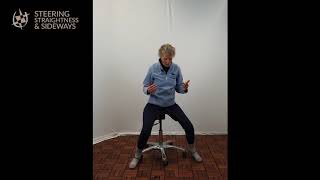
Mary Wanless explains how rider asymmetry creates a skewed container that pulls the horse's shoulders off the line. Most riders have uneven pelvis, knees, and weight. She teaches practical fixes: 50/50 seat bones, knees on the bar, and 10m circles in walk to build straightness.
Hello again, I'm Mary Wanlis, founder of the Ride of Biomechanics Movement and author of the Ride with youh mind books and DVDs. So this little webinar is on straightness. And our start off point has to be to say that nothing in nature is symmetrical. And that includes you and me and your horse and my horse. So you could say that when it comes to the issue of straightness, we all have our cross to bear. Some of us are more asymmetrical than others and part of that are just habits and patterns. You know, I, for instance, am left handed. Very few left handers get away without a big rotation in this direction because writing across your body just works that into your system. And of course, when you add injury to this, asymmetries can become quite a big deal. And your horse as well will not be symmetrical. So we're all learning to make the best of a bad job and it is possible to make some huge differences, although culturally the way we think of it in the horse world is as if it's just the horse's problem and we need to make the horse straight without backing up a stage and going, well, hang on a minute. How might my straightness issues be involved in creating or perpetuating his straightness issues? And I'm going to say to you that the horse cannot not be influenced by your asymmetry, the location of your center of gravity, your wobbliness, your shoviness so much about you that he can't help but be affected by it. You cannot not influence just in the way your mere presence is there in the saddle, let alone what you think you're doing as you're giving aids. There's a whole other scenario going on behind the scenes that has not been highly enough thought about and considered in our general coaching. Let's say it's as if the rider is a container and the horse is a liquid and the liquid takes up the shape of the container it's put in. Or you might say the horse is like he's put in a framework by the rider. You could think of it, for instance, that the rider's thighs are like an A frame. If my thighs continued by magic on beyond my knees and back behind my butt, they'd be just the shape of an A frame. And if we are a wonky A frame, we're making a wonky container for our horse. And I would say that most riders really have an A frame problem. So if I'm sitting a bit like this, this knee's up and more out and that knees down and more in. I am a wonky A frame, and my thighs and their position is very much related to what's happening in my torso and my pelvis. I'm actually falling off this side of the horse. And I will often say to people, if this bony nobble that you can find very easily with your thumb here on the inside of the underneath the end of your thigh bone, if this bony novel was hooked onto an iron bar that passed through the horse's tummy, would the bar be level? And most people can pretty easily answer, mmm, no, it wouldn't be level. It has an up knee and a down knee. It may not be quite so clear to you as a rider which one needs to move normally. For me, as the coach, it's very clear that either the up one needs to go down and sometimes that the down one needs to come up. But if you're going to be a symmetrical a frame, putting the horse in a symmetrical container, having the idea of the bar between your knees staying level is a great idea. And that really adds to the couple of things I said in the video from last time about having 50, 50 weight on each seat bone and your chin and zipper over the mane and thinking about your knees this way will help you with that. So. So let's say things are going wrong. When it goes wrong and the horse ends up where we're pulling on this rein, giving away this one, creating a space for his wither and his shoulder to go out through, ending up shorter on this side of our body, normally with creases under this armpit and lengthened on this side of the body, normally with a raised and lifted shoulder here. When that's happening, we don't mean it to be this way, but by default, our body is making a force from our shorter side towards our longer side. And as the horse falls out through that shoulder, he's very much influenced by the force that we're making. And in addition to that force, here we are again on a circle to the right in this direction. In addition to the force, we have the fact that the centrifugal force would tend to take the rider's butt to the outside of the circle. So her own defaults of a force this way to that way within her body are adding to the problem that already exists with the centrifugal force. And if we want a straight horse and a horse where we can really steer the weather along an imaginary line, we need to try and take away in ourselves the fact that we're unwittingly making a force from one direction to the other. So let's talk now about how it works, when it works well. So let's pretend right now that my arms are like the horse's shoulder blades. So here's the horse's shoulder blades on each side. And most of you will know that they are not connected to the ribcage by bone. Ours are. They're connected by our collarbone here, but the horses aren't. So sorry, this is a bit brutal, but you could slice off under the shoulder blade and the whole front leg because all you've got underneath the shoulder blades are muscles and ligaments. So we have the front legs here and the wither and the ribcage between the front legs make a teardrop shape. And when it works right, the shoulder blades get pulled up and in together and the ribcage and the withers get pulled up between the shoulder blades and that structure of the forehand gets to act as one unit. Now, since horses and riders do obey the same laws of physics as airplanes and motorbike riders and bicycle riders, there has to be a slight tilt, at least in that axis. And it's not very much at all. Somebody once did the maths and came out with it was about 6 degrees on a 10 meter circle in canter, but nonetheless it's there. So it'd be a slight force that way or a slight tilt that way and a turn that direction and a slight tilt that way and a turn that direction. When it goes wrong, the horse essentially says to the rider, well, I'm sorry, but this shoulder blade isn't going to partake in this. It's going to go bong and do its old thing. And the shoulder blade, as it was, falls off from the midline, refuses to cooperate, and the horse goes out through that shoulder. And it could be the other way around. The horse might go boing fall out through that shoulder. His weight goes that way, his withers go that way, his nose goes that way, his body follows his withers and he falls out in that direction. But when it's really right, it's as if he's like a gymnast on a balance beam. First of all, the shoulder blades come up and together the wither and the teardrop shape come up between them. The whole thing acts as one unit like this, and the horse is like a gymnast on a balance beam. So here he is walking along the balance beam until such time as he goes badong and falls off. And then maybe the rider often over corrects and he Goes badong this way and falls off. And you as rider, are trying to keep his wither and his front legs dead along the line. And the gymnast on a balance beam way of looking at it is a great analogy. Somebody who was a gymnast in childhood in a lesson once got it really good and went, I just had this flashback to being on the balance beam when I was a kid. I thought it was wonderful. So you have this happening and you don't want any of your corrections to overcorrect and go the other way. And when you get this to happen, it's really clear because the drawing up of everything makes the way the withers move and the front leg step very distinctively different. And most riders can tell when they're doing it. And it can take us a little while to get to that stage. I often suggest practicing riding 10 meter circles in walk, really going, am I in control of the wither? Is it on the line? I want? Is it out? Is it in? Is it on? Is it out? Is it in? Is it on? Is it out? In? Is it in? Is it on? Really trying to be precise. Another way you could think of it is like if you thought of train tracks where you've got an electric system, maybe a bit like the underground in London, or some little trains that you get in airports between the terminals, where if the legs were on the train tracks at the outside, the wither would be like the electric rail in the middle. And you're wanting to steer the wither along the electric rail with the front leg staying on their rails. And once one of the sides derails, you're in trouble and you're doing the best you can with things going wrong. So this is a major topic, isn't it, really? And one in which people I think, have, you know, some interestingly not quite accurate ideas. I find it interesting that what you hear in the mainstream is how the horse's quarters fall out through a turn. Well, what I see much more often is the horses wither falling out through a turn. And I think that might be said, the quarters might be said because the riders that make our theory, who are the elite riders of the world, have already fixed the shoulder problems. So they get on to problem number two, which is then the quarters problem. And of course the quarters might go out and the quarters might go in. And I can show you more as time goes by potentially about what to do to keep the quarters behind the line of the shoulders. But just saying, if we can organize the hind legs, we'll organise the front legs doesn't work half as well as saying the front legs have their own motor control. They have their own way of going their own way. And if we address that first, we get a good inroad. Thank you for watching. All the best for you. Enjoy riding. Remember the knees on the bar. Remember the chin and zipper. Remember the idea of steering like a wheelbarrow. Or better still, the train tracks. The electric rail in the middle, the gymnast on the balance beam. Have fun.










