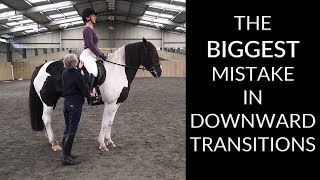
Mary Wanless explains why downward transitions fail: riders lean back while applying contradictory aids, causing horses to hollow. Keep your feet light, thigh snug, and stay vertical instead of tilting back. The physics works against you when you fight yourself.
For most folks, being told to grow tall in a down transition has them push in their feet, hollow their back, straighten their knee, elongate themselves. And the more they do that, the more they're just left pulling on the rein. And, of course, the more the horse hollows out from underneath them, and the more wrong it goes. So you're going to go push down in your feet, make your thighs more vertical, grow up a bit, lift your chest a bit, lift your bum a bit, and then you start to pull. And that's overkill. You know, she's doing rather a caricature of wrong. Many, many people have to go through a huge learning process to discover how to not do that. So within a down transition, the foot must stay light. No more pressure into your foot. The down transition, you want to think of not using your leg into it because you. What you actually don't want to is to give two contradictory aids that are like a woe and a go at the same time. Your thigh can come a little snugger on the saddle on the transition down. And one of the critical mistakes that actually is within a down transition, leaning back. If I was stood on a little rug, I'm stood here on a little rug. Somebody pulls the rug out from under my feet, what happens to me? I topple backwards. The rug's on a polished floor. The more I topple back, the more polished there is, the faster the rug goes. The same laws of physics operate for those of you who ski. You will understand being there on the mountain thinking, I don't think I want to go down this mountain. And the more you lean back, the faster your skis go out from underneath you. So if you lean back and you think you're saying, whoa, by the laws of physics, you're not, you're saying, go. So it's really important in a down transition that the rider stays vertical. And this is huge training that's massively important for every down transition, every half halt, every collecting aid.