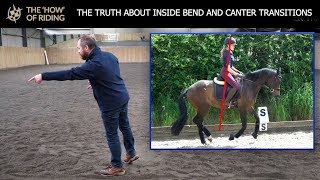
Mary Wanless explains why horses fall on the outside shoulder during canter transitions. She uses Millie and her mare Tinker as a case study, showing how over-bending inside actually makes the problem worse, and recommends groundwork to improve straightness instead.
She would ask Tinker to canter. She would come in straight, ask Tinker to canter. Tinker would go, bleh. Like this. Fall on the outside shoulder as Millie was asking for the canter, and then still strike off incorrectly. So Millie kind of couldn't coordinate the keeping the mare straight and all that sort of thing, which is why really, you know, we use groundwork to help us as much as possible because that would solve that particular problem by getting the horse used to being straight and requiring less good rider biomechanics to make it happen. So, you know, often the advice to get the horse on the correct lead is to bend it to the inside. You know, bend it to the inside. If you bend it to the inside, it'll know it's going to the right, for instance, here, and therefore it will go on the right lead. That is sometimes true. Okay. But if you bend your horse right and it falls off in this direction, as far as the horse is concerned, it's going off in this direction. Okay? So it's really important that you don't over bend your horse to the inside, and it's really important you realize where the horse's weight is in its shoulders, and that will kind of give you a clue as to which leg it will naturally want to strike off on. Okay, so enough chitchat. Let's have a look at Millie do some canter for us.