
Using The Leg with Dressage Training TV
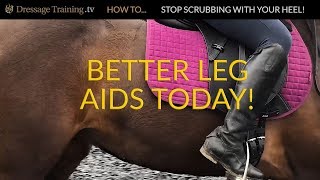
Mary Wanless and Peter Dove teach leg aids in dressage: use small, invisible movements applied directly inward with no forward or backward motion. Release immediately after the aid. Avoid scrubbing or large movements that throw off your seat and make the horse ignore you.
Foreign.
Welcome to our video on leg aids. We're going to look at how you can make your leg aids more invisible. We're going to look at some of the problem type leg aids, such as scrubbing with the heel and how that can affect your stability on the horse and your effectiveness too. So rather than inflict this on our equine friend here, we're going to make our way over to the studio where we can look at this in more detail.
Hi there, it's Peter Dove from Dressage Training tv. Today's session we're going to talk about using leg aids. I talked about leg aids in the last video that I posted up on the Winter Schooling series. And I mentioned when I was using my leg and how I was using my leg during the session several times. Unfortunately, when I play it back, I realize how invisible those leg aids are and that you don't really get a clear sense from the video where what it is I'm doing with the legs. I do describe it, but you know, you can't really see what's happening, especially if you don't know what to look for. So I thought I'd put together a short video here in the studio where I can use my legs from this.
Angle and from this angle and you'll.
Get to see what my legs are actually doing. And we'll also discuss the downsides for the leg aids which I consider to be incorrect.
Join up today as a member of dressage training TV and get access to over 30 hours of existing training videos from courses such as the how of Riding, Rider Biomechanics, Retraining the Horse and Rider Improve youe Dressage Scores and Many more. This is the small leg aid. It is easier to see from the front than the side. Such a small movement is often lost in the bigger movement of the horse. And once you have the horse's sides against your legs, you are probably making an even smaller, more invisible aid. As per the video, notice the aid is of short duration and has an immediate release. It is not held on. In the bigger leg aid, the leg may even first come away very slightly from the horse's sides. It again is a clear aid, has a rebound release and is still pretty hard to see from the side. In the bigger leg aid, you can clearly see the legs come away from the side and then rebound against the horse's side. It's still a clear aid and doesn't hang around being held on against the horse's side.
One of the things that you should notice about the leg aids is There isn't really any backwards or forwards movement to them. So the leg goes directly inwards like this. So if you were watching a person sideways on it, it really would be.
Quite hard to see them actually moving the leg.
One of the reasons why the leg should be kind of used like this and nothing changes from the knee up is that your weight stays distributed in the saddle in exactly the same way as before. You use the leg so you don't get a sudden change. So other leg aids I see that happen are a lot of kind of heels up. And you know, especially for riders wearing spurs, they're doing this heels up. And if they're not riding spurs, I've still seen riders doing this kind of scrubbing with their heels and you can see my knee moving up and down. And as soon as that kind of happens, your thigh comes more off the saddle. You end up bum heavy in the saddle, especially if you're using, using it with both legs and of course the combinations of toes out, knees out, and scrubbing up like this into the horse's sides with the leg coming further back and so on. And it just starts involving the whole of the person's leg and position and seat. Really a leg aid wants to be almost invisible, nothing changing, not changing the position of the rider, everything just staying the same from the knee up.
It is possible, especially using the groundwork.
System that we teach, to get the horse to respond to the leg that lightly that you can see me using in the videos.
But it's also a question of a.
Habit from the rider that the rider gets into the habit of thinking of not using the leg and keeping the leg still and in place, and only using the leg when they want resultant and making sure that they get a result and then going back to sitting still again and not doing what we call filling in for the horse. So filling in for the horse happens when you use the leg and the horse doesn't really quite go and you start using more leg and before you know it, you're doing an awful lot of work just to get your horse to keep going. And you start filling in with all that energy and movement and shoving for the job that the horse is supposed to be doing. And it's really important that you don't fill in too much for your horse in anything that you're asking it to do the horse. You want the horse to be able to do these things itself. So keeping the leg aid still, slight leg, very small leg aid, they're hardly seeable.
And that's what we, the best results on the horse.
It will be the best results for your position as well. You know, imagine you're cantering.
Imagine doing rise and trot and you're.
Busy scrubbing around with the heel and your knee coming up and down and moving around. Or your thigh coming away from the saddle and all the weight traveling down into your backside. Thigh stays against the saddle. Toes still keep pointing forwards. Small, almost invisible leg aid. Alright, we'll have another session up very soon. See you then.










