A short transcript of a conversation led by Mary Wanless explaining two related riding concepts: the "spiral of increasing tension" (a negative feedback loop where rider/horse errors escalate, producing hollow backs, pulling, and control struggles) and the "spiral of increasing ease" (a positive feedback loop where small rider improvements lead to a more lifted back, relaxed movement, and easier sitting). Wanless also describes "seeking reflexes": as the horse's back lifts it seeks contact with the rider’s seat, thigh, and rein and fills out its ribcage; she notes that being "on the bit" can be achieved without a bit (some pupils use bitless bridles effectively).
I like to talk about the spirals.
Of ease and tension. So in the spiral of tension, let's.
Say your horse is pushing back at you.
His back is hollow.
Maybe he's lazy, maybe he's speedy. You end up not feeling very good on his movement, because this movement to sit on could go, thunka, thunka, thunka, thunka, thunka, thunka. And things are going wrong, and you're struggling maybe for control, and you start pulling and bumping and sweating, and he gets more antsy and things go more wrong. And this would be what I call.
The spiral of increasing tension.
And we've all been there at some point in time where we get more wrong and the horse gets more wrong, and as he gets more wrong, we get more wrong. And then you're having a pulling match.
And then you're frustrated, and then, and.
The opposite is what I call the.
Spiral of increasing ease. The horse begins to get more right.
And the chances are that it's actually you that starts it, so you get.
More right, so the back can come underneath you more and lift up, and the horse can reach into the rein more. And then you're less tempted to pull. And at that point in time, energy.
Is flowing more, so you're less tempted.
To kick and shove. And you've got more right, so he gets more right. And when he gets more right, it's.
Way more easy to sit on his movement. So you can sit better, and he can go better, and you can sit better, and he can go better, and.
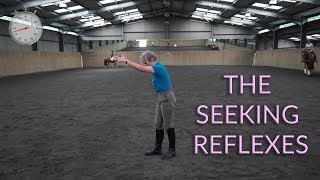
You can sit better and he can sit better. And that's what I call the spiral of increasing ease. Along with that, I like the idea of what I call the seeking reflexes. Because once we're starting to get into the spiral of increasing ease, what really happens is as the horse's back comes up, it's like he's seeking contact with your butt and your body here. And at the same time as that happens, he will actually fill out in his ribcage. So it's almost like somebody blew up a gym ball. So his back comes up, he fills out into his ribcage. And as that happens, you could say he's seeking contact with your thigh and with your calf. The next thing that happens is as the back comes up, the head and neck get to reach out of the wither, and he gets to seek contact with the rein and the end of the rein and the contact that you have there that hopefully allows that length of his neck to happen. So the idea of the seeking reflexes and is a much more whole body concept than on the bit.
And maybe I should say at this.
Point that on the bit can happen without a bridle.
I know a number of pupils I.
Teach who ride in a bitless bridle and can have a really good effect using a bitless bridle rather than a bit, so it doesn't require a bit.