99% of AI "Experts" Have No Idea What They're Talking About | Interview From CES
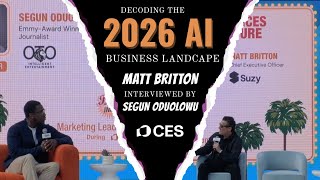
Matt Britton, CEO of Suzy, argues that Gen Alpha will demand conversational AI and hyper-personalization. He built an AI engine trained on 25,000 hours of call transcripts that scores sentiment and alerts managers. For individuals, he warns deterministic jobs face risk but says learning by building personal projects—a tutoring tool, a healthbot—beats rote knowledge.
Chapters
Hello, hello, Hello.
All right.
Fresh air is nice, isn't it?
I love doing this in the fresh air. But before we continue, just a large round of applause for Matt Britton, who is one of the leading minds when it comes to explaining AI and marketing. So, Matt, thank you so much for doing this.
Thanks. I haven't even done anything yet.
Well, you did write a book called Generation AI. And so speak. Speak to the audience about some of the things that are in there that affect marketing, especially for these brands and these industries.
Well, I wrote my first book 10 years ago, and it was called Youth Nation. And I was inspired to write Youth Nation because at that point, for the first time, youth culture was no longer counterculture. Meaning before the age of social media, in order for young voices to be heard, they had to protest. They had to go to places like Woodstock, stand up at town squares, because it was the big mainstream media that controlled the narrative. And now all of a sudden, you had YouTube and you had Instagram, you had these tools that allow people to have a voice. And I called it Youth Nation because for the first time, brands were being built on the sidewalk, not the boardrooms. Right. And they could dictate, you know, popular discourse and the way that society and culture evolved over time. And now we're seeing even a bigger shift here in 2025, 2026, around AI. And as somebody who spends a lot of time with hands on keyboard building an AI, my eyes opened up that this is the next big shift. And with this next big shift is going to be a new generation gen Alpha. Gen Alpha, currently age 0 to 15, is never going to know a world without AI, never going to know a world without a technology you can speak to like a human. And it was based on that that I got motivated to write the book Generation AI.
So when you're talking about this generation that's coming that are consumers themselves that have never not known AI, how are we as consumers? Take me for example, completely a consumer buying things left, right, willy nilly. How am I being influenced by AI, either knowingly or unknowingly?
Well, I think what you're hearing at CES this year is kind of the topic du jour. And I've been coming for 25 years to CES and throughout that timeline that there's been topics that people have focused on. I remember when streaming was a big thing, 3D TVs, like, you know, even when the iPhone first came out, there was a huge boom around AI. I mean, iPhone accessories. Now what you're seeing is every Company put AI at the center of their strategy. And I think this year is the year where brands are gonna really have to prove its value. The investment cycle has already started, the catback cycle has started. So you may have only very sparingly been impacted by today. Now, some will tell you AI has been around for a very long time. When Netflix tells you the next show to watch or Spotify tells you the next song to listen to, that is machine learning. That is AI. But now what ChatGPT has done and everything else that came after it is it put the power of AI in every consumer's hands, made it easy to understand, make it accessible, and that's what's really going to change the world moving forward.
Okay, so for brands, because this, this, this interests me, right? In sports, as we know, back in the days of the doping, it's the athletes were staying ahead of the testers, the drug makers were staying ahead of the testers. They were making like BALCO was ahead of all of the testing. How do brands stay ahead of the consumers? If the consumers are already using AI, how do the brands then use the AI to kind of get ahead and market to these people like myself?
So I think it's about delivering on expectations. You know, with evolution of technology becomes the evolution of expectations, for example, I think consumers are going to increasingly expect and demand hyper personalization, for example. So right now, most companies, when they send out email newsletters, it's one to many. It's the same email going out to a million people. I don't think that's going to be acceptable to the new consumer. The consumer is going to expect that a brand knows them, has the context, has their preferences, has their images and, and they're gonna be treated as an audience of one. I think brands are gonna be expected to move faster. Customer experience is gonna be more seamless. So I think there's gonna be a lot of ways that consumers are gonna drive new expectations that brands are gonna have to deliver on.
Okay, well, I'm a big hip hop head and Biggie had that, Biggie had that line, I'm not only a client, I'm the player president. You just happen to be the CEO of Suzy. So how is Suzy staying ahead of. Of, or actually not even staying ahead? How is Suzy implementing what you just said?
Yeah, I mean, I look at Suzy and his trajectory is kind of a case study of disruption. You know, we spent seven years building a market research tool and a survey tool which seemingly overnight became commoditized. Because in the world of software, and it's another thing we can get into. There's no longer the barrier to entry that there used to be in terms of creating software. The these vibe coding tools like Cursor and Lovable allow teams of one to create software that in the past you needed tens of millions of dollars of capital and tremendous resources to create. So I was faced with what am I going to do about it? We've raised over $100 million. We have to reinvent. And to me, while the layer of tooling has become commoditized, the areas that haven't become commoditized and arguably are the moats in the age of AI are around data. So we are really, really leaning into the data that we've amassed on behalf of our customers, which consumer insight, consumer research data and what to do with it. And what we're trying to do with the data is not just output charts and graphs, but the things that companies and brands really need from that data, which are stories that they can use to drive decisions within the enterprise prototypes. So they could test new packaging, new product designs, not just charts and graphs, but actually use generative AI to create these new prototypes and over time allow brands to use their customer data to actually help drive decision in terms of what to do next.
What do you mean by stories like that? That sounds kind of generic and sure, but define stories in how Suzy is using it and how brands need to adapt.
So the reason that brands conduct consumer research is to make a decision and they want to make a data driven decision to cover their ass, to make sure not making the wrong decision and to be able to move ahead with conviction. You know, we've had brands that use Suzy to test super bowl spots, to actually give them conviction, opening up new factories or launching new products at, you know, end cap displays and Walmart. In order for them to do that, they need to know that those things are going to be successful. And while you never truly know if you're talking to the right consumers, you can put the odds in your favor. However, in the past, in order for brands to use that research to drive decision, they would use charts and graphs. And that's not how I think the new consumer and a new enterprise worker wants to consume data. They want visuals, they want infographics, they want stories that are told so they can understand. Right. What we're doing with Suzy is instead of outputting just charts and graphs, we are now outputting videos, we're outputting infographics, we're outputting on brand imagery that allows whoever to conduct the research to more easily drive change within the organization, hence making consumer research, consumer data, far more powerful. In.
In my business of television, we fear AI because it's replacing the actual living person that's delivering the news and where stories are coming from. So we have to understand it and at the same time, kind of fight against it. If you're a brand, an industry, a company, what happens if they're not doing what you're talking about?
What.
What happens if they're not adopting this style of thinking or using AI as a. As a marketing tool to stay ahead of the consumer? What happens to that brand, that industry, that company?
So let me zoom in a little bit beyond brand to individual. Right? I'm talking to a bunch of professionals who are at CES right now on stage because they want to further their careers, they want to develop in their careers. And everyone here on this patio and everyone here in Las Vegas right now has risk, right? They have risk because if part of their job is walking into work every day and waiting to be told what to do, by nature, that means your job is deterministic in sense. And actions and tasks that are deterministic is actually the automation that I can power the best right now. Which means in order for us to future proof ourselves, we need to go beyond these deterministic tasks. We can't make our job about waiting to be told what to do. We need to take initiative. And that leans into a completely new skill set of creativity, of problem solving, of critical thinking. And if you have that framework, then you're going to want stories that drive change. Because in order for you to take initiative and drive change, you need data collection behind it. But I think everybody listening, either here or on the web, that's watching this needs to think about what they do every day. How are they spending their time moving forward? Are they doing the same thing every day? Are they waiting for the boss to tell them what to do? Because if they are, you're going to get a surprising email one day that you no longer have a job, you just will, and it's only going to continue over time. But conversely, if you can future proof yourself, if you can adopt these tools, you're going to find yourself on the right side of it. And I've spent the last year traveling all over the world, and people are really freaked out about this new change, but at the same time, it creates risk. It creates unprecedented opportunity for all of us.
Okay, so you've kind of outlined the fear part of the risk of basically becoming obsolete, right?
You.
You are the worker on the assembly line that gets replaced by the more efficient robot. And now that's just magnified with how fast and how powerful the AI is. What's the benefit? You know, when you're saying future proof yourself, great, but what does that look like?
I think what it looks like is the world is moving faster than ever before and companies just like my company, Suzy, need to reinvent themselves, that you can't continue to go about business as usual. In order for a company to reinvent themselves, you need people who are taking initiative within an organization. And the way you can take an initiative right now is by using these tools, is by using the power of these tools to do things that in the past you would have needed a whole infrastructure or new departments to be able to execute on your behalf.
Wait a rank. And I've say rank and file. But you typically think of this as a directive from the C suite on down. You're empowering basically the people on the workflow.
And yeah, we are.
So, so, so what does that, what does that look like? Because if I'm a worker and you're basically saying use AI to future proof myself, how does that not necessarily run contrary to what the company wants? How do I know that I'm moving in the right direction? How do I make use of this AI? So I'm not getting that email.
So I think first and foremost you're starting to see a lot of big companies take a step in this direction. So Amazon, for example, announced that they in the fourth quarter were laying off 10,000 people. And Andy Jassy's CEO was very clear in that the people they were laying off were people who were essentially layering the organization. There were just too many people that were just moving data from one place to the other. And what I think you're going to start to see a lot of companies want to do is flatten the organization. You're also going to see a lot of companies eliminate centers of excellence. So let me give you an example. We sell consumer research. And in the past, the people we would sell consumer research to were, were consumer insights departments. And what would happen in the organization is the brand manager of Tide wanted to test different types of packaging for Tide to roll out in retail. They would go to the insights department and the insights department would conduct research and give it back to the brand so they can make a decision. But now what we're starting to see is companies are eliminating that central function, that central insights function, and instead trying to empower the brand manager with tools so they could do the research themselves, thus allowing them to move more quickly and more efficiently. Why couldn't that happen in the past? Because in the past, in order for you to be able to conduct research effectively, you need to know how to operate all the knobs and dials of consumer research. Because it's a very sophisticated practice with all these methodologies that people learn in school. But increasingly, research methodology is going beneath the hood. Meaning you as a brand marketer could just say, this is who I want to target, this is what I'm trying to learn. And the AI will decide the audience and the methodology for you. Meaning the problem you want to solve is now far more important than how to solve the problem. And that same dynamic exists in almost any field. If you're a graphic designer, you need to know how to operate the knobs and dials of Adobe. But now Adobe itself has Adobe Firefly and you just have to know what you want to create. So we had a two decade run of the peak of the knowledge economy. If you were able to ingest knowledge and regurgitate it, if you had the knowledge of how to write a contract and be a lawyer, or how to write code and be an engineer, or how to be a radiologist and read an X ray, right, you would thrive in a knowledge economy. But moving forward, I think we're entering the end of the knowledge economy and it's less about having the knowledge to do the thing and, and more about having the thinking based skillset and identifying what the thing is that needs to be done. And if you, no matter what level you are at in the organization, focus on that. What's the core problem I need to solve to move the business forward and go deep in using AI to do that. You will be incredibly effective in future proofing yourself.
You've just mentioned Amazon laying off 10,000 people and companies are going to have to do massive shakeups to, to get to that flattened level. So how then do you as an individual position yourself and as a company, how do you know who to look for? How does, for example, let's just keep it brass tacked. How do you and Susie identify that person that is able to use the AI to be a creative thinker and not just the what do you, what do you want me to do today, boss?
So let me start with the first part of questions like what should you do? So one thing I've realized in working with a lot of big companies is that the employees within those organizations, while they're being told to be AI first actually are very much encumbered in doing so, because it's not like they can download any AI tool they want and start uploading customer data because there's data privacy, security, legal concerns that inhibit them from doing that. So in the absence of them being able to do whatever they need to do at work, adopt AI. I'm telling them, build AI projects at home where you are unencumbered. Meaning build a tutoring tool for your 8 year old for math. Right. Do what I did, which is I built my own AI Healthbot where I took 25 years of personal health information and actually created my own healthbot. And the first question I asked it was, if I'm going to die in five years, what's the most likely cause? And the answer freaked me out, that it was just built on my data. But going through that process of identifying the problem that needs to be solved, gathering the data that can help me solve the problem, and having an idea of some type of application taught me how to take that same skill set into work. And I think everybody needs to be doing this because you will be, you know, tied up at work and your ability to do it, but at home you can do whatever you want with your personal data and that's where you need to start. The people that do that are the people who I want to hire. Right? So that's, it's. I want people that are taking the initiative to understand it, build on their own. I don't want to build, I don't want to hire anyone right now that hasn't built at least something in AI. And I don't mean asking ChatGPT for the best lasagna recipe, Right. I mean actually building some type of application. Because those are the people that I think are going to have the right mental framework and skill set to really be able to drive change in my organization.
So that's for the individual. But now how do you as a company identify that person? You said you want them very hard. I want to be that person. But how do you, you identify them? Because brands and companies are looking for these unicorns.
Yeah.
So how do they do it? How do they, how do you pinpoint. That's the person?
First of all, those people might already be working for you and they might just be buried in your org. So at my company, we had a Software team of 80 people and we were going nowhere in terms of AI innovation. And then I started to build on my own and I started to just dive deep in the organization. I found the ragtag team of like five to seven people. Frankly, I didn't even know their names, right, because they were kind of buried in my org. But they were the ones that actually understood and were doing the building. And I created a SWAT team. I extracted them from the core R and D team and worked with them myself to build our new product. And then at our last board dinner, one of my main investors who's invested tens of millions of dollars in our company said, I've never seen these people before. Who are they? And I'm like, to be honest with you, I didn't even know them six months ago. But they are the future of our business. And I think that's really emblematic on what's going to happen in a lot of organizations is it doesn't matter what your title is. If you're somebody that can prove that you can use this new powerful technology to move the business forward, hey, if you are one of those people, speak loudly and proudly about it. But as a manager, you need to find and identify those people. And if they're not your organization, you need to put yourself out there. But they are not easy to find because again, the last 20 years has rewarded a completely different skill set and behavior.
In television. The great Don Almer once said, the answer to all your questions is money. Why we do what we do, why we show you this story, why you're watching this particular thing is based off of money. Putting, putting a dollar, a dollar amount, if we're able to, on what happens for these individuals that become these unicorns and these companies that become leaner. What's the type of, of money or benefit return on investment for finding these unicorns, Being these.
I think you can control your destiny. You know, it's like if somebody knows how to build, if somebody has initiative that they can command the tools. There's not one company here in Las Vegas right now that won't hire you, right? So you can control your destiny versus letting the market control your destiny. And it's especially harder for people who are later in their careers. I've seen spoken to a lot of people who are in their 40s and their 50s that had, you know, very high paying, successful, prominent jobs at big companies that all of a sudden find themselves without a job. And it's really hard to reinvent yourself that late in your career. That's one of the downsides of a new disruption coming in. And we saw with the Internet in the digital era. So I think don't wait, try to get ahead of it now, even if you think things are fine. They're probably not for you based upon how quickly this world is moving.
You mentioned your SWAT team. This, this elite brand or elite group of people that are now working for you. What is their task at suze?
To build stuff. To actually put hands on keyboard and build things. And people can build things now without being an engineer. So I. There's not many things that you can tell me that you want to build for you that I wouldn't be able to go back to my hotel room and actually build for you and have a prototype ready for you tomorrow morning. And I've never written a line of code in my life. Right. So what does that mean? How do I do it? It's by focusing on the problem you want to solve, breaking it down into steps, going step by step. When you hit a step and you hit a snag, looking at every angle until you're able to accomplish it and then go into the next step. And by you're at step 37, you look back, you're like, wow, these steps I can use for this, and this step I can use this. And then slowly you start to see what all the buzz is about. The people that talk about 99% of people that come stages like this and talk about AI have no idea what they're talking about.
Say that again.
99% of people that talk about AI on stage have no idea what they're talking about. And the reason why is they've never built anything in AI. And until you have, until you've actually created things, you really don't know what you're talking about. You really don't know what's possible. And it's just the analogy I always give is like the Nash like a national park. I don't know if you've ever been to a national park before, but there's like the majority of people go to a national park and they'll just go to the gift shop, and then they'll go behind the gift shop and take a picture, a selfie of the scenic beauty. But they'll never really go to the woods, right? Then maybe 9% of people go right behind the gift shop and walk on the paved path around the lake, right? So they'll at least move their body, but they're still in the paved path. And only 1% will go deep into the woods, right, and experience the real beauty of nature and waking up and hearing the birds chirp, right? And when you go into the woods, you're going down a trail and you don't know what's going to be out there. But when you get to where you want to get to, you're seeing things and experiencing things that other people won't. That's the perfect analogy for AI. Right now, 90% of people will use AI just to ask for a new lasagna recipe. Maybe 9% will build a cute little automation. But very few people will actually dive in to build things. And those are the people that are going to have the power and the influence in this next phase of business.
I believe that was some, that's some heavy talk, man. Like I mentioned Biggie, but I might have to start saying the Notorious Matt because you're basically speaking with almost a strident tone that I'm an expert. This is what I see. This is what people aren't doing. This isn't what companies are doing. This is what you need to be doing. Why you, what makes you so sure that you can see what others want? Haven't been able to?
Well, you know, I can't predict the future and everything I'm saying on stage right now might be completely wrong. The reason why I have conviction in my mind is I've been an entrepreneur for 30 years. I've started and sold multiple companies. I've had many successes. I've also had a few failures. But in the case of AI, I've done the work, I've done the 25,000 hours of building. I built applications personally. I build applications for my organization. I build applications for major brands. But I also have worked with the largest CMOs. I also run a podcast called Speed of Culture that's interviewed over 225 CMOs in the last three years. So I have a good understanding of what the business world wants right now. So I think it puts me in a unique position to prophesize about where things are going. And you know, people can listen to me, people can't. That's totally fine. But this is what I believe. So I'm speaking my truth.
No, I mean, I love it. I want to, first of all, round of applause for speaking your truth.
Yeah.
Because as you said, having conviction is one thing. Speaking with conviction is, is another. And you're, you're doing both. So as Susie is positioned, as you work with different companies, as you consult and speak to different people, where is the, the gap or the disconnect where companies aren't hearing you or they're not seeing the prophecy that you're just laying out?
Well, many leaders at large companies just don't want to get fired. Let's be real, like if you are a certain point in your career and you're working for a big company, you just want to kind of coast along till you retire. You don't want to deal with any of this shit. A lot of people still have to fire, but that trickles down to the organization and that's where new incumbents will come in and first start nibbling at the ankles of these companies and one day swallow them. So I think if you're at a company like that, you should speak out. You should be a change maker and not be afraid to ruffle feathers. But in order for you to do that, you have to have the chops, you know, and if you have the chops, I think you really dive in. If I were the board, right, who hires a CEO at a big company, I would be pushing my CEO on how AI adept they are because it all starts at the top, right? And if the CEO really just thinks it's a parlor trick that's going to transfer all the way down the org. And yes, they might be saying the right things, impress interviews, but it really takes a transformation inside out, not outside in to really drive this type of change in an organization.
So the idea of get off my lawn, we've done it this way. We are this brand. This is how we operate. This is our, you know, this is our revenue. It's good for me. You're basically saying you're on borrowed time, right?
And obviously it depends upon the category you're in. I run a software company, right? So we are bullseye of disruption. It's like change or you're going to no longer be relevant. You know, if you are Nike or if you are Procter and Gamble and you sell consumer goods, you have a little bit longer window to change. You know, you have the shelf space at Target and Walmart, you have brands that people love. It doesn't mean that you're not going to have to change fast. And even those companies are going to drive internal transformation, but you have a little bit longer of a window. But by nature of people being here at ces, they want to innovate, right? They, they, they care about what's next if you want to drive your career, right? And I'm more focused on driving your career than driving your business. Because let's face it, somebody who is the brand manager of a toothpaste brand really doesn't care about going from 0.37% share to 0.38% share. No one's gonna put that on their tombstone, right? You care about getting a Promotion, moving to a new house, putting your kids through college, taking care of an aging parent. Right. I want to empower people to be able to do that. And if you do that, your career is going to be better and it'll trickle down and have a massive impact on the company that you're working at.
Okay. With the time we have remaining, walk me through a real life example if you can. Don't necessarily divulge the company's name that you worked with, but I am company X. You identify a problem. Walk us through the steps of taking company X from where they were to where you think they need to be.
So I'll just give you a couple examples of things I built for Susie internally so it's more applicable to everyone in the audience. We had a problem at our organization that our salespeople were not able to find the resources and assets they need to better perform on their job. Right. They didn't have case studies and a hard time finding the right data. Information was everywhere. We also had a problem in that we're a remote organization and we had a hard time with our management evaluating our sales team. What are they really saying on calls with prospects and clients? Are they doing a good job? Are they missing their numbers because our product isn't good? Are they missing our numbers because not good? So I built an engine within our organization that started with one single data source, which is transcripts from calls. So we use a tool called Gong, which records every call that we have with customers and prospects. So at the beginning of a call.
It says, wait a second, did everybody hear what he said? Because they disrupted everybody. Got it?
Yeah.
Okay, cool.
So we course calls the customers and prospects. And once I started to dive into this, I found that we had 25,000 hours of customer call transcripts. Customers in the wild. Customers who loved us, customers who different didn't. Customers who expanded. Customers that churned. There's no better source of truth than 25,000 hours of calls with customers. And what I did is I built an engine that extracted all those transcripts and put it into a model. And the output of the model was a variety of different applications, one of which is every time now, a call with a customer or prospect is completed. It writes a summary of the call and gives us customer sentiment score on how happy the customer is with Susie. If it's below a certain score, their salesperson's manager is alerted so we can intervene. These customer call transcripts drive our product roadmap. We drive our content publishing schedule and do a variety of different things in automated fashion, all from that one single source of data. It essentially is the operating system for our company. So for a long time brands are saying, I'm consumer centric. This is the epitome of consumer centricity. We've operationalized it by building an AI powered engine solely on what our customers say during the calls we have with them.
Wow. Okay, I'm pausing just for a moment to take all of that in identifying a problem within your own company using the AI available and the data that you already have stored to basically streamline and improve what your salesforce was doing.
Yeah. And the management of the team and I think a big unlock there is all this data fed into Slack where our team already was. It's very hard to get people to adopt a new tool and change habits. So I was able to build a tool that piped directly into where they already working, which is a big learning as well.
But this, like, this is fun for you. Like you're, you're in this. How do, how do regular companies and you know, regular, regular Joes and Janes, how do they identify see what you just saw? And if they're not able to, how do they get in contact with you?
Well, I think the first step is identifying what your growth limiting factor is. What is the most important problem you want to solve in your business or your life? It all starts with that. Often when I talk on stage, have people come up to me, what tools should I use and they're kind of missing the point because it really starts with identifying the problem and that is the most important thing. Once you've identified that problem, you then have to figure out what is the data that I have access to that can help me build a tool that can help me solve that problem. So in the case of my problem would make my sales people more efficient, it was those customer call transcripts and then having an idea of what an application will look like that would synthesize all that that people could use or you can use to help solve the problem on an ongoing basis. And you can simply just go into ChatGPT and describe those things and say, give me step by step instruction on how to build this. Don't give me step two until I tell you step one is done. And if you just don't give up and you spent three months on it and you're at step 38, you're gonna look back and be like, holy, I know so much more than everybody else about this.
Give me a sound bite for the people to leave with as we come to our end. What is the one takeaway with everything that you said, aside from not being obsolete and understanding the problem, what's the one takeaway, if anything, that you would, you would want them to leave.
So, I mean, I don't really believe in fear mongering. I don't believe in sitting up here being like, we're all gonna lose our jobs or else. Like, no, like there is going to be change, but you could do something about it, right? And hopefully what I tried to unveil during our talk today is what you can do about it. But I think the key is just getting started. And again, the way you get started is figure out a problem you want to solve. And I do believe identifying a problem personally is a great place to start because I can do whatever I want with Suzy's data because I'm the CEO of the company. But if you work at a large company, you're not going to be able to do that. And if you want to get started right away, figure out a problem or something you want to unlock in your personal life and go through that same step, you know, and I think like, for example, I built an agent for my mom who lives alone, is 75 years old, who is texting me all the time for a Netflix password. And I put in every password, I uploaded every manual of every appliance. And I said, before you ask me questions, do me a favor and just type into this first. The least technologically adept person you'll ever meet in your life now is getting value out of AI. So there's little things. And so I'm going through a process like that. As trivial it may seem, that type of thinking is no different than building science substantive for your organization.
Ladies and gentlemen, Matt Britton, CEO of you author. I'm Shiguno Dulo. Thank you so much for listening.
Appreciate you.
More from Matt




MikMak’s Rachel Tipograph on Consumer Spending, Retail Media & Holiday Shopping Trends



Jaguar Land Rover’s Charlotte Blank on Luxury, Purpose & Experiential Storytelling



