Adidas’ Daniel Cherry III on Brand Success, Culture & Positive Change
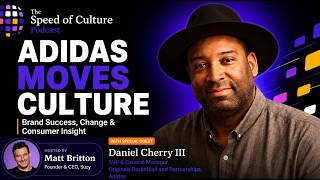
Daniel Cherry III, SVP at Adidas, started by promoting college parties and learned that word-of-mouth beats traditional marketing. He worked at agencies like Wieden+Kennedy before moving to the client side, where he focuses on products that matter culturally and mentors teams with zero tolerance for mediocrity.
Chapters
Up today, we're going to be speaking with Daniel Cherry III, Senior Vice President and General Manager of Originals, Basketball and Partnerships at Adidas. Daniel was named the Sports Business Journal's prestigious 40 Under 40 list back in 2016 and was touted as one of the top 25 marketers leading global brand transformation. Daniel, thanks so much for joining today. It's great to see you.
Matt, pleasure to be here. Follow you. I'm a big fan, so glad to be on the podcast.
Likewise. And we have a lot in common. We were just talking about the people we know in common. But one other thing we share in common is you got your start promoting parties, as did I. So tell me about that and sort of what that taught you in terms of being scrappy and maybe some of the entrepreneurial spirit you still have today.
Oh, totally. You're absolutely right. So I had to kind of put myself through college and we'll get to the And1 story as well, which I did when I was at University of Pennsylvania. But yeah, Ivy League sounds good to get in. Prestigious, but also very expensive. And so, yeah, I promoted parties with some friends. We had a company called XS Productions. We used the Armani Exchange logo, so the X, the bar, and the S. We do parties, spring flings, pin relays, you name it. Yeah, my first marketing tool was word of mouth, literally flyers, you know, vinyl stickers. I come from that world, right, where if it's not hot, they don't show up. If it's hot, they show up again. It's pretty simple. And there's a lot of competition, right, when you're literally promoting entertainment and fun. If people aren't having fun, they are not going to engage. So I learned a lot. And I actually met my good friends who became pretty big artists after that, whether it be John Stephens, John Legend, young kid in Penn who used to come to these parties, and a big choreographer now named Luam, who was at Penn as well. And she used to come to our parties and produce our fashion shows and the whole nine. So while we were doing great things, you in school and in the classroom, we figured out these creative opportunities, right, to either put us through school and also to kind of divert our attention away from the stress that, you know, these, these classes were giving us. But I still take that insight to this day, right? Do what you can to give people fun and they'll show up.
Absolutely. And when you look back at your days at Penn, I mean, because I feel I went to BU, I promoted parties, and I look back at what I learned promoting parties as influential in my career as what I learned in college, if not way more. I mean, do you feel the same way? And also, when you started promoting clubs, is that when you sort of knew that you wanted to be in marketing and culture in the world that you live in today?
That's a great question. I didn't know what I was doing, right? It was all instincts, right? And I didn't know what strategy was. I didn't know what account planning was. I didn't know what all of these terms were in the traditional sense of marketing, but I knew I can get people to move, right? I could create behavior change. Which is what marketing is, right? Yeah, it's predictive behavior change at scale. And I knew I could do that. And once I found out that, one, I enjoyed it, two, I could see the instant gratification on people's faces, right? If the party was lit, you could see it. That's right. You would actually see an empty room. There's no BS. There's no kind of fake metrics, impressions, right? Right. No, like, I don't know, like share of search. Yeah, no, either they're there or not. You moved them or you didn't. You touched them or you didn't. It's pretty clear.
You also have the sense of urgency, like the party starts at a certain time. You have until then to get it done. There's no delayed deadlines.
That's the deadline. Indeed. And also, you also use your own money. I am fond of saying to a lot of colleagues that I have and employees, oftentimes budgets are seen as grown-up allowances, right? Not actually investments. It's like, I'll get it plus or minus 3%. No. When I was spending my own money, put myself through college, I had to put 10 grand or 5 grand on deposit, and I had to make sure I made more than that that night, not at the end of the quarter, the end of the fiscal. That night I knew if I was up or if I was down. And so I still believe you have to keep score, put numbers on the board. Um, and if you do it with passion, you will know very quickly, right, if you were successful or not. There's no BS when it comes to throwing parties or putting butts in seats in sports. And so I wish we had that sense of urgency throughout the rest of the marketing, right, where we didn't just BS ourselves so much, right? The consumer votes, right? There's no lies told, right? We lie to ourselves a lot, but the consumer does not lie to us.
Absolutely. And speaking about putting points on the board, and then very quickly thereafter, you became one of the first employees of N1. I remember N1 as sort of like this disruptive brand. I'm a huge basketball fan, so what they did in the basketball space, I still sort of remember. Talk to us about that experience, how it came about, and, and what you learned from it.
For sure. Um, it was about 7 or so partners. Um, I was a young kid in undergrad, and if you know anything about Penn, there is undergrad and grad Wharton. Right? So I was taking classes at Wharton and they were grad school cohorts at Wharton. So shout out to Seth Berger, Jay Cohen Gilbert, Guy Harkless, a bunch of other folks that, uh, I will forget to mention. But those core group, um, of that 7 or so built this brand. Um, I was a young kid playing ball in Gimbal Gym. I kind of had a scene, right? Obviously I was throwing parties, I was promoting, I was kind of well known. Set the stage, you had kind of Allen Iverson in Philly at the time. You had this party called Black Lily, which was an amazing cultural epicenter that basically the neo-soul movement happened there with the Roots kind of operating as the guest band and people just kind of roll through. So it was a lot of buzz in and around Philly. You had the Sunny Hill, Connie Mack leagues, right? You had 16th and Susquehanna, all these courts that were so amazing. That's where I was playing pickup ball. I was supposed to go to Penn and Temple.
That's my hometown, DC. That's where I'm from, Philly. So I know everything you're talking about.
I played North Philly, South Philly, you name it, I've been around. But I broke my patella and it was almost a gift and a curse. I wanted to play basketball at University of Pennsylvania, but I rehabbed. Never made it back to the team, but obviously was in and around Philadelphia playing ball and met these guys, interned, right? Rose through the ranks, became a director of advertising. Didn't know what I was doing. I was out on the road with a bunch of dudes and kind of at the time before Escalades, there were Ford Excursions when they were the big body SUVs and, right? You know, rolling around with Seth Free, who was my homie to this day. And we basically just made culture happen, followed the lead, did what we could and, you know, move crowds back to the promoting concept, right? You move the crowd however you can. But I knew it was strategically sound because it, if you understand culture, and your podcast obviously moving the speed of culture, if you intuitively understand culture, and most people who drive culture don't really know the nodes that they're connecting into because it's all instinct. They almost take for granted the impact on culture because they haven't actually sat back and studied it. I always had opportunity to kind of be in it but also observe, and observing is probably my best skill set when it comes to kind of understanding how culture moves. But I knew that I was in Philly, I have an East Coast background, so I knew what a New York City street tape mixtape was, right? So if you know what a New York City mixtape is and the DJ culture, and then I also went to boarding school in Southern California, so I learned about skate culture and I watched a bunch of skate videos. If you look at the Amoeba Mixtape, it's basically East Coast hip-hop mixtape on Flatbush Avenue or Canal Street mixed with a skate video with punk rock heritage. It's essentially 45 minutes of basketball moves to music, which is what a skate video was— 45 minutes of skate moves to punk rock music. Same concept, right? And once I understood how these things worked and that we actually had codes, you're able to kind of manipulate the codes. That's why I love comedians. I think comedians are the best example of, right, cultural understanding. They can understand culture so well they can actually manipulate it to make you laugh about culture. They've mastered culture and humanity.
And, and the king of the king or queens of insights too. They uncover these core human insights, whether it's Seinfeld or— yeah, exactly— or Chris Rock. I mean, that's what they're great at, and that's why it's so funny because it's so true.
Exactly. That's what a human truth is, right? So I study a lot of comedians and, right, you know, artists and culture, 'cause I study how they actually intuitively engage and you see where kind of the tea leaves are blowing. So I watch a lot of comedy randomly and I study a lot of, right, kids, 'cause kids wear what kids wear, right? And so I'm always observing. I don't pretend to be the one to make the culture happen. I try to peek around the corner and get there first.
Right. And when you were at M1, I read that you hired Crispin Porter, if I'm correct, as kind of an agency.
Yeah, we hired, we hired CP&B. The big agencies didn't call us back, didn't take us seriously at the time. Crispin Porter was doing some amazing work with Bell helmets. They made this amazing— I'll never forget this print ad spread of two Bell helmets that look like beautiful butterflies. They had Shimano GT BMX. So they have— before extreme sports, they were doing a lot of great work.
And that was when, if you know, because they were based in Boulder, that's where the roots were.
Yeah, well, they were based in Boulder, but this was when they were old school. So I'm talking about the '98s, the '99s. So base Sure Drive, for those OGs who know, in Miami. So they were still in Miami, right?
They moved to Boulder, but that's what they're having. They're originally in Miami. That's what I meant. Yeah, yeah.
And so, uh, so yeah, we called them up and, uh, we did some great work together. I became great friends with, you know, shout out to Alex Bernard, Bernie, Rupert, um, Samuel, a bunch of guys there. Um, I ended up going to work there afterwards. So after I did my stint in undergrad at Wharton, um, I was like, look, that actually sounds much cooler than even what we're doing. I want to learn from these guys and I went down to Miami to work with Crispin. That was my first kind of foray into advertising. And I give a lot of credit to Jeff Steinhauer, Chuck Porter, Alex, and a guy that ran the office, Jeff Hicks, the president, and a young woman who helped me when I got there, Claudia Machado. Like, they were like my saviors and taught me a lot. And I'm probably better off for it to this day because of that experience because Crispin was a great proving ground.
It strikes me when you talk about your experience you're always mentioning other people. And I think that to me, when I interview people and I ask them what they've accomplished and they don't mention other people, it's always a red flag because it basically means they're not a team player. They're taking credit for everything. And then when they get on the court or the field, their teammates aren't going to like them. Right. And why is that so important to you to talk about the people who've helped you along the way and also talk about the power of your network as you continue to grow throughout your career as a result?
For sure. I'll start with a quote that I've quote it a few times, a spoken word artist, Grammy-nominated poet and activist named Amir Suleiman. He has a quote: "You will be someone's ancestor. Act accordingly." Inherently, what that quote means is you're part of a lineage. You're not here alone. You have something that comes after you, and you clearly have something that came before you. So the path you're carving is laid by groundwork far before you were even born. So I can't sit here and say what I've done. I know for a fact it wasn't me on an island by myself doing it. I might have had a spark. I might have played a role. I might have picked up the baton and run with it, but I didn't run the race myself. No way. Right. And I love working with people. Maybe it's the team mindset. I come from a family-oriented, right, let's get it done together mantra. And the team that I've been part of, and even this team here at Audi that I tell them all day, if you look at my hashtag, it's #WinAsOne. We win as one., right? We are a collective movement as one. And if you know anything about culture, you know, rest in peace to Sandy Bodecker, who was at Nike. He's the SB behind Nike SB. We were talking a lot about kind of culture and, you know, how kids move and what the scenes are that people are part of. And we came upon this kind of thought that I think is obvious. In marketing, we call it provenance, right? The kind of origin story and history of a thing or a brand. But what we essentially said is, In culture, everything starts from somewhere with someone and some friends. Just pure stop. Everything that's cool and worth being a part of and worth wearing and worth repping is essentially, right, starting from somewhere with someone and some friends. Any movement— hip-hop, skate, punk, you name the movements, right? Champagne, cognac, Napa Valley, Silicon Valley, Silicon Alley, you name it— they're all places with scenes, right? And friends creating something that people want to be a part of. And I always think about that. So that's why I always think about the friends that I had, you know, when I worked on these projects or right during these areas of my career.
And I mean, that's awesome. And it's definitely some lessons that I'm personally going to take away from, from this talk already. So you were at Crispin, and for those listening who are maybe new to advertising, Crispin Porter Bogospio was a disruptive force in advertising for many years. They kind of reinvented what it meant to be a boutique agency. And through your work there, as well as some other agencies you'd worked at, you then go out and work for like Wieden and Kennedy, etc. You work for some of the biggest brands in the world on behalf of the agency— Coca-Cola, Disney, um, ESPN, etc. What is your experience in working with big brands, and what do you find has been the most successful path to actually make an impact on those brands? Because we, we started this conversation about you being a club promoter, and it's so raw. Like, you're talking to someone, they either show up at the club or they don't. When you start working with big brands, obviously there's many steps in between in terms of the impact, and sometimes people have no impact. You know, how was, how was your approach in working with the larger brands, one of which you're at now, which we'll get into in a minute?
For sure. I had to understand how they looked at success. I, you know, was the person who always wanted to create the cool idea and want to talk about culture. I had to figure out quickly as an agency guy, and I was a strategist, right? I grew up as kind of an account planner, creative strategist in advertising.. So I wrote a ton of briefs and I got inside of a ton of clients' heads and I had to be the kind of consultant, psychiatrist, psychologist, you name it, to pull out, right? The threads. But those threads weren't really about the brand. They were the psychology of the person in the seat. What do they want out of this? What is their goal? Are they trying to get promoted? Do they need a bonus? And we even tied some of our success metrics, right? You get a bonus, we get a bonus, right? Like, let's talk about this. Like, we're here in it with you. There's no ulterior motive other than what does winning look like for you? Let's figure out how to get it done. And that to me was a humbling experience as a young creative. We just want to make cool stuff, right? We want to get awards. That's not the reality. When you really think about what an agency is, an agency is just as much a bank as a bank. They're putting money in our hands expecting a return on investment. Now, if that return is a lot, great. That's a great hedge fund. If that returns a little, that's a good bond. But I got return on my investment. If we can't guarantee return on investment, what are we doing? Just spend their money playing with it, right? That's not the goal. Um, and so I really learned through those agency experiences working with, you know, really smart clients that there needs to be a calculated return on investment in some way, shape, or form, um, beyond anecdotes and fake metrics. Um, and understand the psychology of the company. Where are they in their growth? What do they need? What does the culture of the company looking for? What are the shareholders looking for? Um, and can you help contribute to that narrative. And if you do that often, you will gain success and have lifelong partnerships like a Wieden. If you do that in spurts, then you will have, right, kind of ebbs and flows and fads, which is why I learned even at Crispin, the difference between Crispin and a Wieden. Crispin's amazing. I love my time there. But I learned also that if our mantra was to make brands famous, well, you're only famous for a certain period of time. You're never famous forever unless you're an icon. And it's really hard to make something an icon, right? So you don't really have long-lasting relationships with a lot of clients. You, right, right, kind of are like cotton candy to the client. Um, yeah, and that works, and that's a great model. That's a different model than some of the other, right, agencies that are out there. And I kind of mixed what I learned from Crispin, what I learned from Wieden, and we ended up joining, all right, forces between some Shy Guys and some Wieden guys, and we, uh, were, uh, you know, Anomaly, which was another great experience, right, working with, uh, good brothers and sisters over there. Um, it was phenomenal time. So I got lucky, to be honest. I was spoiled when you think about Crispin, Wieden Anomaly, and then I got out of advertising.
Amazing roster.
I went 3 for 3 and then I'm out.
It's interesting you say about make brands famous. I never really thought about it that way, but even like you think about their work with Subservient Chicken, like that was never gonna be a campaign that lasts forever. It was a fad and it was an incredible fad, but then it went away and it was during a period of time where everybody wanted to go viral, viral, viral, the birth of the internet. And I think that it's really hard to manufacture viral. You have to sort of put in the work and understand the consumer over time and build a brand with staying power, which is what Wieden did obviously with Nike and other brands. And I see that as like a big differentiator from the great marketers out there, the ones who may have a shorter stint.
Oh, absolutely. You have to get to the root cause of what's holding a company back, what's holding consumers back from connecting with that brand and get to that human truth, right? And it's raw. And not everybody's willing to have those conversations about who they really are and what they really want to be. I oftentimes talk about, you know, cities like New York or LA or Instagram or even marketing in general as the land of great pretend. There's a lot of great pretenders, right? Very few have actually done the work. Very many have taken credit for it. And when you do the work, it's very different, right? You're humbled when you actually do the work. You know, oftentimes many of us in this industry are really successful, at least on the surface. Um, and we did good in school, so we're used to getting straight A's, we're used to getting top of the class, cum laude, you name it. That's about what, 98, 99% success rate? The reality is that marketing is more like baseball. You could be a great— all-time great in baseball, bat what, .390 maybe? So you're basically failing, yeah, 60% of the time, right? Things aren't going your way 60 to 70% of the time, and you're a Hall of Famer. You're in Cooperstown, right? Yeah. If you bat .380, .390, um, and that's a horrible, right, success rate, um, on the surface. But when you know what greatness really is and what it takes to actually do this at this level for as long as we've all done it, you appreciate that. And I'm humbled by the experiences that I've had and the success that I've had, but I'm also equally, right, as humbled by the failures. And there's been a lot, right? We fail every day. Right? Every day something goes wrong. So, we fail every day and we are too afraid sometimes to think about that and talk about that. Oftentimes, you look at LinkedIn or Instagram and everybody's successful. But I look at the stock market, I look at some people's businesses and I'm like, they're not as great as I'm seeing, right? We're in a position where we're in a growth mode, right? We're in transition. We're honest about that. But you know, my personal mission is to be a force for good. My professional mission, right, is to chase challenges and create positive change in culture. So I purposefully go toward the fire and I want to see if I can extinguish it, right? I want to see if I can rebuild it. Like, that's exciting to me. I'm not concerned with headwinds. Like, headwinds are the reason why I'm here, right? If there are no headwinds, then it's kind of, right, a little easy, a little boring. You're not growing, you're not challenging yourself. And as a marketer, brand builder, strategist, business person, don't you want to climb a higher mountain?
Not everyone does, but it's clear that you do, and I feel the same way. It's interesting, as you're talking, it dawned on me that you and I both came into the workforce around the same time, you know, and there was no social media then, and there was no Instagram then. And, you know, sometimes I wonder if my career would've been different for better or maybe even, or more likely for the worse, if social media was there, because I see young people now getting sucked into that, getting sucked into sort of the optics of fame and the optics of success. And ultimately it takes away from the real work them really even achieving anything. I mean, have you ever thought about, you know, your timeline of your career and maybe what would have been different? And how do you see that impacting this whole new world of social media, impacting younger people coming into the workforce?
Absolutely. So often when I look at social media or look at Instagram in particular, I'm a visual strategy-minded person. So I'm always looking at the what, the why behind something. Yeah, right. Um, and the reality is all social media is compared— is based on, you know, two things. Right? Narcissists and voyeurs. That's the dynamic of social media. It's narcissists and voyeurs, right? And then you have some, right, vocal voyeurs, haters, right? That's what they are. They're vocal voyeurs, right? They're not creating anything, they're just critiquing everything. Um, and that's the dynamic. And so to me, it's much easier to, right, critique than to create. And pre-social media, many of us have had to create something— a magazine, a brand, apparel lines, you know, a party series, whatever it may be. You had to move people to do things, right? Um, that was more than swipe left, swipe right, hit a heart, or build something tangible, right? Absolutely. You literally had to move people to do something, um, within the world of commerce. Um, and Instagram is not that, right? The commerce comes from the brands. You're not actually getting consumers to do anything. You're getting brands to pay the money based on consumers thumbs, and lifting and dropping a thumb is the easiest action to take. And so we're not honing our skills. It's like lifting weights. If you lift a 5-pound weight for the rest of your life, okay, great. Have you lifted a 20-pound weight, a 25-pound weight? Have you strengthened your muscle? And so to me, we're not seeing as many people create things as make things up, right? I prefer people who make things, not people who make things up. Um, and I think everyone needs to learn the craft of making things. And if they do that, they will again be more humbled than maybe what we're going to see, which is going to be a crash in the media business based on social. Like, it won't be this way. People will not be reaping these rewards, right? It'll be a— the core is going to come. And so what are they going to do next when you can't make as much money off of someone lifting and dropping their thumb, right?
It will have to redefine what it means to be a creator ultimately, what that word means. So, so to shift gears a little bit, so you spent a lot of time obviously being an entrepreneur, working for these big agencies. And then in 2011, you went to over to the brand side, and, uh, you spent 5 years at Diageo, which is, uh, one of the leading spirits, uh, you know, manufacturers and distributors in the world. What was your experience there? What made you decide to finally go over the brand side? You said you were 3 for 3 on the agency side. You certainly were. And here you are working your way up sort of the corporate ranks, um, at Diageo. What did you learn from that, and why did you decide to go you know, the other side of the house?
Great question to challenge myself, right? When you're an agency guy, you can throw briefs across the room, you can throw ideas across the room, and you're always going to assume that the reason why it doesn't work is because the incompetence of the client. It must be the competent— the competency of the agency that created the idea and the incompetence of the client that killed the idea. It must be what it is. And that's a very arrogant way of thinking, right? Because oftentimes when you're an agency guy, you have to realize that you're actually the recess. To that person's day. You're the fun part of that person's day. There's a lot of stuff happening outside of your meeting with that client. And so I wanted to, as a business-minded person, right, I kind of put that, you know, Wharton and Penn degree to work. Like, hey, I need to figure out P&L management, right? Not marketing budget management, actual P&L management. I want to be responsible for a P&L, and I want to see if the ideas and the cultural understanding that I have can be applied inside the machine, right? It's like going inside the Death Star. Like, can I actually survive this, you know, gauntlet? I mean, it was a personal challenge to me. I went from— for those who know anything about New York, I went from, right, my entire career in Brooklyn and SoHo, right? Like, we weren't— like, Houston was north to us, right? Right. You know anything about the agencies that I worked at? We were south of Houston. And then I went to Midtown, right? 45th and 5th, wearing a suit, corner office, Connecticut as well, right? Up and down the Merritt, for those who know New York and the tri-state area. That was a very different world for me. Yeah. And I wanted to see if I can do it. And I knew that I'm up against lifers, folks that have been there 20, 30 years, you know, very tried and true ways of thinking. And so it was a personal and professional challenge. And that's why I did it, honestly. Again, back to my professional mission, chase challenges and create positive change in culture. And so when I went inside the client, I had experience as an entrepreneur. To your point, I made money outside the corporate world. I know how to do that. Many people in the corporate world do not know how to make money outside of a 401-based business. They get scared when they don't have corporate cards. That was my first corporate card. I grew up most of my career figuring out myself, so I felt like I was playing with house money. So I never really, um, once I got my sea legs underneath me, feared the corporate world as much as many people do, because I knew that I can exist outside of it. And the scary thing that I realized when I was a, um, you know, kind of exec inside of corporate America is people are, you know, hanging on to corporate America, right? And they're willing to do anything it takes to stay. And unfortunately, that hinders innovation, right? That hinders creativity, that hinders courage.
They just— the whole thing is like, they say no one ever got fired by hiring IBM, right? It's like, just don't screw up, keep the job. And but what that does is that leaves those companies susceptible to innovators coming in and disrupting their business model ultimately.
Yep, exactly. And so I happen to just choose brands that I had a passion for and I cared about. So I feel like working a company is also me being of service, right? I talk a lot about being a servant leader. I think I'm doing a service here at Audi, right? We both made a choice and I'm here by choice. And I think I'm providing a service not just to the company because companies are inanimate objects, but to the people that I touch, right? There's a lot of young, you know, younger me's here hidden in different corners of the company, right? I want them to go, you're not alone. Like, there is a path., right? Um, and I care a lot about, right, pulling people up. Um, you know, we have a group that, um, Julian Duncan and Jabari Hearn created called Monday Night Mentorship, and they mentor, um, up-and-coming execs, marketers of all various stripes, um, every Monday night. I'm honored to even be a part of it and join when I can. But the fact that you decide that you spend your Mondays giving back, right? Mondays are the worst day supposedly. I look forward to Mondays when you see the energy that you have that you can kind of give to the next generation. So, I look at my job not just to help this company make money, of course, but to me, to grow the next generation of talent so they can actually be their full selves at work. I am my complete and utter full self at work. Anyone who's ever worked with me knows too much about my life, probably.
I believe it.
But that's important. That's important to me.
Yeah, of course.
Because I think too many people hide the most creative, impactful parts of themselves to fit into a corporate narrative when that company is growing single digits and needs to grow double. You grow double digits by actually— back to your podcast— moving the speed of culture. Culture is highly diverse, highly creative, highly disruptive. If your company doesn't have that energy and environment or can't withstand it, you're dead in the water.
Absolutely. And, and, you know, you transition to what I was going to ask you about next, which is your current role, uh, at Adidas. You joined last year. Um, you know, you have a title which is frankly like a dream title for so many people because you're playing at an iconic brand in areas of passion, um, for consumers. So it seems like an amazing job. I'm sure you have ups and downs to your role, just like anything else. But talk to us about why you decided to join Adidas, what your, um, role is there, and how really you spend your time every day.
For sure. Um, for me, um, I'll go back to the summer of 1989. Um, so, you know, and, um, even just before that, right? Um, when you think about the, uh, '86, um, through '89, that era, um, but, you know, there was an era of the Fresh Fest tour, which was this hip-hop festival. LL Cool J, Houdini, right? Um, you know, we had, um, Run-DMC, um, you know, Beastie Boys era, um, and my Adidas Everyone knows that song that came out, right, um, during that era. Um, and they pretty much made this brand in North America. Um, they made dressing the way they dressed, right, like we did on the street, on the corner, on the block, cool. It became fashionable, um, not because you had less but because you chose to act like that and dress like that, right? You co-opted something that folks thought was less than and you made it even more than. Um, and so that era, you know, and Kareem Abdul-Jabbar wearing, right, um, pro model and superstar, um, again with Run-DMC, is why I love this brand. I fell in love with it. Um, and so I joined this company because of passion, because of the culture, right, that, right, adopted this brand and said, come along with me for this ride. And so how it showed up in my life was formidable, um, in the memories and the environments that I moved through. Um, and so I'm trying to find a way to kind of resurrect that and relive that and reconnect with the next generation of, right, fans and consumers the exact same way that I did and do that on the pitch as well as obviously, right, on the corner.
And what would you describe as sort of the pie chart of your day in this new role? I know you just joined last year, but what do you focus on? How are you spending your time tactically? Because I think a lot of people probably don't understand what it would be like to have such a role.
Fair. Um, so just like every other job, a lot of meetings, um, a lot of meetings, but I get to meet daily with amazing people. My job essentially is to understand corporate strategy at the nth degree of where we want to go. And when you work in lifestyle spaces, the idea of a corporate strategy is basically best laid plans, right? Because the reality is culture moves and you must be equipped to follow, support, advocate, celebrate and change your plan, candidly, when necessary. We have, you know, knock on wood, one of the hottest shoes in the world right now in the Samba, but we've always had the Samba, but this moment makes it the hottest shoe in sneaker culture. And we have to make sure we leverage and lean into that moment, right? And give the gift of this amazing product to partners like Kith and Ronnie or others like Grace Wells Bonner, who's an amazing creative and essentially have the trust that they have our best interests in mind too, and let them do what they do best and celebrate them when they do. And also make it accessible to the generations of kids who want to wear their shoe. Because again, I said kids wear what kids wear. So the sneaker culture model, there's probably a fatigue with all of these crazy drops and all these collaborations, but there always is the backlash to anything that's highly successful. And highly commercial. That's just normal. But the reality is, again, back to that mantra I said earlier, everything starts from somewhere with someone and some friends. Our goal is to make sure we support those someones and their friends to create the next movement. That's the goal. But yes, most of my day is meetings, pouring into great creatives, helping with product, helping with com strategies, and really just supporting the team because the team does all the great work, right? So. We have folks that actually literally make the products. So, I sit on the side of the business where we actually are product-focused, where we create the products and we partner with our comms partners, right, to tell the story. So, for those marketers out there, product marketing is just that, is creating the product versus what we consider brand marketing, which is the comms plan once the product is ready for, right, the market. So, I'm kind of further upstream than most advertising agencies or brand marketers. I'm connected to the product. So, my teams are working on the next products, um, and the next creative, right, platforms, um, and technologies, um, with the company, um, to engage consumers. I love that part of it, right? Because we now have a PMO where you have a product in the world— back to that party, right? Like, if you reach the world and if they don't buy it, don't blame the comms guy, right? Because we know the mantra: the worst thing for bad product is great advertising. Tell the world that it's great and it's not, it's a bomb. So I'm okay with that pressure. I like that. And I have a lot of great, you know, designers and product development people and, you know, brand managers to work with. And my goal is to get out the way whenever possible, set the vision, right? Inspire them. Yeah. Support them. And I say to my team a lot, I'm two things to you. I'm a spotlight when you're successful, and I'm Kevlar if it goes south, right? Like, I take all the heat. If something goes wrong. So you have to de-risk the environment. And I do not like, you know, managers who believe in buses, meaning throw them under the bus. I'm a no-bus guy. There are no buses in my team. We don't throw anybody under the bus. Um, and that's the one thing that I won't tolerate, um, is, you know, people who are, right, hyper-cynical and selfish and are willing to throw people under the bus. Um, you know, and lazy folk. Those are kind of the two types of people that I will never engage with and have zero tolerance for. Because I believe mediocrity destroys culture. I believe if you allow mediocrity to exist in your company, right? There's an old sports saying, right? We're a sports company, but there's a sports phrase that, um, you play down to the level of your competition. No one says play up to the level of competition. You assume you do that. The risk is when you play down to the level of your competition. That essentially means mediocrity would drag you down, right? So in a bar fight, mediocrity unfortunately will kick greatness' ass. Because you will take it for granted and you will not be on your A-game. And so to me, our goal as a company, as a brand, and I think any marketer and brand builder is to purge mediocrity, right? Purge settling, purge lowest common denominator thinking from your world. And that's how you get to greatness.
Absolutely. And you talked about sort of like working on what's next and you play a role where you almost have to be an arbiter of culture and business. And then obviously you have the passion points, whether it be basketball or other. Genres that, that, you know, your company plays in. How do you keep your finger on the pulse of like where things are headed and make sure that you're not looking in the rearview mirror or dated in your approach? Because we're getting older, right? So sometimes it's easy to age out, not really know, and I'm sure your lifestyle has changed now than it was 20 years ago. So is it harder for you to actually be that arbiter, and what do you do to sort of stay on the edge?
Oh, for sure. No, as you get older, your life in general disconnects you. That's why, right, older rappers It's tough to stay cool when you're a rapper, you know, above a certain age, right? Because the language, the lingo, and the worlds you move in aren't the same, right? And candidly, that hunger is the thing that I have to keep the most. The hunger, right? I used to say a well-fed rapper is not a rapper that's really good, right? Because you're just rapping about the wrong stuff, right? You're not connecting, engaging. So I have to force myself to kind of get that hunger and stay on the hunt. So I'm constantly on the hunt. So I am a, right, kind of explorer. Of culture, but I'm also a humble, right, kind of aggressively curious guy. So just before I talked to you, I was talking to one of our young, you know, staff members in Germany who is from South Africa, right, and saying, what's hot? Let's talk. What are you seeing? Right. So my goal is to make sure that I stay in contact with as many antennae as possible. Right. So I have to make sure that I have relationships with those who know and don't assume that I know. So I constantly want to just observe, absorb, um, and ask. So if you're not asking questions every day, then you're probably not knowing what's hot. So I'm constantly being aggressively curious. And sure, there's a ton of data that you can get out there, um, and services you can subscribe to. So yes, we have all the things that everyone else has when you're in this space, but the most important thing we have is our people. What do they see? Yeah, what are they hearing? And constantly finding a way to kind of bring that to the forefront, that's important. Companies companies in this space do poorly when the executives believe they know best and do not listen to the youth.
We call it the HIPPO, the highest paid person's opinion. That could be a death for a company.
Yeah, it's death. It's death. Yeah, I cannot wait to find out what the young kid that, you know, just went, you know, to Coachella saw, because his experience at Coachella is different than mine. Right? Yeah. We have great artists performing there. My experience there as an executive is a very different experience.
Yeah, you're backstage with the artists and they're trying to, you know, get a good view. Right. They're with the people.
Don't ever— yeah, don't get delusional. So don't get delusional. I want to stay hungry and curious. And so that's how, right, we keep our finger on the pulse is listen to those who know best. And also back to culture. Culture is hyper diverse. Culture is just about diversity everywhere.
Oh, it's critical.
I mean, look at me. I'm an African American executive. And even the fact that I'm African American, I recognize that I'm not, you know, a global citizen in the way that someone from South Africa is a global citizen, right? Someone from, right, you know, Tokyo or Seoul is a global citizen, right? We're seeing the world differently. And so, my viewpoint of the world is a biased viewpoint even as a young, right, relatively young African American male in corporate America.. So, I need to make sure that I see everyone's perspectives and bring all those people to the table. And if your company is working in the lifestyle space or trading on culture and you do not have diversity, hyper-diversity, in my opinion, hyper-diversity, which means beyond the norm, because if you want to stay ahead of the curve, to me personally, you have to be more diverse. That's how you stay ahead of the curve. It's not being less diverse, it's being more diverse than whatever the data tells you. So if you want to be ahead of the curve, be more diverse. So my goal is to get as many diverse voices around the table as possible at all times. Harder some days than others, but that's my mantra, my mission. And so if you want to win in this game, then you need to be hyper diverse.
Absolutely. And kind of to wrap things up here, I know you're also working on a new venture at Adidas that you were— perhaps you were talking about. I'd love to hear about what it is you're working on and what we can expect from you in the upcoming year.
For sure. So I'll tease directionally what we're working on. There'll be a full release and the like. So corporate comms folks that are listening, I didn't divulge any information that's not public. But the Originals business that we're a part of, as you know, has amazing classics products, right? We have amazing products, the Stan Smith, the Superstar, right? The Gazelle, the Samba, the Campus, on and on and on. And we also make new product, right? We had an amazing product the NMD that was a juggernaut for us. And so what me and the team is working on is working on the next, right, great products for Originals. We want to basically develop what's next for Originals. And I talk a lot about something that I believe in strongly. Again, back to culture. Culture is local, hyperlocal. Yes. Right. And then it kind of scales at pace, especially with social media, right? It goes global fast, right? Ice Spice is so Bronx. So New York, but so global at the same time, right? She was able to scale even faster than someone like Cardi B, as an example, because social goes as fast and as far and as wide as it does, but only goes that far and wide and fast because it's hyper-diverse, right? All those nodes that accelerate and pass that baton to the world are hyper-diverse consumers. So what we're trying to focus on is what I call lifestyle products within originals.. And I look at LIFE as an acronym: Local Innovation for Everyday, right? That's what lifestyle means. And lifestyle, in my opinion, is local, it's innovative, and it's for everyday use. That's what lifestyle is. So we're looking at lifestyle products, um, they're taking technology platforms as well as obviously things that, um, are what I'll consider culturally, uh, cultural utilities. Things that we wear, why we wear what we wear, where we wear it to, where we wear it from, all those insights. In addition to the platforms that we have here at Audi that are amazing, that are for the best athletes in the world and how we bring those things together to create something new that kind of pushes the heritage and pushes the story forward for Adidas and particularly for Adidas Originals.
Very cool. I can't wait to see when this all rolls out and hopefully by the time the podcast comes out, the timing will align, but can't wait to see. So to close out here, you know, you're obviously have a fascinating career and obviously now have an incredible, exciting role at Adidas. If you had to give young marketers who are just coming out of school now, you know, a piece of advice, many of which you frankly have already given over this podcast, but if you were to sort of sum it up in terms of what they would need to focus on or do to end up with the career that you've had to date and you're still building, what would you say?
I would say first thing, and this is an old school hip-hop phrase, get with a sick tight clique and ball out. What I mean by that is get a great crew of people that will hold you accountable. I have a text thread with some good brothers and some sisters that hold me accountable, right? When we are going through it, we go through it together, we support each other, because this journey especially for those diverse marketers and brand leaders out in the world. When you go through this journey, it can feel alone. You know, it can feel lonely, but you have to force yourself to create that kind of deep, deep connection and authentic kind of relationships with your friends so that you can actually vent because it can, right, gaslight you out of the industry. You have to make sure that you have that community that can support you. Not just in the office, but most importantly, outside the office. That's the first thing. The second is do not become your job, right? Your job is what you do. It is not who you are. If you wake up in the morning and you're fulfilled by your role, that's a blessing, but that's not a birthright, and it's not the only thing that defines you. I've seen a lot of people lose their identity through their career, um, and reality is these companies will chew you up and spit you out. Right? It's a choice on both sides. And even if you are lucky enough to have a contract, it's a short period of time. They can rip that up and, right, move you left or move you right in any, right, second. So, it's really important that you do not become your job. It's what you do. And you find fulfillment beyond your role. And then, the third, I think, is ensure that failure is part of your journey. What I mean by that is push boundaries. Because you will fail, but you must fail based on actively pushing boundaries. In corporate America, you can fail with the system, and that might be a safe thing to do, but it's not how you actually get to the best work and the best ideas and the fastest growth. You got to push, right? And if you bring your perspectives to the table, your perspectives will inherently push, right, the company, because if you don't look like those sitting to the left or right of you, your perspective is going to be different. Right? Even if it's the same on the surface, it'll be different based on your lived experience. Bring all of that to the table because there are other consumers out there in the world that have your perspective and they need to have that in the room. So make sure that you're in the room for a reason and share that perspective. So those are 3 that I'd say.
Fantastic. Well, we're going to leave it at that. This has been an incredible, incredible interview and I just really can't wait for our audience to hear it. So thanks so much, DC, for joining and I'm glad we reconnected and can't wait to see what you're up to in the coming year. So on behalf of Suzy and the Adweek team, Thanks again to Daniel Cherry III of Adidas for joining us. Be sure to subscribe, rate, and review the Speed of Culture podcast on your favorite podcast platform. Till next time, see you soon, everyone. Take care.
More from Matt




MikMak’s Rachel Tipograph on Consumer Spending, Retail Media & Holiday Shopping Trends



Jaguar Land Rover’s Charlotte Blank on Luxury, Purpose & Experiential Storytelling



