Adobe’s Rachel Thornton on AI Personalization, Creators & Brand Integrity
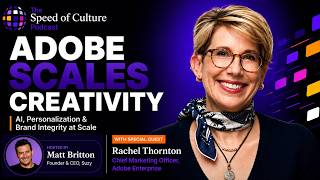
Rachel Thornton, Adobe's CMO, explains how the company is using AI agents to automate audience building and personalization at scale. Adobe acquired Semrush to strengthen SEO tools, and partners with the NFL, MLB, and Premier League to let fans create brand-safe content. She emphasizes that curiosity, experimentation, and critical thinking matter more than credentials when hiring.
Chapters
Up today on the Speed of Culture podcast, we are thrilled to welcome Rachel Thornton, the CMO at Adobe Enterprise. Rachel is a seasoned marketing leader with more than 20 years of experience leading global brands, and today she sits at the intersection of AI, creativity, and marketing, helping enterprises reimagine how they engage customers in a rapidly evolving digital landscape. And it is certainly that. Rachel, so great to see you here at CES in Las Vegas.
Oh, it's great to be here.
Thank you. You know, it's such a fun time of year. You know, the year starts, we all wanna get right into the office, but then there's CES and it brings everybody together. Why is CES important to you and Adobe as a place to invest your time and your resources kicking off the year?
Yeah, I think it is exactly right. It's kicking off the year. It's a chance for everyone to come together after the holidays and really re— you know, kind of get caught up on what's happening, what's new, uh, what are we doing? You know, whether it's us or any of the, you know, the companies that are here really talking about what's new and what's next. And obviously, especially especially this year with AI, also increasingly robotics.
But yeah, yeah, robotics is something where I think most people don't realize that just the product development life cycle of hardware is just by nature longer than software. So we're seeing this incredible innovation rate of improvement in AI. Yes. And we haven't seen it manifest into robotics yet, but I think it's only a matter of time once the hardware cycle catches up that the brain of AI is gonna be in the body of robots and we're gonna be looking out the window and seeing a completely different world than what we see today.
Yeah, I think you're right.
Yeah. So Adobe obviously is such a great brand. It's really done it, I think, an excellent job at continually pivoting. I remember the pivot Adobe made to subscription and cloud, which was a huge unlock.
I've— yeah, cloud, mobile, and then I think with AI as well. So I think it's every, you know, if you look at Adobe's history and especially as we think about customers and putting it at the center every innovation we do, it really is being able to make sure that as customers, you know, their needs evolve, we're evolving with them, we're innovating on their behalf. And I think the work we do in AI is just a great example of that. Yeah.
So you're CMO of Adobe Enterprise, which means you're ultimately focused on deploying enterprise solutions. That's, you know, and Adobe's great tools for businesses of all sizes. What is Adobe's strategy in 2026? What are some of the core products and features that you're leaning into?
Yeah, so it's like I said, if we thinking about our customers and putting it at the center of everything we do, what we're really seeing is customers are hungry for being able to develop and to deploy amazing customer experiences. Right. And I think all of that anchors on how do you really achieve personalization at scale. And having been in marketing for a lot of years, everyone talks about that. But I actually think with AI, it makes it possible. Couldn't agree more. Different levels, right? So you want as a customer to make sure that the brands you're interacting with know you. So that requires them understanding data. That being able then to take that data and create a profile around you and then being able to take that profile, make sure that they have the journey and the content that relates exactly to you. And I think this is what, you know, from Adobe's perspective, what we are helping marketers do every single day, like how do we help you build your data stack? How do we help you build your customer profile? How do we help you build the experience and the journey for that customer and then create the content that's needed? And I think beauty of AI is that you can much— you can be much more agile, you can be much faster as you create things like content, things like experiences. You really can now do this at scale, but at scale so that, you know, you're not one in a million, you're one of one.
Right. Exactly. And I think over time, consumers, especially you look at Gen Alpha who's growing up in the age of AI, they're never going to know a world without it. They're going to expect hyper-personalization. It's not going to be a plus-up. They're not going to want a one-to-many email. They're going to want a brand to talk to you as an audience of one, as an individual. Right. One thing you had mentioned that I hadn't realized is that you are indeed involved in the data stack, which I didn't know.
Yeah, if you think about— so if you think about something like Adobe Experience Platform, so we look at that as our platform for how we help you understand what are the data you have on customers and then how do we help you build that customer data profile? That's critical. Yeah. Having your data in line, like I think a lot of people talk about, hey, deploying AI solutions or AI products, it's only as good as the data you have and your ability to build those customer profiles, take advantage of that customer data, because once you have that nailed, then you can start to figure out how do I build that experience? How do I build that journey? And data and AI, like, you have to have the data in order to make those AI investments pay off.
Totally. I mean, everyone has access to large language models. The core differentiator is data, right?
Right, exactly.
It's interesting, as I, as I prepare for this interview, it just dawned on me that the evolution of Adobe's products over time are very much connected to what it means to be creative. Meaning like when Adobe first came out with Photoshop, you needed specialized skill sets to use it. You need to really understand the knobs and dials. And slowly over time, Adobe rolled out Adobe Express and made it easier for the non-technical designer to use it. And now, of course, we're in a world of Adobe Photo— uh, Firefly, where you just have to know what you want to create and you guys put everything else beneath the hood. Right. More or less. And I think that's really a good analogy almost for any category and any industry in that it's going to be far more about understanding the problem you want to solve versus having a specialized skill set of how to solve the problem, which means what it means to be creative actually is now being redefined. And just curious what your thoughts are there.
Well, I think everyone is a creator, whether you are talking about, I've, you know, I've created this image, I've created this campaign, I've created this ad, to I have created this business, I've created this product.
Yeah.
You know, I've created this experience like everybody creates. Right. We— I mean, in Adobe, we think about it as like everyone is made to create. So how do we bring that to life for you? So your point about you can be, you know, in an agency or part of a creative team or a creative professional yourself, and you're using whether it's Creative Cloud, whether it's Photoshop, Illustrator, or you can be, hey, I'm like, for example, I have a BDR team, so I have a team internally that helps reach out to customers with sales.
We have the same thing at Suzy.
But it's so great because now, like using Express and using tool Adobe tools, they can reach out to customers. They can have customized—
they don't need to rely on a whole team to deliver for that.
They have, you know, within our Adobe brand guidelines using Express, they now can make some great reach out, some great content when they reach out to customers.
They want to move faster, be more efficient, drive better results. Exactly. Which is fascinating. I love your take on just broadening the definition of creator. And I think if more people are going to be creators, then less people are going to be doing what they used to be doing, which I think is just I'll put in the term of like order-taking. Like, I think that if you wait to be told what to do every day when you walk into work, your job is by definition deterministic and it puts it at risk for automation. Right. And I think conversely, if you are a creator, whether you're creating a business, a brand, messaging, you name it, you then can actually be on the right side and future-proof yourself. Right. In this new era. And I think Adobe is the type of company that really unlocks that. Yeah. With that, like, what are some of the skill sets you think it takes to be able to succeed in this new world, especially in the realm of using the Adobe suite of tools?
Well, I think when you talk about whether it's, you know, our creative side of creative tools that we're doing, whether it's Express, whether it's Experience Cloud, or whether it's our— we have a new product, Brand Concierge, that helps customers build out a conversational interface. Oh, wow. With their customers on their website.
That's so cool.
But as you look at all of that, I think for marketing teams, for creative teams, to your point, helping them move faster, be more agile, be more creative no matter what they're doing. That's what we take pride in. And I think that's what we deliver for customers. I agree that if you're just sort of sitting back and waiting, but I think if you were just doing that, that, you know, your job is going to change irrespective of the technology introduced. Right. I think with AI now, and this is what's so exciting for me as a marketer, is there are a lot of things, you know, over the years that I've been in marketing that just have taken so much time. And now when you can move faster, when you can say, hey, I know that there's an opportunity here with this audience or with this, this timeframe or with this offer, let me put a campaign together instead of having to go, you know, 10 weeks, 12 weeks. If you could do this in a week or two, just think about how many things you can unlock, how many opportunities you can unlock. I also think it gives marketers a chance to experiment more. Like on my team, we really focus on what are the are the experiments we can do? What are the learnings we can find? Like, you know, we may start with this was an idea for a campaign, this was the concept. But as we do a bunch of experimentation with different, like, you know, components of that or flavors of that campaign, if you will, there could be something that resonates with a customer that we didn't even imagine. But because we were able to do this with AI and scale with AI with Adobe tools, we can now do this much faster, right? We can deliver to customers the things that are most engaging, you know, this really great customer experience that not only like engages them but keeps them and excites them.
Yeah, it's almost like this continuous loop of testing, optimizing, getting data, and exactly until you refine things. And that's why data plays such an important role. But that was far less possible in the past when it just took so long to make things.
Yeah, exactly.
You couldn't create 20 assets because it would just be too expensive. Take much time.
All right. Take you too, or like, because it took you so long, because it was so, you know, maybe costly or intensive, you think, well, I— it's okay, maybe I don't— I'm not super in love with it, but it took me so long to get there that I'm gonna— I'm gonna run with it because I, you know, I kind of have to, right? And now it's like, no, you can really decide, I love this, or the customers love this, so let's double down.
Yeah. So in the world of AI, and it's all really anyone's talking about here at CES, it's interesting because so many conversations do lead back to what Adobe does, which is about data-driven creativity and customer experience, etc. But we've kind of been on this trajectory and a spectrum of AI evolution, if you will, where it started with AI as a tool, you know, write me a blog post and they'll just write it for you. Right. And then we enter the age of AI workflow and automation, and now we're entering the world. We've already kind of started in '25 and certainly in '26, you know, agentic workflows and AI agents. I know that's an area that Adobe is very much focused on, especially with your enterprise product. Would love to hear how Adobe looks at agents and what role they play in your product mix?
It's like I said a few minutes ago, I think as when we look at our marketers that, you know, that we work with our customers, you know, and we think about the roles they have to do and kind of the jobs they have to do every day. Yeah. When you begin to look at, hey, there's components of this that we could easily have an agent do, that we can have an agent recommend. So a good example is audience. So we have an audience agent and my team uses it. It was like All right. Help us build an audience based on what you know about how this campaign performed or how this event—
a B2B audience. Yes.
Yes. Or it could be B2C. Sure. The type is not so much as— it's not necessarily as material as what do you want to do with that audience and how do you want to take in the information to continue to build and refine your audiences? Now, previously, you know, if you were doing this, it was a— it took time to sort of understand, well, how did this campaign or this event or this program How did it perform? What were the audiences that it really attracted? Well, what, what ones didn't it attract? Okay, now I can have my agent recommend to me, look, based on the results there, you should think about an audience that is interested in this, right? You ran a campaign on, you know, camping equipment, let's say. Great. It turns out that these people responded, but this group over here didn't. However, we recommend based on knowledge of this group that you tweak the campaign in this way. So that's huge. I think We have insights agents that we use to help surface insights. So rather than— and I think this is true in a lot of big companies— rather than maybe saying, I'm going to file a ticket and then maybe another team and another part of the company is going to send me some info, it's like, hey, help me uncover the insights for this campaign so I can now move faster, build better, build better messaging, maybe build better creative. But I think like the insights agents that we have also have been really an unlock for marketers, helping them be more agile, helping them be more creative, and helping them move faster.
It's interesting because it changes, I think, how we define as workflow. Because to your point earlier, you used to have to go to another department to get things, where now you can be sitting there and as part of like one, you know, flow of work, you can tap into different agents and get from start to finish without really needing much. So that is a different way of working for sure.
Exactly. And I think it helps, like I said, it helps marketers be more agile and really unlock a lot of there's that word again, creativity. Like maybe you had an idea for a campaign, but you weren't sure. One, would it be a big enough audience? Turns out, yes. Audience agent recommended this audience. You're like, I like it. Now you can unlock the assets like Adobe Gen Studio. If we think about that entire lifecycle now, working with Gen Studio, you could create the content, you could create the creative, you can scale it. Yeah. So you can really target that audience across multiple channels. I think the beauty is also for global companies as they look at the work of translating, localizing. All right. We can help you absolutely scale that and do that across channels globally much more quickly than we could in the past.
So as a B2B marketer, obviously it's all about adding value. It's about use cases and, and understanding your customer. And in that regard, it's a highly competitive landscape in the world of AI and AI creative tools out there because the, the barrier to entry as a, as somebody who's a CEO of a software company, I just see so many new competitors popping up because you don't need capital or talent the way that you used to to create software, right? So how do you make sure that you're positioning the brand from a B2P perspective in the right way to maintain some level? Obviously you have the heritage of the brand, Adobe, and the trust behind it, but that alone won't get you there. What else are you leaning into?
I actually wouldn't underestimate the power of trust and the importance of trust. Yeah, totally.
But you can't just rest on that, right? Oh, totally agree. Yeah.
But I I definitely think that if you think about trust, if you think about innovation, so the innovation that Adobe has just been, you know, developing, releasing as part of our product portfolio, it's amazing. For decades. But more importantly, we think about how do you make sure what you're doing, how can you trust what the outputs are? How can you trust what the artifacts are, what the, you know, what the outputs are for the campaign? How can you make sure that the data you're using, you own it, it's, you know, no one else's, it's data that you own, that you understand the provenance of. That's not hallucinated or wrong. Exactly. How can you make sure that the content you have is authentic? So Adobe takes this very seriously. And I think when I look at just the evolving landscape, if you're a brand, you have so much to lose if you get those campaigns or those creatives or those assets wrong. For sure. Right. I think a good example of, you know, how we partner with companies and how, you know, sure, there's a lot of opportunities, but still companies come back to how do I make sure that I have brand integrity and that brand integrity carries across every single thing I do. We work with Coca-Cola on Project Vision, Vision with an F, with an F like this. Yeah, but it was really great because they thought about all of their creatives worldwide. How do we make sure that team using Adobe tools, we develop these AI brand guidelines for them. So no matter who's creating an asset, no matter where they are in the world, that asset is on brand. It's in the— within the brand requirements so that when they put it together, they know with 100% confidence that it's meeting those brand guidelines and there's no issue with brand integrity. And I think that's powerful for sure. Really the only ones that can do that.
Absolutely. I know that you've also been doing work in like passion point areas, especially sports. Yes. Over time. And I think that's a great way for you to showcase the efficacy and power of your tools because you're combining it with something that people love, right? And sports are obviously more important to culture than ever before. And I know that Adobe's working with leagues like the NFL and MLB and Premier League to really help fans express fandom, engage more deeply through this AI-powered creativity. So I'd love to hear a little bit more about those efforts.
Yeah. It was actually great. I spent some time with the NFL team here. We've done a couple of panels talking about just the power of sports and the culture of sports. And I absolutely think that what is really fascinating about the evolution that sports are on right now is not just the evolution in fan engagement. So across multiple modalities, whether you're in person, whether you're watching, whether you're on social media, whether you're in your fantasy league. Yeah. How do fans engage with all those things? Like my son, I have a 17-year-old, huge football fan. He's got his favorite team. We're in Seattle, so it's the Seahawks.
Good year.
I know. Fingers crossed.
By the time this comes out, we'll know if it's a great year or a disappointment, right?
So. But, you know, like he'll watch a game, but then he may follow other games on his phone. He may be watching with his friends on his phone. Yeah. He's also tracking on his fantasy team.
Following his favorite players on Twitter, et cetera. Exactly.
Following his favorite players on social media. And now also working with the NFL, we can help them. They have content creators that they have at games that they have with players to create content with those players that's on social media that can be posted on social, but then also that customer, or fans I should say, can pick up and share as well. Right.
Make their own.
So yeah, it's how not only do you engage with the fans, but how do you almost co-create with those fans? And I think that is an amazing thing and it's amazing evolution of sports. So whether it's the NFL or Premier League or Real Madrid or MLB, it's like every single one of them is thinking, how do we engage fans? How do we keep them passionate about the game? But not only the game, the league, the team, the player. Yeah, right. All of those different things. A fan now can have so many different things they love. And we want to make sure that we can engage them, but also help them share and co-create and be creative with their favorite leagues.
Yeah, we had Tim Ellis, the CMO of the NFL, on the podcast. He was talking about some of these efforts and fan engagement isn't necessarily a new thing, but I think the difference now is with the tools like Adobe has, the, you know, the, the fan can really express themselves and they can do so in a brand-safe way. And I would put that, make more broadly just user-generated content in general. I think for a long time brands knew that they needed to let their consumers consumer take control of the brand. The problem is they still have a brand, right? They have a look, tone, and feel, and there's guardrails, and there's all these things that they want to make sure are embedded in any sort of open source of the brand.
Exactly.
But now with these tools, you actually can get the best of both worlds. Yes. You can kind of give up some control, but at the same time feel good that something's not gonna come out that's gonna completely denigrate what you built.
That's right. Like you can, I can share my love of the Seahawks in a way that reflected of, of my passion for the Seahawks, but is still within what the NFL or the Seahawks wanna make sure is conveyed about with their brand.
Right. So you're obviously talking to many different brands across many different categories. What are you finding brands are most interested or attracted to in terms of your overall offering? Or just like, what are their priorities in general that you see shaping cross-category here in 2026?
I think it's absolutely about not just— we talked about fan engagement, but you could substitute the word customer. So it's customer engagement and more importantly, building robust customer experiences that keep people connected to your brands. But I think more and more with agentic and with agents, you have to think about what are the experiences I'm building for my customers, my people customers, my customers, but also how do I want to make sure that as agents engage with me, what is the story, what is the content, what is the experience I'm building for those agents? It's very much humans, agents, both have to be— both are true and both have to be thought about as audiences that you want to build experiences and content for. Totally right. Because if you want to make sure you're showing up like, you know, we have a lot of data on the shift from SEO to what do you call it, GEO, AEO, but just people using things like Perplexity, ChatGPT, Gemini to research, but soon to shop.
Exactly. They're going to go down the whole funnel there.
But if you're a brand, you absolutely need to know how are you showing up there? How are you showing up on ChatGPT?
And it's all about content, isn't it? Exactly right.
How do you make sure you show up well and you're like, I'm happy with that and it's going to make sure it reflects my brand in the best light. So this is what I mean about not only are you thinking about your, your customers all the time, but now you're thinking about how are we showing up for the agents. And we, earlier this year, we released Adobe LLM Optimizer, which was exactly—
Oh, really? I didn't know about that. I got to check that out.
You do. Yeah. LLM Optimizer.
Okay.
But it is exactly designed to help customers figure out how do I make sure that when people are searching in ChatGPT, Perplexity, whatever, We're showing up as a brand, we're showing up well. It is how we want to be depicted there.
It's interesting because what you just described is what I think we're seeing in the software category overall is that lines are being blurred, right? Like you guys are now getting into the, you know, optimization where you see SEO optimization game, which would have traditionally been an area that other companies would have done. Maybe not, but it's just a natural extension given that you have the data, you have the creative content being created on your platform. That's what drives— optimization. That's what CMOs care about. So it makes sense. And I think the more that you can move fast and obviously bolt on these features, the more that you're going to be able to really drive that customer growth.
Right. Well, it's true. Actually, we made an acquisition just recently of Semrush. Yeah, it was in that area. Yeah. And that was a lot of the reason. It's like, how do we really help customers navigate this change? They shift from very traditional SEO to more SEO and, you know, it's going to be a It's going to be a journey, but absolutely, how do we make sure that we have the right tools and the right products to help customers on this?
Absolutely. So shifting gears, we wrap up here, Rachel, and it's been, as I knew it would, a great talk, lively talk, and we covered so many different topics. Looking back on your career, because you've worked at many great tech companies from Salesforce and AWS and Cisco, etc., and you look back on your career journey in the world of tech, what were some of the decisions that you think you made right along the way? Areas that you focused on to put yourself in the CMO role today?
I think my sort of mantra as I think about it is like, how am I always being curious? How can I always learn more? How can I, you know, understand what customers want, kind of dive deep on kind of the information and what are customers telling me? I think that's always critical no matter what job you have. And then I think be open to experimentation, trying something that you would think, I don't know if I'm well, super well suited for that, but I'm gonna kind of push on that and try, because you never know what you pick up and you never know how it becomes applicable later, right? Right.
So when I— it always makes sense in a rearview mirror.
Exactly. When I think about roles I've taken, I'm like, I often— I don't oftentimes say no because I'm like, I could learn something with this that in the moment you're like, eh, but later I'm like, I'm so glad I had that job because it has set me up for this one. Yeah, they have. So I'm all about like how can you walk into things with an open mind, with like a beginner mindset, as they say, and try things, learn from them, and then take those learnings into the next role.
Yeah. And today, as a leader— yeah, of course. And to say, as a leader, of course, greatness is an agency of others and you need to build a team, surround yourself by great people. What are you looking for in talent, especially for people maybe in the earlier stages of their career? We have a lot of listeners that are in the earlier stages of their career here on the podcast. Like, what are you looking for? You know, as a, as a leader and as a manager of people that you want to bring on board your team that you think could be future leaders themselves.
Yeah, I mentioned, I think curiosity is key. An appetite for experimentation is key.
Yeah, it's huge.
I also think now, though, this concept of critical thinking— and we've been— I've been having this conversation a lot over the last couple of days, like, you know, not only are you getting maybe the information quickly, but are you able to look at it and really kind of ask questions about the veracity of the info? What does it make sense? How could I apply it? I think that's important too. Yeah.
For sure. And I think some of those skill sets traditionally weren't ones that were necessarily the most important. Like we were exiting, in my opinion, the age of the knowledge economy. Exactly. What matters most is what you knew, not how you acted. No softer skills. Yeah, but now the softer skills are definitely—
oh yeah, 100%. Like how do you work with people? How do you get the best out of people?
I think that's how resilient are you. You have perseverance. Like, you know, I spent a lot of time building an AI and it's like, you'll hit roadblocks along the way and it's easy to say, ah, I guess it can't work. But if you just don't give up and you go after it, you'll get past that step.
Yeah. You look at it from a bunch of different angles. Like, okay, this didn't work. What other ways could I try this?
Yeah. And then what happens is that once you achieve that step, you'll say, oh, well, I can actually use that step for this thing I'm doing. And then you kind of just, that, that's how the pieces kind of all fall together. At least, uh, you know, I've experienced that. Totally agree. So this has been an awesome discussion. A wrap up here.
Yeah.
This has been really— yeah. We always ask our guests if there's a saying or mantra. That helps sort of encapsulate the professional journey? Just want to know what comes to mind for you.
Yeah, I'm on the same theme. It's like, just be curious, be open. Yeah. Like, be interested in things, asking questions, asking questions about customers, the world around you. I'm a huge fan of that.
Never stop learning, right?
Never stop.
Especially in this day and age where, you know, we look outside the window here in the Las Vegas Strip and there are so many innovations right in front of our eyes and I don't think we've ever seen a time in technology like this where there's so many possibilities and the rate of change is sort of mind-blowing. Yeah, in terms of what's possible. Awesome. Well, listen, thank you so much for taking the time here during a busy CES week to share your thoughts and insights with us. I'm a huge fan of the brand Adobe, and so many people on your team wish you nothing but success in the year ahead.
Oh, thank you.
Thank you. Absolutely. On behalf of Suzy and I, we team, thank you again to Rachel Thornton, the CMO of Adobe Enterprise, for joining us today. Be sure to subscribe, rate, and review the Speed of Culture podcast on your favorite podcast platform. From CES in Las Vegas, we'll see you soon, everyone. Take care, bye-bye. Hey!
More from Matt




MikMak’s Rachel Tipograph on Consumer Spending, Retail Media & Holiday Shopping Trends



Jaguar Land Rover’s Charlotte Blank on Luxury, Purpose & Experiential Storytelling



