ADT’s DeLu Jackson on Trust, Tech & the Future of Home Security
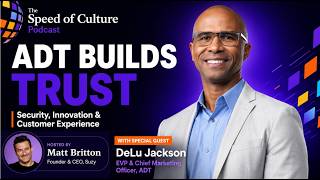
DeLu Jackson, CMO of ADT, talks about rebuilding trust in a 150-year-old brand through AI, DIY security products, and omnichannel strategy. He emphasizes listening to customers, moving fast with technology, and using first-party data to stay relevant in home security.
Chapters
Today we're excited to be joined by Daylu Jackson, the Executive Vice President and CMO of ADT, the company providing safe, smart, and sustainable security solutions for people, homes, and businesses. Daylu, great to see you today.
Great to see you, Matt, and thanks for having me today.
Absolutely. So excited to dive in here. And you know, I'm looking at your background. You've worked with so many impressive brands and companies like Nissan, McDonald's, Kellogg's, et cetera. As you look back in your career, what were some of the big, I guess, transformational moments where you had to take a step back and say, I need to maybe redefine what it means to be a marketer given all the changes that we've seen?
Yeah, it's really been the scale and advance of technology at the consumer level. Again, look back to, you know, over the past two decades, the advancement of digital experiences, websites, really mobile, transform the way we operate as people. Access to information on the go, search engines, and then the sequencing and managing of all that information at the consumer level has changed the way we engage as marketers or interact with consumers from a sales and product perspective.
Absolutely. And of course now the big buzzword here in 2024 is AI. It's really been for the last 18 months. How do you look at AI transforming your role as a marketer and, and marketing in general, looking ahead?
Yeah, I think it's gonna increase the speed and scale of the activities we have as marketers. And it, it will actually create, I think, more and more value for brands, distinctive assets, and distinctive offerings to the marketplace. Because it's going to talk, I think it's going to demonstrate the things that are more standardized, more common. So standing out will be, I think will be more important than ever.
Right. Because in some ways the barrier to entry and execution is lower now, meaning like anybody can create social media content, anyone can put stuff out there. So the barriers to entry are sort of gone. And now for you to stand out, you really have to be more creative and you have to do things that I guess are in some ways really innately human and doing things that the machines can't.
Absolutely. Absolutely. They become differentiators. Because if you think about a lot of discussion around AI, it's about finding those repeatable tasks that are more common. And obviously it's expanding that. But I think to your point, it's really going to allow us to be more creative, more thoughtful, and more impactful as marketing.
Yeah, for sure. So just to kind of wind back the clock a little bit, tell us a little bit about your career. At what point in your life did you know that you wanted to be in the world of sales and marketing and how did that manifest into you seeking out, you know, positions and, and, and at brands early in your career?
Oh, that's great. Well, I started out in sales and field sales and I think it was my first, you know, I wanna,, contests for my region and having the most sales in the, in the region. And I got to go to one of those, uh, big national meetings and all the brand folks were on stage and they were presenting these great brands and these great strategies and programs. And for me it was like, wow, that, that seems, that's what I want to do. I love the way they thought about the customer. I love the way they presented the strategies. I love the way they thought about how to grow businesses. And it, to me, it just seemed like such a combination of art and science. And I said, yeah, that's where I wanted to really see myself having an impact on companies.
So it's interesting, you know, you got your start in field sales and, you know, I think sales is just so underrated as just a skillset that's needed really in any position that you have. What do you think made you good as a salesperson early in your career? And what are some of those traits that you think are still valuable today in the CMO position?
Yeah, I think it really came back to listening to the customers. Yeah. And the concept of jobs to be done, right? What is the customer trying to solve for? And then I always say I listen even now to customers calling and they're trying to solve something. Do we have it? Can we clearly articulate that to them? And then if we don't have it, could we? So we can innovate, right? So it just comes back to the customer and that hasn't changed. And I think it's been valuable across my career to touch the customer at so many different levels.
Yeah, absolutely. And of course, all of those skill sets obviously are probably really in high demand in your everyday role at your current job. CMO of ADT, where you've been for a little over 3 years. Talk to us about ADT, what made you decide to take the leap to this role and what's unique about the category that ADT plays in that really makes you have to, I guess, stretch some of those skill sets within the marketing and sales realm?
Yeah, what I think really drew me to this was, you know, as a longtime brand champion, this brand's gonna be 150 years old. This— Wow. And the, the, I think the great responsibility of stewarding a brand of that caliber as a category leader, um, is really just, uh, what a tremendous opportunity. And then to think about the, you know, we talk a lot about purpose and mission, and when the profit and purpose come together in that we make the world safer when we do our job, that's pretty exciting to think about all the different ways for us to provide our existing and future services to help people have peace of mind and feel safer. That really just, it actually gives me goosebumps when I think about it, just how important it is when we do our jobs well. There's 13,500 employees that are so excited about doing that every single day for people. That's exciting for me to be a part of an organization that's doing that work.
Yeah, and I would imagine as a marketer of security solutions, especially when you're talking about residential, you're talking about Maslow's hierarchy of needs. Like number one is that they'll feel safe and secure for you and your family. I would imagine when you look at the brand pillars of ADT, trust is probably very high on the list. What other things with trust do you want ADT to stand for moving forward?
Yeah, the, the trust is a big one. Innovation and relevance are highly important, right? As, as the space evolves and the needs change and the needs expand, that it's important to know that we're innovating and bringing new solutions to meet those different needs. Things like self-setup or DIY solutions for people who are more mobile or in different spaces, right? Who aren't in, who move or rent and those types of things. Got it. Health solutions as people age in place. We have multifamily solutions as people have, as people and builders support those facilities. So it's really neat to see how the consumers, again, as we continue to listen to consumers and their needs evolve, that we continue to evolve as a brand and bring those innovative solutions to market.
Yeah. And in terms of the breakdown of the business, what percentage of it is on the consumer residential side versus, you know, the business side?
Yeah, it's largely residential, which is a big part of it. We did have a commercial business at one point, but it's largely residential. And again, it's more of an expansion of residential into those different categories and use cases like self-setup or self-install. Yeah. But that's really just an evolution of how the consumers are choosing to interact with the technology. So, but it's still, it's the core of our business.
And are you seeing, you know, because obviously there used to be this notion of the American dream where you would basically buy a house with a white picket fence and the two-car garage and two kids and the pet, and you kind of stay there until you retired and then maybe you'd move to Florida or, you know, Palm Springs or something. And now we see with millennials, especially post-pandemic, especially in the age of remote work, where you have a much more mobile consumer, where they're much less likely to be in the same home their whole lives. Does that provide headwinds or tailwinds for a company like ADT?
Yeah, it's, it's a combination. It's a great question. And I think the, the move is a big trigger when someone makes a choice, right? You go to a new place and back to your hierarchy of needs, you get your first order items and then you get the next thing, security and safety and and, and we call it empowering people to protect and connect what matters most. Yeah. Right. So, and as people move or relocate or resize or, you know, add locations to their portfolio of homes, all of those things tend to be important. And they tell us that, hey, this is what I'm doing, right? I've added a new property or I got a vacation home or I relocated, right? Because I downsized. And so all of those things are very important in where we engage and often consumers contact us looking for solutions. Absolutely.
And you also talk about self-service because I think the millennial generation and really Gen Z who's starting to soon enter as the head of the household, you know, Gen Alpha is now the new young consumers, so to speak. They're obviously much more tech savvy. And when you talk about self-service and DIY, I remember when I first got ADT installed in the home and it was just such a major ordeal with wiring going throughout the house, et cetera. And now obviously with Wi-Fi and very soon 5G permeating throughout the home, I would imagine the installation process becomes much easier, which I also think creates some maybe tailwinds in terms of getting new customers, but it probably lowers the switching costs, right? In terms of other competitors, because you aren't, actual pipes in the home, so to speak.
It's interesting that a lot of the connectivity mentioned is absolutely a critical thing. The importance of the app and mobility and that experience have transformed significantly. And what we see is a combination of things. I'll use myself as a good example is I can do DIY. I have a lot of DIY packages for different things set up at my home, you know? And then, but sometimes we find that time and then confidence is really important, right? This is a really important decision. The good news is we're an omnichannel business. If you want to go online and buy it and do it yourself, to your point is we want to make that possible. We even have virtual support if you get in there and you really just want a little help. But, and then we still have the, this amazing group of people who can come to your home and help you. If that's what you need. And I think that's the recognition of this sort of this omnichannel approach. Consumer needs evolve and we want to be able to address the ones, but at the end of the day, we want to give them the peace of mind and confidence that they made a great choice and that they feel safe. And so being, having those different options to do that is really important to us.
Yeah. And, and of course, the CMO of ADT, I mean, it's not like being CMO of Coca-Cola where you know, it's a volume-driven business where you're selling out of Target and Walmart. I mean, you guys literally are going door to door. You have a massive network of field reps and I believe there was a company called Defender that I think ADT acquired, which was the biggest sort of outsourced sales arm. So, and so sales is still a big part and it's interesting 'cause it's kind of come 360 to your early roots in your career. Given all that, like what is your role like as CMO of ADT? How do you spend your time and how do you ultimately gauge success of everything that you oversee?
Yeah, I really think that, you know, the priority for me is, and I believe in this, transforming this idea of the role of the CMO, and I have great support to do that, that we're everything from, you know, growth leader to customer advocate to customer experience advocate to culture leader. To lots of transformation given our role in martech, technology, AI, all of the things you discussed. So our team focuses on demand planning and data, right? And understanding customer behavior, obviously creative and advertising and messaging. But again, the martech and technology, e-commerce, and even sales enablement are all part of the role that's really critical for us. And I think that's really important as we think about the evolution of this role that it continues to evolve as all these different ways to engage evolve.
Right. Yeah. And I mean, ADT is a company that's fortunate enough to have first-party data where a lot of companies don't that sell through Amazon or sell through big box retailers where you sell direct. And one thing going back to AI that's definitely unlocked is the ability to sort of sort through the noise of so much data that I'm sure somebody like yourself undoubtedly has access to to help drive decisions in terms of this channel is working, this market is working, we have new competitors in this market, et cetera. So I guess how far are you along in that journey in terms of having access to that data and really allowing it to drive decisions on an everyday basis?
Yeah, we work a lot with our partners. Performance marketing is obviously a very big part of what we do.
Yeah.
Because customers contact us through so many channels, right? They call us, they email us, they send in requests, they go to the website. So all of that generates, you know, an expectation of a meaningful and personalized response. And so we use that to help the customers, right, get through that process and reach that state that we'd like them to get to as efficiently and frictionless, as frictionless as possible. And that is, it is a, I say a benefit and a responsibility for us to make sure that we handle that with the utmost care and, and responsibility. So it's a really big part of what we do in creating value for our customers.
Yeah, makes sense. And in terms of actual communications to your customers, what channels have you found to be most effective as a marketer, either in gaining acquisition or retention and loyalty amongst your consumers? Because obviously, as we mentioned earlier, the world's changed so much. It used to be all about the 30-second spot and we're in a different world right now. What are some of the areas that you're particularly leaning into?
Yeah, clearly digital is picked up and we've seen how the next generation consumes information, finds brands, and understands information, whether it's YouTube or Instagram, TikTok, Facebook, right? That's just such a great space for people to consume and learn. So we're active there. We're doing more on e-commerce. Again, we're historically a physical selling business. E-commerce is growing very much for us as consumers seek solutions and compare solutions and want to get them delivered quickly. So, activation and communication through those channels just continues to grow. We still operate in some of the, you know, CTV is growing and You know, we still operate in linear, big moments, live sports. So the key is that we know this audiences, we can find them in different places around their passion points. And I think that's the beauty, go back to the data is, you know, they're telling us where they like us to show up. And if we do that authentically, that really is creating a lot of value for us.
Yeah. Yeah, absolutely. And of course, again, like the access to the data is so important in terms of really being channel agnostic and just going to where you're able to drive the ROI and able to drive the impact that you're looking for.
That's right. That's right. And you see customers, right, online, they're asking for these things. You see the queries, hey, I'm trying to find a solution in my neighborhood, or hey, I've moved, I need a solution. So it's great that we have the ability to respond, you know, appropriately and assist when people are seeking those solutions.
Yeah, for sure. So shifting gears a little bit to you and your leadership style, obviously you oversee a team at ADT and your success is only based upon the ability for you to surround yourself with great people. What have you found to be a common theme throughout your career in terms of what makes somebody effective as an employee, as part of your team, particularly at earlier stages of their career?
Yeah, I think it's, what I've learned is probably most efficient. I call it the 3 C's, communication, communication, communication. And going back to my career, we often didn't have forums. For people at different levels to interact and communicate, right? You would interact with your manager, your team, but you wouldn't see your leaders. You often wouldn't hear things directly. So I think agile has created an opportunity, and I do this where we do daily standups with the team just for 30 minutes, and it allows us to communicate, but also collaborate and better understand the decisions that we made the shared decisions. And finally, one of my favorite leaders I work for, he calls it collective intelligence. I think that's the greatest benefit of the way we communicate today. The, the frequency and, uh, the depth of our communications, I think helps people advance faster because they learn more, they get mentored, and they understand how decisions get made.
Right, right. And in terms of areas that you think maybe young marketers should be focused on right now? That are coming outta college or really trying to establish themselves so they can be in the CMO seat one day. What are some of the areas that come to mind?
Well, you said earlier, AI, make sure you're paying attention to AI. That's for sure. But understanding, again, back to this, I'd say across my career, I love the fact that across the different businesses, categories, and geographies that someone taught me that just focus on the customers because regardless of the market, regardless of the business, you'll find a lot of 'em are the same consumers. Is just a different part of their basket of goods. Yeah. And if you take that with you through your career, these are customers or households and you're understanding what their buying behaviors are. Wow. You, that, that travels. It travels, right? Again, I've, my career I've been in auto and food and brand strategy and financial services and now, uh, security. And I'm seeing a lot of the same households. Right. Life stage changes, life stage advancements, right? And having the ability to think about how a brand can participate in that is pretty, it travels as a marketer.
Yeah. Yeah. I'm really truly understanding the consumer, the life stages of different generations, how cultural and social and business trends really impact them really allows you to be effective regardless of what you're selling, I guess.
That's right. That's right.
Yeah. So, and, and, and just like as we wrap up here, Daylu, if you look back at your career, and obviously not everyone ends up in the CMO role or, or has the ability to work at such prestigious brands as you have, what decisions do you think you made right along the way where you really focused in the right areas that set yourself up to be in the role that you are in today?
Yeah, I think there's, there's two things is and I, and I'm just really fortunate to have had great leaders around me and great mentors, great partners, was I got the advice to watch the technology as it was advancing, right?
Yeah.
And so there were always opportunities to probably take a role that today seemed like, wow, that's the best opportunity. And I had people say, keep doing what you're doing because there are few people doing that and go deep, be good at this MarTech and this technology. Watch how this is gonna change the business. I had someone, gave me that advice and I stayed with it. And so it was watching the things that were transforming the business and he was just great. He said, because that'll be the difference maker.
Yeah.
So just staying in tune with that, you know, networking, find those things. The second thing that I'd say is taking the opportunities that some people would say kind of risky, like going abroad and going to Japan and, and, uh, working, switching companies, you know, cuz we build so much equity in a given place. And, and I love the places, every place I worked, but there were things that were offered outside that said, wow, that's a little scary, but I think we can do it. Right. And so, um, you know, when I look back on my career, some, some people would say you took opportunities that most people would've probably not chosen. But I learned so much. Most of them worked, some of them didn't, but it, it really gave me an expansive view of, of what's out there and the opportunities. And just, again, I just met so many great people and great leaders. It's helped me immensely.
Yeah, it's interesting you brought up the international experience because that's definitely a common theme that we've had here at the podcast with CMOs is that early in their career, they took the opportunity to work internationally. It really kind of opened up their worldview. And I think especially when you're younger where maybe you're not as, kind of held down by kids and family where you don't have that opportunity, you should probably take it because it's going to be much harder later in your life and it gives you a level of experience that's really unparalleled.
Yeah, it literally transformed it for me in career. And I had this great leader. He said, you become the best leader you've ever been when you realize is you're the outsider. Right. I went to a place where I didn't speak the language. I had teams all over the world. He said, you'll have to learn how to lead so many different types of people with so many different cultural differences and nuance. You'll have to learn how to communicate differently in all these different ways, right? You have to slow down, your frequency changes. What happens when you're speaking to people who, uh, English is not their first language? So all these different things. And I think it taught a different level of humanity and humility, uh, when it comes to leadership. And I'm hoping that it created a sense of empathy to understand from all directions, mine and the other side, what leadership really requires.
It's interesting because there's so many things that as marketers, I feel like we maybe take for granted and we're always on to the next new shiny object. And sometimes you need to be like in the case of AI, but sometimes to your point, you lose sense of empathy and like the actual consumer and the person at the other end., and, and, and their needs and wants. And when you have to, I guess, go back to the basics and understand everything from the language to the culture, et cetera, you really reimmerse yourself and it, I guess, changes your perspective in so many different ways.
Absolutely. It's, it, again, it's life-changing, you know, and it, it, it's a reminder of this whole idea we talk about, you know, the IEB or inclusion experience and all this stuff and how important it is. You know, I do work with, um, with BECA, the Black Executive CMO Alliance, and we talk a lot about this, but that's what inclusion's about, is that there's this recognition that there's so many different types of consumers and marketers and businesses and brands and cultures and geographies, and that we're kind of those culture navigators, right? As marketers. Yeah. And, um, and you know, and it's important that we help the next generation marketers understand that. And understand that worldview or that broader view really does create an amazing perspective and opportunity for us as marketers to have more impact. Absolutely. It's been, again, a great experience for me throughout my career.
For sure. So as we wrap up here, Daylu, is there a, given everything we just talked about, is there sort of a quote or mantra that comes to mind that is kind of your thing that you like to drive your career by?
Yeah. Interesting. I like this one. People do the best they can with the light they have to see with. And that's both consumers and I think about it for my team, right? It's my job as a coach and a mentor in that, you know, we often have expectations for people, but we realize they have different experiences, they have different backgrounds, they come from different places. It's always great to understand that, to understand the light they have to see with, and then think, what do we want them to know? What would we like them to know? What can we help them with to keep advancing that or spreading that light? And so, I don't know, it's, I just have always liked that one. There's a great way to think about that back to humanity and humility, seeing the person, seeing the humans and seeing the people really helps advance teams and help people develop.
Yeah, but that's been a real common theme of everything we talked about. So it's clear that empathy and understanding the consumer is sort of something that, along with understanding the technological changes that are driving their lives, has been a big common theme throughout your career. And, you know, it's no coincidence that you've been able to achieve the success you have. So congratulations on that. And thank you so much for joining us today. It's been a great conversation. I can't wait for our audience to hear it.
Thanks for having me today. And it's great talking with you.
Absolutely. On behalf of Suzy and every team, thanks again to Daylu Jackson, Executive Vice President and CMO of ADT, for joining us today. Be sure to subscribe, rate, and review the Speed of Culture podcast on your favorite podcast platform. Till next time, see you soon, everyone. Take care.
More from Matt




MikMak’s Rachel Tipograph on Consumer Spending, Retail Media & Holiday Shopping Trends



Jaguar Land Rover’s Charlotte Blank on Luxury, Purpose & Experiential Storytelling



