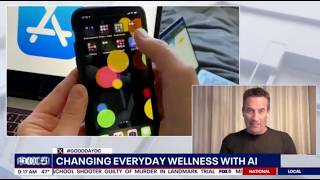
In a March 5, 2026 interview on FOX5’s Good Day DC, host SPEAKER A talks with AI and consumer‑trend expert Matt Britton (author of Generation AI) about the rapid evolution of artificial intelligence as a personal health coach. Britton explains that large language models such as ChatGPT, Claude, and Gemini are improving at a pace that doubles capability roughly every seven months, enabling them to ingest decades of personal medical data (blood tests, MRIs, X‑rays) and answer life‑changing health questions. He argues that AI will not replace doctors but will augment them by remembering and cross‑referencing a patient’s full health history. The conversation shifts to the impact on jobs, emphasizing a move from knowing how to solve problems to knowing which problems to ask AI about. Privacy is framed as a trade‑off: sharing health data carries risk, but the potential benefit—preventing a heart attack or stroke—can outweigh it. Britton highlights two 2026 fitness trends he endorses—custom GPTs trained on an individual’s data and the quantified‑self movement using wearables like the Oura Ring, Apple Watch, and Wi‑Fi scales—and warns against taking advice from non‑expert influencers. The interview ends with contact information for Britton’s social media and podcast.
Chapters
AI is quickly becoming more than a digital assistant. It is becoming a personal health coach. From fitness to sleep tracking to recovery and nutrition, AI-powered tools expected to be a top wellness trend heading into this year for 2026. Joining us now to break it all down, AI and consumer trend expert Matt Britton, also author of Generation AI. Matt, glad to have you here on with us on Good Day DC.
Thanks so much for having me. Good to see you.
So let's talk a little bit about AI in the fitness world here in 2026. Is this a temporary hype here or are you seeing a significant shift towards AI in the fitness world?
This is definitely not a temporary shift. I mean, the power and potency of the large language models like ChatGPT and Claude and Gemini are doubling every 7 months. So if I can do something just okay today, you can rest assured that it's going to do something in incredible form maybe a year from now. And I have personally been experimenting with using AI as a health coach over the last couple of years, and it's been amazing. The results have really wowed doctors that I work with. I've loaded in decades of personal health information from blood tests, MRIs, um, X-rays, and I've been able to ask it questions like, if I'm going to die in the next 5 years, what's the most likely cause? And the answer is obviously open your eyes, and it changes the way that you look at your body and your diet and the way that you live your life.
Interesting. Okay, well, I want to get into the privacy aspect of that in just a few seconds, but I did want to ask you, do you think, uh, where this goes with jobs, does this make people complicit? They're not actually learning about what it is they need to know by just plugging this information in. Just trying to play devil's advocate here when it comes to this.
Yeah, I mean, we can play devil's advocate all day long, but the reality is AI is here and it's going to seep into every corner of business culture and society, and we're not going backwards. And I think what it means to be intelligent and what it means to focus on the right things are going to shift. Because right now it's more about understanding the problems that need to be solved versus knowing how to solve the problem. AI is going to solve so many problems for us, but we still need to know where to focus. And in the case of our health, it's about understanding the questions to ask, understanding how to dig deeper into the data, and most importantly, how to act upon the advice that's given to you. But if you compare this with a doctor who has 5 other patients in the waiting room, this is a technology that can remember and cite 25 years of your personal health information and run that against all the medical information available online to give you recommendations in a way that humans just really can't compete with. I'm not completely giving up my doctor, but I'm certainly relooking at the way that I seek medical advice due to AI.
Kind of giving you maybe a blueprint perhaps to then navigate that conversation with your doctor. Let's talk about the privacy trade-off. What do people need to know when it comes to that?
You know, the use of all technology involves a tradeoff. If you look at social media, people post pictures of their family on vacation. Obviously they're getting benefit from that, but someone can come rob their house because they're not home. But for them, it's worth the tradeoff. I look at the same thing with AI. People who share their personal health information do have some level of risk, but at the same time, they have to look at the benefit they're getting out of it. I always say when I speak about AI on stage that I would much rather have ChatGPT know my cholesterol score than drop dead of a heart attack or a stroke. So it is all about the tradeoff and every consumer has to make that decision on their own.
Okay. And quickly, just want to get your take. Two of your favorite fitness trends and two that you think our viewers should steer away from.
Well, I think the notion of a custom GPT, which is creating a version of ChatGPT just trained on your own data, is a trend that I think a lot of people should understand. The second is the notion of quantified self. Where essentially consumers are adopting wearables, whether it's the Oura Ring or the Apple Watch or the Withings Wi-Fi scale, and taking all that data on their body and feeding it to an AI model so they can understand much more about what they're doing. I would say one of the trends I would stay away from is just listening to influencers and creators online, because most people who are giving you advice on platforms like Instagram really aren't experts and you have to be wary of where you get your advice from.
Very helpful. Matt Britton, thank you so much. Everyone can find your information, I think we have that for them right here. If you have more questions for Matt, he's got a lot of great information on his social media and Spotify for a podcast as well. Thanks for joining us this morning. We'll be right back.