AI & The Future Of Tech In The Workplace
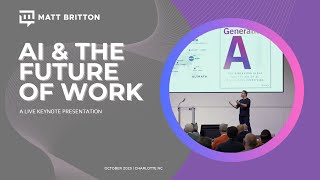
Matt Britton compares AI's workplace impact to past shifts like the iPhone, then walks through building a personal health AI and enterprise tools from 25,000 hours of Gong transcripts. He argues the real change is in skills: away from memorization toward analytical, creative, and agentic work.
So without further ado, please welcome Matt Britton to the stage. Thank you so much. Thanks, Aaron. Great jacket, by the way. I love it. It's really soft. It's awesome. Okay, we're good to go. Hey everyone. It's great to be here in Charlotte. Love this town. Whenever I'm here. And this is my fifth talk this week and I promise it's going to be the best one. I love the energy in the room and I'm really excited to deliver my experience in the world of AI. But before I do that, can we get the clicker working? Sounds like the video games around the room. Here we go. Awesome. So I've spent my entire career helping big brands target the new consumer. When I first started out my career, the new consumer was was the millennial generation, who of course is the first generation to grow up with the Internet in the household. I was a Gen Xer, like many in the room, just by gauging. And when I tell my kids that when I grew up there was no Internet in the household, it's sort of like how my grandfather used to tell me he walked to school with no shoes on. To think of a world pre Internet is almost hard to imagine, given in that the Internet is like running water in our society. And if you think about the way our brains were hardwired before there was the Internet in the household and that seismic shift that occurred where one day people were born, currently aged 28 to 44 years old, right? So many of you in this room that know no other world but the Internet, it changed expectations, it changed the way that people came into work, it changed the way that people communicate with each other. Then 10 years later, there was a new generation that came in China, Gen z. Currently age 14 to 28 years old, Gen Z is known as the iPhone generation. The first generation to grow up with the iPhone in the household. Or for those of you who have a Gen Z kid in the household as an appendage to their body, right? It is also the social media generation. So all of a sudden the power of the Internet, the power of social media and all the connectivity was in their pockets and hands at all times. And we all know what that did to change business. We all know how it birthed incredible new companies like U. It changed the way people shop where right now over 3/4 of all commerce is actually mobile commerce, not e commerce. It changed the way that we expect to get instant information on demand and open up a whole new way of working. And now there's a new generation coming to society. Gen Alpha, currently age 0 to 14 years old, they will be known as the AI generation. They will never know a world where you cannot talk to technology the same way that you can talk to humans. It's going to seem foreign and even creepy to have a kid in the household have a intimate relationship with an AI chatbot. And I totally get that. But at the same time, as this technology continues to get better and as these new people come into society, they're going to know no other way. For them, sharing their intimate thoughts and feelings with an AI chatbot is just reflective of the world that they're living living in. The same way that so many of us stare at our phones all day and somebody who was born before that think that's crazy. Parents aren't going to understand it. New generations are going to come in, AI native generations and look at the world completely differently. For example, I do not believe they're going to want to navigate a website. I think they're just going to want to chat and ask what they want to accomplish or talk what they want to accomplish. So knobs and dials and dashboards and buttons and everything that made up the digital generation is not going to be something that Gen Alpha expects to interact with the same way. We do not want to use rotary phones anymore. Now I'm going to get into AI and my experience with AI, but I just want to get one thing out there, because everywhere I speak, I get a mixture of feelings about AI and I totally get it. Some people think it's incredible and they can't sleep at night because they see the possibilities. I would put myself in that camp. Others think it's terrible. They think it's stripping away what it means for us to be human. They think it's a big risk from a national security standpoint or from an employment standpoint, which I also believe has some truth to it. But the reality is, my friends, that we are not going backwards. We are not going to stop using AI. Companies are not going to put the proverbial genie back in the bottle. This year, big tech companies are spending over $300 billion on AI compute and infrastructure alone, and they are doing that to shut it down One day. We are just in the first inning of how AI is going to be seeping into every corner of business, culture and society. And it is going to change our world. And I see so many people who are pushing it off because they don't like it or they don't understand it, or they don't think it's Right. And that would be the equivalent of you pushing the Internet off in 2000 and refusing to use email. Now some people did that and their perfectly happy doing so. But I would be surprised if they were able to leapfrog in their career, especially in a world where we are all in it. So this is center and any good visionary CEO or leader or investor is going to push their company to transform their business from the inside out. And ultimately it starts with infrastructure and data and IT which puts you all in the center. And the stars are of the new organization, right? Operations need to be driven by data and they need to have a secure framework in doing so. So I'm going to talk a little bit about my experience with AI, but the last thing I'm going to talk about is just why I think Gen Alpha and the topic of my book Generation AI is so very important. So we are in the midst right now of what's known as the great wealth transfer, where over $30 trillion with a T will be transferred in the next decade from baby boomers to younger consumers, which they will inherit over $30 trillion. Now my father passed away three years ago and when he did, I was left to be in charge of his estate. And once I kind of start to go through the paperwork, I was surprised by how much he had saved because he didn't live in a way that was in accordance with the wealth that he accumulated. He would drive around for 20 minutes to find a parking spot instead of spending $7 at a parking garage. We all know those people, right? And I really wanted to try to understand it. I was kind of sorting through everything emotionally and just from a financial and business standpoint. And the conclusion I came up with after talking to a lot of people is he was a product of his environment. He was a baby boomer. He grew up in the shadows of World War II and the Great Depression. And his relationship with money was one of scarcity. So it didn't matter how much money he had in the bank, he wasn't going to make it rain, so to speak, when he went to Vegas and start throwing money everywhere. Right? That's just not what people in that generation did. Now juxtapose that with Gen Z and what happened during the pandemic with the fiscal stimulus that came in, or the stimmies as they call it. Was young people's relationship with money one of scarcity? I would beg to differ. NFTs, GameStop, GameStonks. Looking at, you know, Instagram and trying to figure out actually how to look and Feel like you're way more successful than you are. This is a relationship with money of one of the biggest risk is not spending it. So what is going to happen when $30 trillion goes from a generation that's holding onto money like this to a generation that's holding onto money like this? And what is that going to mean for how people inherit products and how they interact with companies? It's something that really fascinates me. And it's that along with this incredible new technology AI that drove me to write this book, Generation AI, which I hope you get value from, because it's not just a business book. It looks at AI's impact from the lens of a parent, of an educator, of a business person. As someone who's trying to provide, I completely agree with what Aaron spoke about on stage. Really resonated with me in terms of we all have our own hierarchy of needs. You know, if you work for Procter and Gamble and you are in charge of Colgate toothpaste, you're probably not passionate about moving the market share 0.01% and getting that many people to buy toothpaste. You're most passionate about getting a bigger house, putting your kids through school, taking care of aging parents, etc. We all have things that we care about as individuals and then that manifests towards business. And I kind of look at AI the same way. And this whole shift is that we need to understand that it's something that can help us. And once we get our arms around it individually, we can future proof ourselves and then use it as a way to better our careers. So why is AI so powerful? Why am I here talking about it? Well, it's unlike anything we've seen for a couple reasons. First and foremost, it is improving at an unprecedented rate. The evolution from the first iPhone to the second iPhone took 18 months. And I believe in the last 18 months, we see more innovation in AI than the iPhone itself, arguably the greatest technological invention of the last century. We see more innovation and growth in the last 18 months than the iPhone had since its inception in 2008. It is mind boggling to keep up with the rate of change. As someone who's living on the edge of where this technology is, When a conference like this asks me to provide a deck a week in advance, I say no, because news always comes out in that week that I want to talk about. And that's no different. Today. Our minds are not built to be able to digest this amount of change. People are creating businesses one day that are rendered Obssolete by new AI innovation the next day. So one thing I talk about today is how to deal with that, how to deal with the rate of change which is occurring at a level like we've never seen before. I think most importantly about AI is, is it technology that does not need to be understood by a technologist? So my mom, who now lives alone, she's 75 years old, she lives in Florida, she was texting me three times a week to get to get into Netflix because she forgot her password, didn't know how things worked. And I built a chatbot for her where I essentially trained a chatbot on every appliance in our house. Every password, I said, before you call me, just ask this thing and just click this shortcut on your phone and just ask what your Netflix password is, ask how to use it. And she actually adopts it. She's the least technologically savvy person I know in my life. That is the power of AI. There's a misconception that AI is for the whiz kids. There's a misconception that you need to really be a tech nerd to understand AI. It couldn't be further from the truth. By nature, AI is built to interact with you the same way that you interact with everyone else. So if you know how to text a friend, right, if you know how to take a picture and upload it, then you know how to use AI and you should know how to get the most value from it. Now, let me talk a little bit about my story with AI as I put this graph on the screen showing that the power and potency of AI is doubling every seven months. I run a software company called Suzy. We have 300 employees. We raised over $100 million, and we were growing like a weed. It's a consumer research software tool that companies use to test their packaging and their pricing and test ideas and things like that. And when I came out, you know, I knew that we need to do something about it. As every tech CEO and really every CEO in any business knew, my first inclination was to give it to my R and D team. I have 80 engineers, R& D folks that built our software and developers, etc. And I tested the team and I tasked my CTO with coming up with a strategy. And I weighed it and I weighed it and I waited. And sure, they had some AI pixie dust on our product, but it wasn't a transformation. I knew we needed to be able to future proof our own business and stop us from being blockbuster versus us being Netflix. Right. And everything I read and what I just spoke about is that you do not need to be technically savvy in order to use AI. So I made the decision to take the AI reigns back myself. And I told my tech team, let me try to figure this out, because I'm not seeing enough momentum for what you guys are doing through natural channels. My whole life, what I've realized is that in order to be successful at something, you really need to care about what you're doing. So I made the decision that instead of first trying to use AI to help my business, I was going to figure out how to use AI to help myself personally. And then through that, my thought was I was going to be able to take those tenants and principles and apply it to my business. So I went down that path and I first decided to figure out what is the biggest problem I want to solve personally. So I just turned 50 years old. I have two very young children. I also have two kids in college. That's a completely different keynote that we're not going to get into. But the biggest problem that I want to solve is, is I want to stay alive as long as possible, right? That's. I want to see them grow up, right? I had them a little bit later. How can I use AI to help me do it? Everything else I researched about AI showed me that AI is all about data. Well, what data can be correlated with helping me stay alive as long as possible? What's the data of my body? Right. So I went through decades of personal health information. MRIs, X rays, blood test information, past prescriptions from my doctors. Right. I looked at, I searched Gmail, I searched external hard drives. Remember those? I searched file cabinets, and I organized everything and I uploaded into my own model and I trained it with one core purpose. You will act like the leading doctor from Johns Hopkins University with one core goal in life, to keep Matt Britton alive. So it took me about six to seven days to build this. And I was ready. And I got my cup of coffee and I turned on my laptop and I asked it the first question. And the question was, if I'm going to die in five years, what's the most likely cause? Right now this is a model that is trained on just my information. If you go to WebMD and ask you if you're going to die in five years, it's going to say yes, right? But this. And it doesn't know who you are. But this is no, this new me. And it gave me an answer, and the answer freaked me out. And it wasn't what I expected. And I was like, well, why? Why is this the answer? Well, your marker was this six years ago. And this and this, and this is what it's like. And I've lived a relatively healthy life. But, you know, we can't take any of this for granted, right? And it really changed the way I looked at myself. And because this was all data driven, there was no bedside manner, there was no bs. It was data and facts delivered to me in a way that allowed me to dig deeper. And ever since I built that, I ask you questions all the time. And when I get my annual physical, I upload it and it really gives me a lot of confidence. Now, that doesn't mean I'm not going to be hit by a bus crossing the street right after this, right? But it gives me some sense of control on what I'm doing. And then I start to go through the same thing with other areas of my life. So my finances, I took my mortgages and trust and estate information, all that. And now I have a mechanism where I can tap into that data is now able to be extracted, analyzed, and insights pulled instantly in a hyper personalized way to change my life, to change the trajectory of my health, to change the trajectory of my finances. And then obviously the next step was how can it help me change the trajectory of my business? So, like the path I went down with my health, I decided I had to figure out a problem I need to solve my business, right? We were not growing as fast as 2023. We kind of hit a wall. Our software had become commoditized. We were amidst a sea of sameness. My investors were breathing down my neck, right? So I went through the same path. I spoke to all my employees, and as it turns out, our salespeople were less efficient. That was the problem I had to solve. Why were my salespeople not selling as much stuff as they were in the past? I started to talk to them. As it turned out, they were doing a lot of. They were spending a lot of time doing things like trying to find case studies, trying to find information, trying to build proposals, and not spending enough time with prospects and customers. So I had to unlock and figure out how to do that. So my mind went to, okay, what is the blood test and MRI information for this problem? Our company went remote in 2020, as many companies did. And since then we had deployed a tool called Gong. Gong is connected into Zoom and had recorded every single Zoom call we had over the last three and a half years. At that point, right? It was 25,000 hours of calls. The prospect and customer knew it said, this call is being recorded for quality assurance purposes. And we had these transcripts and we weren't really doing anything with it. So I downloaded 25,000 hours of transcripts, vectorized it, which some of you might know as a way to kind of structure the data to make it easier to learn by a large language model. And I fed it in and I asked it, if my business is to die in five years, what's the most likely cause? I ask it, what do our customers want that they're not getting? Why do customers leave? What are words that customers say that signal they want to buy more? What are words customers say that signal we're about to get fired. The other thing I learned from my team is that it was hard for them to adopt a new tool. So I started to build some automations that actually brought this information to where they were already working, which in the case of our company was slack. So I started to build derivatives from this information that started to create a constant feed. For example, now every time after we have a call with a customer, it creates a summary of the call key, learnings from the call, any business opportunities, and rates the customer sentiment from 1 to 10. And if it goes below 7, it creates a churn early warning alert to a different team that can come and intervene. After each call, it writes a redacted blog post about the topic we talk to the customer about, scrapes all the confidential information and publishes it. It pulls out SEO keywords for us. It helps us dictate our future product roadmap, all from transcripts that we get from customers. It's a vision of how data can drive a business forward in a seamless way. That entire workflow I built by myself, ladies and gentlemen, I had never coded before. I had never understood HTML even or any of this. But I persevered. I went step by step. And now standing here today, I'm a full stack AI engineer. There is really nothing that you can tell me that you'd want to build, that I would not be able to build myself. And I do not know how to code. I don't really even know much about technology. So how did I get there? I got there from being a problem solver. I got there from focusing on the core thing that needed to be done. And I let these large language models and the power of them show me the way. So today, with the time that we have, what I want to do is peel back the layers of the Onion, I want to show you the steps I took to build some of these tools, the state of AI today and what it means for all of you in your career. I am going to be giving all of you a copy of this deck as well as a video of a very similar presentation, as well as access to an agent that has all this transcript so you can get all this information. So you're welcome to take pictures or take notes, but you certainly don't have to. So one thing I think a lot about as a parent is education. You know, the way that we are educating people, younger people in this country I think has quickly become irrelevant. I read this article the spring that in China they are rolling out AI courses to kids as young as age 6. Now that may seem crazy, but I can tell you that if we send our kids down the path of the way they've been educated and the way they have in the past, well, I think we are going to find ourselves on the wrong side of this change moving forward. As a result of a lack of trust overall in our institutions around AI, it has trickled down to consumers. 72% of Chinese citizens have trust in AI, while less than a third of Americans do. Despite the fact that most of the large AI companies, whether it be Nvidia or whether it be Anthropic or of course Microsoft and Google are here in the U.S. but the trust isn't there. Now, some people just don't trust what they don't understand. But I actually think we are not setting ourselves up to change this anytime soon. Based on the way that we are educating young people and the way that we are are educating young people is this notion of memorization and regurgitation. I was a terrible student, but I knew how to play the game. The night before a test, I would cram as much information in my head and as much Red Bull and regurgitate both the next morning and move on with my life. But your ability to memorize information and apply it was what made you a good student. And a lot of ways in the knowledge economy of the last two decades is actually what made you a good employee or worker. If you could memorize the knowledge of how to write a contract and regurgitate it, you were a good lawyer. If you could memorize how to do someone's taxes and regurgitate it for them, you were a good accountant. If you could memorize how to read an X ray and regurgitate it back someone, you were a good radiologist. But now I would argue we are entering the End of the knowledge economy, meaning your ability to maintain facts and then apply them is commoditized. And that is exactly what AI is trained to do. I just told you a story how I now rely on AI and my personal health information more than I would any doctor. You can say that's crazy, but if you looked at my doctor's schedule, he has 10 appointments that day. Do you think he's going to remember everything about my body from the last 20 years and apply it? Of course not. Could AI hallucinate? Sure. Could a human have a bad day and just want the meeting to be over? Yes. More likely, the application of facts is only going to be more powerful with AI over time. So no matter what role you're in, if you're leaning into a knowledge economy track, that track is going to hit a wall. And it's going to hit a wall in a lot of different ways. So what are the new skills? What are new skills that we're looking at? Well, this is from the World Economic Forum. It was a Future of Jobs survey, and it showed that analytical thinking is number one. Can you be analytical? I just walked you through how I talked to my company and analyzed the biggest problem. And then I built a model that took transcripts, which I was able to analyze. Analysis and pulling out the signal from the noise is perhaps the number one skill we can apply. Because ultimately, how AI has changed the world. It's far less about how to solve the problem and far more about understanding the problem that needs to be solved. Let me give you an example. Photography. It used to be, in order for you to be a good photographer, you need to know how to develop film in a dark room. Then you need to be able to afford and purchase a fancy DSLR camera that has ISO and F stop and all the knobs and dials. And. And in order for you to be a good photographer, you had to know lighting and all these things and you had to understand angles. And you were specialists. You knew knobs and dials. But right now, 99.9% of all photos are taken on the iPhone. And the best photographers, the most lucrative ones, are just those that know where to point the camera to. Right? That is a great analogy for AI. AI is a powerful machine. Knowing how to operate the knobs and dials isn't what makes you good at it, it's actually knowing how to apply it. Why I've been able to be successful is I knew how to apply AI to my health. I knew how to apply it to my finances. I knew how to apply it to my business, but how to operate it, how to go beneath the hood, that suddenly become far less important. Which is why resilience and flexibility and agility is important. And creative thinking, these are the skill sets that we need to upskill into memorization of facts is nowhere on here, ladies and gentlemen, but our kids are still being taught to memorize and regurgitate in schools. And that is the biggest shift that needs to happen. So what is the new how? And this is something I came up with yesterday, to be honest with you, after too many coffees. But I do believe it is the case. What you're going to build, what you're going to focus on, is so much more important than knowing how to do it. Because the gap between what's in your mind and what can come to life, which I'm going to show you some examples of, is almost non existent right now in every single category. It used to be you need to know how to do something to build something. Now the world's your oyster. What are you going to do? You obviously have to have agency, you have to be action oriented. But there are people that have created companies doing millions of dollars in revenue and they created the company six weeks ago. It is incredible the opportunities that exist right now. So yeah, Aaron spoke about Microsoft laying off 12,000 people. I know three of those people that are now already making twice the amount of money they were making at Microsoft because they knew how to use AI to apply it. So now that is not going to be the case with all those people. Right. But we all want to be on the right side of this. And what I hope to impart on everyone yesterday is how to be on the right side of this. Because not everybody's going to. But if you are, it's going to be the greatest opportunity that you and I will see in our lifetime. So I'm going to break down what AI means fairly quickly here so you understand you're grounded on what we're talking about. And I've created very simple framework for AI that has four layers to it, the first of which is infrastructure. Infrastructure obviously is where a lot of us live. And the number one point I have to make on AI infrastructure is you all should have invested in Nvidia about six years ago. Nvidia copy that created GPUs originally made to power the graphical demands of video games. Right place, right time, now is the is the way that AI is powered and has made CEO Jensen Huang one of the world's richest men. And video now worth over $3 trillion. These GPUs are powered by data centers where the GPUs live and where the data that it powers is stored. We are anticipating a 30x increase in demand in the next 10 years in data centers. Right now, 40% of the power demand in the state of Virginia is through data centers. This is creating a very power hungry landscape. One query on ChatGPT uses 33 times the amount of energy on Google. I spoke yesterday and I asked how many people were using ChatGPT every day. Everyone raised their hand and then two people's like, isn't it bad for the environment? And I said, didn't you raise your hand when I said that? And I asked if you were going to use it. Yes. Is a drain on our power. Yes is an incredible tool for our lives and that's not going to stop us from using it. But it is a big issue and that's why you're seeing companies like Google and Amazon invest in alternative energy sources like geothermal and nuclear and solar to be able to power these increasing demands. The second area of the AI framework is large language models. Back in a 56 pass, I wasn't prepared to translate that. As I was doing that little tease, that little mark with the a and then the ring around it at. See, that's what I said. K said she thought it was about. Yeah. Oh, but I've never heard it. I've never heard it said. I'd always seen the mark but never heard it said. And then it sounded stupid when I said it. Violence at NBC. There it is. Violence at NBC.ge.com. i mean, what Allison should know. What is Internet anyway? What is Internet anyway? That. This is 1998, the world was just starting to turn on to what the Internet was. This company called America Online was first getting ramped up and America Online ended up being the catalyst that got America Online. And all of a sudden this incredible thing called the Internet, which was really just used by the government and military prior to that, became a new way of communicating and changed the world as we know it. ChatGPT is doing the same thing right now all over again. It is a large language model that is getting all of us to use AI every day, the same way AOL got us to use the Internet every day, except it's growing far faster than even AOL did. ChatGPT is a large language model that is built and marketed by a company called OpenAI. What is a large language model? It's a, it's a fairly simple equation. People put in an input, a prompt, no different than Google. You're searching for something you can put in the prompt. A prompt could be in any language. It could be text, it could also be voice. It could even be an image as a prompt. Once that prompt is taken, it will actually the large language model will go and search for an answer for that prompt to give you a generative response, which is why it's called Generative AI. In the case of ChatGPT, it's searching through the whole open Internet, trillions of data points. In the case of my personal health bot, it's actually only searching through my personal health information. That is called the knowledge base. That is where the data lives. That's why data is so important, which we'll get into. And of course it outputs in a multimodal form a generative output. And that's how a large language model works. There are different types of large language models. There's reciting based models you ask for, the new recipe for lasagna gives you an answer. Or there's a reasoning model where to go through a multitude of steps for more edge use cases. In the new ChatGPT5, it chooses for you the best model to deliver the best result. Because prior to that, people actually had to select what the best model was. And there is an endless amount of large language models. ChatGPT is far from the only game in town. Google has a model called Gemini. Meta has a model called Llama. Twitter X has a model called Grok. There are models in China like Deepseek and Quinn. And these models keep leapfrogging each other, leapfrogging each other in terms of their capability and intelligence level. In just one year, the smartest LLM improved its score from 96 to 136. If your weird uncle Billy last year, who could barely put three words together, showed up this year at Thanksgiving from a 96 IQ to 136, you would think he was on something, right? That's where LLMs have grown to. I cannot tell you how many times people told me, oh, I tried that three months ago. It doesn't, it didn't work. It doesn't matter what worked three weeks ago. That would be like me saying I tried to stream on the Internet in 2002 and I refused to watch Netflix today. Right? You have to bet on where it's going. You have to know today is the worst AI is ever going to be. And if it does something just even okay today, it's going to do something in remarkable fashion a year from now. And that's just facts, not just data supporting it. A lot of people are questioning what this all means for Google. Perhaps the most valuable and best business model of the digital era. By show of hands, how many people have used a tool like ChatGPT for a query where you would have used Google a year ago? There you go, it's 75, 80%. I spoke in front of 3,000 people yesterday. A bigger sample size. 75, 80%. Right. And they weren't people who were necessarily in the IT space like you guys are. Point is, this is changing the world, right? It's changing the way that people find things. Google has become a verb in our society. And here I have 75% of people all of a sudden so quickly saying, now you're going to use a different tool to find things. And we are just getting started with this right now. But Google is not sitting on its hands. They're seeing the data. They're seeing the AI is replacing search. I get asked questions all the time, how do I optimize for AI? And while research is still coming out, what I found is it's about specificity in content. So for example, over 50% of my inbound speaking inquiries, people to hire me to speak, have come from ChatGPT. And I asked them what the queries are and they're very specific. I'm looking for the best speaker in London about food and beverage versus I'm looking for the best AI speaker because since you're so interactive with AI, the specificity of search is greater. And what will happen is the AI model is going to look for specificity and content. So the more specific content you put out there in volume, the greater the chance you're going to be found and recommended by a large language model. It also tends to favor video based content over text based content. The third part of the value chain is where I believe all the importance lies, which is data sets. Where would my healthbot be if I didn't have any information? Or I just loaded in last year's physical and it didn't have the ability to look through the last 20 years. Maybe the answer on why I'm going to die in five years would be different and maybe it wouldn't be as accurate. So data sets are everything and data is really the new code. It is really the new differentiator, is really what is going to become the moat. And we're seeing it play out. Many of you probably have been on and know about Reddit. Reddit is billions and tens of billions of very deep conversations about very specific niche topics. Where is the best place to bring your French Bulldog to? In Duluth, Minnesota to hang out with other French bulldog owners. That type of information is information a large language model needs to be able to deliver. Which is why Reddit has a $50 million annual deal with Google to feed their large language model. And allegedly Claude, which is another large language model, a great one, was crawling Reddit's information without paying Reddit. Now Reddit is suing Claude because of the value of their data. The same thing is happening in the entertainment space with Mid Journey, a text to video tool which is getting sued by Disney and Universal because they are claiming that that their IP is being crawled by Mid Journey without them getting just payment. We're seeing the data wars happen. But some data is free. My closest friend lives in New York and one of the largest residential real estate brokerage companies. He has 58 brokers across Brooklyn, New York. And when they're showing prospective tenants apartments, they ask questions like, is there going to be new construction coming up anytime soon? What's the crime rate here? And in the past they'd have to say one thing. I'll get back to you. But as it happens, New York City publishes something called Open Data, which is an API, which I don't have to explain to you all what it is, but it's an ongoing database of all information there is to know about New York City. Crime rates, air traffic and pollution, and new permits issued by city block by day. This has been there for a long time. But before the age of AI, who's going to download these spreadsheets and pour through millions of lines of spreadsheets to get information? Nobody. But now with AI, in the span of a weekend, I was able to build him a chatbot for his agents where they are in the field, they type in the address and it pulls up all that information instantly. So that's unlocking insights in the power of data to make them better, make them serve their customers better with data that was out there and is free and published by the city. That's the power of tapping into data on what you're trying to build. And because of this, the AI training data set market continues to grow. The last part of the AI value chain, the fun stuff as I like to call it, is the application layer. Now some people use large language models like ChatGPT as an application, but what we're starting to see is what's called wrappers. Not wrappers like you know, Eminem, but wrappers on top of it that actually Go on top of large language models that unlock very niche use cases. And we are seeing some incredible innovation and companies that are building so fast by building new tools that are powered by the large language models. And that's how I personally build. I have an API. We were one of the first enterprise API companies to OpenAI. We also have an API with perplexity with Claude. So since we have access to their API, we we can use the power of their large language models to power our tools to put interfaces and use cases on top to unlock completely new ways to use the power of these large language models. The great thing about LLMs is it's both multimodal and multilingual. If you think about the progression social media. First it was I had a burger for lunch people. It was just text. Then it was, look at the picture of this great burger I had for lunch. And then it was, hey guys, I'm here having a burger for lunch. Or it was video. So it went from text to image to video, but it took about a decade to do that with AI. It's kind of multimodal now and it's almost at parity, meaning its ability to output text is nearly equivalent in terms of its ability to output video. It didn't start that way, but we're almost there right now in terms of the fidelity of actually the video and the imagery that it can output. It's also multilingual, which means any company be global overnight, which is fascinating to think about. It stopped many companies from expanding globally. Just the language barriers. Language barriers are now gone. Right? It can translate instantly. I mentioned earlier about how some people said, oh, I tried that a while ago, it didn't really work. Well, this is Mid Journey. It's a text to image and text to video tool. Version one was 17 months ago. And while you can't see it, that person in version one had six fingers on one hand and seven on the other hand and his arm was kind of contorted. Look at version 5.1. Look at the fidelity of that image. And oh, by the way, Midjourney is Now on version 7. So where is this going to be in version 14 a year from now when it doubles? Is it going to be indistinguishable? Yes. Should you act accordingly? Yes. Is this going to create deep fakes, nefarious actors, all sorts of bad stuff? Yes. But this is what's happening. Mid Journeys are gonna be like, you know what, we'll just go back to version one. Nope, it's gonna go in that direction. When People say, I tried to build an image in AI three months ago and it didn't look like this. In their mind, this is what it can do. When the reality is it can do this, it kind of changes their perspective in terms of where this is going. And again, the fact this happened in a year and a half is really the thing to think about. We went from dial up to T1 fiber optics instantly. Where in the case of the Internet, as you know, that was about a decade transformation. So it's opening up all new capabilities. This buff guy over here, who nobody in this audience looks like is actually not a real person. He does not exist. He's an amalgamation of trillions of data points on the Internet and somebody prompted to get this person there with that headband on, standing in front of that fire. And if I want that fire to turn to a bucket of ice, I could do it instantly. Now tell me, do I need a photographer or a lighting expert or a set designer to do this? No, I just need the idea to make it. Which is why what is the new how what happens to all the people who would have had that job is the question. Even the model himself. Now, IP is still going to exist. We're still going to want to see the Rock or Reese Witherspoon in movies, right? But if you're an extra in a movie set, if you're an extra in the workforce, that's where the risk is. Because tell me, what movie director is going to pay to have a team of extras walk across the street on a set, on a street that looks like one in Charlotte, when you can actually just create it with a prompt? Not many, right? And this fidelity is changing things like graphic design, where in the past, if I want to change the shadows or the lighting on that cat, if I want to say that cat should be drinking a Diet Coke versus a beer because it's just driving, right? I actually just swap it. I don't need to do a new photo shoot. If I want the lighting or shadows to change, I could give it a prompt and swap it. Adobe themselves, the company that built Photoshop, the de facto tool for graphic designers, is rolling this out. Graphic designers hate when I say this, but I'm just spitting out what I'm seeing. And ultimately, if you are a graphic designer, your ability to move the knobs and dials are no longer as important as knowing what you are going to graphically design. So taking orders to do this, the orders are going to be given to AI. It's mind blowing and it sucks for some people. But this is where we're at. I just showed you text to image. But one of the biggest leaps we've had in the last couple months is text to video, which means instead of just outputting text from your prompts, you can output video. Ocala throws a great event. I actually can't wait to hear Matt Britton talk about AI this morning. So none of these people exist. I uploaded the Apocala logo. That venue doesn't exist. I don't no longer need to pay actors to do that. I made that 38 minutes ago. Standing right there. 38 minutes ago, guys. I took the logo and put it out there. How long would it have taken a graphic designer to make something like that? To have the logo jump off the screen? What if I were to take an hour? What could I create? What does that mean for advertising agencies? What does that mean for production companies? It's pretty fascinating to think. Just last week OpenAI rolled out something called Sora 2, which is their text to video model. I was Talking to my 5 year old daughter about the government shutdown because she had heard about it at school and I want to create a video to explain to her what it is. This chamber is closed until we agree on something real. You keep saying that, but you won't move an inch because your inch costs a mile. Order. Order. Well, sort of. I saw a story on CNBC how inflation is rising and impacting consumer confidence and I want to create a video to create a post about on LinkedIn. We work with a lot of candy companies at Suzy and I want to talk about a new trend on TikTok where people are making DIY costumes for Halloween. Made that three minutes before a call. Yes. It stops at 10 seconds. Where do you think it's going to stop a year from now? A minute, two years from now, I'm going to be making a two hour feature film about anything I can dream of. That's where we're heading. Look at the tape. Two years from now, what does that mean for industries that are in the creative services or anybody that wants to create or dream of anything? We can unlock anything in our brain and bring it to life. You may think it's Matt Britton talking, but it's really Matt's digital twin. I've been told to speak confidently in front of all of you beautiful people at AP Cala today in Charlotte. Matt doesn't seem too worried I'm going to take his job though. Clone my voice. Use that to do readouts for my podcast. Your Ability to create a digital twin, which is an actual. A second version of you is becoming indistinguishable. We are going to be in a place where you're going to be watching a movie star like the Rock in a movie that was filmed in Vancouver where he never has visited. And his name and likeness is going to be licensed and he's going to be in a movie. People will say no one will ever want to watch the Rock if it's his avatar. And then we'll say go to the Electric Daisy Carnival in Las Vegas every year where half a million people come to watch DJs press buttons on music that isn't made from instruments. We are already consuming synthetic content. This is just the future of it. Voice is also very powerful. I have a device called the bee. It's $50. I wear it during the workday. It's called bai. It was actually just acquired by Amazon, I believe. You put it on your wrist, it records every single thing that said during a day. And then it creates a to do list for you. You can search things, it'll create a strategy for you, but based upon what's happening in the world around you. It's taking the data and ingesting it and allowing it to power your life. Very cool tool. Creeps people out. I get it. But it just kind of shows people the power of data. And a voice coding, very controversial topic. One of the biggest knowledge economy jobs that's existed. People did things right. They went to MIT or Stanford, learned how to be an engineer, got a job at Microsoft or Google. Now all of a sudden there's a tool that codes for you. As it turns out, computers are better at writing the language of computers than humans are. Who would have thunk it? What are coders saying? Oh, it can't actually build the whole thing. I'll just show them the mid journey chart. It's going to code the whole thing. It just is. It's so controversial. Nobody wants to talk about the truth behind any of this. People hired me for conferences. Thankfully, Aaron didn't say don't not say things. But when I speak at big organizations, like, don't scare them, don't say this. It's like, great, so you can fire them one day and they never had the chance to do anything about it. But you don't want me to scare them on the data that's out here. No AI is going to be able to code. And two years from now, I'm going to be able to create any software platform I want with A simple prompt. That's the reality. These companies like Cursor and Lovable are exploding, which are called Vibe Coding companies. Based upon prompts, they write software for you. I am now building in it myself. And through it, you do learn a little bit about code. What do engineers and software developers do? They learn how to stitch everything together. They become more strategic. They can be more valuable than ever before if they unlock the power of it. But if they stay beneath the hood, not so much. And look at the data. Look at the software development job postings in the United States. I didn't make this chart up. So this is where it's headed. And no matter. So what do we talk about today? We talked about coding and engineering, talked about creative services, talked about analytics, we talked about finance, we talked about health. This is hitting everywhere. It also creates one of the greatest opportunities we've ever seen, which is why I've taken the time to build this stuff, which is why I've taken the time to write the book and why I'm here today for all of you. So where is this all headed as we wrap up here because I want to make sure we get time for questions. We're going through a progression. When ChatGPT first came out, we were in the world of AI tools. Give me a recipe, write a blog post, call and response. Then we got to world of automation. In a minute, I'm going to show you all QR code. You're going to take a picture if you're interested, and of the QR code. You, you'll give me your email address. And then I've created an automation that will find out who you are and it'll send customized information to you via email. That's automation. Take the email, find out who the person is, write the email, create the HTML and send it out. Boom, boom, boom, boom, boom. You can use tools like make.com or Zapier to create automation. You can build incredible software tools using automation tools. But where we're headed right now is the world of agents, which is instead of going from step one to two to three, it may know that I know one of you. So when you sign up, it may say, I'm not going to send them out a generic email. I'm going to schedule lunch for you with this person the next time that they're in New York City. That's the power of an agent is it has autonomy, it's not deterministic. It's given access to a set of tools and with the access to those tools can make the decision for you on what it's going to do next. We are entering the agentic era of AI. OpenAI themselves launched their agent tool this week, or I don't even know what week it is, last week or this week. I can't keep track very recently. And this is where we're going to expect for everything to move to. It is in the driver's seat of the organization. Over 78% of organizations are using AI, up from 55% in the previous year. And there's dramatic acceleration. I have tried to seamlessly deploy AM or my organization. It's not easy. Here's what happens. Everybody wants their own tools. You can't do that. You have to deploy a certain amount of tools. You have to train and onboard the right way. You have to have one single structured data set. You have to understand how that's going to be used. You have to have guardrails around, privacy. There's things that you need to do to deploy it the right way. But people get overwhelmed and everybody wants to do their own thing. That's what makes our jobs hard in the world of it, but also what makes our job so very important. So to wrap up Here, there are four AI transformation pillars I think we all need to embrace. One, focus on being a problem solver. There's two Ls there by accident. Got to fix that. But be a problem solver. Focus on the problems that need to be solved before worrying about the tools and the technology. Two, practice perseverance. You may try to build something, you may get derailed at step 7. One thing I like to do is I ask AI give me step by step instructions on how to build this. Do not give me step two until I tell you step one is done. And I just follow one step at a time. And if I hit roadblocks, I go through those roadblocks and I figure it out and I'll be at step 37. I'll be like, oh, whoa. I can apply that step to this. That step. That's how you build an AI. It's not rocket science. It's not magic. It's just having perseverance. Obviously understand the power of data and being action oriented is what it's all about. So we're going to go to Q and A, but this is up here a QR code you can snap, where you can get a copy of the presentation, access to my AI agent, as well as a list of 100 AI tools. So feel free to snap that and you'll get a copy of that so I would love to open it up for questions now, and we'll go from there.
More from Matt




MikMak’s Rachel Tipograph on Consumer Spending, Retail Media & Holiday Shopping Trends



Jaguar Land Rover’s Charlotte Blank on Luxury, Purpose & Experiential Storytelling



