AIE Creative’s Arturo Nuñez on Brand Love, Culture & Authentic Storytelling
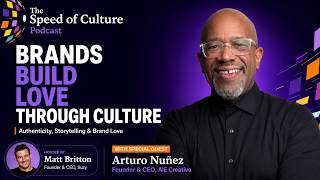
In this live Speed to Culture interview recorded at the POSSIBLE conference in Miami, host Matt Britton talks with Arturo Núñez, founder of AIE Creative and former marketing leader at Apple, Nike, the NBA, and Nubank. Núñez explains how storytelling has evolved with technology and social media, emphasizing that authentic, emotionally resonant narratives are the core of brand love. He discusses the shift from private to instant public feedback, the importance of curiosity and lifelong learning, and how cultural authenticity—especially youth and Latino culture—drives modern marketing. Núñez shares examples of brand love at Nike (logo tattoos), Apple (stickers on cars), and Nubank (rapid customer growth), and outlines his philosophy that brands must connect emotionally before selling features. He reflects on his transition from corporate roles to entrepreneurship, board positions at Estée Lauder and Abercrombie, and his new book “The Cultural Compass.” Throughout, he stresses the value of authenticity, perseverance, and leaving people, places, and things better than found. The conversation ends with advice for younger professionals: obsess over craft, stay disciplined, embrace failure, and prioritize relationships.
Chapters
Up today on the Speed to Culture podcast, we're here live at the POSSIBLE conference in Miami with a very special guest, Arturo Núñez, the founder of AIE Creative, one of the most influential voices in global branding. With a powerhouse career leading marketing at Apple, Nike, and the NBA, Arturo is now helping brands craft emotionally resonant, culturally authentic experiences through his agency. Arturo, so great to see you, man.
Man, great to be here. Thank you for having me. Appreciate it. I listened to that intro, I'm like, damn, that guy sounds amazing. Yeah, I know. You have to meet him one day. Yeah, for sure.
So if somebody was telling somebody else about you and you're like, oh, you have to introduce this guy Arturo, what would they say?
Man, Arturo is a multi-hyphenate. Arturo defies categorization. He does so many things. And first and foremost, he's a storyteller.
Yeah.
And I learned that at some of the best companies on earth. And it's really been helpful and fundamental to everything that I do today. Is that idea of the art of storytelling. And stories are what connect people. Absolutely. What build emotional connection. And the best brands in the world tell stories to build emotional connection between them, their audience, their products, their services, et cetera.
And how do you think the art of storytelling has changed over time in this world that seems to be moving so much faster now?
Yeah, I think technology's been, you know, a beacon in this world for storytelling. You know, just so many things are now like instantaneous that used to be a long time. You know, one of the examples I use a lot is I say like, you know, Michael Jordan didn't live in the social media era. He's alive, but he didn't work at it. He wasn't at his apex in the social media era. It would have been a very different conversation because—
And he's not really the most personal. I mean, it actually might have hurt him more than helped him.
That's right. That's right. That's right. So I think that the advent of social media, of digital, gives the positive side, gives brands complete access and immediate access to customers, but it also can expose your challenges, your flaws, and your problems to customers too. And the feedback is instantaneous. Someone can have a bad experience in your store or with your product and in 10 seconds everyone knows about this, you know? There's a, somebody was talking one day about, you know, when you were a kid in high school, grade school, I'm dating myself, right? I'm an old guy. You know, you took a fall in the schoolyard, 3 people saw it, they laughed at you, maybe they told the story.
Yeah, you could fail in private, right?
Yeah, they video that now and a million people saw your fall, you know, seconds after it happened. It's a game changer.
Yeah, I wrote about that in my book where it's like my first startup One day I'm like in Entrepreneur Magazine, like hot millionaires under 30, even though I wasn't a millionaire, just my company had done over a million dollars in revenue. And then next thing I know, dot-com bubble bursts and I'm like, you know, I really failed and I hit hard, but I was able to fail in private. It's not like everyone's like, oh, I thought you were killing it, now you're not anymore.
That's right, that's right.
I also think where you could, not only can you fail in public, but what it I think does is it sends a lot of young people down the wrong direction that it's so easy to create a successful life or successful career 'cause you're just seeing everybody else's highlight reels. That's right.—
the highlight reel. I was about to mention that. You know, even think about that from a standpoint of, you know, there's a famous commercial that the Jordan brand did about Michael Jordan. It's about failure. It's actually called "Failure." And he says something like, I'm not gonna get it all right, but he says, you know, "I've lost, you know, more than 300 games in my career. You know, 26 times I was asked to take the final shot and I missed. I failed over and over again. And that's why I succeed." Right? Which is a great story. But think about the edited highlight reel of everything now.
I know.
You know what that took 20 years ago to edit a highlight reel of stuff?
It took real work. Now it's just one button, right?
One button, boom, done, we're out. You know what I'm saying? For good and bad. Yeah. That's a huge change in the storytelling, uh, milieu.
Absolutely. So how have you over time been able to evolve your own skillset?
Yeah.
To make sure you keep up, because over since you and I have both been in the workforce, we've seen the advent of the internet, social media.
Yeah.
Mobile. Now of course AI, which we'll get into. Yeah. How have you been able to future-proof yourself and, and remain relevant across all these incredible companies?
Yeah, man. What I think is the most important thing, you know, I talked about storytelling, the importance of storytelling for any marketer. At the end of the day, a marketer is a storyteller. But also, one of the most critical components to any successful marketer is curiosity. Yeah. You got to remain curious about your customer base, about what's happening in the world. I am fueled by curiosity. Every day I want to learn something. I actually have a philosophy that if you're actually a lifelong learner, every day you're getting dumber because you're going to say something on this podcast that I know nothing about.
Right.
And if I'm really curious, I'm going to be like, oh, wow, a whole new world just opened up.
Yeah. I've never been to that place.
I never heard of that thing. Now I gotta dig deeper. I gotta figure it out. So a lifelong learner and having infinite curiosity, that's what really fuels me and drives me and it's made me really successful.
Yeah, instead of walking into a conference and being like, yeah, I know it all. I don't have anything to learn from someone, especially people who don't wanna learn from younger people. That's right. 'Cause younger people have, their brains are wired differently. They were born to a different world. So by nature they see things in a different way.
That's right. That's why reverse mentorship is so important when you're getting young people's point of view on stuff. That's why, You know, Nike as a brand where I worked for 8 years used to have its ear to the street. You know, we had a program at that point called Eakins. Eakins is Nike spelled backwards. These were the young kids who were obsessed with the brand who were out there touching, you know, where the rubber meets the road, meeting with consumers, meeting with athletes, you know, that were athletes themselves. That's where we got the energy, the spirit, you know, of really understanding what customers wanted.
It's interesting because for so long youth culture was really counterculture. If you look at like the '60s, '70s, '80s, like there was Woodstock. They didn't have a voice. So the only way that they could actually be heard was to revolt or stand up in city squares and scream because what dictated culture was large corporations and whatever Clear Channel spun in heavy rotation on radio became the songs. And over time, especially with social media, it shifted. That's right. And now culture's driven from the sidewalks, not the boardrooms. Absolutely. And companies don't really have a choice but to listen because their voice, the voice of the youth is deafening.
That's right. That's right. This is a game changer. You know, I spent some time working at the NBA as well. And I remember when my kid was a teen, my kid was a big fan of basketball. He played basketball. He was a big fan of sport. And I'd be sitting in my home watching the game on TV and he'd never be watching the game with me. And I'd be like, "Hey man, you know, the Knicks are on or whatever." And he'd be like, "No, no, Dad, that's not how I watch the game." I'm like, "What do you mean?" He's like, "There's a guy who recaps all the games." Right. "And he talks the way I like to talk. And he does it in 15 minutes. Tells me everything that happened in the game." Yeah. "In a way that I like to understand and hear and listen." Game changer. It is. By the way, that guy then became like a product reviewer and like invited to like Apple's highest level conferences to talk in plain language about what Apple just dropped in the marketplace. So such a massive change in the way that we get information.
Oh yeah.
Super, super important.
Yeah. I mean, it's funny you bring that up because I was, we were just with Tim Ellis, who's the CMO of the NFL.
Yep.
And we were talking about how fans of the NFL and all sports. Uh, we also had the, the founder of Overtime, which is an incredible story in the sports space. You know, they're consuming songs and not albums, right? In sports. So you're consuming the highlights, you're following players, not only teams. Obviously there's video games, there's fantasy sports, there's gambling, which we can get into and the impact of that. Yep. But all those things are giving people a vested interest in the athlete versus just the team. That's right. So even the way they look at sports and fandom has changed.
Yeah. You know, it's funny that you mentioned that. I had the privilege of working for David Stern directly when I was at the at NBA. I ran Latin American marketing, U.S. Hispanic. I was in a meeting with Stern one day and I made a comment. I was naive and young. I made a comment, something about the NFL, you know, being the biggest competitor and how the NFL was doing whatever. And he kind of looked at me. He was like, "That's not our competition." And I was like, "Wait, what is he talking about?" I'm like, "NFL, big sports league. NBA, big sports league." He's like, "No, no, no. We're in the entertainment business." I said, "Really?" He's like, "Yeah. I want to know why someone bought a ticket to go to an AMC theater yesterday instead of going to the Heat." I got $20 tickets, I got dancers, I got food, I got music, and I've got reality television. No one knows what's gonna happen till the last buzzer sounds. I wanna know why someone chose another entertainment solution versus ours. That's the business we're in. And it was really edifying for me to hear that from him. And he was a visionary genius.
He was. And I think, you know, they're not just competing against other entertainment services, it's about mindshare. They're competing against Joe Smith, the social media expert.
That's right.
That's right. Kim Kardashian, whatever. Instead of going to a movie, a lot of people are staying home on their phones. That's right.
Right. 100%. So he knew that, and he knew that the future was global. And he did an incredible— I was there at a really quintessential time for the NBA when they were trying to make the league international. And he knew that every one of those international players was a conduit to a new audience. So when I joined the NBA, there were 3 Latinos in the league. When I left, there were 19. When I tell people that story, they're like, oh, you guys were involved in recruiting? It's like, no, we had nothing to do with recruiting. All we did was tell stories about how these Latin American guys had reached the apex, the pinnacle of the sport of basketball, playing at the NBA. And that gave a future generation of athletes the idea of like, wait a minute, maybe I can do it too. And so I got to watch Manu Ginóbili, Nene, Leandrinho, Carlos Arroyo, Felipe López, Eduardo Najera. All these guys came up while I was at the NBA. And we're playing the game at a pinnacle level and getting people in Latin America excited about basketball. When Latin America used to be soccer number one, soccer number two, soccer number three, you know what I mean? In terms of religion. But yeah, it was all about that. He had a vision for making the game global and he knew the importance of these guys.
Yeah, and I think the tailwinds for the NBA and going global is that most of the biggest stars, whether it's Victor Wembenyama or Luka Dončić, like these, you know, even Shea Gildress is from Canada. Like, the new stars are predominantly not American. So, you know, those stars are actually, and we saw what Yao Ming did to bring the NBA to China. So we are seeing like the globalization of the NBA in a way that the NFL really doesn't have, 'cause most of the NFL players are American.
That's right. And even the NFL is, you know, making great efforts today. You'd mentioned Tim Ellis earlier. I worked on a project with them talking about how to increase Latino fandom in the US. As a consultant project. And they're trying to figure it out. They're trying to figure out what international looks like. They've done games in Brazil and Mexico City and London. They're going to do Madrid now. They're really excited about doing that.
Germany as well.
Germany as well. An ex-colleague of mine, Priscilla Shoemate, is the CMO for the Dolphins, and they're doing all kinds of stuff international as well. So it's a great time to be a marketer, to be in marketing, to tell stories across populations around the world. And I'm eager to see how those sports translate to the world and abroad.
Yeah, we're obviously big sports fans. I got one more question on sports and then gotta move on to some other topics. But, you know, we saw how Major League Baseball changes their rules, right? And now they have a timer on the pitcher 'cause it was just too slow. Yep. It was disenfranchising the younger fan.
Yep.
And they're trying to make it more built for the TikTok generation, if you will. Yep. Do you see other sports following suit where they're gonna change sort of the complexion and makeup of the game, risking maybe the traditionalist backlash to evolve the game to make it more palatable.
I think the baseball example is an interesting one because I don't think most people even notice now that that's a thing. I watch the game and I forgot that that's a newly implemented thing.
But now they can get it shorter.
And it's shorter, it's amazing, right? So I think that's been a really interesting one and a positive case study. I think even more important than changing the rules of the game is the culture. So I'll give you an example. Another ex-Nike colleague, got a lot of ex-Nike colleagues doing amazing stuff, but Tiago Pinto, is the head of marketing for the Marlins here in Miami, the baseball Marlins. And, you know, you go to that stadium and, you know, they've had a tough time. They've, you know, kind of revamped the team and got rid of some guys, et cetera, et cetera, and had a tough time even in such a Latino marketplace building up a fan base, you know. But I was having a conversation with him one day and I was like, dude, when you go to the World Baseball Classic here in Miami, it's 40,000 raving lunatics in the building. Of course. Right? So how do you bring that energy to the regular Marlins baseball. That's the trick, right? Right. You have rabid fans of the sport here. And whether they're following the guys because the guys are Puerto Rican or Venezuelan or Colombian or Dominican or whatever, doesn't matter. The point is there are people who want this product. How do I make the product more palatable to them on an everyday basis? Not just when it's the World Baseball Classic or the playoffs or the World Series.
Yeah, I mean, it's about stories. You're right. I mean, even though the NFL Draft, which just ended, Last week we're taping this here in late April.
Speaking of storytellers. Yeah.
I mean, Shador Sanders, right, is like, his dad's a Hall of Famer and he was like the hotshot person. He's dropping from round to round and round. And that became the storyline. And everyone just checking back on ESPN. Did he get drafted yet? That's just a story.
That's right.
It's a story that we can all relate to in terms of the guy that thought he was going to be high up and he's not. Now everyone's probably rooting for him as sort of like the underdog story, right? That's the next story. So people are going to be following him. How can, you know, teams and brands, which we'll get into, unlock that?
Yeah, and by the way, you know, he's used to being an underdog. He was from a tiny school first, Mississippi, right? And then he went to Colorado State and he was an underdog. And now he's being set up to be an underdog again. I think that's gonna fuel his fire.
Chip on the shoulder, right?
Absolutely. I think he's gonna have a huge chip and he's gonna do real damage in the NFL. I think the guy's prospects are great.
Yeah, so sports has it easy compared to other brands just because, you know, if you look at live television every year, 90 out of the top 100 live TV shows in the US are NFL games, right? It's the last live bastion of live TV we have.
So they can create— according to Stern, reality television, right?
Exactly. Well, it's interesting cuz that, that is another, you know, emerging genre and has been for quite some time is reality TV. And I think it was the, when we saw reality TV take off with like Real World, MTV Real World, it was the first kind of genetic marker, if you will, that social media's gonna be a big thing. Cause people are obviously more interesting than scripted characters. And that's what sort of has unfolded over time.
1000%.
So, but traditional brands that don't have the luxury of being, you know, running the NFL, you know, have it cut out for them a little more. And more recently in your career, you've gotten involved in fashion and apparel. You're a board member for both Estée Lauder Companies and Abercrombie Fitch. How did that transition happen from being at Nike and the NBA to companies like that? Let's talk about the nuances of those industries.
Yeah, you know, I started my career at CPG, so Colgate-Palmolive, PepsiCo, Diageo, which must have been great. Amazing training ground for sure. It's like getting NBA on the job, my experience. And then transition to, you know, the NBA and Nike and then Apple. But the thread there is like lifelong learner. I mentioned it again, right? The reason I left Nike and went to Apple, like I had a great experience at Nike. It was an incredible company at that time. And I felt really part of making some amazing impact with the athlete stories that we were telling. I left Nike for Apple because I'd never done anything in technology before. And I was like, wait, the world's biggest technology company is hitting me up about a role working in Latin America again, telling stories to Latin American consumers, which I know very well and I love, but in the technology, you know, paradigm. I was like, that sounds great. I'm in. So, I've always looked for opportunities to learn something that I don't know. And then obviously to add value from my storied career and brand to be able to help these companies navigate the brand landscape is something that I take a lot of joy and pleasure in doing. So, You know, the—
And what did you learn from Apple that you realize is what makes the company great?
Yeah. At the end of the day, you know, Apple and Nike, again, the Nike of the past, Apple today to a greater extent, it's all about brand love, man. I tell this story all the time. I say, listen, there are thousands of people in the world that have the Nike logo tattooed on their body. I've seen them. That's insane.
Yeah, it is.
Like, that's irrational behavior. Why would someone tattoo the logo of a company on their body? It's insane. Have you ever seen a Fila logo on someone's body? I've never seen one. Skechers? Not once. They do it with Nike because they believe in something that the company believes in, right? They're committed to that ecosystem, to the storytelling. They feel greatness when they look at this brand. Look at Apple. You drive around any city today, you'll see people with a sticker that costs less than a penny to produce from their Apple products. On their $10,000, $20,000, $30,000, $40,000 car. Who does that? Why would someone put an Apple sticker on their car? Have you ever seen a Dell or Microsoft sticker on a car? Nvidia sticker on a car? Never. Not once. Why do they do it with Apple?
They don't even give out stickers.
That's right. Why do they do it? They do it because they feel so strongly about being part of this ecosystem.
Identity.
They want people to know they're in this community. It's identity, right? It's identity at the end of the day. So these companies have been able to do something incredible, which is build brand love. I had the privilege of being the CMO for the biggest digital bank in the world, Nubank, out of Brazil. Doing business in Brazil, Colombia, Mexico. And that brand went from 30 million customers when I joined to 80 million in a year and a half. We became the number one brand in Brazil, not the number one neobank, not the number one bank in Brazil, the number one brand in Brazil because we told stories that connected emotionally with Brazilians and Colombians and Mexicans who were looking to have a brighter day. And we gave them products and services to make a brighter day.
Right.
And so, we were able to tell those stories. The formula is the same. It doesn't matter what you're selling, what company you are. You have to connect emotionally to customer. That's what builds loyalty. I do a talk called Brand Love where I talk specifically about this and I tell people, I show a lot of creative that my incredible teams have made throughout the time. It's not about me, it's about my teams. Yeah. But I show the creative and I tell people before I start showing creative, there's a quiz at the end of this. And I get to the end, I probably show 7 or 8 commercials. I get to the end and I say, okay, now it's quiz time. See if you guys were paying attention. And I put on the screen like, What's the composite material of the Nike shoes? What's the noise-canceling ability of the AirPods, et cetera, et cetera? What's the cashback on the Nubank card? None of that is in the ads.
Of course.
No one cares. Yeah. It's not about those things. If you make it about features and benefits, you're only as good as your features and benefits. If I make an ad about Nubank credit cards or debit cards and all I talk about is 3% cashback, what happens when Chase has 4% cashback?
Right.
I'm finished. It's not about that. It's about connecting emotionally to something that people feel. Feel relates to their life. And once you do that, then you can sell people products or services. Then you become part of their lives. Then you get loyalty. And loyalty allows you to even make mistakes as a brand and still have people ride with you. I mean, think about this for a second. Um, when you get your iPhone at home, right, you know, you just spent, depending on what country you're in, $1,000 to $2,000 on a brand new iPhone. You get it home, the last 8 seconds you take that top off. By the way, that's actually designed by them. To have the last—
I read about that.
Yeah, the last time you have the last time, you turn it on and it says update now, right? Do you think to yourself, wait a minute, the thing that I just bought is not perfect right out of the box? No, you go, the good people at Apple have made this product better from the time it was manufactured and put in this box to today. I can't wait to download the update, right?
It's a great, it's a great point.
Yeah, it's great. I'll give you one more Apple one while we're on the subject. Is, yeah, when you walk into an Apple Store, tell me where, um, returns, exchanges, defects. Where would I go for that? There's none of that in the Apple Store. There's only gleaming, beautiful product and the people that talk about it knowledgeably, and there's the Genius Bar. That's it. There's nothing wrong with your product that a genius can't help you solve. There's no returns, there's no exchanges, there's no damages, there's no refunds. There's none of that.
Where if you go into Best Buy, there's like boxes of broken TVs out and everything, right?
You see the difference?
People arguing.
Yeah, you see the difference? That's why That's what makes brands special, you know?
Yeah. I mean, that's so hard to craft, especially at scale.
Mm-hmm.
Because what starts to happen as a company gets bigger is these fiefdoms start to build. Yeah. You have legal and then maybe there'll be a returns department and the returns department head wants his department to be bigger. That's right. He wants more shelf space or, or real estate in his store. And it kind of takes on a life of its own to be able to manage through that and keep pace and keep differentiation at scale. Yeah. I really think is a management art form.
Yeah. I had a mentor, man, who said, you know, no matter what company you are, your customers should know what you love. And I really love that idea. If I walk into a bakery, I want to walk in and be like, wow, these people love bread. You know what I mean? You want to transmit to your customer what you're passionate about and what you love. I own a bar lounge here in Miami. I'm one of the owners of this place called Dante's Hi-Fi in Miami. When you walk into our space, it looks like a living room. Room, like someone's living room. And there's 9,100 records on the wall and we only play vinyl in our space. Awesome. When you walk in there, you go, "Shit, these people love music." Right. "And they love vinyl." All about it. You gotta transmit that to your customer, right? What you really believe in. And you will find other people who are like-minded and believe in the same things that you believe in. That's the beauty of it all. We opened that place as the bar we wanted to hang out in. And we honestly didn't really care if anyone showed up or not. No one showed up. It'll just be us and our friends enjoying vinyl in this beautiful living room. From day one, it's been packed to the rafters with people who are like-minded, who love music, who wanna be in an environment where they can listen to high, you know, fidelity music and be able to have a musical experience and leave their cares at the door.
Well, that, I mean, and that, there's so many parallels to that story to people who are successful in business in this new age where if you chase the money, if you try to present yourself in a way where you think people will want to accept you, then you end up looking like everybody else. That's right. Where if you come from a place, whether you're creating content of things that you you really care about, and you don't care if one person likes it or 1,000 people like it, but you're chasing what you love.
That's where you win.
Eventually you win no matter what because you're true to yourself. That's right. And if a million people like your stuff, great, then you're awesome. If 10 do, you know what, you're happy because you are who you are, right? Well, I think we're in a world that in the social media world, everyone's like, I need to conform to that person. They have a lot of likes. And then what people start doing is they start buying likes. That's right. Because they, they feel like that will help me fit in.
Yeah.
You can't buy your way to authenticity.
That's right. That's right. You cannot buy your way to authenticity. And if you try to be everything to everyone, you end up being nothing to no one. Yeah. Right? I had the privilege of spending time with Quincy Jones, who was to me, like one of my idols. Yeah. And I had an opportunity to spend time with him here in the States. I went to his home and I went to Montreux, Switzerland with him. And he said, "Arturo, when you start talking about money, love leaves the room." Everything that I've ever done has been done with love.
Right.
For love for craft, love for the music, love for the people that make the music. Yeah. Love for the artistry of it. And I think that's really, really important. If we had talked about making money at Dante's Hi-Fi, it wouldn't have happened. Right. It happened because we wanted to build a place.
Here's the thing. You were able to be patient. That's right. I think a lot of young people where they see everyone else in their Lambo and everything, they're like, "I need to make it right away." And as soon as you do that, then you're basically reprioritizing what's important. That's right. And you start chasing it from the beginning and then you're dead in the water.
That's right. That's right. I have a book coming out on Simon Schuster at the end of this year.
Oh, I'm gonna check it out.
Which is called "The Cultural Compass" and it's about navigating corporate America. Without losing your soul or yourself.
Yeah.
And one of the things that I tell people, and it's counterintuitive to many folks, is like, you got to lean into who you are, what unique things you bring to the table. Yeah. I go, you know, newsflash, everyone else is taken. You know, you can't be anybody else.
I've been pretty successful in my career, but it took me a while to realize that.
Like, it did me as well.
Yeah, yeah. I look back at my— because, you know, my dad was a lawyer and he played the corporate role, and that's who I looked up to, right? And it's In the earlier stages of my career, there'd be like work Matt and real Matt. And work Matt, like my emails would sound different. I would talk like I thought a corporate person would switch.
Right.
And now I'm just like myself. And the sooner you can get to a point where it's almost like you walk in the room instead of worrying what everybody else thinks about you, you just worry about how you feel and what you think about everyone else.
That's right.
You get to a point in your life, the sooner someone can get there. That's right. I think the more—
The better off you're gonna be.
Yeah.
The better you're gonna be. And it took me a long time to get there. This is why I write about it in the book, cuz I want a new generation of people to see it and be able to get there faster than I did. It's leaning into the self. You know, last night, again, I keep bringing up Dante, but last night we had a special DJ from Hong Kong. Her name is Jia Fu. She tells her story, says she went to a party at the age of 15 and she heard a song at a b-boy dance party. She heard a song that was a Cuban classic. And she said, "Whatever that is, I want to know everything about that." And she dedicated herself to a lifelong mission of learning about salsa, the roots of salsa, and learning about Cuban salsa specifically. And now she travels around the world and does gigs for thousands of people playing. What is a Chinese girl from Hong Kong doing in Mexico playing Cuban salsa? Doesn't make any sense. She got obsessed with something and she said, I don't care if one person or a million people wanna hear this, I'm doing this. And as a consequence, now she's paid to travel the world and tell her stories and play her music, which is really dope.
You know, this is awesome. I think parenting also plays a role in it because parents, especially in this social media age, They're like, oh, my kid didn't walk by age 1, but their kid did. I need to get my kid to walk even though they're not ready. And it goes all the way up. Oh, they got into this school. I need— and you're pushing that and you're pushing and pushing because really it's not even about them.
It's about you.
That's right. And so that's where it starts, right? You're setting somebody down a path of trying to live a life based upon somebody else's version of your success. Expectations. It's what Steve Jobs said, you know, in his famous keynote at Stanford, right? Don't live a life based on dogma, other people's expectations of you. That's right. It all kind of comes back to that.
I have a really good friend. His name is Babito Garcia. He's a New York City icon and legend. He's done so many things in a pinnacle way in New York City, from being a streetball legend to having a radio station that broke all the rappers that made rap, you know, as famous as it is today, the original rappers, people like Nas and Jay-Z and Big L, et cetera, et cetera, to writing books. He does everything. To being the voice of the Knicks at one point, whatever. And I asked him one day, I said, yo, yo, man, what did your parents want you to be when you grew up? And he said, my parents had no expectations of me whatsoever. And I thought that was a sad comment till I let it marinate, and I was like, oh, that's why you're able to do all these things to a level of professional. Like, man, go be you, go do you, go be happy. You know the famous, uh, story about John Lennon, right? Supposedly he's in school and the teacher says, Simon, and 'Everybody needs to write down what they want to be.' And he writes 'happy.' And the teacher says, 'Oh, you didn't understand the assignment.' He said, 'No, you don't understand life.' Right? Like, that's the whole point. Awesome. How many people are walking around being quote-unquote successful that are miserable? There's a woman named Robert Arzon. She's an instructor at Peloton. She's one of the chief instructors for Peloton. And she tells her story. And she's like, 'Dude, I was a corporate lawyer because my parents wanted me to be a corporate lawyer.' And she said, 'One day I got dressed and I went to the office in a suit was too heavy for me. I had to take it off. And I took it off. And today she's one of the lead fitness people in the world because she decided that's not my suit, that's not for me, I'm not doing that. And leaned into what she loved, which is getting fit and being an athlete and changing people's lives through fitness. It's beautiful, you know.
So how are you? So, you know, this has been an amazing conversation, but this whole tangent we went on started with me asking about your current board roles at Abercrombie and Estée Lauder. My first question for you is like, When you were in the boardroom, right? And I know most of the other people, I would imagine, that are around the board table at those companies in corporate America are not like you. They're not, you know, they are products of the corporate world where you're clearly not. And, you know, you strike me as somebody who's so passionate and also commands his craft that you add differentiated value. So it's no surprise why you've been so successful in your career. Other people go through the more, traditional tried and true ways and end up there. And you're sitting at the board table with those people. How do you interact with those people and how do you find you're able to add value coming, you know, in a differentiate angle?
You know, I think it can be challenging sometimes. You know, the idea that like, you know, hey, I belong there because I have a unique set of skills and experiences that help me to add value in this space, right? But it can be intimidating. You know, the board of Estée Lauder is packed with powerhouse individuals who've been doing this stuff for a long time, who have a long history, family history even. Of doing this stuff for a long time. Listen, my life was changed when I was 16 years old. I walked into a room at an organization called Inroads, and I saw the first Afro-Latino man I'd ever seen in a business suit speaking articulately to powerful people. And I was like, whatever he does, I want to do that. I don't care what that is, I want to do that. That's the first business person I saw. My family didn't have business background. They didn't have business acumen. I didn't have uncles and sisters that were in corporate America. I'm a first-generation college student. I'm the first person in my family to graduate from college, right? So when I find myself in these environments, it's a little intimidating. I'm like, wow, there's a lot of history here. Imposter syndrome perhaps? A little imposter syndrome. But then I go, wait, hold on. I've been doing this for 30+ years of my life. Damn right. Telling stories for the best companies in the world. I bring something to the table that a lot of people don't. And by the way, I could do your job in 3 languages. That part. And I think it's helpful. And I don't say that with arrogance. I say that about being connected to culture around the world. Right? And so I bring that to the table and I try to lean into that, lean into who I am and add value. And again, and learn from these incredible, powerful people that I sit with. But I think it's a symbiosis. I think it's a give and take. And you have to, you know, you gotta earn your spot at the table and then you gotta deliver value.
How'd you get into those rooms to begin with?
Well, I think, you know, again, having the Nike, the Apple, the NBA, the Nubank background is super helpful.
Yeah.
Right? I say, you know, oh, I learned too late to lean into myself. Or sometimes I tell people, you know, I love what I'm doing entrepreneurially now. I wish I had done that earlier, but I recognize that all of that work that I did in corporate America is what facilitated me being able to do the things that I do now. Yeah. So part of that is, you know, people see me even in my public speaking and my consulting and they're like, I want the Nike formula. I want the Apple formula. This is a Nike market. This is an Apple market at the highest level in those organizations. I want to learn to do what those companies do to connect to consumers. So that's been really helpful for me to understand those formulas, to learn at those great and prestigious companies. I stand on the shoulders of giants in the marketing business that have taught me so much about connecting with consumers. That's what I bring to the table and that's what I share with folks when I consult and when I sit on boards.
So, tell me about what you're working on today. So, as you just mentioned, you went from working at some of these large companies to now going off on your own. What gave you the conviction to strike out on your own and not be at a large company? And tell me about what you're working on.
Yeah, I felt like it was time. I had dabbled in entrepreneurial things and I said, you know, I really like that energy of entrepreneurial, of imagining something and bringing that thing to life. And it's funny, um, occasionally they let me play at Dante's. I'm a bar, I play vinyl. I don't consider myself a DJ, I curate. They're like, Arturo, you're a DJ. I'm like, no, but I've been the aux cord guy since I was 14. There was never an aux cord I didn't want to dominate.
Yeah, me too. So they let me— I love that.
So they let me play records sometimes at Dante's, and it's funny, I close my sets every time with Willy Wonka's Imagination. And before I play that record, I tell people, I say, the reason I play this record to close my set is This place doesn't exist. This is something that a few folks sat down at a table and imagined could be. And now look, every night we're hosting hundreds of people.
That's how I feel about the book I wrote, the company I started.
Yeah.
This is imagination.
Yeah. You are only limited by your imagination. Yeah. Right? And so a lot of times when I think about my career, I know we're going to get into the box and out of the box and all that stuff, I think I just made this up. I retrofitted the life that I wanted to live and now it's magically existed. Manifestation is real. It just requires work. You can't just wake up and say, boom, there it is.
And persistency.
Persistence.
And you can't be scared.
And belief. And yeah. And by the way, for those people who are would-be entrepreneurs who are in corporate machines, who are thinking about a way out or whatever, I tell people all the time, it's like, it will never be the right time. Never, never. There will never be the perfect formula.
Especially the older you get.
Yeah, there'll never be the right time. You'll be missing money, you'll be missing contacts, you'll be missing experience. You'll be in this, whatever. You gotta jump. Yeah. At some point you gotta jump. And most of the people who are entrepreneurs know you jump and you're building the airplane while you're falling.
It's a big trade-off though. Yeah.
It's not for everyone.
No. You know, it's like, it's eaten up so much of my life and, you know, it eats up your mindshare and you really have to balance a lot. Yeah. It's just not for everyone.
I'll tell you two quick stories. One of them you've probably seen on the internet. I'll tell that one first. But There's a story about a guy who's, you know, in corporate America. He's a diligent guy. He gets there at 6:30 in the morning. He wants to give his best. He wants to, you know, crank the workout. He's there late at night and your weekends. If you're in corporate America, you know, it's weekends and there's never— I used to get text messages at Nike at 2 o'clock in the morning. You got to answer those in 5 minutes. They don't care it's 2 o'clock in the morning. I had a business that was all over the world, emerging markets. There was always someone up and doing Nike business while I was sleeping. By the time I woke up, I had an inbox full. Of stuff from Australia, from Korea, from the Philippines, etc. So this guy, he shows up to the office, man. He gets there and there's this Lambo in the parking lot. Dude, it's like the 2027 Lambo. It's insane. And he sees it, he's like, wow, I would love to have a car like that. It's incredible. And he walks up to the car and lo and behold, the guy steps out of the car, the owner of the company. And the kid looks at the car and the owner says, you like it? He's like, oh my God, it's beautiful. It's my dream car. He's like, listen, kid, If you keep working really hard, you show up here at 6:30 every day, you're the last one out the door, you work weekends, etc., I'm going to get next year's model too. Why do I tell you that story? If you don't follow your dreams, someone will pay you to follow theirs.
Yeah.
Right? If you have a dream and you're really passionate about that, at some point you have to jump and follow that dream. Yeah. Otherwise, someone will be paying you to manifest their dreams in this world. And I know some people are cool with that. I wanted to follow my dreams.
Yeah, right on. So, uh, to wrap up here, I mean, I'd love to hear from you. We have a lot of younger listeners on the podcast that look at a career like yours in awe, as do I, and, uh, and, you know, want to follow the path. Like, what advice do you have for younger people starting off in their careers in terms of how they should spend their time, where they should focus so they can optimize their future potential.
Yeah, man, I had the privilege— I'm gonna answer that question. Um, I had the privilege of working with Kobe Bryant, who was one of the most determined and passionate people I've ever met, one of the most courageous and confident people that I've ever met. He said, Arturo, my first summer league, I sucked. I didn't make one bucket in the entire summer league. But I dedicated myself to be obsessed with the craft of basketball, with the details of basketball, with knowing everything there is to know and working 4 times harder than anyone at this game of basketball. And that's how I got to be who I was. And he said, you know, I want to—
he—
what he wanted to do, rest in peace, um, with the rest of his life is he said, I want to bottle better. And I said, Kobe, what do you mean by bottle better? He's like, yo, man, I want to teach young people that if you put the time and the energy and the discipline in to learning a craft, to obsessing the details, you can accomplish the same things I accomplished in basketball at anything that you set your mind to. I believe that's all it takes. I believe that too. I believe that too. And so I would say be obsessed with what you're passionate about. Wake up every day trying to figure out how to be better than you were the day before. That's something that Kobe instilled in me too. Don't negotiate with yourself. If you say you're going to do something, do it. The most important thing you have is your word. If you say you're going to do something, do it. If you, if you're negotiating with yourself, how are you going to treat the rest of the world, right? So I think it's about discipline, dedication, and craftsmanship. Belief in self. You know, falling down is part of the process. Failure is part of the process. I talked about the Jordan ad, right? 26 times I was asked to take the final shot and I missed. I failed over and over and over again. That's why I succeed. Failure is part of the process of success. One last story. Tim Westergren, I think I'm pronouncing that correctly, the CEO of Pandora.
Yeah, the founder.
He went to 268 investor pitches before he got a dime. The 269th, he got $9 million. 268 investor pitches. How many people would have an idea they're passionate about, go talk to 10 people who are business people, who are in the business of funding ventures and said, "Yeah, that's not a thing," and keep going? Yeah. How about 50? How about 100? How about 150 times you sat in a room and talked to smart business people who said, "Yeah, that's not a thing," and you kept going? He kept going, and that's how Pandora Radio got established. How many of us stop? You got to keep going. Failure is part of the process. Failure is part of the process. Learn from the failure and move on and keep going.
Yeah, love that. We often end our podcast by asking our guests if there's a mantra or saying. I have a feeling you have no shortage of them, my friend. But what comes to mind for you in terms of encapsulating your professional journey to date?
Yeah, I have two, and it's really not about professional, it's about my life. Yeah. Right? My first one that I had for a very long time was, "The quality of your life is the quality of your relationships." I really believe that. It's attributed to Tony Robbins. I don't know if he said it first or not, doesn't matter. The quality of your life is the quality of your relationships. I really truly fundamentally believe that. However, about a year or two ago, I changed— it used to even be my Instagram quote, you know? I changed my quote to, I want to live my life to leave people, places, and things better than I found them. If that, if that's on my tombstone, I've accomplished my job. I want to leave people, places, and things better than I found them. That's my goal now. I want to give back. I've been so blessed, so favored. God has blessed me so, so much that all I want to do is give that blessing back to younger people and to help people be their best. Leave people, places, and things better than Awesome.
Well, you left this podcast better than you were when you joined it as well.
So, my brother, thank you so much, man. Thank you for having me. Really appreciate it. I'll come back again and update you on what's going on. I'd love to have you back. When my book drops.
Thank you so much.
All right.
On behalf of Susie and I, we team, thanks again to the great Arturo Núñez, founder and CEO of AIE Creative and all-around cultural alchemist for joining us today. Be sure to subscribe, rate, and review the Speed of Culture podcast on your favorite podcast platform. We're here live in Miami at the Possible Conference.
See you soon.
More from Matt




MikMak’s Rachel Tipograph on Consumer Spending, Retail Media & Holiday Shopping Trends



Jaguar Land Rover’s Charlotte Blank on Luxury, Purpose & Experiential Storytelling



