Albertsons’ Jill Pavlovich on Grocery eCommerce, Loyalty & Personalization
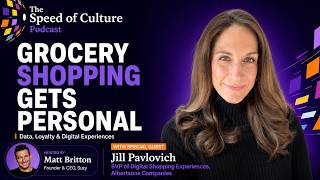
In this Speed of Culture podcast episode, host Matt Britton interviews Jill Pavlovich, SVP of Digital Shopping Experiences at Albertsons Companies. Pavlovich discusses how Albertsons is tackling the massive cognitive load consumers face around food decisions by offering convenient, omnichannel solutions such as fast delivery, shoppable recipes, and digital list tools. She explains how COVID forced a rapid digital transformation, leading to a 20% rise in digital sales across buy‑online‑pick‑up, delivery, and in‑store cart features. The conversation covers Albertsons' loyalty flywheel—digital‑only deals, rewards, and a suite of grocery‑shopping tools that increase stickiness. Pavlovich emphasizes the strategic importance of first‑party data for personalized recommendations, discovery, and increasing switching costs. She describes generative AI use cases, including ingesting user‑submitted recipes to make them instantly shoppable and developing conversational agents that can anticipate shopper needs. The interview also delves into her career trajectory from fashion merchandising to Wayfair and finally Albertsons, highlighting the need for customer obsession, hands‑on experience in stores, and continuous learning. Pavlovich offers advice for young professionals: be curious, work the physical store, understand the omnichannel bridge, and embrace hard work. She closes with a personal mantra about making things better for those who follow, both colleagues and customers.
Chapters
Up today, we're really excited to welcome Jill Pavlovich to the show. Jill is the SVP of Digital Shopping Experiences at Albertsons Companies based in Boston. Jill, it's so great to see you.
Thank you, Matt. Thank you so much for having me on today.
Absolutely. So Albertsons, obviously a huge company, over 2,200 stores, one of the largest food and drug retailers in the United States. When you zoom out just on the current state of the economy and the consumer, what are some of the trends that you have your eye on here in the back half of 2024 that you want to respond to in, in your role?
Yeah, well, you know, we spend so much of our time thinking about the consumer and being a traditional grocery retailer. We've spent a lot of time observing behaviors around food and trends around food and economic impacts on getting access to food. And fun fact, actually, how many times a day do you think the average person thinks about food? 11. That is what everyone says, somewhere between like 6 and 12, right? 256 times a day is what research shows that we think about food.
Whether that's the thing they think about most, or is it sex? Because, well, I read a story that sex is a very high number too.
It probably is. I am not the expert there.
Right, exactly. I'll have to get somebody on from like an adult product to tell me that.
Yes, definitely, definitely. But that's a tremendous amount of cognitive load, right? They're thinking about what their next meal is going to be, what they're going to cook, if they're hungry now, what to have for lunch, how to feed their children, even avoiding food. Right. And so as we think about the trends and economic impacts that, that, that that's having on customers, we think about how to reduce that cognitive load, whether it's payment options like SNAP to make it easier to get access to food, right? Whether it's fast delivery for people who need food in 30 minutes, whether it's free shoppable recipes so that people can cook healthy meals at home, whether it's just the capability to build a digital list and then easily shop the stores. We are focused on all of that and really thinking about what the customer needs and how getting access to food and convenient access to food becomes more and more important. And the way that we're going to surprise and delight our customers is by having the most convenient experience that gives them the food and health wellness items that they need when they need it. And so we obsessively think about the evolution of customer needs on that spectrum.
That's helpful. And I think a lot of what you touched on is, has to do with digital connectivity into the actual physical shopping experience. Omni-channel is a word that's thrown around a lot in your world. Are consumers of the mindset and have adopted habits as such that it's intuitive to them where they, they're logging into your app or they're going on their phone before they go to a grocery store or while or after, because, you know, the old school grocery shopper would never have dreamed of going on their phone and, and right. And, and completing a task before they, or, or, or gaining information before they go into a supermarket. How has that changed over time?
Gosh, well, you know, COVID was a really rough time for us all. But it was also a forcing mechanism for the grocery industry. A once very traditional, non-digitally enabled, with zero omnichannel industry had to go through a digital transformation. At first, it was just, oh my goodness, get people access to food online and do it like now, right? You're already late. So there was just at the beginning of COVID this urgency. How do you even enable e-commerce? What experiences do you have? How do you build first-party capabilities and, you know, do it overnight? And so while COVID was a terrible time, it was also a great moment for the industry to reimagine the customer experience.
Sure.
And to play catch-up, frankly, to the rest of the retail industry. Yeah. And, you know, there was, you know, as we went through that transformation, and frankly, we're still in it, I would say the grocery industry is still scratching the surface, and that we're only getting started with some of the capabilities. But there was a moment as we kind of emerged from COVID and the world opened back up, and people were eating out again, and We were like, oh, is e-commerce over for the grocery industry? We have not seen that. In fact, we've seen at Albertsons adoption of our digital properties and digital capabilities rapidly increase. And as we reported in our recent earnings, we're seeing digital sales up over 20%.
Is that buy online, pick up in store, or is that delivery?
It's a combination buy online, pick up in store, and delivery as well. We're just getting started. People, they try it, they realize what a massive time savings it is. They realize that the prices that Albertsons offers online are the exact same as the prices they offer in store. So they're only getting more for their, their money. The product offerings are the same. We have tools and capabilities that make it easy for them to find what they're looking for, like Quick Start Cart and Buy It Again, that accounts for both their in-store shopping trips as well as their digital shopping trips. So we're bringing that all together for them so they can build a basket in just clicks.
Yeah. And I think what a lot of people don't realize is that millennials, which is the first generation to grow up with the internet in the household, right? The, the first generation of digital natives, so to speak, you know, they are right now, the youngest millennials are actually as old as 30 years old right now. And the oldest millennial is as old as 45. So that's your core head of household shopper. That is now millennial. That's right. And that was not the case 10 years ago when your core head of household shopper was a Gen Xer who did not grow up with the internet in the household. So I think part of it is just the demographic shift and the mindset and makeup of your core shopper where they have an expectation and a better intuitive understanding of this type of technology.
That's totally right. They do. But that sometimes makes a, an industry who is behind in technology have a bigger gap to fill to catch up. Yeah, that's right. Expectations. They've been shopping online for as long as they can remember. Everything else they purchase in their subscriptions and everything else is already online, right? So they, they already know what they expect, right? And you have to meet that and meet them where they are. So it gave— it made us take it even a more giant leap than where a lot of other industries got to start and grow up them, we had to just jump ahead and catch up to them.
Yeah, for sure. And how price sensitive is the Albertson shopper and how much does price play a central role in your, in your overall messaging?
Every customer is price sensitive. Every customer wants a good, what I would call value, regardless of economic status, regardless of where they're shopping. Did they get good value, whether that is a discount on the deal, a great service with a good product, bulk for a reasonable price, bulk assortment for a reasonable price. It's extremely important. And even the higher income households are becoming more and more price sensitive.
Yeah, I'm sure. And, and obviously a big part of you driving your business is maintaining your customer base and not having to find new ones, just like any other business. So loyalty plays a huge role, and loyalty, I imagine, plays a huge role in your job in terms of shopping experiences because you want to make sure that people are enjoying the experience and coming back over and over again. What are some of the tactics that you found successful at building that loyalty amongst your customer base?
Yeah, well, you know, you mentioned deals and price sensitivity. Deals for our loyal shoppers, right? When you sign up with an account, whether that's just putting in your phone number or downloading the app, You get access to all of your local stores' deals. You get access to digital-only deals. For each purchase, you earn rewards that you can redeem for cash off of your next order. All of this creates that loyalty flywheel. And then when you have capabilities in those digital properties, like the ability to build a list and push it to cart, or when you mistakenly build a cart and now you're going to go to the store and push that to list, and organize that list by aisle or open in-store mode and easily shop, right? Or get access to over 8,000 proprietary chef-created recipes that are shoppable with a button. Like, you can literally plan a week's worth of recipes in under 4 minutes for a family of 4 to 6. And things like budget mode on the recipes. So, well, you know, we can tailor the ingredients and that we match to the recipe or the products that we match to the recipe ingredients based on your budget needs. Then when you start to experience all of these convenience tools, this Swiss Army knife of grocery tools, that, that really amplifies that loyalty flywheel because they're coming, they have deals, they have rewards, they have ways to save money, earn points to put to their next grocery. Shop and all these convenience features that helps them shop the way they need to shop at that particular moment in time.
Yeah, for sure. And, and obviously first-party data is so incredibly important right now in this marketplace. And so many brands that don't sell direct to the consumer are struggling in a world where, you know, we are entering a cookieless world, though Google recently backtracked a little bit from that. So how important is first-party data and what are some of the ways that you guys are mining this data to be more contextually relevant to your customer base? Because, you know, I would think that all Albertsons customers aren't created equal and you have different segmentation within that. So how are you looking at first-party data and its growing importance over time?
Yeah, well, the first thing is the customer's data is the customer's data, and we use that and we protect our customers deeply. And we use that to give them their individualized experience, right? Customers shop for groceries every week, some customers more than once a week, right? But the frequency of those transactions gives us an opportunity through that data to make those shopping journeys seamless and easy for the customer, right? Buy it again. All of that, everything they bought in their last—
Right.
Available for them to add today. Helpful recommendations where we know that you buy bananas every week and you forgot to add them. Did you forget to add? Right. Helpful recommendations across the journey as well as helping discovery. Something that we're constantly told by our customers is like discovering newness or those impulse purchases is hard online. Customers often like to walk the stores to see new products or what the outpost stores— outposts are, or what new fruit they might like to try depending on the types of shopper they are. And so understanding what they've tried and liked in the past allows us to make that moment of discovery, find a new brand, see a limited edition Star Wars Oreo, right? We can proactively expose that to customers when we know that that's the type of shopping that they like to do, that they like to be inspired and they like to discover versus a transactional shopper that's like, I have my list, I know what's on sale, I just want to get that and get out. We can also cater to that customer as well.
That's interesting because, you know, as you speak, it dawns on me that like by doing this, you're really increasing the switching costs for the customer. Right? Because the more you know about them, the better of an experience you can give them over time. And we'll talk about some new technological advancements in a second, but over time, you basically know your customer and it's so hard for them to go somewhere else where the store doesn't know the customer. So why wouldn't they stay with you? And by you driving things like discovery, you're driving a higher basket size for your customer, which drives our ROI along the way.
Totally, totally.
Yeah, absolutely.
You know, if we do right by our customers, they, they don't want to leave, right? And then we have to lean in on the convenience. We have to lean in on the product selection. We have to lean in on non-food necessarily, like, right? We have to make sure that we have their favorite toothpaste, the paper towels that they want. We have to offer programs that are compelling against certain competitors. That make convenience easy with subscription programs, right? So Albertsons actually has our subscription program for customers where they can put 60% of their basket if they want on autopilot, because we do see that customers' orders week over week, 60% of the items are the same.
Well, so, so a lot of what you're talking about obviously depends on technology that you can deploy. And obviously we're in a world here in 2024 where AI is the key buzzword. How has the evolution of the tools that you can tap into as a marketer change and got more sophisticated over time? And where do you think those tools are going to potentially unlock new capabilities for someone like yourself on behalf of Albertsons?
Oh gosh. Well, I mean, the rate at which technology is evolving has never been faster. It, it can almost like make your brain spin sometimes.
Yes.
But certain things that we've really found inspiring for our customers and things that we weren't able to do before something like generative AI came onto the scene was ingest our customers' recipes. So one of the things they've always told us is, gosh, I love shopping these recipes. It makes my life so easy, but I have a bunch of my own. How can you make those shoppable? And we were like, hmm, how can we make those shoppable? Well, you know, at the intersection leveraging GenAI and a few other technologies, we're actually able to ingest customer recipes, whether they, they upload a picture into their private app. That's like, um, upload manual, or they input a URL. We can ingest that recipe, make sense of it, right? Match it back to our product catalog and make it instantly shoppable for them, essentially creating their own digital recipe book. So these are moments, yeah, okay. Cognitive load. Yeah, like they've like got like some recipes, they've got all their browsers saved. They've like some recipes in old traditional cookbooks. I've got cards from my grandmother for the Vigilia, her pierogi recipes. Like, can we bring that all together for customers? Before, so cool, couldn't. Now we can. You ask me like where I think it's going? No idea. But I do think, you know, there's a lot of productivity gains for businesses. That I think is going to be the— continue to be a major unlock with this new generative AI technology. And where it's going for customers, I'm really intrigued by the agent capabilities, not just a standard chatbot, but agents that are smart and intuitive and conversational that can actually change a conversation with a customer from, "Hey, I need items XYZ," to, You know, what do you want to eat? We'll, we'll populate the items for you.
Yeah. I mean, I mean, I think people could have their own digital Albertson shopper over time. They're, they're Albertson's digital agent. And then you're putting this in, it has your historical information, but it knows information about your family and maybe it knows it has access to your calendar and it knows you're traveling over the month of August. So you don't need as much of certain things because you don't want them to spoil. But over time, the more it knows about you, then, oh, and I think that's the opportunity for brands with AI is if you gain enough trust with the customer where they're connecting third-party data inputs, whether it be their calendar or their budget or, or yeah, or their recipes, right? That's a starting point, right? The more and more of that that you can get, you're essentially building a brain, like an LLM that's dedicated to a customer and the agent activates on that LLM and basically starts to make recommendations and then takes away all the cognitive load, right? That's, that's ultimately where we— it's scary, but it's also so— it, it adds so much value to the customer because the one thing we all need more of is time, right?
Oh, we all need time, right? And Albertson's mission is to bring people together around the joys of food and inspire well-being, and the only way you can do that is by giving people back time.
Yeah, absolutely. So let's talk a little bit about you and your career. So before Albertsons. You spent 6 years at Wayfair, which obviously wasn't e-commerce darling, especially during the pandemic. And I see you were there during the pandemic. Oh yes. Yeah, a very impactful business in terms of the evolution of e-commerce. And now, you know, you're in your 4th year at Albertsons. What have you done across your career before that at Periellis? And, you know, how have you managed to stay relevant in your career keep your finger on the pulse of where things are going. Obviously, we're just talking about all these technological advancements, and you have to have a certain level of savviness in that area as well. So talk to me about how, how you spend time developing yourself.
Yeah, well, you know, I grew up in traditional fashion merchandising and design, working for, uh, you know, traditional fashion houses like Calvin Klein and Perry Ellis. Donna Karan. Um, and I actually thought I'd always be in fashion, right? I thought I would always be a merchandiser, designer. Uh, it taught me amazing business rigor. It taught me absolute customer obsession, because when you are merchandising and designing, let's say, a set of swimwear, you have 6 weeks to sell it. You have like 5 square feet of physical retail space. You get 3 styles, 3 tops, 3 bottoms, 6 total. And it was an extra long winter and coats aren't off the floor yet. There is no stress like that. And there is no customer obsession that can be learned better than something like that because you have to get it right. You do not have a window to not get it right. Taught me the business rigor, but it also taught me the customer obsession rigor, truly unpacking the trends, not just that blue is trending. Well, what about the blue? And why blue?
Right.
How do you—
the why behind the what?
Yeah, right. Blue to attract a customer from 5 feet away when you only have 5 seconds to capture your— their attention on a huge department store floor. Um, and so I— that was just great training. And, you know, as I came up through that industry, in those positions, I was watching like kind of the slow— some may call it a demise, some may call it a change, some may call it an evolution of department stores, right? Traditional retail was massively changing. Flash sales were the big thing. Everything was moving online.
Fast fashion.
Fast fashion was evolving. That's right. H&M, Zara, all of that was hitting the scene. And I knew deep down that I had to evolve. Like, I couldn't be in this industry whether I wanted to stay in fashion or move to another one without deeply understanding technology and e-commerce. And I was selling product at the time to like Macy's.com. Of course, I was considered a door at Macy's or Nordstrom or any of the traditional retailers. But then that was the extent of my e-commerce experience. And so, I set out on a journey at the end of 2014 to start over. I essentially thought I needed to start over. Read everything I could on technology, had no idea what I would do for a tech company. And like the stars aligned and I met folks from Wayfair. And they were at a really interesting intersection in their journey as well, where they had at the time, I think their slogan was actually a zillion things home. They had done a great job at curating all of the suppliers, right? But they needed help merchandising. That's the one thing I knew how to do, how to take this, you know, 3 million product options and organize the catalog, not by supplier that nobody knew, but by style and price point. Right? And so, I joined Wayfair, and that is where I got my crash course in technology. Amazing company, by the way. Yes, it was a darling. It will always be a darling in my heart. They taught me everything. And they gave me so much leeway to do product management. I think I even wrote a line of code at one point, first and only line. I ran a business called exclusive brands. I got to develop over 100 brands, you know, and trademark them, create curation tools and product technology, and reorganize the catalog and the taxonomy and help people shop for furniture online. It was an amazing, amazing experience and just an amazing learning opportunity. And I got to build a team from scratch, which, as, you know, an emerging leader, you led teams, and I had led teams in the past, and I was put into specific roles that had teams. But here at Wafer, I was, you know, end of one, and then I got to—
way more entrepreneurial, right?
Yeah, it was much more entrepreneurial, and I got to build a team over time based on how the customer responded to what we did, right? And so by the end of my career there, I was running, um, what we call our exclusive brands, um, program, and it was just the most amazing opportunity. And then I took everything that I learned there and all of my traditional fashion merchandising and design and brought it to my next role here at Albertsons to help them on their digital transformation and really begin to reimagine that customer experience.
And how much of your evolution over time— you talked about you wrote a single line of code, maybe you'll write more one day, you never know. Never know. But how much of your time are you— Exactly. You never know. How much time are you spending actually hands on keyboard with some of these tools and customer experience and data analysis, et cetera? Or are you leaving that to the agencies and the people that work for you and you more just playing more of a strategic role?
No, both. I would say hands on a lot of keyboards right now. Not, not, not coding, but there are programs that I still act as a product manager for, right? And I am a, Maybe I would call myself a manager doer, perhaps. Yeah, I really like to understand what's happening in the experience. I spend all of my time here on this guy, checking out all of our variety of apps every single day. If there's an issue, I'm probably the one that's going to find it.
Exactly. Exactly. So, and you mentioned, you mentioned kind of running a team. At Wayfair. In your opinion, moving forward, if, if, if there's a young professional that wants to come in and, and be in your seat one day, what are some of the areas do you think they should be focusing on, particularly earlier in their career to set them up for long-term success in the digital marketing space?
Gosh. Well, I'm, I, you know, I, I would call myself maybe an expert in customer experiences and maybe not even an expert. I just have a passion for them. Definitely not an expert in digital marketing per se, but somebody who wants to be on the customer-facing side, whether that's marketing or product development, building the technology and working with the engineering team that's doing the code, um, or leading a team of, you know, uh, business professionals who are bringing the go-to-market strategy for new products and services to life, you know. Any of those roles, I think you just have to have a passion for the customer and you have to be willing to do whatever it takes to understand the customer. For, in my role, you know, I've been in digital for a long time now, like getting out from behind the computer. If you're doing digital experiences, go in stores. And I don't just mean visit stores, work in them, shop them, cut meat behind the deli counter if you're in traditional retail or traditional grocery retail. If you're, you know, in fashion, like, go work the stores, learn the customer and associate experience from that end. It'll make you better and vice versa, right? If you're working in stores, spend a lot of time on the digital properties to truly understand how customers see their bridge in the omnichannel experience as they flip-flop back and forth between in-store and online shopping. So I think The best thing anybody who wants one of these types of roles can do is be super customer obsessed, right? We think there are problems, we can imagine solutions, we put them out in the market, and customers don't use them. Why? Because it didn't actually solve their problem or their need, right? And so, that's why I go back to when somebody on my team asked me, you know, "What can I do? What should I be focused on?" Like, 226 times a day, customers are thinking about food? How do we help them 226 times a day? And when you start to orient your thinking, whether regardless of what industry you're in, around those customer problems, just changes the way you see developing the customer experience.
Yeah, that's a fascinating stat. And I, I think throughout our conversation, it's clear that You're really just focused on, you know, what you call cognitive load. I haven't heard that term before relative to your role and what you do, but it makes so much sense because ultimately it's about mindshare and about making the customer's life easier. And that sounds like really what you're trying to accomplish. And it makes so much sense. And the other thing, you know, observation I have in terms of how you answered the question of how young people should repair is, and we hear this a lot, is they need to be curious. They need to really want to know what the customer thinks, how they shop, how they experience your stores, etc.
Yeah. And I think like the other thing and there's just like I'm going to sound so old when I say this, I'm going to say it anyway. There is no shortcut for hard work, right? There is no shortcut to the top. There is no fast track without hard work. Right. And some of the other thing I always tell people is you might want a different job. You might feel that you are aspiring to be above where you are, but the only way you can get above where you are or past where you are today is to kill the job you have. You have to crush it, right? That's how you fast-track yourself. And remember that no job, as you're learning, is below you, right? Do them all and do them all well because you will be a better, um, I don't want to call employee, right? You'll be better at whatever it is that you're doing. You will be a better leader because you've done all the jobs and you yourself will be better and have more knowledge because you've done all the jobs.
Absolutely. Yeah. I think a lot of people in this Instagram-obsessed age are just not patient. Uh, they lack patience, you know, because they, they see everybody else who they think is doing better than them because of that. They're looking ahead and to your point, not focusing on the job in front of them and just crushing that job in front of them, which really will set them up for the future, not only accelerating their path to go to higher levels, but also the learning you get by doing it. Actually doing the work is really what's going to set you up for throughout your career, which is clear that that has been the case for you. So, um, to wrap up here, Jill, and this has been such a great discussion, we'd love to hear if you have a quote or mantra that you like to live by? You seem like such a thoughtful person. I just want to know if anything comes to mind there.
I do.
I do.
I always tell people that I'm here to make it better for those that come behind me, whether that's being a working mom in the workforce, right? Whether that's being a female leader, whether that's just being a digital leader or an old-fashioned merchandiser who made the transition into digital, whatever that means. To the individual that I'm either leading or mentoring, my stamp is to make it better and easier for those that come behind. And I also apply that to customers, right? Like everything that we do, every customer that comes and experiences that as we continue to progress, they should have a better, more robust, more personalized experience.
I love that. Well, I wanna thank you so much for sharing your thoughts and your wisdom today on Speed of Culture podcast. Thank you. It's so great. And to, in all honesty, I definitely wanna check out Albert's dozens now. I, it's maybe just not in my region where I live, but I want to see this experience come to life. So you would have—
as a customer, I think you'd have to leave New York City. I know, I know.
Exactly.
But you— there are King's and Balducci's, I believe, in your, you know, stratosphere.
Yeah. Well, I'm going to hit it up and I'm going to get back to you and let you know what I think. So, uh, but I really appreciate, uh, you sharing everything with us, and I can't wait for our audience to hear it. On behalf of Suzy and Adweekine, thanks again to Jill Pavlovich, SVP of Digital Shopping Experience at Albertsons Companies, for joining us today. Be sure to subscribe, rate, review the Speed to Culture podcast on your favorite podcast platform. Till next time, see you soon, everyone. Take care.
More from Matt




MikMak’s Rachel Tipograph on Consumer Spending, Retail Media & Holiday Shopping Trends



Jaguar Land Rover’s Charlotte Blank on Luxury, Purpose & Experiential Storytelling



