Allegiant’s Scott DeAngelo on Leisure Travel, Live Events & Brand Growth
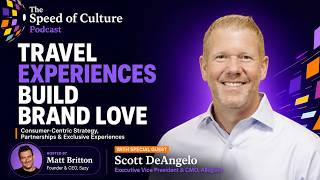
In this Speed of Culture podcast episode, host Matt Britton interviews Scott DeAngelo, Executive Vice President and Chief Marketing Officer of Allegiant Travel Company. DeAngelo shares his unconventional career path—from journalism and economics studies to consulting and data‑driven marketing—highlighting how his blend of creative and analytical skills shaped his approach. He explains Allegiant’s ultra‑low‑cost carrier model that focuses on nonstop flights to underserved midsize markets and a direct‑to‑consumer strategy that gives the airline exclusive first‑party data. Leveraging that data, Allegiant positions itself as the “nonstop life” brand, emphasizing low price and nonstop service, and expands its reach through high‑visibility partnerships: naming rights to Allegiant Stadium, Super Bowl 58 activations, and a branded EDC (Electronic Daisy Carnival) aircraft. DeAngelo details how these sponsorships are treated as fixed‑cost, long‑term assets that drive awareness without incremental spend, and how real‑time traffic spikes from events are measured to assess ROI. He also discusses the Sunseeker Resort project in Southwest Florida, describing it as a vertically integrated “Amazon of travel” that captures the full economics of the leisure journey—from flight to lodging, food, and entertainment—while diversifying the company’s revenue. The conversation turns to post‑pandemic consumer behavior, noting a resurgence in experience‑driven spending despite economic headwinds, and how Allegiant’s data‑rich model captures that demand. Finally, DeAngelo offers career advice, emphasizing cross‑functional experience, staying true to one’s personality, and mentoring younger talent.
Chapters
Up today, we're gonna be speaking with Scott D'Angelo, Executive Vice President and Chief Marketing Officer at Allegiant Travel Company. Scott has more than 20 years of data-driven strategic marketing, finance, and product leadership experience in both consumer-focused and B2B environments. Scott, so great to see you. How you doing today?
Very good. It's great to be here. Thank you.
Yeah, absolutely. Really excited to have you, um, on the show today and really excited to hear about some of the things that you're working on at Allegiant. But just to start off, Can you tell us a little bit about your background and kind of how you ended up in the fun world of marketing?
You bet. So I started off my career thinking I wanted to be a sportscaster or an evening news anchor and quickly got weeded out. Went to the University of Southern California as a broadcast journalism major and realized you didn't just get a degree and go on the primetime evening news. And very quickly picked up a second major, economics. So graduated with both a journalism and economics major. And those really became, right, kind of the two parts of marketing, right? The creative side, but it's also the analytics side and understanding how marketplaces work. The economy was terrible. There was no jobs to be had, right, when I graduated. So went immediately to grad school at Northwestern where they had a new and emerging program, Integrated Marketing Communications, that was all about data-driven marketing. What we called database marketing at the time, but what we refer to as kind of data science personalization now. And that's really what got me on my way. I started off at McKinsey Company, so a big strategy consulting firm that we did a lot of different things for a lot of different industries, but a lot around marketing strategy and kind of played a little hopscotch in between, you know, industries like the gaming industry, the payments technology industry, obviously now the airline and travel industry, as well as some other consulting gigs in between. So I've done a little bit of everything in and around the areas of marketing, data, and technology.
And throughout your career, how have you been able to sort of keep your finger on the pulse of how things have been changing, not only with the consumer, but with kind of like technology within the marketing and media space as well? Because I know a lot of people kind of can get lost along the way with all the changes and quickly find themselves sort of out of touch.
Yeah, you know, I'll, I'll answer both questions by starting with the answer to the first question. That is keeping your finger on the pulse of your customers, right? We do weekly tracking surveys. We started these during the pandemic to really understand how people were thinking about it, what their plans were and what they were or weren't doing, what they were fearful of, what they were excited about. And being a longitudinal study here, 3+ years later, We still do it. Yes, we ask still some questions about, you know, the state of health, but now a lot of it shifted to the economy and other things like that. And so that's how, you know, we constantly keep in track with our consumers. And by the way, in between, we're constantly fielding one-off short surveys, right? Even if they're not 100% accurate, if they can give us, you know, is 90% or 10% of our customer base into or not into something that we're about to try, it helps steer us in the right direction. And when it comes to technology, you know, we do largely the same thing, right? We certainly want to understand what our consumers are adopting, etc. Or if it's a case of technology that we're leveraging, we want to make sure it's providing some benefit, it's helping do something that improves that customer experience, not because we think it will, but because our customers tell us it will.
Yeah, absolutely. I think, you know, obviously being able to roll with the punches and understand what your consumers are saying, especially over the last couple years, and we'll get into what you've experienced in the travel space, but, you know, we haven't really had a time in history like we've had over the last couple years, kind of the slingshot effect that we've gone through, and I know the travel industry has been disproportionately impacted. So with that, you know, you joined Allegiant Travel Company 5 years ago. What drew you to this opportunity? And for those of our listeners that aren't familiar with what Allegiant does, it'd be great to hear a little bit about the company.
You bet. So we'll start there. So Allegiant Travel Company, right, at its heart is an ultra-low-cost carrier airline, um, but it's very different than any other airline in a variety of respects. First off, we started Allegiant so the one person who couldn't travel could, and that meant We went to small and mid-sized cities that were either unserved or underserved by traditional airlines, specifically when it comes to nonstop flights. All of our flights are nonstop. There's no connections. And for places throughout the country, but in Montana and South Dakota, small cities throughout the Midwest, the Southeast, we are the airline that can fly them nonstop to world-class domestic destinations like Las Vegas, like Orlando, Nashville, Austin. And so it was built around that. One of the other key things was we sell only direct-to-consumer, so you have to come to Allegiant.com. Well, that was done for cost reasons originally, 20 years ago when the company was founded. Now it's super cool because that means we own the relationship with everybody.
All the first-party data, right? So no, no, no Expedia, no Travelocity, no Kayak.
If you want to buy on Allegiant, you have to go to your website. That's right. And what that's done is enable us to build a robust database with great information. Because say, unlike a 20% offer you get on your first purchase at a retailer where you might give them a, a tertiary or even a fake email address to get an offer code, when it comes to AirlinesRight, your data has to be right. Number one, because you're gonna be checking it against an ID. And number two, you sure as heck want to get your itinerary and your check-in information to your most used email box. And so what that's enabled us to do is, it turns out, when it comes to leisure travel, which is pretty much, you know, all we focus on serving, 85% of the time customers book air as the first part of their leisure travel experience. That means 8.5 out of 10 times we know where they're going before anyone else, and that gives us pole position to now sell them a hotel, a rental car, you know, tickets to events. And that's really what drove me there, was we were building what we internally refer to as the Amazon of travel, which was an entire leisure travel ecosystem. And that was more of a technology and a data play than, say, a traditional marketing or brand. And that was my background. And having the ability to, you know, help build this, um, has far and away been the highlight of my career.
Absolutely. So let's talk about some of the things you are doing to build it. So I'd imagine, you know, joining as chief marketing officer, one of the first things you want to do is sort of establish the brand equity pillars in terms of what makes Allegiant different. So how are you looking at the Allegiant brand relative to the competitors in the crowded, you know, airline travel space?
Yeah. So, you know, let's talk about a different kind of research that helped inform this one. And that was general population research. So, you know, largely non-allegiant customers. And we, we asked them, you know, what are the most important factors that go into you selecting your airline for leisure travel? No surprise, number 1 was price, number 2 was non-stop flight, distant third was schedule, and then you have all the other amenities somewhere after that. But then they were asked, thinking about your preferred airline, whatever airline that is, how well does that airline deliver on what you just said was the most important? Right. And the answer was the two things that we stood for, low cost, all nonstop flights, sat there in that quadrant that was, it's very important to us, but other airlines aren't performing well on this. So that told us that was the ownable space for us because we were uniquely capable of delivering on that. Given our business model. And so we wrapped that up into a brand that we refer to as living the nonstop life. And of course, that has a little literal double entendre allusion to— yeah, but it also means, hey, you know, it's not just about flying places, it's attending live sporting events and concerts, specifically those at Allegiant Stadium here in Las Vegas, but also venues nationwide. And so That was really kind of how we established what we stood for and what we believed in.
So, you know, after you establish the brand and, you know, the things that make it different, obviously the next step is getting that message out and building the brand. You mentioned Allegiant Stadium, which is frankly the first time I'd really become familiar with the brand. So it worked with me. I was there for a Philadelphia Eagles game, which we lost to the Las Vegas Raiders a couple of years ago. But the stadium is incredible. For those who haven't visited, it's like a spaceship in the middle of the desert. But so first of all, let's talk about that and then maybe some other things that you're doing to continue to build, which is definitely a fast-growing, you know, brand in the space.
Yeah, no, thank you. Yeah, so Allegiant Stadium presented, you know, obviously a once-in-a-generation opportunity for us to not only have our brand get exposure like only the NFL can deliver, some 88 of the top 100 broadcasts last year were in— incredible. Yeah, it's insane. Um, but we, you know, there's a couple things here. So the first was one of the ironies to me was when it came to stadium naming rights, the only thing that everyone could agree on was that they can help with awareness, right? The benefits beyond that people will dispute. But ironically, most stadiums up until the time that we and SoFi and now Paycor, where I have friends out in Cincinnati. Up until that time, almost all of the stadiums, save for your Philadelphia Eagles, they have a local hometown financial company that sponsors that. But where, you know, MetLife, AT&T, Mercedes-Benz, they were brands that I knew about when I was a kid, right? So they were more vanity plays. And what we knew was, gosh, this is a platform to help brands like ours gain exposure to folks like you that live in large markets that honestly are cost prohibitive to advertise in, but which we can penetrate on Sunday Night Football, Monday Night Football. But there was one other thing that was important about Allegiant Stadium. You know, any stadium naming rights deal can be a big billboard, but travel we knew was going to be— as I told Wall Street, the Raiders playing in Allegiant Stadium in Las Vegas will be the team and the venue that relies more on air travel than any team or venue in the history of sports. Absolutely. And, you know, it's obviously because Raider Nation hails from Northern, Southern California, the rest of the West, but also because the visiting teams, just as you noted, no surprise when the NFL asked fans, you know, which city would you be most likely to take a road trip to follow your team? Barnabás, yeah. Barnabás, home of the Bulls, was Las Vegas. And so it was a way to contextually have relevant brand awareness because the data's in, you know, at any given game, nearly two-thirds or more, or concert, by the way, two-thirds or more of attendees in that stadium have come from outside the Southern Nevada area, and some 60 to 70% of those flew in. Whether it's Taylor Swift or whether it's Raiders-Eagles, you know, in the end, we're able to play a role in helping bring folks to that stadium. And so, you know, now here in town, we set out to perceptually own it, right? Everyone can kind of get that it's a naming rights play. But, you know, MetLife is in the life insurance business. You know, Mercedes makes cars and AT&T sells wireless and other. But when it comes to Allegiant Stadium, people oftentimes confused, like, wait, do you own the stadium? Because I see you're selling packages on your website for tickets, air, and this and that. And the answer, of course, is no. But creating kind of, as a leisure travel company, having a venue with our name on it that we're able to convey and sell and treat as though it was our own you know, asset, um, has what's created like a super valuable naming rights agreement with our great partners, uh, at the Raiders and Allegiant Stadium.
Yeah, and speaking of the word super, of course I'm sure you guys are not mad at the fact that Super Bowl 58 this upcoming February will be held at Allegiant Stadium. So I'm sure your brand is super excited about that, and I'm sure you're already thinking about ways that you're going to be activating upon that, I assume.
100%. So, you know, this year really is just, uh, a coronation. Our first home game, Sunday Night Football versus the Steelers, second home game Monday night versus the Packers. And what a way to bookend it with, you know, brand name, huge, well-traveled fan bases to come on in and to finish it with the biggest celebration in all of American sports, the Super Bowl and Super Bowl 58. And yes, we, we pride ourselves in affordable and accessible, you know, travel for all. And so plenty of promotions, giving people the opportunity to win Super Bowl tickets to Super Bowl 58. At Allegiant Stadium here in Las Vegas.
Awesome. I'll look for mine in the mail too. Absolutely. So I also saw, by the way, that you're doing also some activations and some passion points beyond sports. Just this week it was announced that you're going to have an EDC-branded Allegiant airplane. EDC, for those who don't know, stands for Electronic Daisy Carnival, which is one of the biggest live music festivals in the world. In Las Vegas, it occurs around electronic dance music. What inspired that? Because I just thought that was a super cool idea and one that frankly I was surprised no one had executed on sooner.
Yeah, so we, we have a, uh, a large partnership also with Live Nation and Ticketmaster. Yeah. Um, and that has us in, you know, venues nationwide, um, as well as across their entire digital ecosystem. And one of their companies they own, Insomniac, who puts on EDC here in Las Vegas and Orlando Great partners, always looking to do creative things. So why not make a rave plane? For those who may listen and attending, there's also the Allegiant Rave Hangar. So amongst all the spectacle, there's a special activation space where you have DJs, you know, playing within a more intimate environment, you know, with the bar and that kind of indoor setup. So lots of fun things, but really We want to weave ourselves into the fabric of leisure. We don't glamorize, right, the inside-the-tube travel experience. You need to get there as safely, as quickly, and as cheaply as possible. We embrace that. And what we look to do is recognize that the most important part of your leisure trip is whoever or whatever is on the other side. Yeah. Of you when your wheels down. And we want to be associated with those things. We talked about the stadium, world-class live sports and mega concerts, but the same thing in the live music industry with venues and festivals nationwide.
Yeah, and it's, it's interesting because for those that are listening, you hear about sponsoring a stadium and doing, you know, activations around concert festivals and you think, oh, this company is not really spending money efficiently. Yet Allegiant is actually one of the most profitable airlines in the world. So I would imagine all of these decisions have a lot of data and ongoing measurement behind it to make sure that you're gaining an ROI. So how, how are you looking at that and what does that process look like?
Absolutely. Because we're direct to customer, right? Let's take a Sunday night game. As soon as Carrie Underwood's done with the Sunday night anthem and they show that stadium, right, we can see and measure that spike in traffic to Allegiant.com, whether it's coming directly through organic search or otherwise. And overall, to your point, I'm glad you made it, is the stadium itself, it's a fixed cost. And what's great about it is as we continue to expand to new cities, add new routes, and people continue to get more and more exposed to the brand through the stadium, I'm paying no more year 1 than I am year 20, right? It's a straight line. So in fact, it's a very efficient spend because as we've continued to grow in record-setting fashion revenue-wise these last 2 years coming out of the pandemic, it actually is a smaller proportion and I don't have to call it linearly spend, you know, to get more customers. So in fact, it does heavy lifting that otherwise we would have to be spending like, you know, world-class advertisers like GEICO or State Farm or Progressive. To continue to keep that volume up. But instead, we have a set amount of money that's for, you know, decades-long partnership that will continue every time those lights go on or that major Taylor Swift or Beyoncé or BTS concerts announced bring Allegiant back into the, you know, the foreground. And we don't pay any extra for that. So, you know, when you think about it that way, you realize, wow, You know, this is something that will continue to drive awareness nationwide, worldwide in some cases, even though we don't serve outside the nation yet. And it does so, you know, on a fixed basis. So it's a highly profitable, you know, when you get a venue like this or when you have an arrangement like the ones that, that we've constructed, it reduces the reliance on advertising. And, you know, the one point I always like to make there is You know, as humans, as we continue to increasingly delete traditional advertising from our lives, the most potent way for your brand to be seen and be relevant is to be interwoven with the things that people care about. Absolutely. And while there's a lot of those things, live music and entertainers as well as live sports happen to be two of the biggest that I can think of, and we're seeing that with our customer base.—
and only growing in popularity. And I mean, and you're right, you, you look at the data in terms of the power that the NFL has on the media world, and it's astounding where 88 of the top 100 shows watched live across both male and female viewers is the National Football League. So the power it commands is really evidenced by Google's recent deal. Google TV took over the Sunday Ticket— YouTube TV, rather. It just kind of exemplifies that. So I completely am in agreement with the strategy. In terms of another thing I, I, I just recently uncovered when we were doing research for this episode is that Allegiant is expanding the business to building a world-class resort in Southwest Florida. I can't remember another time I heard that an airline was actually building a resort. So what's behind that idea? What's your role in it? And, and why is that something that you guys are bullish on as a company?
You bet. So, um, the, the resort, Sunseeker Resort Charlotte Harbor, will open in October of this year. It's down in Southwest Florida at Punta Gorda. It turns out Punta Gorda is one of our largest markets that we fly into. In fact, only we serve the airport, PGD, down there. It's about 30-45 minutes from Sarasota, an hour-ish from Tampa, just to give folks an idea. And it was the brainchild of our CEO, John Redmond, who was former CEO of MGM Resorts and was brought on specifically to help us expand into a business that's, you know, not only more profitable than the airline industry but also commands way greater multiples from the market. I mean, sure, way greater multiples from the market, up to 15 times for some of the, the recent, you know, world-class resorts like Cosmopolitan here, which was recently sold, and The Venetian and Palazzo, the Sands properties. So it was all about broadening and diversifying our portfolio in areas that drive greater margin and greater value put on that margin. The other rationale was it's not unlike Kirkland's brand at Costco or AmazonBasics at Amazon, right? Not every product have they decided to do that, but at some point, people have checked out with enough of a given product, whether that's batteries at Costco or paper towels at Amazon. They said, you know, it makes it worth it for us to control the economics now and not just be flying a bunch of people in here to go stay at Ritz-Carlton or JW Marriott or any others, but to be able to provide that world-class experience and to capture the entire economics of air travel, which typically about 5% of a leisure travel budget versus the resort stay. And here's the kicker: the 20 food and beverage outlets that are all fully owned that will be featured throughout Sunseeker Resort. It'll have the biggest in-ground pool in Florida, and yes, that includes Disney properties as well. It'll have a rooftop pool— think infinity pool off, you know, the roof, seeing sunset, sunrise over Charlotte Harbor. And literally food and beverage galore, from fine dining to world-class food halls to tiki bars, sports bar, um, and all of that is, is fully owned by Allegiant. And why that's important is because while this one we built from the ground up, that gives us the ability now to take our loyalty program, Always Rewards, and our Always Rewards co-brand credit card And along with the Sunseeker brand and the brands of these restaurants, be able to go buy other properties, rebrand them, let someone else operate them, and just in an asset-light fashion, right? Take your management fee, take your marketing fees, have a loyalty program and an airline that can help fill them. Um, so we're really excited, yes, for the opening of this one, but what it's going to enable us to do throughout the country as there's other resorts out there that we can then acquire, uh, rebrand and have as part of the EliteGen travel company ecosystem.
Yeah, I mean, in many ways, you know, you talk about— we talk about tech innovation earlier. It's— you're building a vertically integrated solution much like Apple did, where Apple builds the software and they have the hardware, and because of that, they're able to really create magic for the consumer. It's, it's much like the physical version of that, where, you know, you're controlling the experience from the second somebody gets to to the airport to the second they return, and including everything, you know, the food and beverages and the entertainment and everything. And I think it's a really interesting model. And it's something that, you know, again, I was surprised that when you think about the other companies in travel have not kind of gone into, and then, you know, that combined with the fact that people are starting their travel with their flights, which is true largely because you wanna make sure that you can afford the flight and the times align and you're not gonna have to have 3 stops on the way there, you are basically controlling that consumer journey from the onset.
You know, and to that end, a large part of the other 15%, the only time you don't book your flight first is when you need tickets to an NFL game or a music festival, and hence the partnership there to even cover off on that one. You know, the ability to come to our site and earn your rewards points by booking, you know, ticketed events, um, helps us cover both sides of both the majority And even that very important minority that's like, I don't need a flight if I can't be assured that I'm gonna get tickets to the game or the concert or the festival. And we're trying to cover all of it, just as you said. Very cool.
So switching gears a little bit in terms of the consumer and just travel trends in general, you know, I've read so many stories that this is gonna be the first summer of the $1,000 concert. You had the Taylor Swift tour and the Beyoncé tour going out this summer. Consumers are definitely in a post-pandemic world right now where we're spending in droves. Every flight I've been on over the last 3 to 6 months have been completely sold out. What type of demand are you seeing from the consumer and how does that play in with some of the broader economic headwinds that we're seeing at the same time where we're hearing about softness and record low savings and high debt for consumers? How do you see it all playing out?
You bet. So there's definitely been some Some may call it softening, uh, because we've always served leisure travel, uh, and not business travel. Um, we've, we've seen these trends before, you know, every year before the pandemic, where you have this surge in bookings and travel and spring break, and then, you know, April to about now-ish, right, middle of May, folks kind of lay off and you start beginning to, to think about and plan summer travel. And so that will peak again Then for families, kids go back to school, summer vacation's over, and, you know, your next big times are around Thanksgiving or the winter holidays. And so what we believe is that the demand remains strong. Yes, right, a lot of that, that forced savings has been burned off. A lot of those credit cards that are paid down have, have now increased, and there's certainly all economic, you know, indicators that there'll be a recession in the back half of this year. But, you know, this isn't Great Recession stuff. Consumers are still, relatively speaking, really healthy versus where they are. And more to the point of your question, what they're spending on their consumption patterns, right? They bought all the TVs they need. Yeah, got their cars. And so now it is about experiences. So even in as much as consumers are going to be spending less overall, the portion of that that they're willing to allocate to having experienced that for, you know, depending on how active you were, 1.5 to 2.5 years in earnest, you were kind of locked away from the world or unable to attend events or go to places you wanted to go. We continue to see, you know, disproportionate consumption happening on those experiences and/or experiencing friends and families you love, but all of which requiring you to, to travel to some degree.
Yeah, I mean, I think what people too easily forget is before the pandemic hit, we were in the, the experience economy. I've heard about that in my book Youth Nation, that people were valuing experiences over the accumulation of physical things. We had the sharing economy and companies like Rent the Runway where people would rent their, uh, their, their clothing instead of buying it. And that was all happening. And then the pandemic hit, and to your point, then people were looking for a new corner in their house where they can shove a TV or electronic device. And basically they bought everything that they needed to buy— Peloton, Sonos speakers, you name it. And now the demand for some of the more durable goods has kind of waned. But now you have a sort of resurgence or renaissance, if you will, for experiences. And that's why I think we're seeing cost of concert tickets being driven up and we're seeing hotels and airlines sell out.
Absolutely. No, that's exactly what's, what's been happening. So we expect, uh, strong summer. And look, like I said, you know, I mentioned kind of implicitly that fall is not a big leisure travel, but add another, you know, reason why Allegiant Stadium and the NFL makes so much sense for us, because if you are traveling in fall, it's a good chance it might be around a college or a pro football game. Yeah, yeah. Certainly if your team's playing here in Las Vegas, we'd be excited to see you.
Absolutely. So shifting gears to wrap up here, Scott, you've obviously had a really exciting career and an incredible role right now. And you strike me as somebody who's really passionate and really understands and commands the business that you're working on. What steps do you feel like you've taken that have put you in a position to be where you are today? Maybe for some of our younger listeners just getting started out that wanna end up in the CMO seat one day.
Yeah, this is one of my biggest passion points. And I'm glad you mentioned to younger users because I think one of the things that we just need to do more of in this country is provide, right, more professionals out there talking to not just college but high school students, answering the question that you're asking now. And here's my answer. It's that, you know, I was willing to try things, different industries, different disciplines. I spent time as the leader of product development, as revenue management professional in finance. It wasn't just a pure marketing career, and all those things have helped me. You asked earlier about like, you know, how you justify and measure the return on investment on some, you know, not straightforward marketing investments. And the answer is not just from my marketing background, but from time I spend in finance as we develop the Amazon to Travel A lot of that vision comes from time I spent in product development and around technology. So I would encourage folks that there's not a checklist to get there. Every experience, every place that you can pick up a new perspective, a new way of thinking, you know, is super important. And I was speaking with high schoolers, which, you know, it dawned on me like, wow, we don't do this enough. About sports marketing. There's a great program here in Southern Nevada where, you know, students literally have a high school course on sports marketing. I mean, where was that when I was growing up 40 years ago? And I asked the question, I said, who in the audience here kind of wants to be in sports marketing but they don't think they know enough about sports to really be in it? And, you know, there were two young women that raised their hand, and I'm sure there was a bunch more that wanted to. And, you know, I had the ability to deliver them, hey, great news, right? You know, unless you're a coach or general manager, it's really not all that important. It's more important that you know your partners, their business, that you can listen to what their needs are and you can be creative, not just at the given venue, but through your social media channels, through your digital ecosystem where you're interacting with fans. And I said, I suspect both of you are pretty active on social and you got the head nods and feel pretty good about digital, I'm like, you can do it. And no matter what industry it is, I think more and more young people need to be able to understand what's out there so they can make good choices about what's possible. A ton of people count themselves out, right, long before they've even given themselves a chance to be great at something. And, you know, that's really the— get out of your comfort zone early and often. And you'll, you'll find, right, you'll buzz back in and you'll figure out— I've had jobs, I'm like, this is just, it's not for me. We'll, we'll do it until something better comes along. And then ultimately you get to something where you can really recognize what you like. And I mean, both industry-wise but also people-wise, what type of environment, what type of, you know, business philosophy, what type of work culture, um, that works for you. And, you know, the only way you find that is finding a bunch that don't, uh, and then being able to recognize the one that, that does. So just go out and grab experiences, even in the workplace.
Absolutely. And to close out here, is with all that, is there kind of a mantra that you like to live by that kind of embodies all that into a phrase?
Yeah, and, and I'm gonna just give you a little short story here, and it's just— yeah, please, you know, you, you, you have to truly be yourself, and I'll explain what I mean. So in my early 20s, single guy, I'm dating, you know, 1, 2, 3 dates, and you know, we're at dinner and she looks at me and says, "Scott, you're a really great guy, but you know, you're loud and you're passionate and you're this, and I just need someone mellow and chill." And so I took that at the time as feedback. And so I don't know, 6, 9 months later, dating again, first date, second date, third date, sitting across, you know, Scott, you're a really great guy, but you're just mellow and chill, and I just want someone with passion. I'm like, no, that's me. And I learned in that moment, right? Same thing with work environment. Just, you got to be you. And even when you isn't right at a given culture, well, you need to find a different place. Because if you go down as you, you know, great. This live by the sword, die by the sword. But you start to try to change you to fit into what other people expect, and you go down that way when they really wanted you, like, you never forgive yourself. So, you know, be true to what you value, who you are, and find people that respect that, and find work cultures and groups of friends that, um, you know, that, that help you thrive.
Yeah, and everyone else is already taken, as they say, right? So it's really the only choice that you have. So, right. Well, listen, Scott, thanks so much for joining. This has been Awesome episode. I mean, I learned so much about you and, and your company, and I'm really excited to see the things that you're going to continue to do to build the brand moving forward. So, uh, best of luck with everything.
Good luck to your Eagles this year.
Uh, thank you so much, sir. So on behalf of Susie and the Adweek team, thanks again to Scott D'Angelo, Executive Vice President and Chief Marketing Officer at Allegiant Travel Company, for joining us today. Be sure to subscribe, rate, and review the Speed of Culture podcast on your favorite podcast platform. Thanks again, everyone. Until next time, see you soon. Hey!
More from Matt




MikMak’s Rachel Tipograph on Consumer Spending, Retail Media & Holiday Shopping Trends



Jaguar Land Rover’s Charlotte Blank on Luxury, Purpose & Experiential Storytelling



