Ally’s Andrea Brimmer on Digital Banking, Consumer Trust & Brand Acts
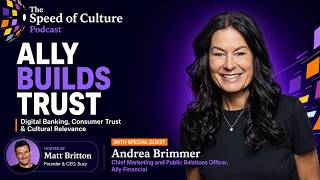
Andrea Brimmer, Chief Marketing Officer at Ally Financial, built a digital bank during the 2008 financial crisis by offering 24/7 service and no fees. She uses brand acts like waiving overdraft fees and funding women's sports to build trust, and reaches younger customers through gaming partnerships with Animal Crossing, Minecraft, and esports sponsorships.
Chapters
Up today, we're gonna be speaking with Andrea Brimmer, Chief Marketing and PR Officer at Ally Financial. Andrea's been recognized as the FCS Financial Marketer of the Year 3 times since 2017, and in 2022 was recognized as one of the most powerful women in sports by Adweek. Andrea, great to see you. Thanks so much for joining today.
Thank you. I'm, I'm excited to be with you guys today. Thank you.
Great to have you here. So I wanna start by talking about your earlier days in advertising because you have a very unique career. Career trajectory. Many people we talk to at Speed of Culture, uh, their, their past background is littered with many stints of different brands. But, uh, the two places that you spent time at, you've been at for a very long period of time and have a very substantive impact. And that's fascinating to me in a world where people seem to be jumping around a lot. Um, so we'd love to just first dive in, in terms of you entered, uh, the workforce back in '87 at Campbell Ewald, really an iconic advertising agency in the auto space. And I would love to hear what got you into advertising and talk about your journey there.
Yeah, look, I've always, I've known since I was a little kid that I wanted to be in advertising and marketing. Why? I've always been fascinated by what makes people fall in love with brands. The psychology of it is fascinating to me. Why we will pay more money for a certain brand that does the exact same thing as another brand because of either what it says about us or how it makes us feel or just, you know, whatever emotional connection we tend to have to it. And so, When I graduated, I went to Michigan State. I graduated with a degree in advertising, and I wanted to work on a big iconic American brand. I don't know why. I just, that was what I wanted to do. And I grew up in Detroit, so I love cars. Got an opportunity to work on the Chevy account. And Chevy was really interesting to me because if you think about the DNA of Chevrolet, it had always been largely defined by the marketing.
Yeah.
See the USA in your Chevrolet, Heartbeat of America, Like a Rock, all these big iconic—
lots of nostalgia and sort of American history.
Totally, right? It like connected us to the democratization of everything great in America. And so for me to come into Campbell Ewald was a tremendous opportunity, married my passion for cars with my passion for, you know, the psychology of marketing and advertising. And it just kind kind of worked my way up through the agency. I started in traffic and, you know, it seemed like a blink of an eye, but it wasn't. 20 years I was running the Chevy account. I was the youngest person to ever run the account and the only woman in the entire history that Campbell-Ewald had the Chevy account.
Yeah, because the old boy network in Detroit in the auto industry used to be real. Now there's obviously many women leaders and throughout the C-level.
Absolutely. But in the '80s when I was there, like 100%. And so it was, it was a really interesting time for me. Half the agency I think, hoping that I would be a success and half the agency was hoping that I wouldn't be. Right. And we were under a lot of duress. We had a new, a new person running Chevrolet. We were launching 20 new products in 40 months. He wanted to put the account up for review. So it was, it was a really tumultuous but really exciting time. And we did a big iconic campaign, American Revolution, retained the account, launched the campaign, launched 20 products in 40 months, restored Chevrolet to sales leadership. I really never thought I would leave. But the opportunity came during the financial crisis.
In '08.
In '08.
Yeah.
To go over to what at the time was still GMAC. And GM had sold GMAC, and we were going to come to market as an independent marketplace competitor. And so I had this opportunity to come and build a brand from the ground up.
But it was a brand in a different category. And many people who spend 2 decades in the auto industry normally spend the next 2 or 3 decades in the industry and don't move. And, you know, Ally Financial is a financial institution, right? And it doesn't just serve the auto industry. Was that a difficult decision to make in terms of leaving? I know you were technically working for an ad, but, you know, an ad agency, but you were solely focused on, you know, building an automaker.
Yeah. You know, it's funny, I was talking with some students last week and I told them not only did I move, I took a pay cut and I took a demotion. In terms of title, because I felt like I would never get an opportunity again to come to a fairly well-capitalized startup, if you will.
Yeah, that's what it was.
And build something from the ground up. And what's amazing is we launched a digital bank, first of all, in the middle of the worst financial crisis since the Great Depression. Second, in the same year that Apple launched the iPhone.
Yeah, I was going to bring it up.
So we made this huge bet, right, that everybody was going to start to bank digitally. And so it— For me, it was such a fascinating time because I not only got to build a brand from the ground up, I helped the team figure out how we were going to go to market, what the offering would be, how to deploy a brand. You know, I thought maybe just print a few business cards and change the signs on the building. Nope.
Right.
Very, very different. So it was exceptional, an exceptional career move for me. And I think about how if I hadn't done that, how different my life would be today.
Like sliding doors, right? You're still here today, so it must have been the right decision.
100%.
It's interesting because last week I did a webinar just in terms of the state of the financial system and how consumers feel trust-wise after what happened with Signature Bank and Silicon Valley Bank in terms of their faith in the banking system. And one insight that dawned on me, which is very relevant to this discussion, is that the notion of physical bank retail locations, which is sort of like a yesteryear— Totally.
—thing, right?
Because people used to walk by the retail location, say, oh, maybe I should get a mortgage, maybe I need a loan, where now you just Google it. Right. So why do banks even still have physical retail locations?
You know, I mean, I think there's some utility to physical locations, but largely it's because they have the infrastructure and it is very costly to unwind it.
It's legacy, right?
It's legacy. Yeah. And so for us, there's so many advantages from a consumer perspective. We're able to have less fees, pass on higher rates, and be there 24/7, right? And so it's just, you know—
You don't have to deal with bankers' hours, so to speak.
No. And that was one of— when we launched, that was one of the most significant aspects of the value proposition, which was how do you solve for customer pain points? And so, you know, it was one of those moments that you'll always remember in your career. There are about 10 of us. We got in a room and we said, let's just talk about everything that we hate about banking. And we plotted it out on a wall. From, you know, high value to low value, easy to execute, difficult to execute. And the stuff that rose to that top right-hand corner of high value and easy to execute, we went after. Right. And that was the differentiator for us. 24/7 service, no fees, you know, onshore call centers, all these things that have changed banking forever, candidly. Absolutely.
And, you know, trust is definitely probably one reason why these legacy banks have the physical infrastructure is that if you can touch and feel, you know, the store location, meet a banker, maybe you're more trusting. Is that something that you had to overcome when first launching? It's like it's a digital bank. You can't touch or feel it. Maybe people won't trust it. Maybe we won't be able to gain, you know, consumers' trust over the long term.
It was a massive challenge for a long time. And first of all, just the act of getting people in the habit of sending their money to the internet. Right. People had never done that. Right. How do I make a— how do I make a deposit? How do I know it's real? How do I know you're just not some scammer?
We're talking right when the iPhone was introduced. Exactly. So now it kind of comes second nature. But back then, it was a leap.
I know it sounds funny to talk about it now, right? Like we all do it all day long. But back then it was a massive challenge. And we launched, I think, one of the best campaigns we ever did, which was our kids campaign, where we kind of used big banks as the foil and we used kids as the arbiter of the truth to, you know, kind of tease out the proposition. Over time, that changed. And I think people just implicitly trust digital transactions for everything. And COVID absolutely accelerated our, you know, even those that were fence-sitters and even an older demographic who was more apprehensive about online banking. We saw a big shift in that after COVID as well.
Yeah, for sure. So when you first launched Ally back in 2008, 2009, I imagine you had to more focus on the younger consumer who was more digitally savvy, or was that really not your— because they have less funds at the same time.
Yeah, funny that you should say that because that was what we thought and we We were definitely focused on a younger demographic, but in reality, we got a higher net worth, very sophisticated older consumer. I shouldn't say older because I'm in that age range now. That's technically older. But what we saw was a big influx of people over 50-ish. Why? What was the insight behind that? Because they had a lot of money and they understood how to stack investment to maximize FDIC insurance. And they were very savvy at looking for highest rate. And moving investments around because we've never defined our proposition as being your primary bank. We've always said we want to be, we want to be one of your banks. And for us, that initially was the strategy is we want to be one of your choices. And we got a demographic that was a 50-plus demographic. Now that's changed over time. Really heavy affluent millennial a ton of Gen Z. And so we've become, you know, I think more bifurcated in our target. But it was a surprising demographic attraction that we really weren't expecting when we launched, to be honest with you.
Absolutely. And, you know, having launched, you know, 20 years ago, not quite 20 years ago, I guess 15 years ago, you know, many, many financial institutions that launched 15 years ago are no longer here. Right. So many neobanks and, you know, new concepts in financial services just didn't take, right? Why is Ally still here? Look, I think—
I mean, first of all, I'd say it's banking's heart. It's highly regulated. I mean, it's not easy. And that's why you've seen a lot of these startups, you know, kind of these fintech disruptors, right, implode and go away. And even a lot of them that, that have gone public and have gone from unregulated to regulated, it's tough. I think for us, a combination of things. First, we had a lot of people with deep banking industry knowledge that know how to run a bank, how to put a bank together and have, you know, been really successful in that throughout their careers. Second, I think because of the value proposition and what the brand stands for and just this whole idea of financial services that truly serve. And we've grown now to be full-scale financial services. We're a top 25 bank today, which is amazing. I mean, you think about it, 15 years ago, no customers. Today, 11 million customers, $138 billion in retail deposits. We are the largest non-captive auto lender in the country and full-scale digital financial services. So the appetite was there. And when you married it, I think with the right set of product offering and then the trust and the utility and the FDIC insurance and all those things, it was a great value proposition. Yeah, for sure.
And being a digital-only bank, like many other digital-first companies, they tend to focus more towards the bottom of the funnel because they You can't rely on just passerby traffic at retail, like say Procter Gamble can. But I know you spent a lot of time thinking and growing the brand. How is your mindshare split across the funnel as you continue to try to build Ally into the future?
Well, if you looked at the totality of our budget, we spend half on brand and half on more acquisition type of marketing. But a big part of actually what I've been doing with MMA is really studying the intersection between the two, because I think they're intrinsically— you can't have one without the other. And so brand has always been something that we've invested in and has been really important. It gets back to my first comment. Why do people fall in love with brands? And we've always said we want to be a brand that matters. And so doing things in this category that matter, whether they're teaching people financial literacy in engaging ways.
Yeah, I want to get into that.
Whether they're being in the community and doing the right things, especially because we don't have brick and mortar and physical presence, whether it's, You know, just constantly innovating and things like waiving overdraft fees, eliminating overdraft fees, having the most comprehensive COVID relief package of any bank. It's the whole Deeds, Not Words mentality that are all big brand acts. Aside from just the marketing things that we've done that I think have really made us a really relevant brand, not just in banking, but I kind of think in, in, in any category.
Yeah. In culture, etc. I mean, one area I know that you guys have doubled down on has been esports. Yeah. Which I believe is still in the very early innings of what it will be. Talk to us about why esports and the Rocket League Championship Series was important to Ally and why do you think that connects with what the brand equity pillars are?
Yeah, we actually just got done with a really interesting women's only tournament in esports as well. So really trying to get into diverse and female gamers as well. Look, we've always been super progressive in terms of gamification and esports. We are early on sponsor of Twitch. We're a digitally native company. Gaming is a huge target. There's a lot of affluence in the gaming community. 80% of people in this country play games in one way, shape, or form. Wow. Even my dad, right, on his iPhone, you know, playing Candy Crush. That's a shocking statistic. Yeah, it is, because I don't think— I think people are so hardcore about defining themselves as gamers. It doesn't mean you have to sit in front of your Xbox for 4 hours. Right, like a teenager, right? Exactly. And so I actually have a gaming team within marketing. I hired 4 people that came in from the gaming industry and they spend all day, every day thinking about how to intersect that audience. A lot of affluence, perfect for our target and ubiquitous and relative to the stat that I just gave you.
Yeah. And then do you see a world where esports and payments and that your actual business models start to collide over time? Absolutely.
And I also think there's a lot of learning that we can get from esports just in terms of consumer behavior. And think about the way people use, really use online technology as every form of learning, right? Gamification. From early on, we use gamification as a form of learning from elementary school through college, through all the things that we do. And so Being facile in that as a brand is extremely important. And that's something that we've always leaned into. And look, what we do, financial literacy is hard to teach people, and our country is not as financially literate as it should be.
And nor is it taught to kids at early ages. Not at all. My kids are taught things that I don't think they'll ever apply later in life, but they're not taught how to balance a budget or how to negotiate or anything like that.
100%. There's a huge gap. And that's why gaming has been important to us because it's not the sexiest thing in the world. If I came and sat down with you or your kids and said, do you want to talk about financial literacy? You'd say no. But if I took 6 cities in America and I turn them into a virtual reality Monopoly game that's all powered in VR, you're going to play that and you don't even realize you're learning about finance at the same time. That's why we've leaned into gamification and esports and all of those things.
So how does the esports piece tie into the financial literacy? Are you actually creating content and teaching younger people? And what is your, I guess, approach in that area?
So we've done a number of things. First of all, we created an island on Animal Crossing right at the time that Animal Crossing had a relaunch just before COVID Yeah, massive. Like we actually broke the game. And so if you think about Animal Crossing, there's a lot of financial literacy in Animal Crossing. You're collecting turnips, you're doing all of these things that you're monetizing and using. And so we created this island and really focused on financial financial learning in that environment.
Is that geared towards a younger audience? You can kind of seed the brand for future consumers?
Animal Crossing is actually a little bit of a mixed demographic. More about financial literacy, though.
Is that geared towards people who aren't really in the financial system yet?
Yes, absolutely. Or even though even people that are in the financial system that don't know as much about it as they should. Yeah. You know, more geared towards a younger audience. We actually worked with our, some Moguls interns that we had and we created a world in Minecraft called Fintropolis, and again, focused at middle school-aged kids. And we also created an educational platform around it that we provided to schools, all geared on teaching financial literacy. I mentioned the partnership that we did with Monopoly that was geared towards families and older people. So I think what— the way we've used esports and gamification is to authentically intersect places where gamers already are and integrate into things that are already based in finance that people don't really stop and think, yeah, Animal Crossing actually is a game about finance. You know, even Monopoly. When we did the Monopoly deal, Hasbro said to us, congratulations, you're the first bank in 100 years that figured out that we're a game about banking. Right? Right. You don't think about it that way. But intersecting it in a way as a bank to teach financial literacy You know, was a brilliant move on our part.
Absolutely. And for some of these more progressive tactics that you're talking about, how are you measuring the success of it? Because obviously we're in an environment now where people are spending less, ultimately maybe depositing less. It's a tough environment. We're not in 2021 anymore. I would imagine there's more scrutiny on how you spend every dollar, just like every other company. How are you, how are you, I guess, connecting the dots between that sort of work and the core business drivers you're looking to achieve ultimately?
Yeah, I mean, I think we can definitely do things to see pull-through. We've got multi-touch attribution in place so we know what channels people are coming from. We can see if somebody was, you know, in a game and we've got those folks either tagged or some kind of an offer or a landing page that we're driving people to in conversion. But honestly, we're just the kind of brand that believes deeply in investment across the board and that you can't be focused just in, you know, lower funnel, bottom of funnel tactics. You've got to invest long term. And a lot of this gamification goes towards that. That goal of investing long term.
It's almost like the new way of branding. It is. Driving engagement versus just running 30-second spots.
Because think about how hard it is to get to consumers anymore, especially with the death of linear.
Yeah, we spoke about 30-second spots everyone's on CTV. Exactly. Yeah.
You gotta go where the social currency is today. And gaming is a big area where there's a lot of that currency.
Yeah, and I think what I found in my career is that there's a distinction between cutting edge and bleeding edge. Right. And if you're bleeding edge, you know, you go too deep into the metaverse right now, for example, and there's 20 people that show up to your metaverse, then maybe it is too bleeding edge and you can't tie it back. So understanding where in the, I guess, adoption curve some of these new channels are, I would imagine is key in terms of figuring out where to invest.
Yeah, you hit it on the head. In fact, we stepped slowly into the metaverse and we actually just launched last week our first foray into the metaverse, but we did it in a very different way. We didn't do it in a way where it's required for you to have a headset and, you know, really jump in that far into Web3. We kind of dipped into what we call what we call more of a Web 2.5. And we've intersected, we've just launched something called Ally Arena. It's an interactive experience that you get to, you get to through gaming. And it provides an area where not only can you interact with the Ally brand and play games, but you can also get exclusive experiences, whether they're concerts or other interactions with some of our brand ambassadors. So it's a really Really, you know, I would call it more of a step approach into new technologies because I agree with you. I don't think people don't want to be, they don't want to be bleeding edge right now. But I think you as a digitally native brand, you at least need to be leading edge.
You have to, absolutely. So I know that Ally has done a lot in not just esports, but sports in general. And it's notable that you were a D1 soccer player at Michigan State. I have a lot of heart for Michigan State. It's where my father went. Oh, awesome. And so it was great to see that. That. As an aside, how was, was being a college athlete and what you had to learn in being a college athlete, what did you take away from that that helped you, you think, in your career?
Oh, I think, I think it was the most important part of making me who I am today, both as a person and in my career, candidly. Okay, so let's unpack that. Um, I think you learn so many things about that are tools that you use in business every day. Leadership tools, organizational skills. I mean, I think people underestimate the schedule of a college athlete. I mean, you're up, you're going to class, your grade points being reported. You have to maintain a certain grade point average. So, you know, there's no slacking or sloughing off, right? You're going to practice, you're getting on a bus or a plane, going to games middle of the week, weekends. There's very little free time. So being able to organize and stay on top of things, all skills that we need. And then I think it's just Wow. Learning how to interact with people and show up for people in the right way and show up for your team in the right way and have that grit and have that, you know, that swagger that you need in business today. All of that has served me so well in my career and I draw on it all the time.
I would imagine so. And what are your thoughts on kind of the evolution of kind of name interest likeness, image likeness, and what's happening where NCAA athletes can be sponsored Do you think that's a good thing? And what's your take on that?
It's such a double-edged sword. Yeah. I look, I think it's a great thing that money's going into athletes' pockets and they're monetizing for themselves now because they generate a lot of revenues for universities that we've never been able to share.
Most of them aren't gonna go on to have pro careers. 100%.
Right. Right. The percentage is very, very low. And so that's a really good thing. The downside of it, I think, is still yet to be fully understood what the impact will be around team dynamics, etc. But I think one of the immediate downsides is that many of the donors to NIL were donors to athletic funds. Right. And so what you're seeing happen is—
boosters and the like. Yeah.
You know, where maybe somebody would point their money towards the athletic fund. Now they're giving it specifically to football athlete or basketball athlete.
So it could take away from some of the lesser known, less participated in sports, right? Exactly.
It's taking away from athletic funds. And many of these schools are gonna run outta money quickly because they don't have that influx. Unfortunately, a disproportionate share is going to football and basketball, male athletes. And that's another detriment to it as well, which is how do you get more ubiquitous with spreading out the investment so that female athletes have a better opportunity to participate? Yeah.
And on that note, going back to LA, now you have this 50/50 pledge. Yeah. Where, you know, You want to put just as much money on men's sports as women's sports. I imagine your background has a lot to do with that, but why do you think that's something that's important for the brand?
So last year was the 50th anniversary of Title IX. We wanted to do something impactful, something that was real. And we made a pledge in May of last year that for every dollar we spend in men's sports media, we're going to match that dollar for dollar in women's sports media. Less than 10% of the media coverage today goes to women's sports. You just saw the Final Four. You saw the numbers. The appetite is there for, for women's sports. It well outpaced the men's Final Four. People just can't find the content. They can't find the coverage. And so the brands need to break that vicious cycle. And that is something that's important to us because we know empirically 94% of C-suite women in the Fortune 500 played sports at some point in their time. 54% played at the collegiate level. That's creating economic mobility. That's creating economic trajectory. And as a bank, that's our responsibility. And that was really what led us to take this pledge on, is there was an authentic reason for us as an important part of creating economic mobility in this country to intersect that insight.
Yeah, and it's a great example of doing good by the consumer and also doing good by your brand. Doing the right thing. Yeah, absolutely. So let's shift a little bit towards the consumer. So as I mentioned earlier, we are in kind of uncertain times, yet there's so much possibility. This is the year of AI, which is a whole different level of innovation, like unlike we've seen in the last 20 years. Right. How are you looking at the consumer moving forward and what are the specific areas that you're leaning into besides the areas we've discussed as we head forward here in 2023?
Yeah, I mean, look, the media environment is so complex and the consumer is so overburdened and marketing is just— the pace of change in marketing is relentless. It really is. And you have to be on a constant learning agenda. I, you know, I was up at Michigan State last week with a bunch of students and the number one question every single one of them had was, what is AI going to do to my future career possibilities? Right. So I think there are so many aspects of whether it's human capital, whether it's efficiency, whether it's effectiveness, whether it's just what is, you know, where AI is going, that are all things that we're still trying to figure out. I think insourcing is another big one that the industry is still reconciling. We've brought a lot of core competencies in-house. I think how that all will shake out over time.
You mean like an in-house ad agency, content studio, things like that?
Exactly. Digital planning, buying, all of those things. Those are all things that we're aiming to do.
As a former agency person, I'm sure you're super sensitive to what does that mean? How can it work, etc.? Very much so.
Yes. I'm a big believer in agency agency resources. I think what's happening in terms of product placement, show integration, we were just in LA a couple of weeks ago with a bunch of studios and content developers. I think that's another area that we're really leaning into with linear becoming more and more difficult to get live eyeballs on. How do we make sure that we're getting and staying in front of the consumer through all the explosion of content? We have a massive program coming out around the creator economy that I'm really excited about. I think there's no reason that as a digital bank, we can't be the official bank of the creator economy. So we've got a lot going on in that regard.
We'll have to look out for that.
Yeah, it's going to be a lot of fun. It's going to launch in the next couple of months. And as I've mentioned, we just launched our Ally Arena, which is really our first foray, I think, in a relevant way into the metaverse. And that will be definitely something that we're going to be leaning into more this year in terms of how do we grow it, what's the actual interaction with it. So all, I think, a lot a lot of really interesting things coming and happening.
Very cool. Awesome. So to wrap up here, you know, you've had a fascinating career and it seems like you've touched so many different parts of this business and then you had a whole nother amazing career at Campbell Ewald. What are some of the— as people who, you know, our listeners want to end up in the C-suite one day, they want to be a CMO one day, especially of an emerging brand like Ally. What are some of the things that you can point to throughout your career besides your participation in college sports, which I agree is probably a huge driver that you feel you did right that you would want to impart in other people in terms of if you wanted them to have a similar career path?
Yeah, I think for me, I characterize it as embrace the slop. I have always run into the fire. I have never cared about what the title is. As I mentioned, I left Campbell Ewald. I took a demotion and a pay cut. Yeah, not a lot of people would do that. Not a lot of people will do that. You have to be able to move laterally. I've, at Ally, I have had, 7 different jobs. I've learned everything along the way. You have to know how your company makes money. I had jobs that allowed me to understand that, to go deep beyond things beyond marketing. And I really think that that's really important. I think today what I see, especially with a lot of the younger people on my team, is they want to— they think everything's a time-based promotion. Get in, in 2 years I'm here, in 3 years I'm here, in a year and a half I'm here. I never had that perspective. It was always try and be a sponge, learn as much as possible, take lateral moves, take things maybe sometimes that don't seem interesting on the surface that turn into be learning that I've been able to use. In these jobs, as you know, your day is so different. You have a million things getting thrown at you. You could be going from everything from a board meeting where you're having deep financial conversation to, you know, a call with a content studio, right? Talking about brainstorming ideas and everything in between and throw in there a crisis communication and an employee relations issue. Right. You have to know how to handle all of those things. And balance it all. Yeah. So embrace the slop.
How about the power of the network that you've built over time? And how would you, I guess, urge others to think about their network and their connections professionally?
Yeah, look, I think networks are obviously really important. Lean into them for mentorship. Don't be afraid to ask for help. I think for me, the best way that I've actually leveraged my network is to learn from other people that I admire, brands that I admire, brands that I think are doing great work, companies that I think are really interesting, just to reach out and be curious and have a, you know, have a conversation. Those have been things that have been really important to me and I think have made me a better marketer by observing and being a student. Read the trades, understand what's happening and reach out to people. People love to help. They sure do. That's always been something that I've done and that's helped me in so many ways. And it's also opened a ton of partnership opportunities up where, you know, all of a sudden you're having a conversation with somebody in the spirit of learning and you realize, wow, we could do something together that could be really impactful.
Yeah. And you also never know where your future is going to take you and when some of those relationships will come handy.
Exactly. And help everyone you can. That's a really important thing in this business. It's a very small business and you definitely don't want to burn any bridges in it. For sure.
So finally, on that note, Andrea, are there any any mantras that you like to live by? When people are like, what is your thing? What's your mantra? Does anything come to mind?
Yeah, I have two that are my favorites. One is never drink your own Kool-Aid. I think that this is a business where people can be very precious and people get very full of themselves. So never drink your own Kool-Aid. Nobody is irreplaceable, and that's just the reality of it. And so stay grounded and stay true to who you are. And then the second one is just one that I've I've always lived my life by, and it's a saying attributed to Picasso, but there's a lot of debate about who actually really said it. And it's the meaning of life is to find your purpose, and the purpose of life is to give it away. And I think that if you're given a platform, you should make impact with that platform. For me, this 50/50 Pledge will always be my legacy. I think we will change women's sports forever. And that's something that I will always be the most proud of. And that's a perfect example of that saying. Yeah, it's something you should be proud of and it's a great legacy.
And I'm so happy that we had the chance to talk about this and for you to share it with our audience. So thanks again, Andrea. On behalf of Susan Adwee Team, thanks again to Andrea Bremer, Chief Marketing Officer and P Officer at Ally Financial, for joining us. Be sure to subscribe, rate, and review the Speed of Culture podcast on your favorite podcast platform. Take care, everyone. See you next time. Bye-bye.
More from Matt




MikMak’s Rachel Tipograph on Consumer Spending, Retail Media & Holiday Shopping Trends



Jaguar Land Rover’s Charlotte Blank on Luxury, Purpose & Experiential Storytelling



