Amazon Ads’ Carly Zipp on Retail Media, Live Sports & AI Personalization
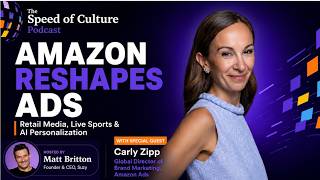
In this episode of the Speed of Culture podcast, host Matt Britton interviews Carly Zipp, Global Director of Brand Marketing at Amazon Ads. Carly explains the three‑part Amazon Ads canvas—stores (e‑commerce and physical locations), media (Prime Video, MGM, Twitch, podcasts, Audible, Fire TV, devices) and the demand‑side platform that leverages Amazon’s massive first‑party data. She describes how Amazon is moving beyond its traditional bottom‑of‑funnel role by launching ads in Prime Video, creating a true full‑funnel experience that connects awareness, consideration and purchase. The conversation dives into retail media’s advantage of first‑party shopper data, the integration of content (MGM, sports) with advertising, and the importance of non‑disruptive, audience‑based creative in live sports such as Thursday Night Football, NBA, WNBA, NASCAR, and international events. Carly outlines AI‑driven hyper‑personalization, new DSP tools, and how smaller brands can use AI‑powered creative to compete with larger spenders. The interview also covers creator partnerships, highlighting the MrBeast‑backed Feast Games series, influencer collaborations on Twitch, and content‑to‑commerce examples like Daisy Jones & the Six, where viewers can shop wardrobe items directly from the show. Finally, Carly reflects on her career path—from wedding media to out‑of‑home billboards, TikTok, and now Amazon—emphasizing timing, self‑advocacy, and strong partnerships. She offers advice to emerging marketers about executive presence, networking, and the sacrifices required for success, summarizing her mantra as “Messy but worth it.”
Chapters
Up today on the Speed of Culture podcast, we are thrilled to be welcomed by Carly Zipp, the Global Director of Brand Marketing and Amazon Ads. Carly's helping to shape the future of advertising with Amazon's expansive ecosystem from Prime Video to Twitch, all while creating deeper, more meaningful connections between brands and consumers through innovative ad tech and live sports partnerships. Carly, so great to see you today.
Thanks for having me.
Absolutely. For people in the audience who obviously everyone knows Amazon, right? But not everyone knows knows what Amazon Ads are, even though they are probably subjected to it many times a day. Would you mind just explaining what Amazon Ads is?
Sure. So what's really interesting when I tell people that I work at Amazon, the very first and just prevalent comment I get is, oh, you know, you should thank me. I just ordered like 10 packages from Amazon. And I always like to tell people, well, thank you for your service. We appreciate that. But secondly, the really interesting part about Amazon is while that is such a big part of our business and we call that stores, it's really actually not the biggest part of our business. So if you think about the vast Amazon canvas and everything that falls under it, there's really kind of like 3 buckets. One is the stores. So the homepage that we all know and love that you get your toilet paper and your jeans on. There is our physical stores like grocery stores like Whole Foods and Fresh and, and anything kind of that falls falls along with that digitally. Then the second bucket is really media. And so if you think about streaming, that's everything from Prime Video, MGM, and the acquisition of MGM kind of unleashed this massive historic, you know, catalog with so much gravitas that we haven't even scratched the surface of yet. There's Twitch there, you know, for all your livestream and you kind of the way that we can engage with a younger audience through UGC. There's Wondery Podcast. There's Audible for books, there's Fire TV that allows you to, you know, plug into all these channels. There's the devices. So, you know, Ring, Alexa. And then there's a third part of kind of the business, which is all under this canvas I mentioned, which is our demand-side platform. So basically taking all the, you know, trillions of signals that we get from shopping and streaming and, you know, buying behavior, and we can kind of help brands and agencies tap into that audience. So under the Amazon Ads canvas, it's really anything that can be monetized through advertising across all of our consumer properties.
So, you know, when you look at the funnel, obviously Amazon is known for being the bottom of the funnel, right? It's where you purchase. But as I understand, and you kind of alluded to this, Amazon can help advertisers not just at the point of sale, but in the awareness and consideration phase as well. Talk to me about how Amazon helps advertisers throughout the user journey and like how some of those touchpoints come to life?
Sure. So, you know, I don't think we could really make a full-funnel claim until last year when we launched ads in Prime Video. And so really launching it within streaming TV and really being able to think about a whole new subset and going up against linear, that really unleashed like this very top funnel in awareness and consideration opportunity for us and then allowed us to connect it to the bottom of the funnel, those performance marketing opportunities that we have. And so what's really interesting for me to be able to tell this story is, you know, the phrase full funnel is nothing that's new to any of us. I mean, I remember coming up in this industry being like, God, full funnel sounds kind of antiquated. So the fact that we're still using it today to me is really fascinating. But I think it's safe to say that the funnel is definitely like broken open. There is no one linear way to consume. We are all— I'm sure even if someone— if I'm fortunate that someone is watching or listening to this podcast, I do not have any kind of any qualms about the fact that they're probably scrolling on their phone or maybe there's a TV on in the background and they're doing 3 other things. So, so it's really about how to capture attention, how to earn attention, and what to do with that hard-earned attention.
Yeah, that being said, I mean, a lot of people go to Amazon and they search for Nike sneakers and you have a lot of merchants that sell Nike sneakers that are size 11, that are white, that are Air Max. And obviously while you do have multiple touchpoints, that is a very kind of linear, very powerful offering where if you are a seller on Amazon, you can have a sponsored, you know, result there. That makes it far more likely that they're going to choose you and you're going to be able to sell more product.
Absolutely. Yeah. Well, thank you. It sounds like you're very familiar with the Nike offering on Amazon, so I appreciate that. But yes, I think to that point, the interesting thing about the Amazon offering is at its core, it started in retail media, and I don't think anyone does retail media better than Amazon. And the difference between, you know, retail media and expanding to, our whole media and advertising network versus, you know, an entertainment company then trying to go retail media is our roots are in shopping. And so you're like primed to shop and air, no pun intended. And therefore, you know, when we expand it, it's a very natural fit versus trying to shove an ad in and trying to disrupt an experience. We know that our consumers are coming to us because they want and need something. And so if we can find a non-disruptive and additive way to put it into their daily lives, you know, from touchpoint A to touchpoint B, then we've done our job and we've made a consumer's life easier.
Yeah, I mean, I'm glad you brought up retail media. I was at the POSsible conference last week. Oh yeah, in Miami and had multiple conversations with both brands and providers in the retail media space because as I'm sure you're well aware of, CPG companies, food and beverage, they are clamoring towards the offering from retail media companies, not just with Amazon, but with the more brick-and-mortar type companies, whether it be Target or Walmart or Albertsons. They're all rolling out retail media and they're incredibly successful because the fact is that these brands' lifeblood is having shelf space at big box retailers along with having presence on Amazon. And I think what Amazon and other retailers really excel at is being able to leverage and unlock the power of first-party data. And if you're Coca-Cola, you sell through channels, you don't sell direct, so you don't have first-party data. And in this world, first-party data is so incredibly powerful at being able to target. I guess my question for you is, you know, in one of the discussions actually, we were talking about the Amazon differentiation. And I think one of the Amazon differentiation is not only do you have retail media, but you have content. And I think that is what's drawing attention because sure, you can have data to reach people throughout the web. And in the case of Walmart and Target and Albert in store as well. But ultimately, it's not just about being able to reach them, it's about being able to engage them. And I think that's where like the MGM and, and, you know, your Prime network and everything really comes in in a powerful way is not only can you identify for Coke who they need to reach, but you actually can gravitate their eyeballs towards you because you have content that they're gonna wanna seek out.
Absolutely. I think it's that perfect marriage that allows us to kind of not only capture attention, but then sustain it. I think, you know, there's so many people We're walking into upfront. We're in Newfronts right now. We're walking into upfronts next week. We very purposely have a presence, you know, across both, along with Possible, along with Brand Masters and Platefronts and all the rest of them, because there's a different story to tell and it's all connected. And at the end of the day, we are in the business of being customer obsessed. It's our, you know, it's my favorite leadership principle that guides me at Amazon and to truly do that, it is something that needs to create an additive experience for consumers and ultimately for brands and agencies who are looking to reach them. So not only kind of reaching them where they're at, when they're shopping, when they're thinking about it, but proactively reaching them. And that's why I'm personally so excited about our intense and our amazing expanded live sports portfolio.
Talk about NEXT. Yeah, I'm glad you brought that up because, you know, one of the interviews we had here on the podcast in the last couple of weeks was with Tim Ellis, who's the chief marketing officer of the NFL. Yeah. And if you think about the NFL or the NBA, who has the playoffs going on right now, or NASCAR and, you know, or obviously F1, which is massive in terms of its engagement. Live sports is really the last bastion of like live, live content consumption that exists. Everything else is time shifted. And sports is such a big part of culture. And I know that Amazon has leaned in to your point very heavily into live sports over the last several years, with the NFL included. Tell me about the live sports investments you guys are making and how you're seeing it pay off relative to the Amazon ad strategy.
So it started with Thursday Night Football. We're going into our fourth year, and it started with the idea that, you know, you have this community and to your point, they're really live Live TV viewing, if you remember when, you know, you and I were, were coming up, you would sit around, you'd wait for Friday nights, you know, Must TV, right? TGIT, TGIF, Step by Step, Family Matters, like, and you would talk about it with your friends. And now because of the fragmentation, you know, and we're a part of that, things are not the same anymore. So live sports viewing is really kind of one of the last bastions of that. And it's the idea of community. And building that community and being able to speak to people when they're together with relevant information. And so what they did with Thursday Night Football, and I can say this with confidence because I wasn't the genius that came up with it, and I can very much point to the people that did, was they created something called audience-based creative, which is if you, Max, are watching the same game that I am, if you're watching, you know, the Packers versus the Lions, and there may be an ad that comes on that's sponsored by P&G, you may see something different than I'm going to see because my behavior has signaled that I may be really interested in something that you're not interested in.
Your car lease is expiring.
Exactly. And that's a way for us also, you know, talking about car leases, to get people who are non-endemic to Amazon, who do not sell within our store, to be a part of our universe and to tap in to that, you know, that possibility. So the idea of audience-based creative, the idea of contextual advertising, of not disrupting but adding to the experience has been really powerful. And they tested it and they succeeded at Thursday Night Football. And now it's incredible to see how it's expanded. So I'm super excited about not just the NBA but the WNBA. We have so much going on there. NWSL, NASCAR is launching this month. We have the next 5 races. I went to school in the South, so I'm a fast like NASCAR kind of girl. And then the international sports portfolio, you know, we have all across the world, we have tons of offerings, whether it's Roland Garros or leaning into, you know, the Toronto Maple Leafs, like local sports teams, you know, national. And it's, it's really fascinating to see. And it's a great opportunity to connect that idea and build on community because I think that's what brands are really trying to tap into is the authenticity and the community and the conversation and being a part of it. And I think that we provide that through, you know, being able to reach across a lot of our offerings.
Yeah, I mean, another thing you touched upon there was, which I think is very powerful, is just a notion of not only attribution but hyper-personalization, right? Yeah. And, you know, talking about must-see TV on Thursday nights, what back then, if you were an advertiser, you'd market to an 18 to 49 demographic, right? It was very broad, monolithic cookie cutter demographics. And then over time there was the Food Channel and there was the Golf Channel, and you could start to market the people based upon their interests. And now, especially with a company like Amazon that has so much powerful first-party data, you can serve specific ads to a specific person and also, you know, see if it converted. Because you know that person after seeing it went on Amazon and bought something. And I think that is what marketers are not only going to expect, but I think demand in years ahead. My question for you is, how are brands kind of taking advantage of this opportunity? Like, do you— are you seeing brands leverage AI right now to have hyper-personalized creative and ads to take advantage of the capabilities that you guys are offering? And what are some of the best use cases for brands to be able to take advantage of all these capabilities?
Yeah, I mean, I think for us, we see that that AI-driven hyper-personalization is driving a lot more deeper and relevant advertising experiences for consumers. I mean, hard stop. You know, what's so interesting right now is you see across the canvas, not only just Amazon, but really everyone in this space, like there's so many choices. And I really, I've always strongly believed that the pendulum swings. And so, you know, right now you're seeing so much that people are craving personalized content that's relevant to them. And if it's not, then it's, it's a distraction and you want to get it out of your way. So I think for us, what's particularly exciting is the investment in our Amazon DSP and our 3P supply, really being able to optimize, you know, the ad spend through performances of the DSP and really seeing how AI can help drive that. I also, you know, want to mention that there are a bunch of tools that the team is working on and creating where we can Brands taking advantage. Brands, I think, that take advantage right now are those that may not have, you know, the same creative budgets as some of the larger brands that are going to tap in. But what's really cool about something like NASCAR or the massive amount of coverage we're going to have with the NBA is it democratizes, you know, the entire landscape. So smaller brands, midsize brands, they can tap in and they can use some of these, you know, AI-driven creative tools to really tap into those audiences in a way that an NFL buy wouldn't allow that for.
I, you know, I think Amazon's always kind of been ahead of the curve on just hyper-personalization, whether it's been its recommendation engine, um, either on Prime or on Amazon or the emails you send out. You're not talking to everyone the same way. And I think that is where it's all headed. Like, I think we're headed to a place where if I watch a TV show and you do, it won't be the same script, right? And it could be the same actors, but— and it could— they— we could think they're really saying those things, but, you know, they're— those actors are actually really cloned and they're saying different things. Like, I honestly think that the way that we view entertainment, even if we like the same exact properties, in a lot of instances will be presented to us differently based upon the— the— our DNA makeup and our past behaviors.
Yeah.
Which is fascinating to think about. Another big shift, obviously, and you know, we've talked about, you know, Amazon's ability to create entertainment properties, whether it's through MGM or Prime, etc. But the reality is when you look at Gen Z, which is known as the iPhone generation, they're spending most of their time not watching traditional linear entertainment. They're spending time on their phones. And when they're on their phones, they're consuming content not from big media, but from other people. And that's where kind of creators come in. Um, and in that regard, I know, um, in December of last year, '24, Amazon partner with MrBeast, Jimmy Donaldson, to launch Feast Games, which was a kind of a reality competition series. And MrBeast obviously is one of the most prominent creators and has one of the largest individual creator audiences that exists on platforms like YouTube. Yeah. What is— why does creators make sense for Amazon? And, and how does that, I, I guess, overlay with some of your efforts on the Amazon Ads front?
It's a great question. First of all, I love that we're talking about MrBeast. I will tell you that show surprised me greatly. Um, I don't know if you got to watch, but I was really entertained and not just me, the kids in my household were.
He, he didn't build an audience by not being good at capturing people's attention.
Yes. And also just like the sociological experimentation of it all, like what he did was so fascinating and it was, listen, it was a risk. It was a first of its kind for Amazon to invest in. Um, particularly You know, we, it's funny 'cause I actually had a meeting on it this morning, like particularly for brands and agencies to invest in something like that. That's, you know, when you invest in a creator, no matter how powerful they are, you are still taking a risk because you're letting their brand, their IP speak for itself. And that can go many ways. But I think what we found with the secret sauce is, listen, you know, Amazon is not a creator company. We're not a UGC company. I came to Amazon from TikTok, and so I myself have seen the power the power of creators and it's seen the influence of creators and it's incredible. And my own consumption habits, you know, I, my algorithm is like a lot of mom bloggers and, you know, hotels for one day when I have a life. But I think what's, you know, it's really important for us to understand at Amazon like who we are and who we're not. And I love one of the things, you know, that we think about, which is like build versus buy and, and where do you tap into things and where do you invest in things? And I will say Amazon, you know, there's part of Amazon is Amazon Live and Amazon Influencers, and that's when we do leverage influencers and creators on behalf of Amazon. Um, but it's hard to— it, like, it's hard to have one influencer or one creator represent all of Amazon. I mean, looked at everything that you and I have talked about today. So, so I think when— where possible, when it comes to leveraging, you know, the 275 million we have on Prime Video, like that massive streaming reach number across all of our platforms. If we can put that up against the largest creator with the largest following, um, that's something that I think the team was really interested in and seeing how that played out. Because when you put his name with the Amazon name, it was just something that we were able to bring to audiences and that we were able to bring as an opportunity to brands to tap into. And I thought it was fascinating.
Yeah. I mean, and listen, content, content to commerce is sort of where it's at, right? Yeah. You know, and if you think about the notion that, that these, like, look at, you know, Casamigos and George Clooney, or you look at Skims and Kim Kardashian, right? Yeah. These are celebrities that are able to put their brand next to products. And in a world where there's not much differentiation in apparel or tequila, the differentiates, the differentiation becomes a celebrity. And MrBeast, as you probably know, rolled out a hamburger place that had 10,000 people show up at the American Dream Mall. I think this is, that's where obviously it's going to continue to go because as it becomes easier to create a, you know, an adequate version of any product, really what differentiates is the brand and the biggest brands right now are people. So I think that's where it's at. And I know that you guys do also do a lot with affiliates and, you know, if you're an influencer creator, you know, a big way where you can, you know, earn income come besides advertising is by selling and moving products. And not everyone creates their own product. A lot of people have affiliate relationships with companies like Amazon where they can essentially push people to the things they like best. And, you know, people who follow creators, they trust them more than anything, certainly more than a review that they'd read in, in Vogue, right? So because of that, it, I just think it's a, it's a great marriage moving forward in terms of creators and, and commerce.
Yeah, I mean, I'll tell you, I can, last year I was fortunate enough to interview Alex Earle and Mariana Hewitt. And so, you know, you have this like influencer who's the founder of Summer Fridays, this massive Gen Z influencer. And I mean, truly, I would love, you know, we walked off the stage and there was a crowd of like 600 people. None of, maybe one of them was there for me, maybe like maybe my husband was somewhere, but they were all there for the two of them. And really namely Alex Earle, anything she says, it moves. And that's why Amazon, you know, has enlisted her as an influencer, because she moved— to your point, she moves product. If she is out there talking about the fact that she has bad skin, and this is, this is a, you know, her true fact, like she was out there, bad skin, talked about a pimple cream, sold out. Next thing you know, for her it's beneficial. She got a partnership and she was able to develop something. So I I think you also have to be careful, right? Like who you're working with, like do they value brands? So that's something that I think is really interesting about Twitch. Like Twitch in and of itself is not necessarily, you wouldn't think of those creators as being brand friendly all the time, the same way that you see some of the other transactions across other platforms. But it's been really fascinating to see some of the brand partnerships come out of Twitch. It's a much more creative and much more like custom content of a partnership, but it's really cool to see like these Matt, like Kai Sunat, I mean, look at all of the brand partnerships that he has now. And it's truly fascinating. So I've really been along for the ride of it. It's very cool.
Shifting gears a little bit towards just the topic of AI. My book, Generation AI, just came out yesterday. We'll have to send you a copy. I spent the last year just just diving into AI's impact on business and culture and society. And, you know, I actually wrote in my book at length about AI's impact on commerce. And, you know, ChatGPT announced, you know, a commerce engine and Perplexity has one. And, you know, there's a lot of people who believe that the future of shopping is going to be different than just searching for something. Just like there's a lot of people that believe the future of searching on the web is going to be different than, you know, the Google blue links. Like the world is changing and AI is going to change consumer behavior. Just personally, and I'm not asking you to talk about Amazon's AI plans, which I'm sure are vast in this area, how do you think AI is going to impact the way that people buy things? And where do you think the role of like AI shopping agents are going to play in terms of just the curation of products and services in everyday life?
Well, first of all, congratulations.
Oh, thank you.
I look forward to seeing it. My husband is an AI fiend. Yeah, check it out. Ooh, there we go. Wrap it up. Wrap it up. You know, it's interesting. As you might imagine, Amazon has been leaning into AI and, you know, LLMs for a long time to inform, you know, what they've built and everything that we've done. And so it's really interesting for me kind of on the other side of it to be able to see how the team is thinking about like those shopping recommendations or, you know, really thinking about like the personalization and how to really scale that But I think the other thing that's really interesting, kind of being on this side of it, you know, I think it's, it's been a really interesting journey being a brand marketer at Amazon because Amazon doesn't lend itself like an AI future company doesn't lend itself to like stop and take a beat and do storytelling and, and think about, you know, custom creative. But I think that what's interesting is there's also like there's also a desire to not let the pendulum go so far. AI is going to rule everything, right? So I think the— I think it's really going to be influencing shopping decisions and kind of how we curate the personalization and how we curate the user experience. You know, I'm really involved with Prime Video ads. And even when you think about the UX of Prime Video right now and how the ads show up, there's definitely work to be done. We're only in year 2 of Prime Video ads. And so we're leaning deep into, you know, what AI can do for that. And how it can be so hyper-personalized.
And integrate it. Like, people watch TV shows and they're like, where's that couch from? And you should be able to just order it right there. Yes. I mean, it's just shocking that that doesn't exist. And like, you know, people watch like Bravo and you see these, you know, reality TV characters wearing certain outfits and you should be able to buy it right away.
Of course. I mean, I, I love a good search after a Real Housewives. But what's so interesting is this, you know, there, there's a lot of that that's being built now. So like the fact that we have IMDb in our wheelhouse, the fact that we have Amazon, and, you know, and at its core this retail capability, it's been interesting to see as we're building out Prime Video ads, like something like interactive pause ads. So like, you know, a great example is The Summer I Turned Pretty is like our biggest YA hit, and, you know, they— I think they've just wrapped the final season, and we're looking at it, and we're looking at sponsorships and what worked last year. And one of the coolest things that I saw was you pause it, and all of a sudden, you pause it while they're at Cousin's Beach, this fictitious beach. And all of a sudden, oh, I love that beach. Well, isn't that funny? Because Booking.com just gave me 5 recommendations of similar beaches. So yeah, so I think those dots are being connected. And I think also to your point, you have to have the right show, the right creator, and the right brand to all build it together, so to have that AI. Because another— I mean, I will say probably my best example, and I wish it was still— I wish it was still one that was out there. But last year, with Daisy Jones and the Six, when we put that out, it was a—
Love that show.
That show, right? Amazing book. And not only that, the soundtrack rose to the top of the charts, but then And we also had— so think about this. With Amazon Music, you had their soundtrack, like The Sixes music that was up there. The book was on Audible. Then you had the show on Prime Video. You could pause. You could shop Daisy Jones's wardrobe on Amazon. And so that, to us, is when it all works so beautifully together. And that was an amazing effort. It doesn't happen to us every day. It was powered. By some of our AI capabilities, but it was also because we had brands and, you know, creators willing to lean into it.
We had the team from Hello Sunshine who, as you know, helped create that. And they're great partners of ours with Suzy. And, you know, that I know that they are super excited about, you know, their work and partnering with you guys and bringing that to life. And it was fantastic.
Yeah. And we're, you know, and now they, last year at the upfronts, we announced, you know, Elle and what, what was Elle Woods like before she was Elle Woods? And now there's The Search for Elle, and now we have Elle, and now we start the work of what does it look like to build out that show across not just Prime Video, but the entire Amazon canvas? And I can promise you the overwhelming interest has been completely fascinating to see.
Brand— nostalgic yet contemporary.
And it—
exactly. I mean, obviously the ability to monetize something like that are endless. So, yeah. Um, so wrapping up here, Carla, and it's been as expected, a great discussion. Just in looking at like your career history, you know, you spend time at lots of large-scale, more traditional media companies like Viacom and obviously at Outfront Media and more recently TikTok. I just wanna know, like, if you look back on your career in media and advertising and business development, like, what are some of the things that you think you did right along the way to put yourself in a position where you are today, where you're a global director at one of the most influential companies in the world?, you know, at Amazon, like you couldn't have gotten there if you didn't make some right decisions along the way. Look around the corner at certain points. When you look back on your career, what do you think some of those pivotal decisions have been?
I think 3 things. I think one, knowing when my timing was gonna be right. So, so it's interesting. I, I worked in weddings. I worked for The Knot and Estabump. Yep. And it was a life stage media company. The Knot was the biggest thing in weddings. And then I got engaged, and then my wedding became a massive publicity stunt for The Knot, which was really cool in its own way. But by the end— where my wedding was in Middleburg, Virginia, at the Salamander Hotel, um, and we was the first wedding takeover. They had just built it, and they had approached me and said, do you want your wedding to be here? We'll, you know, roll out the red carpet. And it was amazing. And at the end, my husband and I said, we never want to talk about brides again. Um, and so I made a hard pivot to billboards, and I think it shocked most people that knew me. And even when I tell the story today, people say like, wow, you were on billboards? And I say, yeah, because I was looking to do something that had never been done before. I was recruited by CBS Broadcasting, a TV company, to spin off and rebrand and re-IPO their out-of-home sector, CBS Outdoor, to Outfront Media. And I wanted a new challenge and I wanted a challenge of making billboards cool again. So I spent a lot of time doing that, but I also knew during that time that I was gonna be married and have kids and that I wasn't gonna be able to travel all over the world because of what I wanted to do. And when I, you know, had my second child, a little-known app called Musical.ly came my way and said, you know—
Which became TikTok, right?
Right, exactly. The early days prior to being TikTok, and it was right before the pandemic, and they said, um, we have— we're starting up in the US, we could use a global leader, we don't want the same old people from the same old tech platforms, we think what you did is cool on billboards, like, would you do it here? Um, and I came over there and it was amazing, and it was a rocket ship, and I built a team from, you know, 3 people in Beijing to 1,200 globally. It was fantastic, and And I also knew that I put my heart and soul into it. And then I knew that when Amazon came calling, it was the right time for me. And so I think, one, it's about timing. Two, I think my mom always taught me that closed mouths don't get fed. And so if you don't advocate for yourself, no one's ever going to know. And so I've always, I've raised my hand for every opportunity.
You don't get what you don't ask for.
Exactly. And so whether it was being in front of, you know, the right person stuffing gift bags or raising my hand to do a project that was out of my remit. I've always done that because I've always felt like that is the only way that you're going to get noticed. And then lastly, I found the right partners. I've always really been able to find amazing partners at Amazon. Surprise to nobody, finance is everything. And so I'm very lucky to have found an amazing finance partner, amazing team members, and I just could not be more grateful for my team. So I feel very lucky.
Speaking about your team, you know, we have a lot of— younger listeners who are earlier stages in their career here at Speed of Culture Podcast. What is one or two pieces of advice you would give to someone starting out in our world of media, marketing, entertainment to focus on, or skill sets to build to set themselves up for success in a future, in a world that's changing faster than most of us even realize?
It's really funny that you ask because in so many meetings I have, the phrase executive presence comes up. And, you know, there's always a debate, a very healthy debate that goes on, like, does someone in this role in a marketing or PR or talent-facing role, do they need to have executive presence? And I always say I would rather hire someone, like, with incredible executive presence.
How do you define executive presence?
I would say the ability at no matter what age to talk to anyone, to do whatever is needed. To raise your hand, to also know when to listen and learn, but to not be afraid.
And it's a confidence, isn't it?
It's about confidence. And even if you, even if you don't have it, to like push yourself. It's not easy, but I—
Have there been times as a woman in business, Carly, you've— it's been harder to have executive presence?
Um, I think for me, I somewhere along maybe in that those out front days, um, I made a concrete decision that I, like my mom, was going to be a working mom. My mom worked in finance for 30 years and started out in a time when women were not in finance. And so I think I always looked to her and just, you know, it wasn't— there was never really a barrier that I felt until I had kids. And then I decided, you know, if I'm going to do this, then I'm going to go all the way and I'm going to work really hard and listen. It's not easy. And I would tell younger viewers, particularly people starting out, it's funny when people say you can have it all. Well, you can, but you can also, like me, wake up at 4:30 in the morning to take a 6:00 AM flight to be in New York for New Friends and do a team meeting and have a bunch of one-on-ones and then be in a quarterly business review and then get on a flight at 5:00 PM today. And, um, and people always ask me what drives me and I say Diet Coke and mom So I would say not kidding yourselves that you can have it all. Something is going to be sacrificed, but it is damn well worth it.
It all takes sacrifice. I mean, the problem with social media is it looks so easy from the outside, but you don't see all the, all the things that people have to go through to get there. And to your point, all the sacrifice that it takes to get to where you want to get to. I'm glad you said that.
Yeah. And I think, you know, just, um, making sure you put yourself out there. I interned my entire, like, end of high school. I actually took a year off before I went to college. I was a radio DJ in D.C. It was top 40. My name was DJ Zippy. It was Hot 99.5. And I interned unpaid all throughout college. At the end of, you know, at the end of before I went to college with the radio station, I was able to, you know, do something really cool. But at the end of the day, I networked, networked, networked, and I kept a running list of everyone that I met and I would check in with them and I wouldn't just check in with them to say like, hi, I need something. I'd say like, how's your, you know, I remember you told me, how's your kid? Or like, can we meet up for coffee? Can I do this for you? And I just always would put myself out there and I always will continue to put myself out there because that's how, that's how you make relationships and that's That's what this industry is about. Yep.
It's fantastic. So, finally, you know, we always ask our guests, Carly, if there's a saying or mantra that helps define your career journey to date. What comes to mind for you? Oof. First thing that comes to mind.
Messy but worth it. Okay.
Which basically encapsulates everything you just said, right?
Yes.
It's all the stuff you have to put up with to get to where you're on the other side. But yeah, perseverance, sacrifice, et cetera. Well, this has been a fantastic discussion. We've covered so much ground in a short period of time, and I can't wait for our audience to hear. So thanks so much for taking the time today out of your busy schedule to discuss.
Thank you so much, Max. It's been great.
Absolutely. On behalf of Suzy and the iWe team, thanks again to Carly Zip, formerly known as DJ Zippy, global director of brand marketing at Amazon Ads, for joining us today. Be sure to subscribe, Rate, Review the Speed to Culture podcast on your favorite podcast platform. So next time, see you soon, everyone. Take care. Hey!
More from Matt




MikMak’s Rachel Tipograph on Consumer Spending, Retail Media & Holiday Shopping Trends



Jaguar Land Rover’s Charlotte Blank on Luxury, Purpose & Experiential Storytelling



