Amazon’s Ofori Agboka on AI, Robotics & the Future of Work
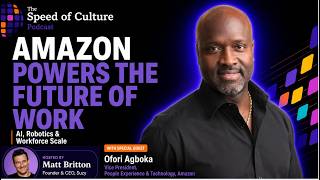
Ofori Agboka, Amazon's VP of People Experience and Technology, discusses how the company hires 250,000 seasonal workers and uses AI from warehouse robots to shopping assistants. He oversees Career Choice, a program that includes robotics apprenticeships, and Amazon's $2 billion Upskilling 2030 pledge to retrain workers for tech jobs.
Chapters
Up today on Speed of Culture Podcast, we're thrilled to be joined by the great Ofori Agboga, the Vice President of People Experience and Technology at Amazon, who oversees Amazon's global workforce. Ofori's team ensures that everything from fulfillment centers to delivery operations run smoothly during high-demand events like today, which is Cyber Monday. Ofori, thanks so much for joining today on this busy day.
No, thank you, Matt. Thank you for being here. It's a pleasure and honor to have this opportunity to speak with you.
Absolutely. You know, I was just walking through this incredible warehouse and seeing all the logistics and all the machinery and robotics and the hardworking people here that make all this happen. What is one thing that most people don't know about running a workforce that's behind such a logistical marvel that is Amazon?
You know what? I wouldn't say there's one thing that people don't know, but I'm happy to share with you so that you can see—
Please, yeah.
The excitement, the energy, the magic in the methodology. It just runs smooth. It just has a, the system runs, but it does well because of the people. The people and the machinery work hand in hand, and it's exciting. It's magical. I've been at Amazon 5.5 years, and I'm so proud of what the teams do. And I think seeing is believing. You know, it's one thing to read about it, hear about it, but as you saw and walked the floor, it's safe, it's innovative, it's inclusive, it's clean. And, you know, people are learning, and we bring in people from all over the world, all walks of life and backgrounds, and we find a way to work together and learn and grow together. So—
Uh—
So I don't know if I answered your question completely, but I'm excited to share and talk about what we have going on here.
And of course, Cyber Monday is unique because there's so much volume and you're shipping so much goods out of warehouses like this, which means you have to scale the workforce for peak seasons. What does that look like as someone who's overseeing, you know, people operations?
Yeah. So I work with a fantastic group of PXT. PXT, what we call People Experience and Technology, which is commonly, you know, politely known maybe as HR. We believe people, the right experience, and supplement with technology. But with that, we prepare year round for days like this. This feeds into our goal of making sure we have great selection, low prices, and speedy delivery to employees. In a place like this with a fulfillment center, we have multiple around, you know, hundreds of fulfillment centers like this around the country. This is where small business owners were. More than 60% of what you see in these, in our facilities is contributed by a small business owner. And we're—
Yeah, a lot of people don't realize it.
Yeah, that's right. We're fulfilling the order and we're sending it out. But to prepare for that scale. You know, like we've announced it, we hired over 250,000 employees.
Wow.
For the ramping up the season. So that's full-time, part-time, seasonal. And you know, and many people are gonna stand with us. Some people join us just for the season and come back each year. But it is, as you said, to scale it, we prepare, but we learn. We learn what our footprint looks like. We learn what customer orders and patterns are. We try to get ahead of what the shopping season may be. And as we grow, You know, we are putting our fulfillment centers and our delivery stations and whatnot closer to the customer.
Yeah.
So we, we, we were constantly analyzing to make it better and again, ultimately deliver that customer promise.
And when you bring on 250,000 employees, what does training and onboarding look like at that level of scale?
You know, it starts with making sure selection, making sure people clearly know the type of operations and opportunities ahead of them. People join us and it's onboarding.
Yeah.
Onboarding, making sure they understand our safety, our practices, our policies, where you go for help and what it means to you, what it means to you, to making sure they understand their pay, make sure they understand the benefits. But, you know, that standardized work, we call it behind the smile when people onboard. It is very important that we, we give people a great customer experience as an employee to start up and ramp up well so they can go on and continue to be very, very successful.
And when people stay, they get brought on during a peak season and you bring on 250,000 people. And as you said, some are temporary, others stay for and make a career out of it. What are the attributes that are most common for people, whether it's in the warehouse or in the boardroom or otherwise, take off and really succeed in a place like Amazon?
You know what? Fantastic question. What I found with Amazon, what I really love, I love a lot of things, but really being grounded in our leadership principles. We have 16 leadership principles and, you know, bias for action, customer obsession, think big, learn and be curious. Those are attributes that whatever, whatever level of employee, wherever you stand, those things, the more you dive in, dive deep as an example that you demonstrate those abilities, you know, you can grow, you can continue to— well, you're gonna grow either way, but if you wanna advance your career and do different things, those type of attributes. And if I step away from the leadership principles, an example is optimism. Optimism and just the willingness to be a team player.
Yeah.
And wanna learn and hear and grow. And that curiosity of, well, what can I do next? It's one thing to recognize that you work at this building, but when you recognize for the greater Amazon and the boundless opportunities, people who you do, who demonstrate that, you know, we're, we're willing to let you in. Come on in, give us a try. Let's learn and grow together.
Of course, today on Cyber Monday, a big topic in the business world is the impact of AI, especially on the shopping journey. And I would imagine for people to succeed at Amazon, no matter where they are in the organization, being adept at AI is certainly a distinct advantage. How do you look at the new set of skills that's required in the AI era for people to be able to thrive?
So there, I think this is multifaceted.
I'm sure.
There's the, there's the overt AI that many people are talking about these days, but then there's the AI that Amazon, we've been dealing with AI and machine learning more than 25 years. Our robotics and technology in the last 10 years, some of it is so seamless that you won't even know.
Right.
Okay. So it's just how we work. It is shaping the nature of work. So let's, let's start with our customer-facing side. And when you go on amazon.com and shop, you know, we're understanding your, your buying patterns, what you like, what you're, what you're used to, what you don't like. We're understanding the address, we're understanding the shipping routes. We've added again, an overt form of technology, AI, Rufus technology where, you know, this busy holiday season, you don't know what to buy, you don't know what you want to get. Well, we've got a curated section of the 100 best gifts for him, 100 best gifts for her. Couple that with, hey Rufus, I'd want to, I want to buy a special gift for my wife, my spouse, my partner. She likes this, help me out. You know, there's a, there's a gift for everybody, and that's that AI that is, is machine learning and learning you. In the workplace, again, with our employees, when that employee, when that customer buys a, pushes that button to buy a product, our systems are working behind the scenes that feed into a fulfillment center like this to make sure where is that product located? Is it near the New Jersey area? Is it near Texas? Where should we be sourcing or fulfilling that shipment from? What's the best route? How fast can we get it to that employee? Right. So now the leader, the employee here, our team member that is sorting or stowing, AI is working all around them. And it is, and it's, it's, it's bringing the product to them. So if you, as you walked in our fulfillment center, those pods that are on those Herculean mobile units. Yes, I saw them. Those technologies that we're proud to build, proud that we built over 100, over a million of those units in America. You know, those units bring the product through AI technology to their employees. So they're experiencing AI right now. Then on top of it, I think the thirdly, when we, when we dive deep into our employees and upskilling them and preparing them for the future.
Yeah, that was my next question.
The nature of work is changing, you know, so where they may stow of something may change in the, in the workplace different than this particular facility that they don't do that type of activity. They do something different. Now we're upskilling them to maintain the robots. Now we're training them to be an example of our robotics mechatronics in the apprenticeship program. You know, that's part of our, what we call our upskilling program under the big umbrella of what we call Amazon Career Choice. So our Career Choice looks at everything from helping you get, helping employee get a high school diploma to prepaid college tuition, prepaid, prepaid college tuition. Now I'm a proud graduate of Louisiana State University. Our Baton Rouge facility and other employees, they can, they can get a prepaid college degree from LSU. Now if they want to get into the tech trades, we have again our robotics, mechatronics, and apprenticeship program, which is approved by the US Department of Labor. It's a certified program. Employees work 1,200 hours, they get certification, accredited degrees. They graduate from those program and gain higher wages of 30% plus. So the jobs are changing, the tasks are changing, but the evolution of work is changing because of some of that AI technology that's coming in. But it is, we're moving to our next pledge of $4 billion towards, excuse me, $2 billion over called our Upskilling 2030 pledge that not only are we trying to upskill our employees provide them careers and, and paths to jobs of the future, also in the community. So, uh, example is our, our, our Future Engineering Program. We're going into elementary schools, middle schools, and high schools. We, the future has a lot to behold that, you know, we may know, may not know, but we're investing today on what we do know.
Yeah. 'Cause of course, you know, just from a national perspective, there's a lot of fear right now about AI. And I think people tend to fear what they don't understand. And I think what I try to impart on people when I speak around the world on AI is is that yes, it's scary, but there's been technological advancements in the past. I mean, look at the internet itself. People said the internet was gonna kill small business, and here you are saying that this incredible complex is servicing 60% of which small businesses. And think about all the benefits a company like Amazon has given to the consumer. So you have to believe that with this new evolution, yes, it's gonna create some uncertainties in the near term, but over time, you know, I believe it's gonna create incredible new opportunities.
New opportunities. And I think as you, as you pointed out, what people don't understand, they fear. And that's a whole Yes. So as I travel around the globe and travel to sites, I meet different employees that when I talk to them about self-service and what it means to them and how does AI look to them, I get varied responses, but I look at it as an opportunity. So I'll give you an example. I went to a site in Alabama and I actually joined the day one orientation. It was about 6,200 employees. I was happening to be traveling that day. I walked in and I wanted to, you know, welcome them to Amazon. I talked about the opportunities and I asked them, how many of you know about AI? How many of you play around with anything with artificial intelligence, which learning? Not one person raised their hand.
Yeah.
Now, now they might not raise their hand because they were nervous. You know, they didn't know where's this, who's this guy, what is he gonna go with next? But I looked at it, I, and I said, let's talk about it. And I talked about self-service and their apps and what we have with our A to Z where employees can learn about their schedule, their performance, their accolades and their, their awards and recognitions of their swag bucks, a whole host of things that It's at the touch of their tool, if it's on their cell phone or on a tool we have at the kiosk, letting them know that we're gonna expose you and get you excited about this because this is gonna shape how you work. And the more you learn, it's better for you. You see, we have a leadership principle at Amazon called strive to be Earth's best employer. And that's one of our newest leadership principles. And it talks about leaders work every day to create a safer, high-performing, inclusive, leading with empathy, where employees are having fun, are they empowered, and we're helping them build careers for inside or outside Amazon. And that is true. We want people to know that this is the future. It is now and the future and is part of the past, whether you wanna recognize it or not.
Of course.
But we wanna prepare you. And even me personally, there's so much about AI I don't know. I signed up for AI bootcamp in my— So we have team members all across operations that they're doing their own learnings. And there was a young man in our fulfillment technology area who decided— his name is Alex— decided to just be a teacher of AI to everyone. And he's— we're partnering here with our global leadership development team, and he sends out a distribution list every single day with an AI tip. And he asks people, do you want to join me for an AI boot camp and learn with me? I signed up. Every day Alex gives me 6 initiatives to work on and to get better at, and I'm loving it. So you're right. What you— people don't know, they fear. But once you learn to get comfortable with it, it gets better and better. But I'll tell you, don't be surprised. There's a lot of people who aren't afraid of it. They aren't, they aren't afraid.
Yeah.
And, and I'll give you my one last example. I was in Shreveport. Shreveport Ship One is one of our newest, our newest, most highly technological facilities in, in the world. Okay. And I remember meeting Ms. Ruby. Ms. Ruby, you know, I'm, I'm, lemme get you a picture of Ms. Ruby for you. Okay. Ruby joined Amazon about a year, a year ago. Ruby joined us from the casinos. She's about 62 years old, African American lady. And I asked her about Ruby, what, you know, it was a host of employees and we, you know, we went down line and asked and Ruby loves people. And I didn't know what was gonna come out her mouth. Ruby said, bring it on. I love the self-service. I love AI. I use it every day. I use it for my shopping list. I'm learning new, new recipes. I'm getting stuff from my grandkids.
Inspiring.
It's helping me. It's helping me with my benefit selection. I'm like, go ahead, Ruby, let's do this. All right.
I love that. So before the interview today, we were talking and you told me that you played college football at LSU.
Lion Tigers.
And, and which surprised me when you said you actually went to a warehouse at Alabama. I'm sure you had the, Maybe keep down the down low when you went in there.
It was all SEC, baby.
Exactly. What are some of the commonalities between being a great player and leader on the football field and being one here at a company like Amazon?
You, you know what, what it has taught me, even starting from 7th grade high school, and again, I was a proud member of the team. And what it taught me is every person has a position to play. From the trainer to the head coach, to the star quarterback, star— everybody has a position to play. And if you play your position well, with the ultimate goal of we want to win together. That is— there's some beauty there. There's some beauty there. And in the— in knowing that you don't just show up on Saturday night. It's the practice. It's the effort. It's the energy. It's the instantaneous feedback. So those are the things that I translate to the workplace of make sure everybody knows their position, make sure everybody gets rapid, candid, constructive feedback, and make sure people play to their strengths. Because everybody isn't gonna be a defensive end.
Right.
Everybody's gonna be a quarterback. But whatever your role is, do it well and do it for the team and do it to win. And let's do it the right way. Let's do it the right way. Let's help each other out. And when someone's failing, give them, give them an opportunity to succeed. Tell 'em specifically what's going on. And also data, you know, data's all around us. Data's your stats. Let's look at the scoreboard.
Right.
Are we winning or are we losing?
Right.
What do we need to do different?
There's also individual stats that while don't mean everything, certainly mean something in terms of how are you producing, how are you pulling your weight, so to speak. Exactly.
Exactly., but let's learn together and do something about it. And in clarity, that clarity of purpose and clarity of vision, clarity of role is so important. And so what I've taken from the, the athletic world to the business world, this is what I've learned. I, my career, I, I worked 24 years in automotive industry before joining Amazon. And I live, and I started employee relations operations. I was an area manager and then moved into HR. I worked domestically in Michigan, Texas, Virginia, internationally in China, in Switzerland. I worked in corporate, I worked in field. Everywhere I've lived and worked in the workplace and even outside the workplace, people want 5 things. They wanna be treated with dignity and respect. They wanna know what their role is. They wanna know where they go for help. They wanna know how they're being measured and they wanna know what's in it for them.
Yeah.
And we can do those things every day. And you, I will again translate it from the football field to the workplace. It, it works.
So shifting gears as we wrap up here, you know, you had mentioned that you spent a long time in the automotive industry at places like General Motors and have obviously kind of cut your teeth, so to speak, in many different roles. And now you're in an incredible position here at Amazon as VP of People Experience and Technology. When you look back at your career journey, which I'm sure you never dreamed would end up where it is today—
No, no, did—
What are some of the decisions that you think you made right along the way to put yourself in the position where you are right now?
Yeah, I am truly blessed and fortunate, and no one gets where they are by themself. Fantastic wife, partner for 25 years, who's been supportive, family and friends, loved ones. I'm a person of faith. I thank God, you know, Jesus has done a lot for me. So I wanna go, but—
Yeah.
But then I will say there's 4 things that I look back on my career that I talk to other people who ask me about career and aspirations. Number 1 is I went to places where nobody else wanted to go. I went to jobs, you know, looking back, it's glamorous to say I've lived in Shanghai, China for 3 years, or Switzerland. But at the time, people didn't want to go to those places, and I took them up.
Mm-hmm.
Two, when I got to those jobs, I was able to deliver results, which completely connects to part 3 and 4. I was able to deliver results because I was able to build relationships and work with people. I was able to build good relationships. In those relationships, people wanted to work with me again. And again, I was fortunate again to have great teams and great leaders and people invested in me who took time. So I didn't know where I'd be, but I would tell you if, as I look back, something I did learn away, particularly when I lived in China, was about being very intentional, very intentional about your career. Similar in the workplace when we have succession planning, you know, there's gonna be open position in 2 years, 3 years. Similar in the sports. You gotta have next person up. And how do you prepare the next person up? And what— as I look back in my career and I give advice to other people, be intentional about what you want and why. By 2010, I started my career in 1996 as an intern. By 2010, I was living in Shanghai, China. 2010, I would begin very— being very intentional about what I wanted for myself in the future, for me and my family, and what career steps and jobs it would take to build a future. And so my advice is, again, take on the job that you want I guess first start with the why. What is it that you want? What does you want? Where do you want to go? But as you understand that, be willing to take the jobs that nobody else, uh, wanted, wants to take. Be mobile. I've moved 8 times in 25, in 25 years. Um, deliver results, know what's expected of you and deliver it. Work hard, work well. And then fourth, work well with other people, build great relationships and treat everybody with dignity and respect along the way.
That's fantastic framework. I think one that applies almost any industry.
Yeah, absolutely.
So to wrap up here, mm-hmm, before we often ask our guests if there's there's a saying or mantra that helps encapsulate their career journey. And given your background in sports and everything we talked about, I'm sure you have no shortage of them. But what comes to mind first for you?
Man, man, I'll just tell you, I'm blessed and fortunate, man. There's, there's nothing special about me. I've just been rewarded with great opportunities and great leaders and great people to work with on side to encourage me and work together that we learn and grow together. And I'm just so excited I get to do that here at Amazon every day with a great team of people, business leaders, ops leaders, and PXT HR professionals and fantastic employees. And I, I get excited excited to see what's coming next for them, you know, to invest in people's careers and to go into cities and almost triple the minimum wage from an hourly standpoint.
Wow.
And help people get day one benefits with vision, healthcare, and dental. To know that after 90 days they can get prepaid college tuition and invest in their own career development to take care of themselves and their families and their communities and also bring that to the workplace to help us be successful. It's just a win-win all the way around. So being, I sum it up, be blessed and fortunate, man.
Fantastic. Well, thank you so much for taking time out of your busy schedule here on Cyber Monday at this incredible facility to talk a little bit about the great work you're doing at Amazon and your personal story. I'm wishing you a great holiday season and obviously a very successful one for Amazon.
Wish all the listeners, thank you for attending. Hope I was able to share more about Amazon.
Oh yeah, lots of nuggets here.
Yeah, but I do, we, on behalf of Amazon and all our employees, we wish everyone a great holiday season.
Thanks for saying that. On behalf of Suzie and I, we team, thanks again to the great Ofori Agboga. The Vice President of People Experience and Technology at Amazon, for joining us today. Be sure to subscribe, rate, and review the Speed of Culture podcast on your favorite podcast platform. Till next time, see you soon, everyone. Take care. Bye-bye. Hey!
More from Matt




MikMak’s Rachel Tipograph on Consumer Spending, Retail Media & Holiday Shopping Trends



Jaguar Land Rover’s Charlotte Blank on Luxury, Purpose & Experiential Storytelling



