American Eagle’s Craig Brommers on Gen Z, TikTok & Purpose-Driven Marketing
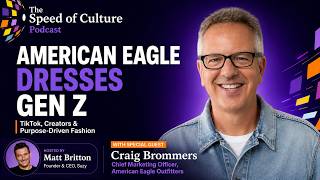
American Eagle's CMO Craig Brommers explains how TikTok turned the brand's marketing upside down. A single creator post can make an item a top seller overnight, so AEO now runs a 700-800 creator program each season and shifted most ad spend to paid social. Retail still accounts for half their revenue, but AI personalization is next.
Chapters
Up today on The Speed of Culture, we're thrilled to be joined by Craig Brommers, the Chief Marketing Officer of American Eagle Outfitters. Craig brings a wealth of experience from leading iconic global brands, and today he'll share his insights on brand collaborations, connecting with Gen Z, and creating purpose-driven marketing strategies. Craig, so great to see you today. Really looking forward to this.
Matt, thanks for having me. This is gonna be fun.
Absolutely. So tell me, how did you find your way into the apparel industry?
You know what's funny? I got some great advice from someone pretty close to me, my mom, and she said, "Do what you love and love what you do." And I've architected my career around industries that I love. I started out in sports, I dabbled in politics for a moment, and then I've always been fascinated by retail and fashion. And so the last story arc of my career has been spent at iconic American retailers like Calvin Klein, like Gap, like Abercrombie Fitch, and now here at Gen Z's number one retailer, American Eagle.
And when you joined Abercrombie, it was in 2013, so it was about 10 years ago. How would you say the apparel industry has changed the most in the last decade?
There's one thing that's changed it the most. It's called TikTok. And I'm actually not joking. The reality is social media has certainly influenced consumers, especially our young G, customer— sorry, Gen Z customer here at American Eagle. But TikTok has really changed the game in terms of virality. The first call that our head of e-commerce makes when he sees something weird in terms of product sales, usually weird meaning good.
Yeah.
Has this thing gone viral on TikTok? I think it's an incredibly powerful platform, incredibly visual and audio, and it's really changed our industry.
So let's unpack that a little bit. So a creator will wear one of your outfits or accessories in a video that gets highly shared, and all of a sudden you start seeing tremendous volume. Is it that simple?
It is, Matt, and I'll give you a real-life example.
Please.
So Alex Earle is one of the top creators on TikTok. I went to bed one night, woke up the next morning, my phone was blowing up from other CMO friends that said, "How did you get Alex Earle to say such positive things about a very specific American Eagle fit. Turns out that fit was the 65th bestseller on the day I went to sleep. The next morning, it was already in our top 5 sales.
Wow.
And that trend just basically blew up. So I think that is the power of TikTok and certainly the power of creators and influencers and their impact on Gen Z customers.
So how does that change, I guess, your prioritization when you're thinking every year? I'm sure right now you're planning for 2025, and traditionally most brands would say, okay, we have a pot of money and the first thing we're gonna fill in our champagne tower, if you will, is mass media. So we're gonna buy billboards, we're gonna buy television spots, we're gonna paid social, and then further down the line you have more alternative spend, and traditionally that's where influencers and creators have come. Is that being flipped around? 'Cause I would imagine you have to kind of relook at your entire marketing mix based upon anecdote you just gave me.
Yeah, Matt, it's changed the way that we approach our marketing mix in two ways. First, we actually have to be more flexible, more nimble, and make decisions way closer.
Be reactive, right?
Exactly. So if I reflect back on my personal career, when you think about places like Calvin and Abercrombie, those were high-touch, high-control, high-command marketing roles. And now I think the flip has been switched, and my role is more around enabling and supporting not just my team, but actually our community to lead us where they want to lead us. Another real-world example: late June this year, we soft-launched with literally no marketing support a Snoopy Halloween collection. Again, late June, kids have just gotten out of school. You probably know what I'm about to say. That was the number one selling item on AE.com and still the top search term on AE.com. And that's through a back-to-school season that for Gen Z's number one market share jeans brand should be all about jeans. And it wasn't. So that flexibility, that nimbleness. And then to your point, you know, we've really just had, had to continue to shove money over into paid social to take advantage of TikTok, of Insta, of Snap and, and other platforms. Yeah.
So when you're taking advantage of a platform like TikTok, how much of it is your brands creating their own content? And what I found is a lot of brands really struggle in terms of creating content for TikTok that's really native to the platform. It looks too polished, too much like an ad, and as we both know, that's not really, really work. So what's your journey and experience been around creating content yourself in those platforms?
Matt, our journey is that we've tried it all, and yet it ultimately ends up that creator or customer content by far performs better than anything that we do. And so today we're roughly 90% creator-led content because that's what's driving performance. It's a platform that people really want to see and hear from people that look like themselves, and they certainly do not want a slick TV-like ad from a company. Now, there are other places that we do put more highly produced content, and it does work. I would say TikTok is definitely not that platform.
So basically trying to get creators to create in the platform, are you going out and trying to source them and just kind of giving them the green light to say, "Create content on your own." And in that regard, like how much creative control do you give them and authority? 'Cause I've also seen brands hire creators and actually force them to create content that an ad agency would create. So how's that balance play at a brand like yours?
So there's a number of different ways to approach scaling TikTok creators. One is the simple fact that we work with somewhere between 700 and 800 creators in any one given season. And I just want to drive that point home for your listeners.
Wow.
Because scale is so important. And while we do dabble with some of the biggest names on the platform, I actually find the mid-range, and I'm talking about mid-range in terms of followers, is where you can really drive true results. So that's one takeaway for your listeners. Two, we are selecting creators. However, because of our brand size, because of our brand strength, we do have creators coming to us as well. So there's a natural dialogue both ways. I would say one other great platform for us is actually our store associates. If you think about it, we have 35,000 mostly Gen Z store associates. They're great creators of content for us as well. But I think as we think about TikTok and other social influencer platforms over the next year or two or three, I think scaling is going to be the name of the game. And that's certainly what we're thinking about right now.
So from an operational standpoint, how do you actually bring that to life? How do you work with 800 different creators who all have nuances about them and different ways that they wanna produce content and communicate with you to make sure that you're kind of bringing a cohesive approach into the marketplace.
I think one of the biggest things that I've learned in the last decade in being in one of these CMO roles is, again, 10-ish years ago, high control, high command. Now, I don't wanna say that we're not in control, but I definitely think that we have co-creation with our customers, co-creation with creators, and I and my team have to feel more comfortable about lessening that control.
Of course. Well, in the Alex Earl situation, it was happening whether you wanted to or not. Yes. Being good for your brand, but you didn't have any control over it and then you tried to take advantage of it.
Exactly, Matt. So I think today we're going to the market with looser briefs and we are not being too over-controlling in terms of the content that people develop. Because I think when brands do that, at least Gen Z, but I think all customers see through it. And I think that you're working with a creator so that he or she or they are bringing something to the market that feels uniquely themselves. And I think that that feels like a right source of success for us.
Yeah, so we've talked a lot about creators, but you also are working with more, I guess you can call traditional celebrities. You have Live Your Life campaign where you're working with sports stars like Coco Gauff and Trevor Lawrence. You have a big collaboration with Timberland. Tell us about those campaigns and what the role of more traditional celebrities in sports and entertainment as part of your overall approach.
You're nailing on the head on one thing. I think what we found the key to our success is that we have to do it all.
Yeah.
We don't just do micro-influencers or mid-range influencers. We actually do have to still work with people that are cutting through culture and are really in fact driving culture. I think as you reflect back on our fall campaign, which was this Live Your Life brand platform launch, I think you'll notice that Athletes are something that we are leaning into more than ever. I think fandom and fashion have collided.
Yeah.
And athletes, whether it's through tunnel walks or what they're wearing on the court, or for us, just importantly, what they're wearing in their daily lives has become a public source of fascination. And that's what led to our work with Coco Gauff and Trevor Lawrence. I also think that Gen Z is streaming more than ever, and that's why we're working with Talent from Outer Banks, talent from The Summer I Turned Pretty, talent from The Walter Boys. These are all the top streamed shows on Netflix, on Amazon, and then other platforms. And so while they're, I guess, more traditional air quotes than creators and influencers, they still feel different from where we were as a retail industry 5, 10, 15 years ago when you were really being driven mostly by film, sometimes by music. I think that youth culture is really driving it. And so you see athletes, you see streaming, you see gaming, you even see people that are making an impact in their community, doing good in their community, you know, playing a larger and larger role in our campaigns.
Yeah, I mean, it's interesting that you lean to sports. I mean, you probably know this, but out of the top 100 watched live telecasts on television, I think 82 I'm looking at were NFL games. So it's very hard on the traditional television medium to reach consumers when so much is time shifted and streamed. And if you want to really garner those eyeballs, sports is really where it's at. So I think Trevor Lawrence may not be a name that's on the tip of everyone's tongue traditionally when they think about American Eagle, but in terms of reach and eyeballs, most male Gen Z consumers that like the NFL—
All.
All rather. Know Trevor Lawrence. And I should also add that the NFL isn't just the most watched live program amongst male viewers, but also female viewers. And obviously you're using female athletes as well, like Coco Gaal.
Yeah.
So I definitely think you're going in the right direction, leaning to kind of the crossroads of sports and fashion.
And I think, Matt, the key thing for us has been it's not just about what they're doing on the field of competition, it's their overall story. Yeah, of course. We've also been a leader in the NIL space and working with college athletes has just fascinating. Fascinating why? Because the typical college football and men's college basketball stars— well, perform fine— are actually not our best performers. The best performers tend to be female athletes in more niche sports, and they tend to actually be great creators of content themselves. And again, our audience is finding their stories more interesting than necessarily their accomplishments. on the court or on a field.
Yeah, I'm glad you brought that up. So NIL, for those in the audience that don't know what it is, stands for name, interest, and likeness. And there is a big new legislative change as relates to amateur and college athletes about 3 or 4 years ago, I think, where now instead of them not being able to make any money, which was creating, I think, a lot of issues given how much money the schools are making in broadcast rights from having these big college sports on TV while you had a lot of college athletes struggling to even be able to like live a decent life, right? Now they have the ability to essentially leverage their persona and get sponsorships to basically be able to pay the bills along the way and start to monetize their influence before they go pro, which many never do. So do you approach these college athletes the same way you do any other influencer? And how did your company react to a big change like, like the NIL shift that we saw in college athletics.
You're right, Matt. We do look at 'em as creators and influencers, but people that happen to be athletes. I also think these athletes are so, these college athletes in particular, are so fascinating to our audience because Gen Z is the ultimate hustle generation.
Yeah.
And when you look at these college athletes, think about everything that they're juggling. Of course, they're competing, but they're students as well. They're often active in their local community. Now they're business people as they're signing NIL deals. But that hustle, I think, is really attractive to our general Gen Z audience too, because individuals within this generation cannot be defined maybe like a Gen Xer like myself was. You are an athlete or you are in a band or you are a student. They're all these things. And so I think student athletes have really hit a nerve in a particular way that maybe a typical influencer does not.
So just shifting gears a little bit, you had mentioned retail and you had mentioned the opportunity to kind of leverage your retail associates as ambassadors, which obviously makes a whole lot of sense. American Eagle's unique company because you really do define omnichannel. I believe like it's nearly 50/50 split in terms of sales and revenue between digital and retail. Many from the outside that aren't familiar with your business would probably think, especially given the Gen Z targeted, that it'd be far more ecommerce at this point. What has been the draw and staying power of your retail channel, and how are some new ways you're leveraging it besides the great strategy of turning your associates into ambassadors?
Well, remember, Matt, high schoolers and college-age students who are our core demographic are social creatures.
Yeah.
And, and yes, they're on social media. They are all the time. They obviously always have their phone on their body, But the reality is they're social creatures and want to get out into the real world. And certainly we saw an acceleration of that trend post-pandemic when these kids unfortunately were locked up for a little bit longer than they ever wanted to be. And so I think that we see stores and stores traffic really driving some of the success of our business. And yet we're still continuing to see exciting growth, double-digit growth.
Mm-hmm. Yeah.
On our e-com platform as well. And so I think the mentality that we have is wherever, however, with whoever our customer wants to engage with our brands, we'll be there for them. And that's why, you know, we dabble into things like social commerce. We've had an American Eagle store inside of NBA 2K. That's obviously one of the bigger games on the planet.
Yeah.
So we've been on Roblox selling things. So I just think that you have to find these interesting ways in because retail is not just about retail anymore. Retail is as much the entertainment business—
Right.
As it is the, the retail business. And I feel like our competition is not just the normal retailers that one finds on a mall or on the high streets. It's actually attention. And so that does mean streaming, gaming, and other things.
And in terms of just the overall category, there's been obviously huge growth with these new types of fast fashion players that don't care so much about quality, but they really lean into price, like Temu and Shein. What is your take on the rising popularity of those platforms, and what does it mean for the future of your business?
What I've seen in my career is a cycle where certain fashion players come and certainly make an impact in a moment, but they don't usually survive. And I think that this Gen Z audience and certainly Gen Alpha behind it are becoming smarter that I'm just gonna go there, that Shein and some of these other ultra fast fashion players are not good actors, not good actors for workers, not good actors for the planet.
Yeah.
And I think that where we come in is we want to tell that quality story. We wanna tell a story about how we're, making progress in terms of how sustainable our products are. We want to tell the story of the impact we're making in local communities through things that we're doing, like the launch of the AE Foundation, which is really helping to tackle this mental health crisis with today's youth. So I think really every good story has a good villain.
Mm-hmm.
And I think that when you have someone to compare and contrast yourself with, that can lead to success for your brand. And I think that we're going to tell that story pretty aggressively in the coming years. And I think that our customer base is really tuning in.
Yeah, it's well put. So you'd mentioned earlier Gen Alpha, and of course Gen Z was defined as the first generation to grow up with the phone and specifically the iPhone in the household. And obviously that changed their entire media consumption habits, which led to them really is spending so much time browsing and ultimately buying on social platforms, which is why creators are so important for you. Gen Alpha is the first generation that's gonna grow up knowing no other world where AI exists. So the only world that Gen Alpha knows is a world with AI. So it's gonna be a completely new type of consumer based upon that. Given that, what role do you think AI is gonna play in shaping your business, both from a consumer experience and marketing product development? standpoint moving forward?
I think when I reflect on my retail marketing career, I'm thinking that dot-com e-commerce was one of the massive shifts.
Yeah.
Social media, which we talked a lot about, the next massive shift. And then I think AI will be in fact the next massive shift. Listen, we're already pretty aggressive in what I would call below the line use of AI, especially when we take a look at planning and executing media, and the results have been super impressive. Our ability to hyper-target someone in a much more efficient way has really paid dividends. We're both excited and scared to death on AI above the line, but we are very actively taking a look at what it could do. The interesting thing when you think about the brand values that both American Eagle and Aerie bring to the market is we've been about real, real people. Our sister brand Aerie talking about no retouching on women.
Right.
The American Eagle brand really talking about being yourself, whoever you are, embrace yourself and go out and live your life. I think how we use AI tools to build on our core brand value is gonna be interesting, gonna be tricky, but I think that we will absolutely embrace this new AI future. And I'm fascinated as CMO just to see what could come out of this.
Absolutely. One area I think you're gonna hear a lot more about in 2025 is just personalization.
Mm-hmm.
Because I think the days of everybody getting the same email newsletter, for example, are gonna be over because what you'll be able to do is the more information, especially a company like yours that has the benefit of selling direct, both through retail and online, you're gonna be able to harness so much first-party and zero-party data about your customer base that you're gonna know exactly not only the products they're into, but what are their interests? Are they into Trevor Lawrence? Are they into Timberland? Are they into Alex Hurl? And you're gonna be able to kinda ramp up that type of content in your messaging to them, so Joe Smith and Jen Smith sitting next to each other are yet two completely separate messages. And I think that's gonna really allow you to be more of a content creator and be much more effective in the way that you build your brand amongst your consumer base.
Totally, Matt. And listen, we're already on that road of personalization in many aspects. I know that if you or a family member has just bought a certain product, you're most likely to buy this next, and we're gonna hopefully market to you in a way that both of us will find value from. But to your point, we're just scratching the surface. I think this this thing just continues to accelerate. The amount of content that will be needed to serve personalization is overwhelming, and that's probably where tools like AI will actually come and help us greatly. But again, when I reflect on Gen Z, and to your point, Gen Alpha, I mean, this is a generation that's grown up with Netflix, Spotify, Amazon, and others.
Yeah.
And we both know that when you go to those home screens, it's already personalized all the way down to the creative tile that you see for a show like Outer Banks. I could be served, you know, one character, you could be served another. So I think that we're gonna have to, as an industry, meet that challenge because it's going to be an expectation of consumers that are gonna continue to play a larger and larger part of the buying power in this country and around the world.
Yep. Absolutely. So you're a chief marketing officer, and being someone who's been in and around the advertising industry for 2 decades, the CMO is put on a pedestal. Everybody wants CMOs at conferences and at dinner events, et cetera. And when I speak to so many CMOs through this podcast, they're normal people who put their pants on one leg at a time, just like everyone else. But they obviously have things about them that have made them differentiated and successful over the years. And part of that is obviously the power of partnerships. One question I ask from time to time is, what makes a partner, whether it's an agency or a vendor, or somebody from the outside, valuable to you, Craig, and would be worthy of you spending time with them? Because obviously we have a lot of agencies and other players in the ecosystem that are listening to this podcast.
Yeah, I love that you asked this question, Matt, because honestly, I'm not great at everything, but I think I'm self-aware enough to know that partnerships is something that has really defined my entire career. People matter more than technology, more than tools, at least for me. And I think a great partner is one that unemotionally can challenge you just as much as you can challenge them, cares deeply and passionately about your brand, deeply and passionately about your success, but pushes you into some uncomfortable places. And I think that— Yeah. Whether that's the advertising platforms that we work with, whether it's the agencies we work with. And honestly, even as I reflect, a great partner now, the fact that I go out of my way to ask the most junior members of my team what we should do. And when we hire people, we want you to come in here with a point of view. You don't always have to be right. We make mistakes all the time. I make mistakes all the time, but I want you to have a point of view. And I think that— Mm-hmm. That point of view, again, through all of the partnerships I just put out, has been enormously successful in my career.
Absolutely. So how are you spending your time as CMO in terms of the pie chart of your day?
I love this question as well, Matt, because I was literally this week talking to a student from the University of Texas where my daughter goes, and she was asking that very question. And the reality is, No two days are the same. No two hours are flying at the same altitude. And what do I mean by that is one meeting I could be talking about a 3 to 5 year strategy on something. The next, the bat phone could ring and we are making a promotion change to accelerate the momentum behind a product or solve some challenge that we're facing. The next could be like I did yesterday. I looked at— Uh-huh. The holiday concept for 2025. But yet this morning we were talking about what we call Green Week, which is the week of Black Friday and Cyber Monday and that all-important sales time. So the picture I'm painting for anyone that wants to continue to build their career in this crazy profession called marketing is you have to be able to pivot at all times. And that adrenaline has made my— Mm-hmm. Life and my profession very exciting. And there's many nights I go to bed absolutely gutted, exhausted because the intensity has increased and won't slow down at all for the rest of my career either.
And do you like that pace?
I do. I mean, you know, there are moments that, you know, it's funny because one thing that I built into my day is two, hopefully 30 minutes, but sometimes 15 if I'm honest, but just breathing breaks.
Yeah, super important.
I think just whether it's walking outside or just closing your door and just stopping for a second, I think is important. I think a CMO is constantly challenged to make decisions throughout the day, and I find that I can make better quality decisions or support my team better if you just have a little bit of breathing room. Because if you don't literally program that into your day, It's just an onslaught, and sometimes you get tired, and sometimes you might make poor, poor choices.
Yeah, absolutely. And lastly here, Craig, what are some of the decisions you think you made along the way throughout your career that put you in a position where you are today, leading marketing in an iconic brand like American Eagle?
I think one is to always be curious, and I think that I'm not bashful walking up to someone, picking the phone up to someone, reaching out to someone on LinkedIn, if I find something that sounds interesting and curious. And by the way, Matt, that could also be a failure. Like, again, I—
Yeah, of course.
I really try on my team to talk about it is okay to fail, and we should celebrate failure as much as we celebrate success, because out of failure, you know, you really learn about yourself. You really learn about how to approach something in the future. So I think being curious is probably one. Two, as I mentioned before, I think networking has been such an important part of my career, and I love to talk to other marketers or people in other functions and just kind of understand them a little bit more. I think that's been exciting. And then 3, I think really using the tools of the trade. And I admit all the time that every day I come to work, I'm learning, and I've been doing this for a long time. But I think getting on TikTok or using the AI tools that you you and I have talked about, or going to a store, working in a store. I think you have to actually put yourself in the environment that your customer is. These may have been years ago ivory tower positions. These are not ivory tower positions anymore. I mean, you got to roll up your sleeves, get a little bit dirty, and get in there. And, and I think that's made me personally successful.
Yeah, you, and you also, you know, as you kind of alluded to, always have to connect everything you're doing to business results. We have more pressure on us as leaders than ever before. So everything you're doing in terms of leveraging the company's resources somehow has to drive the growth of your business.
There's no doubt. And Matt, I always say, whether it's to my team or to our external partners, is I don't get to sit in my seat for very long if we aren't driving business results. We could be having great campaigns and Alex Erkel be wearing our jeans and all the things, but if we aren't delivering for our investors, if we aren't grabbing mindshare, if we aren't driving market share, there are many other people that want to sit in the American Eagle CMO seat. I am certain of that. So to your point, that sense of urgency to drive results is always there for myself and my team.
Absolutely. So lastly here, and we always ask this of all of our guests, is there a quote or mantra that comes to mind when you think about your professional journey?
Well, the quote or mantra that comes to mind is something you and I already touched on, and that is love what you do, do what you love. But I mean that very deeply. I think that I spend more time working than I do with my own family and friends, and I hope to— and I have so far— architect a career where I'm having fun doing what I'm doing. That doesn't mean that we don't want to win and we don't want to compete at a high level, but I want to create a very fun environment, of course, for my team, but honestly, selfishly, for myself as well.
Of course.
And this right here at American Eagle has been a ton of fun.
—Yeah, well, it's clear you're having fun, and this interview is also a ton of fun for me, and I've really been looking forward to this, and you did not disappoint. So thanks so much for taking the time to join us today, Craig.
Awesome. Thanks, Matt, for having us.
Absolutely. On behalf of Susan and the Adweek team, thanks again to Craig Brommers, the Chief Marketing Officer of American Eagle Outfitters, for joining us today. Be sure to subscribe, rate, review the Speed of Culture podcast on your favorite podcast platform. Till next time, see you soon, everyone. Take care. Hello.
More from Matt




MikMak’s Rachel Tipograph on Consumer Spending, Retail Media & Holiday Shopping Trends



Jaguar Land Rover’s Charlotte Blank on Luxury, Purpose & Experiential Storytelling



