American Express’s Jessica Ling on Premium, Personalization & the Future of Commerce
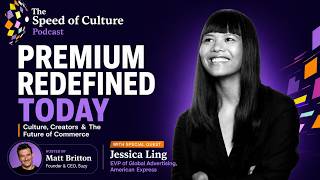
In this Speed of Culture podcast episode, host Matt Britton interviews Jessica Ling, Executive Vice President of Global Advertising at American Express. Ling explains how Amex redefines "premium" as access to experiences that matter to consumers—concerts, travel, dining—rather than a demographic label, and notes that 60% of new accounts are Gen Z and Millennials. She outlines Amex’s strategic focus on entertainment, travel, dining, and sports, leveraging assets like Amex Travel, Resy, and major sports sponsorships. Ling discusses balancing Amex’s 175‑year heritage of trust, security, and service with modern, high‑value product propositions, emphasizing a "game of ands" approach. On global advertising, she stresses that core brand truths stay constant while execution adapts to local cultural nuances. To scale storytelling, Amex builds unified creative platforms (e.g., the "Nothing Like Platinum" platform) that enforce consistency across TV, social, OOH, and experiential assets. The channel mix for 2026 blends live sports TV, social media, and influencer collaborations, with a heavy investment in major sports properties and creator partnerships that feel authentic to members. Ling addresses AI’s emerging role, focusing on optimizing content for large language models, improving discoverability, and using AI for workflow efficiency rather than content generation. She highlights the importance of personalization powered by Amex’s data, while respecting privacy, and notes the need for talent that is digitally savvy, data‑oriented, and comfortable with AI tools. Finally, Ling reflects on her career trajectory from B2B marketing at AOL/Verizon to B2C brand leadership at Amex, emphasizing a generalist foundation and a personal mantra: "Do the things you love."
Chapters
Up to speed on the Speed of Culture podcast. We are thrilled to be joined by Jessica Ling, the Executive Vice President of Global Advertising at American Express. Jessica oversees the global advertising team driving Amex's brand storytelling across media, creative, and culture, from their Nothing Like Platinum campaign to experiences that redefine what premium means today. Jessica, so great seeing you today. Thanks so much for joining.
Thanks so much for having me, Matt.
So what does premium mean today? How has it shifted for Amex's customers? I remember back in the day, the Membership Has Its Privileges campaign, which was so effective. And I always looked at growing up Amex being something that grownups had. And now I think Amex is more of a cool brand and isn't really focused towards people of any age, but more of a lifestyle. Is that sort of how you define what premium is? Like, how does that definition fit in with today's brand?
Yeah, it's a really good question. And really, I love how you see the brand. It's very much how we see our brand also, which is one, it's attracting a younger and younger base. So 60% of our new accounts are Gen Z and millennials. So increasingly an attractive proposition for younger consumers. But what I would say in terms of premium is it's really simple. For us, premium means access to the things that you love. And so for a a Gen Z consumer, that could be a really incredible concert or sporting event. For millennials, it could be a really elevated travel experience, right? And so for us, premium, it's not about a certain type of consumer or card member. It's really about the access they get to get just closer to experiences they care most about.
And how are you able to effectively, with consistency, I might add, like curate those experiences? Because obviously IMAX can't grant access to everything. Like, how do you know the areas to really dive in and make those big investments in?
We're super focused in a couple of key areas, right? So we look a lot at entertainment. And so when you think about some of the biggest names in pop culture, whether that's Olivia Rodrigo, and thinking about how do we focus really in on the artists and platforms that our, our customers care most about. We think a lot about travel. Amex Travel is one of the largest online travel agencies in the world. And so through that platform, we create value through fine hotels and resorts, through all those kinds of travel benefits. And we think a lot about dining. So I think we have Resy as part of our portfolio and giving customers access to really incredible dining experiences is again part of our focus. And so you're right, there are so many different things we could go after. We really think about sports and entertainment, dining and travel.
It's interesting because the brand is seen as a more younger contemporary brand, but at the same time, like recently the annual membership fees went up and it seems that like that went off without a blip, meaning like there is like an insatiable demand for these premium experiences and premium products, even with younger consumers. And I guess just from a broader economic standpoint, like what do you think is driving that? Why are younger consumers able to afford such a premium card?
I think it's a couple of things, but I also think that while what you're talking about in terms of access to experiences is quite an emotional proposition, we continue to also deliver a ton of rational value. At our core, we are both. We are a brand that creates incredible emotional connections with our customers, and we are a brand that delivers tremendous value. So you talk about the fees going up on the Platinum product specifically. We're offering $3,500 in value. And so our customers can do that math and they can see that the value on those products—
I did the math, Jess, so it's all good with me.
Yeah. Then you know yourself, far exceeds the fee.
Yeah. And just in terms of the brand itself, I mean, Amex I think has been around for 175 years and obviously has a deep legacy and heritage, and obviously you need to modernize it, but you also need to hold on to the brand pillars and you can't lose trust. And obviously you can alienate consumers that have been with you for a while. How do you look at that balance as you move the brand forward?
Matt, it's a game of ands, not ors. We have to do both. And so when we think about 175 years, that's 175 years built on trust, service, and security. People trust our brand. They trust that when they interact with our brand, they'll do so in a way that is secure and safe. And we have to continue to drive that foundation while also modernizing it. So for us, what that looks like is a brand that has a very strong foundation. And the way that we think about it is powerful backing. And so our brand platform is all about supporting our customers to succeed in life and business. And then what we do to modernize it is to create those product value propositions and benefits that feel very, very modern on top of that baseline of security and trust. And so really what it is, is when you have an Amex product, you move with confidence financially and through the experiences that you want. And you know that that benefit that we're going to deliver is the thing that is on the top of the culture list. It's the restaurants that are on all of the sort of must-go lists and travel guides. And so it really is that blend.
And Jess, I know you oversee not just the advertising organization, but the global advertising organization at Amex. When you look at sort of global reach and global messaging, what is the hardest part about creating work and connecting with audiences around the world? In, well, different markets and different cultures?
I think, Matt, at the core, the brand doesn't change. It continues to be about powerful backing. It continues to be about trust, security, and service. I mean, we have been in some of our biggest international markets for almost as long as we've been in the US. And so we have long legacies as a global brand. How those benefits and stories come to life are unique by market. And so what customers care deeply about in the UK may look a little bit different from what they care deeply deeply about in the US, but at its core, we continue to build our brand on that intersection between emotional and rational, and we continue to build really relevant and modern value propositions. It's just, you know, if you're in New York, you love the US Open. If you are in London, you might be thinking about Wimbledon. It's, we think about different expressions, but always to the same brand truths.
Yeah. And you mentioned the word stories and obviously storytelling and especially when you think about today's consumer. You know, I saw a stat the other day that for the first time ever this year, the average age of a first-time mom is part of the iPhone generation. So it's not just kids now that have grown up with the mobile device in the household. It is now slowly becoming the core household buyer, which basically means if you want to reach that consumer, you need to reach them on the mobile device. And as we both know, that requires much more stories and content than traditional advertising. And obviously Amex knows this better than anyone else. When you think about a storytelling engine to be able to do it consistently, like what is your approach for storytelling and content creation that makes it scalable and reliable to really continue to drive the brand forward?
Matt, that is a thing that people who have my job, it's what keeps us up at night. How do you think about message consistency and how do you think about scalable platforms that can sort of elevate and shift with the customer experiences by channel. And I think for us it's a couple of things. How do you create a platform that transcends channel and format? And so what is that overarching creative strategy that holds everything together? And if you look at our most recent work for Platinum, that platform was really simple. It was, there's nothing like Platinum. But in that platform, it forced us into an incredibly disciplined space because everything we said, every benefit we communicated, there had to be nothing else like that.
Kind of set the standard for everything you do, right?
And so like for us, that means if you're shooting a TV spot or you're shooting a social asset or you're looking at out-of-home, go shoot in a real location, go to a real Rezi restaurant, go to a Centurion Lounge. And what that does is, one, it forces everyone to elevate how they're producing and going to market. And two, it creates that consistent thread so that whenever it's if you see our brand and you see that message, there's a ton of cohesion. And so for us, it's about the strength of those platforms and really pushing and pressure testing them. And then it's continuing to drive just ownership and differentiation within those and how you bring them to life.
And in terms of obviously the channels that you leverage, TV is far from dead, and we'll see in the Super Bowl in a couple months that it's gonna be sold out again. So I think that's definitely a, a misperception about the market, but at the same time, social media is undoubtedly where it's at in terms of where eyeballs are. How would you look at a channel mix heading into 2026 to keep up with evolving consumer?
Again, Matt, it is for us a game of and. We are in live sports TV because our audiences are passionate about sports, right?
And what are some of the sports you guys are investing in?
We invest heavily in sort of all the major sports. And from a media perspective, NBA, NFL, baseball, it's a lot of them. US Open tennis. And for us, those are some of the biggest moments in culture, right? And so if you have a brand who is in the cultural conversation, it's hard not to be part of that sports conversation. And so when we think about our presence, one, we want to be where our customers are and we want to make sure that we are driving relevant storytelling in those spaces. And we also need to make sure that we are driving incremental reach with every single channel and partner that we add. And so for me, it is very much how do you build a strong foundation and reach as many people as you can. And then how do you, every time you add on to that layer cake, how do you drive more and more incremental engagement? And you can't do that without social. So it is for us very much about both.
And obviously when you talk about social or really just distribution in general, a growing trend is tapping into creators and influencers because they have now become the new media force. What is MX's approach to working with creators, influencers, and do you still lean into traditional celebrities as well? How do you see see that evolving?
I think that from an influencer perspective, they are an important part of our mix. They help us speak authentically to customers we care a lot about, and they help us find customers that we couldn't necessarily get to in an authentic way otherwise. And so I think that it's a really important part of our overall mix. When you think about the more traditional celebrities, you know, I've mentioned Olivia Rodrigo. She played a big part in our recent Platinum launch, and for us, What was really important for that relationship was she's part of the Amex membership story as well. So she is both a wonderful way to reach and engage Gen Z consumers. And when you're with Amex, you get closer to Olivia Rodrigo. We have card member events, we have special access, we have very specific swag and other types of ways of tapping into fandom. And so for us, it really is that magical unlock of people who help us drive incremental reach and engagement. And in the case of people like Olivia Rodrigo, people who represent membership, and in that case, it's the best of both.
We'll be right back with the Speed of Culture after a few words from our sponsors. As we head here into 2026, obviously AI has been the buzzword du jour of 2025, and I don't think it's gonna change heading into next year. And one particular area that I'm really fascinated by is just the shift in the front door of the internet from Google to perhaps more chat-based interfaces like ChatGPT and Google's Gemini, et cetera. Obviously, I'm sure somebody who sits on top of Amex's marketing association has to be thinking about that shift and what it means for how you push out content, how you look at the overall consumer journey. What are your thoughts just, I guess, more broadly about how AI is going to impact the consumer journey from overall awareness to consideration and through purchase? And what role is Amex looking to play in that?
Look, to your point, we cannot think about that. It has to be on the forefront of how we think about the future of content, the future of commerce. And what I would say is we're in learning mode just like everybody else. But very, very much on the top of my mind is how do you optimize your content for LLMs, right? And how do you think about discoverability? What is the future of search? And of course, what is the future of commerce? Because right now, so many— and that for us is, that's more from a payments perspective also, not just a marketing perspective. And so that is for us a huge, huge area of focus. When you figure out all of the secrets, you should— you need to call me and tell me too.
Yeah, I mean, we're recording this in November and it was just announced yesterday that Target is opening up a quote unquote store on ChatGPT. And I think We're really in the early stages. It reminds me when Facebook just took off and everyone's building Facebook apps and it was sort of like a gold rush, if you will, to be there. And then a lot of the activities ended up being more gimmicky. And over time, the platform itself changed and it was less about Facebook apps and it was more about where it is today, which is content. But I think it's going to be interesting to see how some of these big brands experience early on and at what point consumers are really going to get comfortable buying on ChatGPT? Because if you think about it, I do think it is a more convenient buying experience because you're getting that advice and you're going further down the funnel. And if you trust this chatbot that knows everything about you, then it could make the shopping experience easier. And from your seat, I, I'm sure one of the things your company must be thinking about is, well, if they do buy on ChatGPT or Gemini, like how can we make sure they're buying with an Amex card?
Right? Yes. That's exactly why I said it's as much a payments question as it is a marketing question, right? I mean, all of this is both, and I I think one of the things that we have always talked about but becomes much, much more urgent is just how you think about the customer journey and customer lifecycle overall. When you think about sort of more traditional notions of brand building, we don't have some of those luxuries anymore in an AI and agentic world. And so what I think about a lot is how does our brand show up? How do we understand and optimize for LLMs? Like, that is a whole different way of thinking about content and brand building. I think it's really, really exciting, but I think I'm like a lot of other people, really curious and sort of in learning mode.
Yeah. I mean, of course, the ultimate unlock in AI is data, and data is something that Amex has no shortage of. I know that you guys really pride yourself on privacy of your cardholders, but at the same time, you have access to tons of transaction data and merchant data and all of these things. I'm sure if fed into a model could unlock some pretty incredible opportunities and applications for the brand?
Matt, it's all about personalization, so it will be. And I think that it continues to just give us more and more ways to create more personalized experiences and also more connected experiences, right? Because if you think about the ecosystem across Amex, not just purchases, but where you go to eat, where you like to travel, thinking about all of the sports you like to consume and the teams you want to see live. If you think about all of those, harnessing the power and creating a more connected experience for our customers is key.
And how do you see AI impacting the creative process at MX? Obviously, it's pretty controversial. There sometimes can be some consumer backlash when they find out that brands are using AI, although I would imagine it's being used more often than they think. How are you looking at AI within the creative process, and are you using it personally in your everyday kind of workflow?
So what I would say there is for us, AI is very much in efficiency and potential efficiencies in production, not in the actual output and content generation. So for me, I oversee the in-house agency at American Express, and for me, I'm trying to reduce friction and I'm trying to look at the ways in which we get work done and say, is there a faster way of doing this? It doesn't replace the creativity. We're not using artificially generated images or anything like that. But what we are looking at is are there areas in workflow and is— are there areas where we can use AI to help us move faster and more efficiently? So that's really the focus here is how do I help my teams work faster and smarter, not how do I sort of— it's not customer-facing right now.
Makes sense. And when you look at your teams using AI and just overall them evolving with the times, what are some of the skill sets that you find prevalent in your high performers within your organization? And is that different today than it was 5 years ago?
Matt, I think the skill sets continue to evolve. I think, look, being tech-forward and having a really sort of like digitally savvy orientation is helpful no matter what. I think the way we look at sort of the talent of the future is can you transcend channel and really think about customer and what kinds of data orientations do you need in order to make the right decisions? And for us, That's what I look for, is you have all of these incredibly trained technicians, and I think there's wonderful training that goes into our ability to execute wonderful work. The future of that is how do you bring all of that work together in service of the customer? And that's the unlock for me. And so do I want folks who are increasingly comfortable using AI and using tech-enabled tools? Of course I do. That's the future of the, talent pool, but I also want them to use it in service of the customer and in service of an elevated experience.
Yeah. And you mentioned earlier quickly personalization, and I couldn't agree more in terms of that being one of the ultimate unlocks of AI in the world of advertising and marketing, because I think for so long we've talked about personalization, but I think it's largely just been a buzzword where most companies, when they send out an email to a million people, maybe besides their name being customized, it's not much different. But now We should all be building for audience of one where we can kind of synthesize information that we have on a unique user or customer and give them what we know that they care about and what they believe in. And with your brand and all the assets and entertainment properties and you have access to, I imagine you have such an incredible opportunity to really deliver such value for your cardholders.
Yeah. And when we talk about digital experiences, that's where I see a lot of that coming together. And so when you think about when you go in to that Amex app, how have we created connected and personalized experiences for you? For me, it's not about the data. The data is there. It's about how do you create the interfaces and structures around that data for customers to be able to leverage. I think that's where we continue to push innovation.
Absolutely. So let's shift gears a little bit to you and your career journey. You know, you've worked at so many great ad tech companies and companies that focused on data and you spent a lot of time at AOL and Verizon, which ended up acquiring AOL. So you've been steeped in B2B marketing, working with advertisers and where technology meets the advertising and marketing function. As you look back on your career journey, that's when you— to the seat you're in today, what are some of the decisions along your career journey that you think were the right ones? And then separately, like when you decided to make the leap from one company to the next, How did you know it was the right time? Because I think that's something a lot of people think about as they're successful, as they're moving up the chain. Should I stay here or is there something else for me?
It's such a good question, Matt. And I wish that I could tell you that every single move was made with all of the foresight and prediction that I, I could have manifested all of it. I think early in my career, I followed opportunities and I followed opportunities that I thought would expand my portfolio. And so, I'll, I'll give you a really good example. You know, when I was in my late 20s, I was in sort of a marketing generalist role and it was totally fine, but I worried a little bit at night about whether or not I could do enough. Like when push came to shove, could I do the stuff? Could I create a PR plan? Could I make sales collateral? Could I write a website? Could I throw an event?
Right? Hands on keyboard, basically.
Yeah. And there are people who have grown up doing each of those things, and there are people who grow up more generalists or more strategists. And I had a little bit of a more traditional approach. I went from an agency into account management, and then I went into marketing from account management. And so for me, I went from a Fortune 50 company to a startup because I wanted to be hands on keyboard, because I thought there would come a day where I would need to be able to throw an event and I would need to have already known how to do that. And so some of those decisions were about just building and so, and building horizontally. So those were some. And then I was really curious about video and I was really curious about mobile. And then I was really curious about how, especially in the case of AOL, which was at the time incredibly acquisitive on the B2B side, how do you continue to build like a revenue discipline in marketing. And so I think that transition was really important for me leading B2B and industry marketing organizations to really think about how does marketing impact the P&L in a really powerful way. And so that was the path that led me to American Express was B2B, and I came into the commercial business and helped run small business marketing. And that background in B2B and in performance marketing is also what led me to the brand seat that I'm in now. And how do you take what is an incredible brand organization and layer performance mindset and orientation to it?
And I'm glad you brought this up. I mean, making the shift from B2B to B2C, was that less of a, I guess, shockwave to you in terms of the way that you thought about going to market, or was it more like, did you wake up one day and say, this is kind of the same thing, or is it completely different?
It's pretty much the same thing.
Yeah, that's what I thought.
Right. I don't know. You'll have to tell me. I've only made the transition in one direction from B2B.
I agree with you. Yeah. I mean, I don't have a lot of B2C experience, but I would imagine that, you know, mom shops for businesses the same way she does for Tide. She buys from brands she trusts, and it's about data and reach and frequency and relevance.
Ultimately it is. I mean, look, what B2B trains you to do really well is to know your customer and understand segmentation. I mean, B2C also, but like, you really start to get underneath mindsets. It also helps you understand sales and revenue and sales-facing organizations as a very powerful channel for your brand. And so it just trains you in different muscles. But at its core, what makes good B2B marketers are people who understand how to create and communicate value propositions. And that's the same thing that makes a great B2C marketer.
I agree more. So just to wrap it up here, we always ask our guests if there's a saying or mantra that's helped sort of encapsulate their career journey to date? And just very curious what comes to mind for you.
Yeah, it's a great question. For me, it's really easy. It's just do the things that you love. And I think that there are a lot of people who try to muscle their way through things they don't love. And I think when you focus on the things that make you happy, you're also better at them. And so, that's been the mantra.
Yeah. Well, it's clear that you're doing just that at Amex, and it shows in your passion for the work and the results that you're able to bring for such a great brand. And so congrats on all your success and thanks for taking time outta your busy schedule to chat with us here today on the podcast.
Awesome. Thank you so much. It's been fun.
Absolutely. On behalf of Susan and I, we team, thanks again to Jessica Ling, the Executive Vice President of Global Advertising at American Express, for joining us today. Be sure to subscribe, rate, review the Speed to Culture podcast on your favorite podcast platform. So next time, see you soon everyone. Use your Amex and take care.
More from Matt




MikMak’s Rachel Tipograph on Consumer Spending, Retail Media & Holiday Shopping Trends



Jaguar Land Rover’s Charlotte Blank on Luxury, Purpose & Experiential Storytelling



