Barry’s Joey Gonzalez on Boutique Fitness, Community & Global Growth
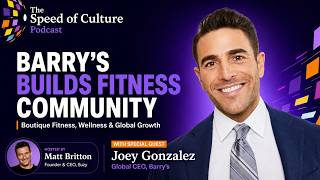
In this Speed of Culture podcast episode, host Matt Britton interviews Joey Gonzalez, the global CEO of Barry’s, a boutique fitness brand celebrating its 25th anniversary with 84 studios in 14 countries. The conversation traces Joey’s unconventional journey from a childhood actor in Chicago to a fitness trainer, detailing how he discovered Barry’s as a customer, became a trainer, and then proved the concept’s portability by opening studios across the U.S. He recounts the high‑risk financial moves he made—leveraging a second mortgage and personal assets—to launch a flagship New York studio during the 2009 financial crisis, and how he premium‑ized the experience with locker rooms, a Fuel Bar, and larger capital investments. Joey explains his evolution from operations head to global CEO, the role of investors and the pandemic, and his current focus on expansion, product innovation (Barry’s Lift, Barry’s Ride), and community‑driven growth. He highlights post‑COVID consumer trends favoring in‑person, HIIT‑focused workouts, the importance of organic referral campaigns, and a marketing strategy centered on Instagram and user‑generated content. The interview also covers international franchising, localizing studio design while maintaining a consistent “Red Room” experience, nuanced pricing strategies across markets, and Joey’s servant‑leadership philosophy. He concludes with a personal mantra: replace fear with focus.
Chapters
Up today, we're gonna speak with Joey Gonzalez, the global CEO of Barry's, a health and fitness brand that will be celebrating its 25th anniversary this year. It has 84 studios across 14 countries, as in the period of massive expansion. Joey, it's so great to see you. I've been so looking forward to doing this. Thanks for joining today's Speed of Culture.
You as well. Thank you for having me.
Absolutely. We're here in Miami, uh, your hometown, and, uh, I'm really excited to just dig into how you started in this role at Barry's and how it's kind of evolved over time and kind of where the business is headed. So why don't we start with your background? Okay.
Yeah. Well, background is actually unrelated to business. I grew up in Chicago and was a childhood actor. Oh, wow.
From the age— Were you in anything I would know of?
I did a lot of like, The Untouchables was a TV show. I would play young Eliot Ness. I did a movie called Matinee with John Goodman. I did a lot of, random things here and there. Worked throughout most of high school, ended up at USC to study film, TV, and continue to pursue acting, and then fell very out of love with it when I entered the real world of Hollywood.
Yeah.
California was very different and started immediately, I'd say at like 23, 24 years old, trying to find another job, but committed to this idea that I had to be obsessed with and in love with what I did. Otherwise— And did you—
I'm going to stop you there because my daughter's into acting. She just started college. And there's these sort of passion careers you go into. And sometimes they can turn into your lifetime love and business. But often they don't, whether it's in sports or in entertainment, et cetera. When you realized that, was that a hard realization for you to come to grips with? And how were you able to kind of get back on your feet again and say, you know what? I'm going to do something else. It's going to be OK?
It's crushing because in order to pursue something like that and to get through so many years of rejection, you have to truly believe that it's what you're meant to do. So to have that sort of sobering moment where you say to yourself, this is not what you're meant to do, I need to find something else, is extremely depressing. And I had a few like really dark years where, you know, I was trying to figure out what to do. I did real estate, I did massage therapy, I did— I worked in restaurants.
Oh, in LA, right?
Yeah.
Which isn't an easy place to reinvent yourself. No.
Challenging, right? But the one thing I knew, and the reason why I kept quitting things, is that I was not going to resign myself to just doing something to get by, even if I was good at it. I wanted to do something that I was great at and knew that if I found something I love, I'd feel like I never worked a day in my life, the same way I did with acting.
So— So what did you kind of, I guess, stumble into?
So I had heard about Barry's Bootcamp for about—
Formerly known as.
Formerly known as, for about a year and a half before I finally worked up the courage to go. And when I finally went, all of these sort of preconceived notions I had about it were totally shattered.
You're saying to go as an actual customer to actually check it out. As a customer.
Yeah, to work out with. I just was terrified. I wasn't super fit. I didn't run. I wasn't weightlifting a lot either. And that's basically, you know, it's running and lifting. And so I finally showed up up and was, you know, welcomed with a friendly face. I had the most fun experience, even though I couldn't necessarily keep up with everybody. I felt like it was okay, and I left only thinking about the next time I could come back. And after probably 6 months of going to Barry's, I'd say twice a day I was going, Barry finally noticed and said, do you want to be a trainer here?
Barry, the founder of the company.
Barry. Yeah. Barry Jay's the founder of the company. And I can pivot to sort of how Barry's started if you want to hear that story.
Sure.
It's a quick one. It's a great one.
Yes.
So Barry was teaching at Gold's Gym Hollywood and he was dividing his, you know, group fitness training room in half and sending half of them out to grab huge weights and come back and the other half to get on treadmills. And he was running back and forth screaming direction to each of them. And eventually, you know, after a few weeks got fired. But his clients had gotten so hooked on it and they saw immediate results and they fell in love with it that two of his fans invested in him opening up Barry's Bootcamp, which essentially gave birth to the boutique fitness industry because there was really nothing prior to that. So Barry is definitely a mad scientist and a major disruptor.
Wow.
And Gold's Gym should have invested.
That was a great story. Yeah, sure, exactly. Where are they today, right? I'm glad you shared that. Very interesting.
So yeah, I fell in love with the business. He asked me to be a trainer. I knew within the first couple of weeks of being an instructor, which fit really easily for me because we actually call our instructors intertrainers because they're half fitness and the other half is performance.
Right.
And so you're on a mic, you're a DJ, you're making people laugh, smile, feel good, filling the space with entertainment. I knew within a few weeks that this was something I wanted to I had people visiting me from all over the country. Also, my parent— my mom's from Italy, my dad's from Cuba, so I have a lot of international friends and family as well. And everyone would say the same thing, that this could really work where I live. And the founders in Barry didn't necessarily believe that. They thought it was very Hollywood-centric. So I really was the guy who stepped in, invested, you know, put my money where my mouth was, and essentially started to move around the country, prove its portability, create the the tools to scale.
You basically told Barry, "Let me show you that this is applicability across the country." Exactly. And you went to different markets and actually, what, did you just rent out a space and start running classes on your own?
Yeah. Exactly. Well, yeah, I would obviously go to the space. I'd live there for a period of time. I'd hire and train all the instructors with the manuals that I drafted, would do the same thing with the operations teams.
So it wasn't like testing, you were rolling out locations.
I was rolling out the source.
Yeah.
Yep.
And when did you know, or how soon did you know that this really was gonna be the hit that it is today?
It's one of those moments where the, I think the bigger the risk, the bigger the reward. So I was engaged at the time, living in LA. I had opened San Diego. It was successful enough, but it opened in January of 2009. So it wasn't the best time in the world.
Right after the global financial crisis or in the midst of it really.
Yeah. So premium, you know, boutique fitness was not necessarily top of mind for consumers, but it still did well. Still did well. I think we paid back in like 9 months or something like that, which was pretty extraordinary. And that's when I decided I wanted to do— I wanted to go big time. I wanted to go to New York City and I wanted to evolve the concept and make it something bigger and better than it had ever been. Because up until this point, Barry's was the best workout in the world. I mean, at the core, its efficacy is what really brought people back. That was it. It was no frills. There was one toilet in the red room. So if anyone went, you knew. There were long lines of people waiting to change before class and after class. And so I really wanted to sort of raise the bar, premiumize the experience. I added locker rooms and showers. I brought in a great premium amenities partner. I started something called the Fuel Bar, which is our food and beverage experience. My husband's a chef, so he helped me develop all those recipes. And, but all of this from the build-out to the rent came at a very large cost. And so we ended up spending 4 times what we had spent on any previous studio.
And was Barry okay with that, or did you— was there a lot of back and forth because he was more focused on the—
Barry and the investors had, you know, the core business in LA that was helping them fund future studios. It was really me who was coming up with the other 50% that took on a ton of risk.
Right.
And so what I did, I had bought a house from the money I'd made in acting. I leveraged that asset, which was all I had, took out a second mortgage, which, you know, can be very high risk.
Of course.
And if you default on that, you're really screwed.
Yeah.
And I had no backup. And moved to New York for what I thought was going to be 6 to 12 months, ended up being 5 years. So essentially risked everything in my life, my relationship. I was engaged. I'm going across the country. He was very supportive. Thank God we're married today. So everything worked out.
That's great.
But financially, I risked everything. And that store blew our P&Ls. What we had projected, we were at, you know, by month 3, we were at year 7 or so.
And how different was the New York experience given that you sort of annex the entire concept and run it on your own, then what had started in LA was a kind of night and day. Like if you were to go from New York to LA, would it even feel like the same brand?
Very, yes, very different. There were a lot of brand inconsistencies that remained for about the next, I would say, 4 to 5 years as we started to level up. All new studios felt like Chelsea, the original New York City studio. But, you know, take San Diego as an example. We had to wait a long time. It was only about 5 years ago where the adjacent space finally became available.
Right.
And so we knocked down the wall, we signed the lease and we added locker rooms and showers, right? So almost every studio is now up to brand standards. There are only a few remaining that haven't, you know, vintage studios that haven't been upgraded, so to speak. But out of the 84, you know, I'd say 80 of them are exactly like Chelsea.
Got it. So, and in 2015, so I guess 5 to 6 years later than when you first opened up your own, you know, location outside of California, you were named global CEO. Of Barry's, what did that transition look like from originally just being, you know, a trainer at the— or an instructor at one location to them being the CEO? What did that trajectory look like and how did that change Barry's role over time?
So Barry was very much— he was a trainer at the very beginning and at the very end. Like that was really how he contributed to the business. And it was massive how he contributed because he built a cult following, and he also birthed the culture that still exists.
And he originated the concept.
Yes.
All of it.
Like, no one would be here without that.
But you scaled and created it into a business.
Zero business acumen.
Right.
Had no appetite, wouldn't have known where to start. Right? And so, um—
But that's sort of like the peanut butter and jelly of a business partnership, right? It was great.
It was the yin and the yang. It was perfect. But to your point, like, how did things change? Actually, not at all, because I was head of ops.
Did you say, "I want to be CEO. I'm running this thing anyway." Not at all.
No. The former CEO is one of our, our lead investor.
Okay.
Um, and a former attorney. And, um, he was very open to, you know, how things went in a post-transaction world. We were working with North Castle Partners, who you know very well.
Yes.
Have been the best partners over the last 8 years, which have been very challenging years.
Yep.
Uh, given the pandemic. Um, but they were the ones that said, like, you know, for all intents and purposes, you, you are currently serving the role of CEO.
I think it makes— You're acting as if, basically.
Yes. It makes sense for you to formally step into that role, I said, great, I'm a whatever. And my partner and I had a very healthy conversation. He said, please do. We did a series of town halls around the country where we made the announcement. And employees were sort of like, wait, we thought you were the CEO. So it was kind of an anticlimactic moment, but an important one nonetheless.
I have to say, as you go through this story, to you, it seems so natural in terms of the steps you took. But what strikes me from the outside perspective is, It seems like you never really asked for permission. So I've just mentioned like, act as if. You saw the concept and you're like, I'm just gonna do it. I'm gonna run with it and I'm gonna make it my own and, and make this business where I know it can be. And I see a lot of employees throughout my career where they're waiting to be told what to do, even though deep down inside I know that they could just take the initiative and do it. Yep. And I think, so what advice, I guess, would you give to maybe some of our younger listeners? Well, in terms of the steps that you took, I have so much advice for younger listeners because.
I feel like right now, even though it's not trendy, the value of working hard is how it all happens.
Yeah.
I worked—
Right on. So hard.
Yeah. And I understand how important it is to have work-life balance, but if you have high ambitions, you have to work hard. And I worked my butt off for, gosh, I mean, 15 years. I'd work like 20-hour days, which I'm not recommending anyone does, but it is how I got to where I wanted to be. And the other piece I think that's important is to make sure you know what you want and not to let anyone stop you from getting it. And a good example of how that served me is I worked for this team for 5 years where I kept asking for permission, like you just said.
Yeah.
To invest and become a partner. And the answer was one day, one day, not now, one day, not now. And then finally, after 5 years, I did the most terrifying thing, just like taking out the loan and everything else. You know, it's like fear blocks us from everything in our future. I walked into their office and I said, I am going to do this with or without you. So I'm going to leave the office right now and leave you with a choice. Do you want me to be your partner and invest? I love this. Or do you want to watch me do it?
Why do you think they weren't ready? Why do you think they were pushing off? Just because you didn't have the experience? Like, if maybe if you worked at Gold's Gym prior—
Fear. The same reason it took me 5 years to walk in there. They had the fear around investing additional capital in, you know, they didn't necessarily believe. It's a lot easier, I think, as a huge brand evangelist who's obsessed with the brand to say, work anywhere, right? Than someone who came up with it.
Right? Right. Wow. And so fast forward to today. So, you know, you're running this company that is expanding rapidly, going global, which frankly, I didn't even know prior to today when we had this interview. What does your role look like today? And what are you most focused on? Barry's now in his 25th anniversary, by the way. Yeah.
Congratulations.
And taking the business forward, what are the— what's the pie chart of your day look like?
So I, you know, run the leadership team, essentially. I have an incredibly talented president who co-serves with me in that responsibility. But, you know, I spend most of my day in meetings with leadership of marketing, brand, talent, you know, all the teams, bringing them together, aligning on our strategic vision and execution. In terms of what that looks like for us, there's the expansion piece, which is where do we take our core product next? And then there's the extension piece, which is the piece that I love so much, and that's the innovation.
Yeah.
It's like, what else can we do?
Within the current experience.
What's the vision for the future? What else can we scale? And so we have Barry's, the original product, which is the treadmill weights, but we also have Barry's Lift, which is a 50-minute weightlifting class. Now, as of— we just had our 1-year anniversary of Barry's Ride, which is in Chelsea, New York City. That's the same thing as the original concept, just with, with bikes instead of treadmills, which is a bit more palatable for the average client, right? Spinning is a little less intimidating than treadmill. So we're calling it sort of the gateway experience. But it's, it's, it's been so fun to— innovation is one of our core values, and it's been so fun to really embrace that and to now begin to scale some of those other concepts is really— Yeah.
And you mentioned COVID. And, you know, obviously, I know it hit your business, obviously really hard. Coming out of COVID in a post-COVID world where we are now, are there new trends emerging in terms of what consumers are looking for within the boutique fitness space? Because obviously, you know, Peloton kind of flamed out. I always knew it would. I just knew that that's not what people would want to do is stay in their house. I actually tweeted a couple of years ago, these Pelotons will be great coat hangers one day, which is basically what they are. Some people still love it, but it hasn't been the transformation that people thought it would be.
Yeah.
What is the consumer looking for post-COVID that's different? Yeah, I think— If anything.
So there has most definitely been a rush back to in-person experience from a fitness standpoint, and thank God.
And all experiences, really.
Yes, yeah. I can only speak on behalf of my business and my industry. What we've experienced in many markets, New York, LA, et cetera, Texas, all across the Southeast is, higher attendance numbers than we were seeing even in 2019. There are some exceptions like Chicago, San Francisco, cities that have fallen victim to some of the migration patterns during COVID And, you know, are also certain trade areas that have been impacted by work from home.
Yeah.
But on the whole, I think most consumers are rushing back to in-person fitness. I'd say some exceptions are some of the studio concepts that have been more severely impacted in a negative way from COVID are the cardio-only concepts. So think like a spin class or a tread-run class. People have really outfitted their garages or spaces with the ability to do that digitally from home.
Yeah.
And I think a lot of those habits did stick. People are running outside. The HIIT concepts, the HIIT category bounced back much quicker. And when you think about it, it's very—
What's HIIT?
HIIT, high-intensity interval training.
Gotcha. Right.
A combination like Barry's is a combination of interval cardiovascular on a Woodway treadmill, which costs $12,000. And most people are not getting those shipped to their garages.
They're amazing, the treadmills at Barry's.
They're unbelievable. They're better than running on anything other than an athletic track, right? But not many people have access to that. To our weights, our equipment, our antimicrobial rubberized flooring, our specialized red lighting, our sound systems. The harder it is, I think, to replicate both the workout and the immersive experience, the less likely people are to do it at home.
Yeah, absolutely. And talking about the experience, I mean, one thing that we were talking about right before the interview is you are still a fitness instructor at Barry's despite the fact that you're the CEO.
Yeah.
Which to me, I just find amazing because you clearly don't think you're above it and you clearly love it, right? There's a lot of people who run a company because they like the financial aspect and they like leading a company, but they really don't use the products or like the products, et cetera. You're the opposite. You're an evangelist and you love it. Why is that important to you? And is that something you think you're always gonna continue to do? And how does it help you in your day-to-day role?
So it's, you know, you asked what I do as CEO and I gave you like the HQ, when I'm wearing my HQ hat.
Yeah.
But another big part of my job is exactly what you're saying, which is being out there in the field, teaching classes, immersing myself in all of the different initiatives we might have going on, whether it be, you know, what to do with a first-timer or certain ways we're asking instructors to teach classes. It's so great for me to be out in the field trying them on. And in many cases, I'm humbled and come back and say, y'all, that it's not working. You know, it's like I really get to experience what employees do. And on the other end of it, that contact with clients is what fueled my career from the very beginning.
Do they know that you're the CEO when they go to one of your classes? Do you say it or is it just sort of—
I mean, I don't poll people generally. And when I introduce myself, I'll say, "I'm Joey. I'm visiting from Miami." I never say I'm the global CEO or anything like that. I'd say probably half the class knows who I am and then the rest are told maybe while we're there and then some have no idea.
Right.
Because I do get a lot of people come up to me and they say, "Are you new? Are you going to be on the schedule?" And I'm like, "I wish." Right.
Right.
But so being, you know, not only having that touchpoint with our employees, but also with clients, being able to hear how the brand has changed their life, hearing about their journey, hearing on, you know, on the flip side, things they don't like because people are always generous with sharing.
Yeah. Yeah.
You know, right. Opportunities we might have, which is just as helpful for me.
Yeah.
And they'll do that, you know, either in class or on LinkedIn or on Instagram, you know, regularly. I'm very accessible, so I get a lot of feedback. That's fantastic. Drink from the feedback faucet. Yeah. On a daily basis.
Yeah. How can you not? So we're here in Miami at Brand Week and, you know, obviously advertising and marketing is a big piece of your continued expansion strategy. You want to make sure people recognize the brands, you can bring in new customers and enter new markets, etc. What role are you playing in the advertising marketing strategy at Barry's and where do you think that space is headed relative to you continuing to build your brand?
So I mean, candidly, 90% of the work we do is organic and not paid. Right.
So what does that look like?
So we'll do campaigns. One we're running right now actually called Friends with Benefits, where we ask our clients to bring a new client who's never been before. And if they do—
Refer a friend, basically.
Refer a friend. If they do come together and they bring a new friend, they both get a class on us. This has been a way that we've grown the business for over a decade. It's a no-brainer. And it's much more effective when we look at the conversion rates on our organic campaigns as compared to our paid digital campaigns. It's 3x, right? We're converting something around 35% of clients who come for the first time. Those unpaid, it's like 10% or less. So we really try to run those campaigns 2 to 3 times a year. And we love it because it's just a natural way for us to grow the community.
Yeah.
Community at Barry's is so special. And I always feel better when it's actual members bringing in new members because then there are already built-in relationships.
Yeah. And are there digital tools that— are you leaning into social media to foster that community? And how has that worked over time?
Yeah, we do a little bit of TikTok. I'd say we really lean most into Instagram and we do a combination of, you know, we definitely represent the brand on our global platform in a way that is you know, premium, we represent our retail, we do a great job of just sort of saying to all of our followers who we are and what they can expect. And then separately, we will, you know, repost UGC, right? We make people feel like we see them, right? Every Sunday, we'll just do a repost of UGC from all around the country of all, you know, the clients who are taking class and sharing their experiences.
Fantastic. And now, you know, I mentioned earlier, you, you're going global, or you already are global across 14 countries.
We're in 14 countries today. Wow. So we started in Norway, was our first studio in 2011.
So when you first entered new foreign markets, was it hard to translate the US Barry's experience there? And were there nuances to the local culture that you had to alter? And that you kind of To the extent that Barry's—
well, so Barry's has always— there are a few different approaches, obviously, to brand. One is, you know, the McDonald's, almost like the soul cycle.
Yeah.
Which is like you're just going to roll out a white box and it is going to look the same no matter where you go.
Yeah, cookie cutter, basically.
Barry's has always embraced sort of local nuance and where we are. So if you go to Barry's NoHo, which is, you know, the neighborhood in New York City, it's going to look very different than Barry's Charlotte.
Or the Hamptons.
Or the Hamptons, right. And when you go to the Hamptons, it's great one to bring up. It's a loft and there's like—
Super cool.
Feels like you're in the Hamptons. And so as we started to scale internationally, we just really embraced that and took it to the extent that we could and really opened our mind because we, for the most part, expanded through the franchise model internationally.
Okay.
So we really trust our partners and our boots on the ground and we consult with them on like architectural renderings on how to make the space look and feel. And most things are up for grabs as it relates to everything until you get to the Red Room.
Yeah.
And once you open that door and you step into the Red Room, you would have a hard time knowing where you are 'cause it's always gonna look and feel the same. I guess if your instructor's speaking a different language, you might know where you are.
Yeah, exactly.
But the class, the moves, the way that we program runs, the floor exercises, it's always going to feel the same. And the way that our instructors are meant to make you feel when you visit is also sort of a brand standard for us.
Yeah, makes sense. And a lot of companies in the boutique fitness industry has also tried some, not so successful in some type of membership or subscription model versus pay-you-go.
Yep.
How do you look at kind of the pricing in the space and how that could evolve moving forward?
Yeah, so this is a very complicated brand to run from pricing strategy to how the imagery we use because the business is so nuanced.
Right.
And so we'll have New York City where it's, you know, 10% or less of membership.
That's what made me think about, right?
And most people are buying, you know, 10 packs. It's $40 a class. The headline is, you know, almost 2x what it is in somewhere like Charlotte. And Charlotte's a great example. It's probably, you know, 60, 65% membership. So we have learned as we enter markets, secondary markets to sort of pivot and embrace the membership strategy. We still position ourselves as premium. So if you were to do a competitor matrix of membership pricing, Barry's would be 20% above, you know, our next competitor. But we do understand the importance of pricing ourselves so that we can attract enough clients within the region that we're in.
Yeah, absolutely.
Yeah. The willingness to pay. Yeah, essentially.
And obviously, in terms of you bringing more customers in, you know, obesity is a big problem in America and around the country. Barriers can be intimidating, as it was to you when you first started. Yep. How are ways that I guess you're trying to, despite the fact that it's a luxury brand, because I don't think, you know, you could be a luxury brand, but it could still be alienating to somebody who has money but just isn't in shape.
Yeah.
Right. To, to get them in because it hooked you, it hooks a lot of people, but I would imagine there's a high barrier to walking through that door.
Right.
So how much are you thinking about that as well?
Well, is obesity a problem? Because I feel like the media says it's not.
Right.
Well— Are we allowed to talk about that and be real?
Well, factually it is. Yes.
Yeah.
I agree. Yeah.
It's a medical hazard.
Yeah.
And it's something that, you know, for many years has motivated me and one of the reasons why I wanted to bring Barry's to as many places as possible, 'cause it physically transformed my life.
Yeah.
And our vision statement is to transform lives worldwide. And that might look different for different people, right? Some people may end up losing a lot of weight. Some people may not even be there to lose weight, but no matter what, we're looking to help people people, uh, transform their lives, and we're looking to make people's days better every single time they come.
Right, which is a great mission.
Yeah.
So awesome. Well, wrapping up here, this has been such a great conversation. In terms of just the pillars of being a CEO and the things that you try to focus on, because you strike me as somebody who's very also like very disciplined and regimented in your approach, and clearly you, you'd have to be, um, in your role. What are the pillars of being a good CEO in your mind? And how does that also impact the people who you bring onto your team? Because obviously you're only as good as your team.
Yeah.
So that must be a big part of it as well.
I think it's really important to establish your style of leadership. And so for me, I always tended to lead a certain way and didn't even know it had a name until about 5 or 6 years ago when I realized it's called servant leadership. And that's sort of the acknowledgement that the people that report into you, it's a privilege and an honor to have that.
Yeah. Simon Sinek, do you know Simon Sinek?
Yes, of course.
He speaks about that all the time.
Of course. I'm a huge fan of his. In fact, we just had an instructor forum in Austin and I started the entire thing with explaining the why behind why we're there and why we're making changes. So I really buy into everything that he says. But I think it's important to understand your style of leadership. Mine is servant leadership. I am there to develop the people that report into me. I'm also there to hold my leadership team to those same expectations. I've hired in the past C-level amazing candidates who haven't lasted at Barry's because they just can't serve in that way. And that's okay. It's not right or wrong, and they've gone on to do amazing things after they've left. But I just think the second part of establishing your leadership is ensuring that the people you align with have the same values and lead in a similar way. Otherwise it's just a very confusing place.
And how do you know that when you're bringing new people on, when you're interviewing people?
You can ask your team specific questions around like, what's your style of leadership? The problem is not everybody's honest, right?
You know, so that's what I'm getting. Yeah. Yeah, it's hard. But obviously, as you know, you can't, you can't get to where you want to alone. And especially as you scale global, you need to rely on people and get different types of skill sets to bring along the way. Well, this has been fantastic. Lastly, is there sort of a quote or mantra that you could point to that you kind of live by if you had to embody your career journey into one thing?
Well, I think you've heard me talk about fear a lot.
Yeah.
And how it stands in the way. So I always remind myself to replace fear with focus. 'Cause the problem is you can never eliminate fear. It's always gonna be there, but you can recognize it and move past it.
Yeah. Yep.
And— And that's really hard to do.
It is. But if you can, obviously there's incredible things on the other side.
Totally.
As you've waited.
Or bad things.
Yeah.
You're not gonna know until you do.
That's right. You know what I mean? Exactly. Well, thank you so much for joining. It's been an amazing day. I cannot wait for our listeners to hear this.
Oh, thank you.
Appreciate it. And, uh, looking forward to seeing your continued success.
Good to see you.
On behalf of Susan and the Adwee team, thanks again to Joey Gonzalez, the CEO of Barry's, for joining us today. Be sure to subscribe, rate, and review the Speed of Culture Podcast on your favorite podcast platform. We're here from Miami and we'll see you real soon. Take care, everyone.
More from Matt




MikMak’s Rachel Tipograph on Consumer Spending, Retail Media & Holiday Shopping Trends



Jaguar Land Rover’s Charlotte Blank on Luxury, Purpose & Experiential Storytelling



