Barstool Sports’ Erika Ayers on Scaling Culture, Creators & Media
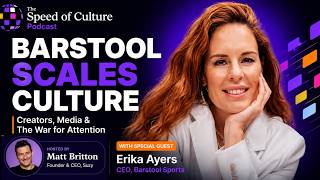
In this Speed of Culture interview, Matt Britton talks with Erika Ayers, CEO of Barstool Sports, about her personal journey from a brand‑obsessed kid to a tech‑advertising professional at Microsoft, Demand Media and AOL, and ultimately to the helm of Barstool in 2016. Ayers explains how she won the CEO role by bypassing traditional hiring channels, the confidence she built through continual failure, and the hiring "DNA" she looks for—curiosity, initiative, and authenticity. She details the challenges of scaling Barstool from 12 to over 400 employees, emphasizing the need to constantly reinvent product strategy (from early blogs to podcasts to short‑form video) and to stay frugal. The conversation moves to Barstool’s diversified revenue mix—advertising, commerce, licensing, live events, pay‑per‑view—and the "authentic" content style that fuels audience loyalty. Ayers contrasts Barstool’s creator‑first model with legacy media, noting the importance of giving talent freedom and data‑driven feedback. The discussion covers the 2020 investment and 2023 full acquisition by Penn Entertainment, the regulatory constraints it introduced, and how the partnership has shaped betting‑related content. Looking ahead, Ayers sees a fragmented, attention‑scarce landscape where creator‑driven, live‑sports‑adjacent experiences will dominate, and she stresses curiosity, risk‑taking, and relentless feedback as advice for young professionals aspiring to leadership.
Chapters
Up today, we're gonna be speaking with Erika Ayers, the CEO of Barstool Sports. Erika's leveraged her expertise to take Barstool to new heights since joining the company as CEO in 2016. Erika's been named Forbes' Most Powerful Woman in Sports, recipient of Crane's Notable Woman in Sports, and was Adweek's Most Powerful Woman in Sports. Erika, so great to see you. Thanks so much for joining today.
Thank you for having me.
Absolutely. So let's zoom out for a second back to before you got into the workforce. Okay. When you were sort of in college or even before college, did Did you always know you want to sort of be in media and technology, or is this something that kind of happened?
I always loved brands since I was really little. Like when I was little, it was Benetton and Absolut.
Sure, I remember that.
And I would, you know, cut out the ads and plaster them all over my walls. So I, when I graduated from college, I wanted to work in advertising. I wanted a job. So let's just be clear, like I wanted a job, but I really wanted a job in advertising. And the advertising business was so different back then. This was the late '90s. So I always wanted to do something that was creative. I always really had an affinity to the ad business overall, the creative business, the business of being creative. It wasn't until early in my career that I really fell in love with publishing and the idea of making content for people. And Microsoft was really my first big foray into that. But I, I was lucky to be joining the workforce at a time when the internet was just starting.
Yeah, you and me both.
And which was awesome. And it was weird and wild and kind of uncertain and no one was really sure where it would go. And that was, that created a lot of opportunity for me.
Yeah. So you were in the ad industry for 4 or 5 years and then found yourself, I guess, moving to Seattle and working for Microsoft.
I worked for Microsoft. I had a global job, so I lived in Boston and then spent, I basically traveled nonstop. So I had an office in Tokyo. I worked out of Amsterdam. I worked in London. Was in Seattle a fair amount. Um, and it was an interesting job because it was trying to figure out how you took Microsoft technology. At the time, it was the portal era where you consumers access the internet by going, you know, dialing up on AOL or going to MSN and selling banner ads. Right. And selling banner ads. And I wasn't particularly interested in banner ads. I thought mostly they looked like shit. Um, and I had come—
they still do.
They still do. Banner ads are so ugly. Like you go to a publisher's website and they like throw 16 banners and then a video that plays over the words you're trying to read. It's so annoying.
Or on mobile when you're trying to exit out and you end up clicking it.
And you can't get the X. Yeah. Or like, anyways, I could go on for this forever. Last night I was trying to order food and I thought maybe a restaurant that I wanted to order from would deliver through Grubhub in this case. And then you can't get off the Grubhub URL. Like, people have been so badly behaved about advertising and trapping consumers on the internet. But anyways, um, I was more interested in how could you use technology to create consumer experiences that were enriching or valuable or meaningful and creative. And then how could, how could the publisher get paid for doing that? Right. That's, that's really for me where things came together.
Gotcha. And after Microsoft, you spent some time, um, at Demand Media and, and AOL. So you were in the tech space for a while.
Yeah, a long time.
And then spent a, a short stint, um, back in the ad world. And then finally this opportunity appeared at Barstool. Barstool, and one thing I had read, I don't know if it's true or not, might be urban legend, but there were 74 people, all men, that you beat out for the job. Is that true?
That is true. Okay.
Um, so why Barstool? Why did, why did you even look at this opportunity and how did it come about?
Oh, I loved Barstool. So I, you know, um, I don't know how many people applied for the job. I know it was the last after a long line of people and they were all men.
Um, and did you know you wanted to be a CEO because you hadn't been a CEO prior?
No, but I was excited. I wanted the Barstool job. Like I really, I loved Barstool Sports. Barstool Sports, you know, from Barstool Sports was just shared over text message. It was, it was articles and blog— it wasn't articles, it was blogs shared over text messages with really funny t-shirts that you ordered from a very janky website and then an even jankier app. Like, that was Barstool Sports. But the— it was so funny. Like, I remember when Dave, you know, Dave Portnoy, who founded Barstool Sports, I remember when he would you know, hand out the paper at the T station. Like, I lived in Boston at the time. You could get the Metro or you could get Barstool Sports, and it had a cult following. It really meant something, um, and I loved that it meant something to people. I think it's so hard for brands to break through and to have people talk about you willingly, you know, liberally.
Like, yeah, everyone's so scared to say or do the wrong thing.
And these guys were like this little renegade shop that was— they didn't care what people something, and they didn't care how it was delivered. They— but they cared about making people laugh, and I really loved that. And I had read an article, I think maybe in, you know, Adweek, AdAge, somewhere, of like the Chernin Group had put a majority investment in Barstool Sports. And I was so jealous because I was like, I want that job. Um, I had a job at the time. I was like, they're gonna hire a white guy with an MBA who comes from sports, who knows what he's doing. But actually, my career had been kind of perfect for Barstool. I'd worked at big companies. I'd worked in the commerce business, I'd worked in the ad business, I loved content, I had lived in Boston, I was a sports fan.
Like, it, it just felt right to you.
Perfect. Yeah, I really, really wanted the job. I stalked a friend of mine to introduce me to Dave and basically worked here from the day I met him. Like, that was kind of it.
What was the interview process like?
Oh, the interview process was funny because I came in the back door, so I met Dave first and I think the recruiter was annoyed because I didn't come through the, you know, the recruiter didn't find me. I didn't come through proper channels. Sure. Um, which I've really never come through proper channels in my entire life. But, um, so I, I first met with Dave. I loved Dave. I, I talked to Dave for a really long time. I met Dave a bunch of times in New York City. I remember hugging him after one of our meetings. Like, I met Dave a lot. And then I had a conversation with the Chernin Group, and then the recruiter got involved and, you know, made me go to Midtown and sit in a stiff air and like barraged me with, you know, gotcha questions. And, but by the time that happened, I knew I had the job. I knew, I knew I wanted, I knew I really, really wanted it. And I knew it was mine if I—
I think it's so interesting, Erica, because so much of what people are taught when they're younger is to play by the rules. Mm-hmm. Is, is to go through proper channels. Yeah. And here you are back channeling with the founder of the company.
Mm-hmm.
Having the confidence to know that you can be a CEO. Yep. Even though you've never been it before. And I think especially for women, Growing up, I think it's hard to really feel that. Yeah, for sure. How do you think you got that confidence? Because even now you speak about it so confidently, but I think to a lot of people in business, it just doesn't come as easily.
I think you have to, like, I'm writing a book about this now. I think you have to fail always. I think you have to put yourself out there constantly and it gives you the confidence. Falling and failing actually gives you the confidence to succeed. And if you don't have little mini failures constantly where you fuck up and you hate yourself and you're like, I shouldn't have done this. Like, I feel like that every day of the week still to this day. But the process of doing that, I think, makes you feel more confident about what you learn from the experience. You trust your gut more. You're more self-assured. You're more decisive. You're more— you're more dedicated to something you want to get to or someone you want to be. Like, I had never been a CEO. You know, I remember interviewing with Peter Chernin for the job, and he was literally like, "You don't know what you're doing." And I was like, "Yeah, you're pretty right, but you know what? Like, I have the work ethic to try. I have the experience from places these guys want to go to, and I have the curiosity and the initiative to go figure it out." And so, for me, I think for women in general and for people, I agree with you. I think people wait all the time. Like, I hate— Wait for permission. Waiting. Wait for permission. Permission, wait for the— wait for there to be no danger, wait for there to be less risk, wait for everybody to be okay with things. And I think you're kind of screwed if you spend your career waiting for that perfect moment, because the perfect moment never exists. And then the second thing—
Or if it does, you think it is, but it's not the perfect moment, right?
It's not. And you know what? You're— that's exactly right, which is you'll make a lot of jumps in your career that you think are perfect and are not. You know, for me, it was— I finally, I had worked so hard to get a CMO job. I had worked so, so, so hard. It was all I wanted, all I wanted. And I think in my heart I'll always be a marketer. Like I'll always be a producer or a marketer, but I remember getting the job and I thought it was everything I wanted and it was absolutely nothing that I wanted. And I was like, shit, like now I'm here and I'm unhappy. Like, what do I do now? So I think for people to just keep trying and to do things that scare you and to make decisions that are right for you, even if they don't seem right to everybody else.
Yeah. I mean, it can sound like hyperbole, but here you are sitting in the chair, living proof of that.
Yeah. Like you can make it. Like, it's not easy. It's not fun all the time, but, and it's not without its scrapes and bruises and dangers and all that. But I'm really proud of what we've built at Barstool Sports. Absolutely. So, I think it's incredible.
So, let's talk about what you built. I mean, when you joined, there were 12 employees at the company. Now you have over 400. Um, I've been on the similar ride leading the organization from 10 people to 300, 400 people.
Yeah.
And I know that that's not easy either. Yes. Talk about, I guess, some of the challenges and, and why you think you've been successful at being able to scale the culture. Cuz walking around these offices, you can tell this doesn't feel corporate at all.
Yeah.
No, you might as well still be a company with 12 people, except there's just multiple different areas of work. There's a bunch of 12 people, right? Just, but you've been able to maintain that and the company's been successful. Not everyone can do that. So why do you think you've been able to achieve that? And talk about the journey to get here.
Yeah, I think it's— I think that's a really hard thing. Look, it's hard to— 12 people to 400 people in 5 years, 6 years is a lot. Um, and it wasn't easy, and we made a ton of mistakes, and we continue to make mistakes and all of that. So the first thing I would say is like, it hasn't been a seamless, like, magic wand of Wah! Here we go. But what I would say is that you have to hire people who are curious and who are motivated and have initiative and who want to learn and care about what they do. Like, that to me is more important than anything. Like, I don't care where people went to school. I don't really care what you know how to do, but do you have those— do you have that type of DNA? That's Barstool DNA. The second thing is, I think in management, you have to be willing to break how you do things. If we had kept Barstool doing the same things we were doing in 2016 when we had 25 people, we'd be out of business. If we kept Barstool doing the same things we were doing in 2019 and the way we were doing things, we would also be out of business. You look at Vice, you look at BuzzFeed, you look at all of these companies that have kind of fallen by the wayside. A lot of it is they took a lot of money, they spent a lot of money, they didn't have a lot of discipline. We didn't have any money when I joined Barstool, so we were always really frugal.
That's probably—
you probably thought it was a curse at the time, but actually it was the biggest gift. 100%. Um, but we were also willing to break how we did things. You know, when podcasting became, you know, kind of, you know, podcasting— we had 3 podcasts, I think, in 2016 when I got here. Dave's podcast, KFC Radio, and I think we had 2 episodes of Pardon My Take. Flash forward to 2023, we're almost post-podcast where we're like, it's all about short-form video. If we were still fixated on creating a podcast, we, we, we would be screwed for where we are and where we want to go. So you can't buy your own hype. I also think you can't get stuck, at least in the media business or the content business, you can't get stuck in how things used to be done, even if you really liked it. Yeah. You know, podcasting, early days of podcasting were great. You could like vomit out a podcast, it didn't cost any money, you could put it on the internet and it would get views or downloads and listens. And it's not, you know, it's not like that anymore. I think a lot of times what holds people back is that they're stuck in how things used to be.
Yeah, the golden goose, whatever it may be.
Exactly. You're stuck. And if you're stuck there and you're not intellectually honest with yourself about if it's working or not, you're not going to, you're not going to grow.
Absolutely. So let's talk about the business as a whole. So from its origins of handing— of Dave Portnoy handing out, I guess, printed newspapers, literally printed papers, sports and pop culture to today. How has the business grown and what is the business in terms of the pie chart and how you guys make money?
You know, I think we've grown like 4,000%. I think the size of the company, um, revenue-wise.
Yeah.
And audience-wise, it's, you know, we've gone from, I don't know, something like 5 million uniques on a blog to 220 million uniques around the world and all over the internet. Um, the, the business was always about making content that resonated with people and putting it into places where they could consume it and would want to engage with it. So, you know, at the beginning it was just the blog, and then it was the blog and it was streaming video, because I really believed that if our crew was good at blogging some of them could take those words that they wrote down and they could say them. Sure. And then podcasting came along, and then we started to, you know, hire obviously more talent, make more serial video, make all sorts of different kinds of video. Our business is really predicated on advertising, which is, you know, the vast majority of our business. We have a very healthy and growing commerce business. So soft goods, t-shirts, hats, you name it, flags. We have a licensing business, so we have of, you know, large partnerships, particularly in the alcohol category, but also beyond the alcohol category. We do live events. We have a pay-per-view business. We're really— I care most about finding fans and delivering, delivering for them in a way that means something, and then finding a way to make money while we do that. And that's really the name of the game, and we're willing to try most anything, but everything starts with what are we making and who is it for and do they want it and will they respond to it?
And what's the special sauce, regardless of the channel, of barstool content that makes it uniquely barstool?
I think it's, um, so stupid because everybody uses this word, so it doesn't work anymore, but it's like, it's authentic. It's real. It's like authentic.
Everyone uses it and everyone pays it off.
Not everyone pays it off. Exactly. Like how, you know, people put the word authentic in conference rooms and PowerPoints. Yeah. And that doesn't mean anything. Someone going off on a video that's being filmed by their camera after their team wins or loses, that's authentic. So, you know, I think for us is the content's very real. I think for the most part it's really funny. Um, I think it's highly opinionated. I think it's weird in a lot of ways, like it's unexpected. Um, and it's constant. It's 24/7. Right.
And, and I think what's really interesting about Barstool is you've really grown on the backs of your talent.
Mm-hmm.
So if you look at more traditional media platforms, you know, it's about the brand, the media brand.
Yeah. It's not the shield.
Yeah. And with you, your company has really pushed these individuals.
Mm-hmm.
In some instances to such heights they've gone off on their own and done their own own things. Do you think it's the future, generally speaking, of media where it's about the individual versus, versus the brand?
Yeah, it's funny, I think the media business is in a tough spot right now. We straddle that where we were a creator company, honestly, before creators and influencers were a thing. Like, yeah, Dave Portnoy was so ahead of his time, like, geniusly ahead of his time. Um, and now we struggle with that a little bit You know, are we a creator company or are we a media company or is a media company a creator company? Most media companies are not creator companies. Most media companies have a show and they have desks on the show. That's programmed so much. That's scripted or structured. They've got producers on top of producers on top of producers. And you are hired for a very specific scope. In our case, you show up here and we're like, what do you got? And they're like, well, what do you got? And we're like, but what do you got? Like, so we have have people show up. We don't tell them what to make. We don't tell them how to make it. We don't tell them, you know, we give them the benefit of all of the data we have. We have an insane amount of data, um, and we give them the benefit of all the gasoline we have and the brand love that, that these people, everyone here has worked for for 20 years. Like, that's, that's what's irreplaceable about Barstool Sports is it's a 20-year story. Absolutely. And it was 20-year story. It's a 20-year story that for the large part didn't have a huge amount of fragmentation. Now media is so fragmented, you know, you go on your Instagram feed, you go on your Instagram feed 3 times in a day, you're going to see 3 totally different sets of posts or videos or reels or TikToks or whatever it may be. That's how much fragmentation it— that's how much fragmentation there is. I can remember Dave telling me Probably before I got here, so let's say 2009, 2010, Dave could sit on something for a month because he knew no one else would cover it. He could find something, it was kind of weird, it was interesting, it'd be something he'd want to talk about, and he could sit on it because he knew no one else was coming. And now it's like, if you're not on it in 5 seconds, somebody else has got it. So the pace and the fragmentation is so much harder. That's why there'll never be— there will never be another Barstool Sports. Because it's going to be— it's infinitely harder for brands to break through now than it was 3 years ago, 5 years ago, 10 years ago, certainly 20 years ago.
And in terms of the just new verticals that you've been able to go into, what's the decision-making framework to say we're going to go into this vertical or that vertical, or is it just instinct and saying this is on brand, our audience likes it? Because you guys seem to be so much like, yeah, sure, we'll do that, we'll do that.
There's not really tons of spreadsheets. No. No, we're, yeah, sure, we'll do that. We'll try anything here. You know, sure, we'll try it. We'll see how it goes. If it doesn't work, it doesn't work.
It works. Because it's not really a barrier to entry to put something up. You have a platform. If it sticks, how do you know if it's working?
We are obsessive about if it's working. So we know instantly, likes, comments, unique video views.
So on the backend, the analytics matter, not necessarily in the decision-making, but after something's out in the wild, that's when you're nervous.
We will never say, Oh, there's a focus group that says we should go after, I don't know, country music fans or whatever it may be. We'll say, hey, we think, you know, country music is hot right now. We have a big footprint in the Southeast. There's this girl or a guy who, you know, want to work for Barstool Sports. They seem to have a good work ethic. They seem to have a point of view. They seem to be authentic. Let's give them a try and see how it does. And that's That's how we think of things. Or we'll find a person, you know, in large part we don't even intend to cover a particular topic or vertical or segment. We just find people who are wildly interesting and that's who they talk to.
Yeah, absolutely. It's so funny because right now everyone's talking about AI and it's replacing this and that. The things that you do, just looking at the studio and the personalities.
No AI will.
No AI is never going to touch some of the personalities you have. They couldn't even dream it up.
Yeah, no, and look, it's like, you know, AI is such a buzzword right now, right? I was reading this morning, like, you know, the metaverse is over, right? Like, that was today's, you know, the metaverse is over.
I mean, I think Facebook named their entire company after—
um, but we're not really faddish that way. Um, you know, we're not gonna upend our whole company because ChatGPT can write a blog better than most people here. Okay, fine. Like, how do we use ChatGPT or AI to get smarter about what we're doing? Can we Can we use more AI to help with our editing? Can we, you know, how, how can we be smarter and faster on things? Something we care about. But I think there's just, it's a little bit much ado about nothing on the creative side. Yeah. Yeah.
It'll be interesting to see how that plays out. So the, so Barstool was acquired recently, fully acquired.
Congratulations.
Thank you. On that, by the way. But you, I, I guess the initial deal took place in 2020. Yes. Um, so what was the impetus behind that deal? Was by, uh, Penn Entertainment, which is a gaming company. Yep. Which at, at time I think raised a lot of eyebrows, but now in retrospect makes a ton of sense.
Yeah, for sure.
And now a lot of other companies are following it. Yeah. You see FanDuel coming out with their own TV network.
Sure.
Yeah. So how did that process come about and how has that sort of unfolded?
Yeah. Look, we always wanted to be acquired. We, you know, when Dave took the majority investment from the Chernin Group, which was in 20— end of 2015, early 2016, the intention was to grow the company, make it a company, legitimize the company. Scale, you know, create this Truman Show, Saturday Night Live fun factory, which we did. And then ultimately to find a home for it as part of something bigger. That was, that was the terms of the Chernin deal. And that's, you know, 7+ years old at this point. When Penn came along, it was after PASPA repealed, which enabled the states to legalize sports betting. Yeah. And Penn was smart about the deal where they said, hey, we don't know a whole lot about running a media company, but we're really interested in it and we're interested in a brand that has followers and an audience that's loyal to it. Yeah.
They had no real consumer brand.
They didn't have a consumer brand. Right. Or certainly the Penn national brand at the time was not consumer. They have casinos who have consumer brands, but not a national consumer brand. Right. And certainly not a national consumer brand that appealed to sports fans. We had that. And, you know, Penn said, we're going to put a majority, you know, or minority stake in the company. They invested in Barstool Sports. They taught us a lot about sports betting and compliance and, you know, how we could promote betting in a way that worked in a highly regulated environment. And we taught them a lot about consumers and the internet and, you know, how to, how to engage people around live sports and sports betting., and we've, you know, we've worked through that for 2 years and then the acquisition became formal this year. Um, and it's been, you know, it's been great for Barstool Sports. It's been hard. It hasn't been perfect. We've certainly had our moments and they've all, you know, mostly been very public. But I think that what we do is very unique and what we offer is very important. And what we do is talk to consumers authentically on the internet. We have the biggest megaphone around in the world, I would say, for, you know, 21 to 35-year-old people. And we know how to turn that on, whether it's promoting new shows that we have or products that we create or bets that we think are funny and interesting. And we want to do so in a way that's good for our business, that's good for our fans, and then good for our partners. Absolutely. We work on that.
And has being owned by a gaming company, which is highly regulated, impacted at all the decisions you make or sort of the verticals you can go into?
Yeah, of course. Like, it's, you know, it's important. You know, we have, you know, kind of been growing from a blog to arguably one of the most influential brands, if not the most influential brand on the internet. There are things that would fly in 2016 when we were really small and the world was different that did not fly in 2019. That didn't fly in 2021, that don't, that doesn't fly in 2023 and won't fly in 2030. So it's been a learning process for us on multiple fronts. And being part of a public, you know, highly regulated company is a learning for us on a lot of fronts. And you know, there's some lines that, you know, Penn really doesn't have a whole lot of latitude. They're governed by the SEC and by the government. Like we're a renegade blog out of Boston. So it's like, that's a learning experience for us.
When your founder says what he wants, when he wants to do it. Yeah.
Like that's, So we all need to figure out how does this work together? Where are those lines? What happens when they're crossed? How do we go into new areas? What are those new areas like? And that's something we continue to navigate.
Yeah, I can tell you, I was at the Wynn headquarters before, and what their offices look like look nothing like the Barstool headquarters here. It's literally night and day.
That's right.
But if you think about, you know, I believe they tried to launch an online gaming platform to not much success. Reason being that you guys are authentic, you do speak to your fans, you have an audience. As a brand that people care about. And because of that, they're gonna gravitate towards what you're selling.
Yeah, that's right. That's exactly it. Like, it's very important, you know, I think the fact that we're so loud and it's so noisy is uncomfortable. You know, it's brilliant on some days, it's hilarious on others, it's excruciating on other days yet, but that's part of this thing. Like, that's what it means to be relevant. And that's also what it means to be real.
Awesome. So shifting gears here, in terms of the future,— and big opportunities, you think? Because obviously you've had incredible success scaling the business, going from 400 to 4,000 people. Not saying you'd ever want to get there, is a whole different journey, or even 1,000 people. Where do you think the opportunities are moving forward, given the market's changed so much, given where you're at?
I think the future— look, I think though, I think we're in a creator universe right now. I think it's a war for attention. Um, I think attention spans are getting shorter and shorter. Distribution is getting crowd, you know, more and more crowded. Consumer trust is eroding so quickly. And the rules are— rules have just changed. You know, you used to think about where did you watch late night? You watch late night on cable television. Now you watch late night, like, what is late night? Late night is everything everywhere, you know. So I want to play in that. I think that's very interesting. I think live sports were things that only very esteemed, you know, networks did, and then cable companies did, and now streaming companies are doing. Why can't Barstool Sports do more live sports? You know, we started as a newspaper when Dave started Barstool Sports. We moved into an internet company. We scaled as an internet company. Maybe we can be the biggest consumer products company, you know, so I think the roles are all shifting and the rules are all shifting. And I think that creates, you know, chaos is a ladder, like it creates an insane amount of opportunity. I don't know exactly what it's going to look like, but I do really believe so long as, you know, we have people who are curious and take initiative and care and have the right, you know, mojo to make something happen, we can make most anything happen. Absolutely.
Which is really exciting. So, uh, as we close out here, Erica, I mean, we have a lot of young listeners, young women specifically that listen to Speed of Culture. Podcast, I would love to be in the CEO seat one day. What advice would you impart on people earlier in their careers so they can take the necessary steps and the risks to, to end up where they ultimately want to be, whether it's CEO or elsewhere?
I mean, they could have my job.
There'll be lines outside the corner on 7th Avenue.
I think there's a couple of things. One is, I think in your 20s, the more risk you can take, the more things you can try, The more, the more flavors you can taste, the more you can learn. Good bosses, bad bosses, good jobs, bad jobs. You just need to find out who you are. Like, I think it takes a long time to find out who you are and who you are keeps changing. So you, it's not really the who you are or where you are. It's the process of understanding what do you like? What do you not like? What's fulfilling to you? What's stressful for you? Where do you thrive? What do you love doing? Um, and I think the more, the more you can mess around with that in your 20s, the better. Like, I think your 20s is such an amazing time to work, um, and to, to really try things with very, very little risk. And I think the lessons you teach yourself in that time will carry with you in your 30s and will carry with you in your 40s. I think you should do something that scares you. I think you should take a job nobody thinks you should take. I think you should quit a job if you don't like it and everybody thinks you should keep it. So just learning what works for you and why, um, I think is insanely important. And then to work hard, to listen. I think people really struggle with feedback now. I think we were in a time where people are really coddled, um, and protected from themselves. But if you're protected from getting better, you're, you're never going to get better. And I think I'd rather personally get hurt and learn and be sharper for it or smarter for it versus not having been hurt in the first place. And I worry a little bit because I think we're now in a little bit of a time where like feedback, feedback is an affront, like feedback is offensive. And I'm like, look, you don't agree with everybody's feedback. You're not expected to agree with everybody's feedback, but if you're insulating yourself from the experience of it, it's going to be very, very difficult.
Yeah, we all have blind spots. We all have things that we're doing that we don't realize that other people— so glaringly obvious.
Totally. And you look, everybody sucks at things. Like, you know, I'm the harshest critic on myself. I think most everything I do sucks. I still feel that way, but I'm like, at least if I'm saying it to myself, if everybody else is saying it, like, I beat you to it, you know, like like I got there first. So, I think just keep, keep playing with things, keep trying things, take jobs that scare you, put yourself in a position where you have to succeed. Absolutely. And I think those are, then, you know, you can easily have CEO job.
For sure. And with that, just finally, is there sort of a mantra or one quote you like to live by that drives you every day? You sort of summed a lot of it up in, in what you just said, but.
Yeah, I think like, I think it's really good to fail. I think You, you've gotta stay curious and wanting to learn. And then I really think the best thing about the time we're in is that you can be yourself and be successful. You don't have to be a cookie cutter mold of everybody else. And that's what's so amazing about the internet. And that's what's so amazing about the time we're in is that you can be yourself and be successful.
Absolutely. Well, thank you so much. Thank you so much. Congratulations on your success.
Thank you.
We're here at Barstool Sports, amazing headquarters here in Manhattan. And thanks so much for joining us. On behalf of Suzy and Adweek team. Special thanks to Erica Ayer, CEO of Barstool Sports, for joining us today. Be sure to subscribe, rate, and review the Speed of Culture podcast on your favorite podcast platform. Until next time, see you soon, everyone. Take care.
Hey!
More from Matt




MikMak’s Rachel Tipograph on Consumer Spending, Retail Media & Holiday Shopping Trends



Jaguar Land Rover’s Charlotte Blank on Luxury, Purpose & Experiential Storytelling



