Black Friday & Cyber Monday 2023: What Consumer Spending Means for 2024
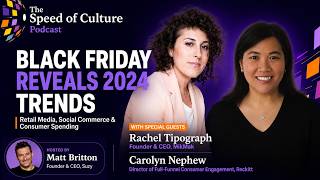
Matt Britton and Rachel Tipograf analyze 2023 Black Friday spending and what it signals for 2024. Credit card debt hit record highs while consumers bought less often but in bigger baskets, trading down to cheaper products. Small brands face pressure from retail media costs and private-label competition from Walmart, Target, and Amazon.
Chapters
Hello everyone. This is Matt Britton, founder and CEO of Suzy. I'm joined today by a very special guest, Rachel Tipograf, the founder and CEO of Micmac, who I will introduce herself in a second. But today we are here to talk about the retail and consumer shopping trends that are impacting the current day. It's been another whirlwind of a year this year that's slowly coming to an end, 2022. Really flew by fast and there's been a lot of ups and downs and especially as a marketer, a lot of headwinds to contend with. And today we're gonna be really diving into some of those headwinds and trends and some optimism as well that we're seeing coming out of Cyber Monday that happened yesterday. Rachel, first of all, thanks so much for joining. This is always probably my favorite webinar and digital event I do every year just because I really love collaborating with you and I really have so much admiration and respect for your knowledge in the space. So, Thank you. Thanks for joining. I'd love to hear a little bit about how your year's going and tell our audience who might not know a lot about Micmac, what Micmac actually does.
Yeah, well, thanks for having me, Matt. Always love doing this with you and love the team at Suzy. Micmac, we're an e-commerce enablement and analytics company. We work with major consumer product companies. So picture any brand that's available at places like Amazon, Target, Walmart, Drizzly, Minibar, Sephora, Ulta. Those are our customers. And we help them understand the end-to-end customer journey across every major media channel, Meta, TikTok, Snap, Pinterest, programmatic, your brand website, all the way down to basket-level sales data at places like Amazon, Target, Walmart.
Right.
We like to think that we dispel the black box that a lot of big brands used to live in.
Yeah, and I mean, the retail landscape has gotten so much more challenging over the last decade really, where it used to be, You know, if you got a lot of shelf space at Walmart, you know, you were taking your family to Aruba over Christmas, right? Because you knew that that couple extra inches of shelf space, you were going to move enough product that you're going to have a great year. And while the big box retailers are still incredibly powerful, you know, it's a little bit more complex in terms of an omnichannel approach. And we'll unpack what that means over, especially over the holiday season. But I'm sure a lot of the companies that you work with are really confused and really trying to unpack all this. Yeah.
Yeah, I mean, there's more retailers than ever before and there's more media channels than ever before. And as a result, there's still the same amount of consumers. Like the population hasn't really changed. And so how you gain those people's attention in such a competitive environment is the major challenge.
Yep. And innovation, as they say, is not evenly distributed across the country. There are some consumers, you look at Gen Z and you know, they're a completely different species, so to speak, in the way how they shop and how they consume products versus boomers who are still a huge percentage of the population and especially the spending pool. And you almost have to approach those generations or consumers in different parts of the country completely differently.
100%.
So we're gonna talk about retail and retail growth overall has slowed 2022 as people have probably read ad nauseam at this point. We have entered in an economic downturn coming out of COVID It has been sort of a slingshot effect as we all know where COVID hit, you know, we were told that we were gonna be entering the next Great Depression. Then interest rates went to zero, consumers got flooded with fiscal stimulus from the government. Government, and as a result, everyone felt rich. It propped up, um, speculative currencies like, uh, cryptocurrency and meme stocks and collectibles and all sorts of things, as people had so much cash and nowhere to spend it. And we saw a boom in the stock market, and then almost just as quickly as that happened, we saw a little bit of a bust in the stock market in 2022, where the high-flying technology stocks and cryptocurrencies all of a sudden came crashing down hard, much to the chagrin of maybe younger consumers who have never lived through a boom-bust cycle like older people like I have in 2008 and also 2001 after the 9/11 crisis. And, you know, it's been really so much for brand marketers to figure out how to deal with this because not only has it impacted their business, whether it's the supply chain or pricing, etc., but most importantly, it's impacted their consumer. You know, inflation is still top of mind for so many consumers, especially holiday shoppers right now, because one of the impacts of that boom-bust cycle is during the boom cycle, there was so much demand for products that, you know, the supply chain got clogged up and there wasn't enough product to meet the demands of consumers. And any time there's more demand than supply, obviously that drives up pricing. And inflation has been a huge topic for consumers as well. So, you know, what we're going to talk about today is— go on, Rachel, please.
You know, with inflation, we've also seen certain brands benefit from it. So you, you look at the luxury market or consumer electronics and they've actually been able to lean into inflation during these times. So depending on the customer segment that you're going after, there's a very different outcome.
How have they been able to lean into it?
By raising prices.
So they're taking advantage of it and stretching their margins?
100%. For the high income customer, they're actually spending more than ever before.
Right.
And are willing to do it. Right.
And they have the ability to do it. You know, we talk a lot about people are hoping for a V-shaped recovery and what we saw out of COVID and what we might be some— see coming out of 2022 economic issues is more of a K-shaped recovery, right? Where you have certain sectors of the economy, you know, and socioeconomic classes really faring much differently coming out of this than maybe others where, you know, there's a big swath of America where if, if bread and butter and cheese are a couple bucks more, it really impacts what they can afford every month. And there's other consumers that they don't even look at that. And for them, you know, they still have made so much money outta the last decade that, you know, they're literally leaning in. I guess the luxury sector would be the biggest indication of that. So today we're gonna talk about the recession and the, and the impact, some of which we just touched on, product availability and sort of the byproduct of what we're seeing in terms of demand outstripping supply and how that may have eased up. How the media world is impacting the retail landscape and how certain merchandisers are looking at different retail opportunities to impart into their manufacturers to basically drive eyeballs, drive awareness through new channels that are popping up, as well as most recently Black Friday and Cyber Monday, which is of course yesterday. What was the data that we, we saw coming out of that and what are the implications for 2023? So first we talked about the recession. There's been news of an impending recession for months. In some ways, the tail's been wagging the dog in that people read the headlines in, you know, the USA Today, or they watch the Today Show, whatever it may be, mass media, and they think, oh wow, something's coming. I'm gonna let the headlines drive my decisions versus maybe what I'm seeing in my wallet or what I'm seeing, you know, happen with pricing. But over time, consumers also have been hit with pricing. We are seeing signs of a slowdown and we don't really know how long it's going to last. Over the course of this year, the Federal Reserve has consistently raised interest rates, and that's impacted things like credit card interest rates for consumers right now. And we'll talk about it. Consumers have record credit card debt in the US. Debt for credit cards have never been as high as it is today. And a year ago, maybe a little over a year, savings were never as high as they were today. So it's quite a shift. Are your— brands you're working with seeing the impact of that just in terms of the debt load that consumers have right now, Rachel?
100%. I mean, the, the thing that I'm paying attention to is, is not the stock market, it's the interest rates. If you talk to different economists, some are more optimistic, but they feel like by June of this upcoming year, interest rates might level around 2.5%, but then they actually believe that they'll go way back up again. And so if you're planning for 2023, A lot of folks think that there's gonna be a window and it's essentially gonna be—
Like a double dip almost, so to speak.
Yeah, like April to June, we're gonna all think that like the economy's bouncing back and it's gonna feel like the gold rush again. And then it's gonna go back to maybe more normalization. When you talk about credit card debt, I mean, there's a big elephant in the room. One of the major causes of this, especially amongst millennials and Gen Z, are the buy now, pay later companies. Everyone was heralding like, look at these insane e-commerce conversion rates that we're getting on our site now that we've installed Afterpay. But if you look at just California, 75% of the credit card debt that's occurring is because of the buy now, pay later companies.
Right.
This artificial sense that you have money.
And that's disproportionately with younger consumers where they'll go on Aeropostale, right? And they'll say, oh, I'm gonna buy one pair of jeans And instead they can end up buying 7 for what is essentially the same cost that day. But what they don't realize is then the bills are going to be coming for the next several years. And, you know, then multiply that by 5 or 10 other shopping experiences and all of a sudden consumers have debt loads that have added up and it's going to impact their ability to do other things.
And you asked, how is that showing up for our customers? You know, our customers are these mass consumer product companies across food, bev, personal care. Alcohol, consumer electronics, toys. And what we've seen consistently over this calendar year is that consumers are trading down. So instead of buying the $150 bottle of whiskey, maybe you're gonna buy the $75 bottle of whiskey.
Right.
So making sure that you have a portfolio that speaks to these different price points right now is super important.
Very interesting. And you know, as we, as we've mentioned, you know, nearly three-quarters of consumers are concerned about a potential recession. And you know, you mentioned trading down, Rachel, and some of the research we saw is that that electronics and clothing are two of the areas that consumers are most likely to scale back on. Can you elaborate on that at all?
Yeah, I mean, we've certainly seen the data with consumer electronics. So a really telling moment was Amazon Prime, they had two big Prime Days this year. It both occurred—
Which is new, right? They usually only have one.
Yeah, July and October. And typically during those moments, that's where you see electronics pop like rise to the top. We didn't see that. We saw household staples pop. And so it was a very, very telling moment that right now people are being way more cautious with their spending.
And I think one reason why, I was speaking to an exec of a major consumer electronics retailer who was saying, you know, our TVs are stacking up against the ceiling. And the reason they say why is that during the pandemic, people bought a TV for every room in their house and every bathroom in their house, right? And they bought every Sonos speaker, et cetera. So they just don't need things anymore. Everyone has bought everything electronic-wise for their home that needs to be purchased.
Well, Matt, you just touched upon something that's so important and significantly impacts the economy. People can't buy houses right now because of mortgage rates. People are staying put.
Right.
Typically changing homes is a huge buying moment.
For furniture, for electronics, for all sorts of different products. Yep.
And then a lot of different services, right? You switch doctors, cities, all these things. Sure. And then the other part of it is now what we're seeing in big tech, right? People's jobs are being challenged right now. And that, that was the upper middle class.
Yep.
And so all of this is going to significantly impact the economy going into 2023.
Yeah. You mentioned this earlier, but shoppers have prioritized in the October deal days of Amazon and Target because Target has their own version of Prime Day now. Shoppers prioritize the essentials over these big-ticket items. So is that a shift overall? So just looking at Target, you know, Target in July, it was groceries and then toys and electronics. And then in October, it was grocery still number one, but then health and personal care. So shifting to necessities, is that sort of a general trend you're seeing really across all retailers?
Consistently. Absolutely. And when we get later into the presentation and we break down product subcategories, by retailer, you will see that the retailers that win are the ones that have the SKUs within grocery, household items, and alcohol.
Right. So the everyday basics, you know, if nothing else, it gets them in the store. And if they're going to sell other higher ticket or discretionary items, they're in the consideration set because they have those core products.
Absolutely.
So we've seen this the last couple of years because Prime Day Correct me if I'm wrong, but didn't Prime Day used to be in November? It was closer to the Black Friday Cyber Monday period and it got moved up. I think post-pandemic was in July, wasn't it? Wasn't that super early?
The last few fiscals it's been in July.
But I remember that was, that was early. I think before that it was in October.
Yeah, you're probably right. My memory is jogging, but ever since like 2019, it's really been this Christmas, you know, in July moment.
Right, and is that a trend you see to continue? And why are these big retailers doing that?
Oh yeah, I mean, the thing about retail is about training people to shop. So for example, at NicMac, what we consistently see in our data is before any big holiday, Valentine's Day, Cinco de Mayo, Memorial Day weekend, people start shopping for that holiday 2 weeks in advance. We've essentially trained consumers through promotional messaging, advertising, like you gotta start planning or things are gonna sell out.
Halloween candy, whatever it may be.
Exactly. So fast forward, Amazon events this holiday, Prime Day, and then Walmart joins in and Target joins in and Sephora and Ulta. And now it's this huge shopping moment that America has gotten behind. So that shopping moment is absolutely here to stay, especially in tough economic times. And we'll get to this, but people will show up for the deals.
Right. It's really interesting because it's kind of like the definition of consumerism, creating a holiday around shopping. And I'm a victim of this. I mean, I bought on Amazon on Prime Day things that I really didn't need. It was just, oh, this is a deal, I should get it. And I'm sure that that's really what they're feeding into.
Yeah, of course. Like, who doesn't want to brag about the great deals you got?
Right, right. So, you know, obviously, you know, we're entering the holiday season, and one trend we saw entering this, and we had talked about this in the prep for today, Rachel, is that we are seeing shoppers taking fewer trips to retailers. However, their basket sizes are increasing. Does that have to do with rising gas prices? You know, why would consumers be putting more in their cart versus less in the wake of an economic downturn?
Yeah, so this data right here is very, very important. This is data that Micmac has seen throughout 2022. And so when news headlines were predicting doom and gloom holiday season, that consumers weren't gonna come out to shop, we didn't feel that way. We actually said, hey, consumers are gonna come out, they're gonna come out for the deals, and they're gonna drive bigger baskets because that's what we've consistently seen in our data over the calendar year. Fast forward, if all of you've been seeing the headlines, that's exactly the outcome that happened. And so what's happened essentially over the last 2 years, especially in the US, is that people now see e-commerce as a vehicle to drive bigger baskets, drive convenience, so they don't have to shop as often. Average American pre-pandemic was going to the grocery store 1.5 times per week. Now they can have the same outcome with 3 trips. So they've essentially reduced their shopping by 30% by driving bigger baskets and having convenience at home.
Mm-hmm.
And then when you see what people are putting in their carts, because we get basket-level sales data at Micmac, you see right here, it's essentials and baby formula number 10, given the crisis that's happened across the US around baby formula.
So is what's driving it— because, you know, obviously there was this habit that ensued during the pandemic where people were sort of stockpiling essentials. Do you think that was one of the things that kind of kicked this became a catalyst for this type of behavior?
Well, stockpiling will always happen in times of distress, right?
Right.
You have a huge snowstorm happening, a hurricane, but this is what we're seeing right now is more sign of the times, which is with the money that I have, I'm going to buy the necessities for my family. And then the hair removal cream, I also think is sign of the times, which is I'm not gonna go to my local nail salon to get waxing done.
Right, or nail care serum, right?
Right, I'm gonna do it at home.
Exactly. And that's another thing, again, we started to see during the pandemic is people couldn't go to the salon, they couldn't get their pet groomed, right? They couldn't go get their oil changed because there was so much shutdown. So they learned how to do a lot of these things on their own.
Exactly. And something that we'll get to in a bit, but what you'll see here is like hair removal cream, nail care serum, This is happening in the same cart where potato chips are happening.
Right.
What this means is that the big box retailers are now starting to steal market share from specialty retailers.
Very interesting. So we saw so many, I don't want to call concerning, but so many headwinds with the consumer earlier on. And the question is, is that going to— was that an arbiter of what was to come? And we'll obviously get into what we saw Black Friday, Cyber Monday, because as I mentioned earlier, it wasn't as much doom and gloom as what we thought, which at least to me, came as a surprise. I was thinking that things were not going to be as rosy as they were, but we'll get into that in a little bit. Product availability is obviously a huge thing in retail, maybe slightly less so in the e-commerce world. But does e-commerce ultimately, I guess, use that as an advantage for them because they don't really have the same shelf space issues? And how is that sort of manifested?
Oh, product availability is, I want to say, as important as is in e-com, what we've consistently seen in our data is that if the brand SKU is not available, the consumer is willing to put a competitive SKU in the cart because it's about needs, not wants. And then the challenge e-com is that the user behavior is replenish, replenish, replenish. So if your product moves out of the basket because it wasn't available, it becomes infinitely harder to regain that opportunity.
You're saying, so you'll go to previously purchased items or whatever it may be once it's in that— commerce flow, you're kind of good. But the first time it's out to get back in, you're almost at the top of the funnel all over again.
Absolutely. And you know, there was this, a lot of the—
Is that different than physical retail, Rachel? Sorry to interrupt, but I mean, I guess physical retail, if you're going into a store, it's a slightly different dynamic. I guess the habitual, I'm gonna grab this brand exists, but it's not actually in a cart when you log in. It's a little different.
In physical retail, it's more in your face. Oh, my favorite thing is available versus just replenish the cart. The, the flip side of this is that early in the pandemic, when a lot of major brands were out of stock, that's when challenger brands were able to try to gain some market share because they were filling a need. But now they're being hit really hard with supply chain issues because the big brands are always the first ones out of the factory.
Yeah. Let's talk a little bit about private label, cuz you know, obviously private label has been and will always be in times of economic hardship, a growing category, cuz some consumers will say, you know what, the premium brand soda or shampoo is great and all, but if I'm trying to make ends meet, I'll just get the store brand. And, you know, I won't know the difference anyway. How much have we seen that as a trend this year during, you know, what, what we've all encountered?
No, private, private label is tough. There's a lot of conversations that are at the FTC level around the efficacy around some of these speculations.
But if you— Meaning what? Meaning that they say it's just as good as the, as a premium brand, but it's not?
If you listen to Andy, you know, the CEO of Amazon, and he had a recent interview with Kara Swisher, you know, a lot of folks are saying, hey, you know, your algorithm is favoring Amazon private label brands. Meanwhile, you're forcing us to pay all these dollars to beat them in the algorithm. You're making money every which way. So at the like lobbying level, you're gonna start to see more and more discussion happen around private label. As you see consumers switch to these brands. So it's a really, really tough spot for brand manufacturers.
Just because basically the retailers control the rails. So they control the rail, you know, they're, they're going to push their own products because they obviously have higher margins there than pushing the name brand products.
100%. And so the question is, is whether government is going to help break up big business to, to change this.
Right. And really Amazon is the one that has a disproportionate advantage just because of the amount of data that they have.
Yeah, well, I mean, all the big retailers. So I think one of the big headlines that happened was 2 years ago when Target published their earnings. It was summer of 2020. I'll never forget, but it was the first time that they highlighted the revenue of Good Gather, which is their private label grocery line, which they've done a phenomenal job with. It did $1 billion in revenue. That was 2020. So that was the moment where a lot of folks were like, uh-oh, This is going to create a huge ripple effect in the industry. And so I would say, you know, folks like Amazon, Target, Walmart have a lot of strength in this environment.
And what are some of the categories where disproportionately consumers are flocking towards private label as of late?
It's necessities, it's household items, it's, you know, even food, you know, given what the success that Target has had with Good Gather. Where you, you see it less is more in consumer electronics, as you've, you've seen it here. And Amazon's actually, and Target's done a pretty strong job with apparel. So folks for a long time thought that would never happen, and it successfully has happened.
So if you're a brand and you're a brand manager of a packaged good, multi-hundred million or billion dollar packaged goods brand, and you wanted to become private label proof, so to speak, and make sure that your brand was so alluring that no matter how, you know, appetizing it might be for a consumer to switch, they're gonna stick with your brand. What are some of the things that you see, I guess, consistent across the brands that have kind of been able to weather the private label storm?
Well, we have a perfect example, Liquid Death.
Okay, yep.
It's water in a can, it's water, right?
Worth $700 million now.
Right.
New category, right.
And they market water the way that you market beer. So that's a perfect case study of being ruthless about investing in brand and executing flawlessly.
So it's about brand and brand trust ultimately.
100%.
In a world where a lot of companies are really focused on performance, and we'll talk about the shifts in media, it really speaks to the fact that brand still matters, right?
100%. And then you saw this, this is a totally different category, but in Airbnb's earnings, they've pulled so much of their bottom of the funnel spend, and they're right now only investing in upper funnel media.
Right. Now they've become a verb, to be fair. So, you know, not every brand has that luxury.
No, but like, it's, these are stories about investing in brand.
Yeah, absolutely. But no, to your point, Liquid Death isn't a verb. They're a startup that is a couple years old. So if, if they're able to gain the benefits of brand to future-proof themselves with a private label, it just shows the power of it.
The founder of Liquid Death, what was his job before? He was a creative director at an ad agency. That's it. Yep. He was never in CPG.
Where are you going? He's—
Yeah. Woodworks and advertising.
And ultimately they're selling water, which is basically as commoditized as it gets in terms of consumer packaged goods. You know, there's one ingredient in it. So if there's any way where you can truly see the power of the brand and the storytelling and the packaging, it's in the bottled water space or in their instance, the canned water space. But I think it's a great insight for sure. So we're obviously also seeing shifts. You talked about this a little bit. In terms of where consumers are shopping differently this year versus last and who some of the winners are in 2022. Can you talk about on a category basis where you're starting to see consumers gravitate towards this year?
Yeah, I think the big thing to take away from this slide is Walmart. Walmart is gaining real market share.
Right, I mean, look at 2021. I mean, beauty was Ulta last year and then you had grocery was Instacart and now you have grocery with Walmart, and now you have beauty as Walmart as well as personal care. So you just see the data from 2021 to 2022, how much share Walmart's gaining, which is crazy because their stock has not had a good year, right? They've had terrible earnings misses on over inventory, etc.
So it's, you know, we cannot use the stock market as an indication of business success.
Not even the stock market, right? Not even stock market. They basically said they had, they, they over-ordered. They had too much inventory. So, you know, so, but I guess you're saying that's disconnected.
I think every CEO, and Matt, I don't know about you, but I like to think that we're like-minded. I think founders, CEOs, you're always going to be optimistic.
Yep.
And we all believed that we were gonna grow a certain amount in 2022. We knew it wasn't gonna be like 2021 and 2020, but we didn't think it was gonna be what the year actually ended up being. And so everyone kind of misforecast in that way. But I think the most important thing about Walmart here is that the investments that they've made in omnichannel, the investments that they've made in grocery, right? Like the key thing here is grocery is the anchor. We showed you the basket level sales data. People are looking to buy household products. They then obviously have millions of other SKUs that they can cross-sell into that customer that's shopping for their family.
Yeah.
And then the investments that they've made in retail media. It is a perfect storm for Walmart to continue to gain market share. And this is all Micmac first-party data. And then if you've seen the news headlines, what did we learn from the news headlines around Black Friday? Walmart was the winner. Right now, America prefers Walmart even over things like Amazon.
And so— And it's so interesting because Walmart was so relatively late to the game in digital. And there are many that were predicting Walmart's demise because Walmart.com was a shell of what it is today, as recently as maybe 5 years ago when Amazon started to dominate. I mean, have they caught up in digital? Is that really what's happened? Because I know they have their own membership program now as well.
They have made massive strides. They made some really smart hires. They went all in on omnichannel. Like they call it Walmart Connect. It's one team. You're meeting with the merchants of brick and mortar and online at once. You're meeting with the media team of brick and mortar and online at once. And I think that they're making some really aggressive moves to continue to keep this market share. For Amazon to change the game here, Amazon actually needs to make way bigger strides in grocery, and they're struggling to right now.
Very interesting. It's something that, you know, in 2020, you probably didn't think you'd be saying as a kind of dominant. So, you know, you mentioned also, you know, retail media. Last year, you were one of the first people that kind of turned me on to the power of retail media. A mutual friend of ours, Mark Edmondson, who's the CMO of GoGoSqueeze, I interviewed him for our Beat of Culture podcast and he was talking about how important and impactful and really how much of a prerequisite that is now becoming for them to be able to play in some of these retailers. So I really want to kind of dive into retail media. What, first of all, what is retail media for those who don't know? And why has it taken on such great momentum here in 2022?
Yeah. So retail media is retailers like Amazon, Target, Walmart using their first-party consumer data. People are completing purchases, right? So they know my name, my household address, my credit card, and now building an advertising platform on top of that data. And so all of a sudden retailers' competition is not just each other, it's also Meta and Google and The Trade Desk and anywhere else that you could buy media. Yeah. And so what's happened is a few things. So if everyone remembers the headlines, and this all started around summer of 2019 when Apple woke up and realized that companies were building billion-dollar businesses inside their hardware, meaning like Google and Meta, these huge advertising businesses. Yeah. And Apple wasn't seeing a piece of it. What did Apple decide to do?
They just— Take their cut.
Changes to make it increasingly more difficult to retarget consumers through their hardware, right? So this is all the trends around cookieless internet.
Yeah. So today we're gonna talk about, you know, the recession and the impact, some of which we just touched on, product availability and sort of the byproduct of what we're seeing in terms of demand outstripping supply and how that may have eased up how the media world—
You gotta come up with new strategies.
And that, by the way, Rachel, didn't that really impacted a lot of the, you know, that huge wave of direct-to-consumer brands that popped up. Whether it's Casper Mattresses or Warby Parker, et cetera, they were all doing incredibly well before these changes took place. And now, and then they started to see really depleted ROI.
D2C businesses, everyone was using the same playbook, which was use Facebook ads or Meta ads to drive customer acquisition on the backbone of Shopify.
Right.
That playbook no longer works. So this created a perfect opportunity for retailers to fill the gap. Because what does Amazon, Target, Walmart sit on? They sit on all of the purchase data. So, hey, I know who purchased diapers this day last week. They probably need to replenish. Let me go hit them with an ad. And so I share this because so much of the rise of retail media happened because of the changes in iOS 14 and cookieless internet. It started to fill this gap. That was number one. Number two. Is that retailers have a different advantage over advertisers than traditional digital and social platforms. And that is if a laundry detergent company wants to do business, they have to make the retailers happy. 'Cause without that shelf space, have no business.
Right.
And so I see this because the retailers come from a position of strength and negotiation power. And so if they say, hey, laundry detergent, You now need to give us 20% more advertising dollars than you did this day last year. The retailer says, okay, let me write a check right now. The advertiser, the advertiser has no strength in these negotiations. And so this chart that Matt has right here is again, McMack Data. We, we work with over 600 brands and we have the privilege of working with some of the biggest executives at the biggest consumer brands. They sit on our customer advisory board.
Yep.
And in one of our customer advisory board meetings this year, I asked them, what percentage of your media spend today goes to brand versus retail media? And they told me, Rachel, 25% goes to retail media, 75% goes to brand media. I then asked them to project that into the year 2025. And it was the inverse. They said that 75% of their media spend would go to retail media and 25% to brand.
Wow. I mean, this is kind of crazy. I mean, let me think of it. If I'm a CPG, if I'm Procter Gamble, I'm basically building my own retailer because you're, we're basically, we earlier were saying that the retailers are creating their own products and now they're creating their own re, you know, they own the rails and now they're creating their own media channels. They're essentially, you know, going vertical. And how are the CP, traditional CPG companies going to be able to compete. I mean, ultimately they're going to need to create their own rails, right? I mean, you kind of see how this is all playing. And these guys have air cover, right? Target and Walmart have air cover because they're not going to get— they may get antitrust concerns on the private label stuff, but ultimately Amazon's the 800-pound gorilla in the room. And ultimately no one's going to say Target, Walmart, you're getting too big because of them.
Yeah. So this is my perspective on all of this.
Yeah.
And I know we'll get to predictions, But retail media has essentially been given a hall pass the last few years.
Right.
It's this new channel and no one was really looking at the efficiency of it.
It was pay to play. It was almost a means to an end to get the distribution. And because of that, they could write the checks because they know they were getting the sales on the backend.
Exactly. But for my most sophisticated customers, this year is the first year really for many of them that they're starting to build in retail media into their media mix models. Primarily with Amazon and Walmart data. And what they're learning is that retail media is not as profitable as you might believe it is. And that is because to do retail media, you actually have to do lots of other things. You have to pay slotting fees. That's essentially paying rent to the retailers for shelf space.
Right.
Then you have to pay fines. Like if your product shows up late to the distribution center, you have traditional Sharpie shopper—
So hidden cost that all go into the ROI analysis.
And they're putting it all there versus Meta where you can log into Facebook Ad Manager and buy an ad for a dollar and it just literally costs you a dollar.
Right.
And so that I truly believe will become the conversation going into 2023 as more people become more educated around the expense around retail media. And I believe that more brands will start to come together and you're starting to see it at the ANA and the IAB. And they will create a more of a collective force to create more balance in the ecosystem. And that's why I believe if you went back to those pie charts, we're not gonna end up at 75/25, but yes, I do believe we're gonna end up at 50/50.
Which is just a shocking number compared to where we were just a couple years ago when retail media wasn't a thing. I mean, there were Sunday circulars back in the day, right? Maybe for your time where brands had to buy ads in Best Buy Sunday circular in order for them to be sold. At Best Buy, and this is basically that rebuilt for the digital generation, right? That's kind of the best way to put it. But seems like they have more leverage than ever before to kind of impose these channels. And on the retail side, it probably just stretches their margins even further, right? Because they must have incredibly high margins on selling this retail media.
100%.
So let's talk about social, because that's kind of the area that Micmac really specializes in terms of social commerce and driving those social interactions into e-commerce. How has social media and social commerce fared this year? There's been so much negative publicity. I mean, there are articles now saying we're at the end of social media, right? Because to think about it, we have the Twitter debacle, which is a whole nother webinar in its own right. You obviously have all the challenges that's going on at Meta as Mark Zuckerberg tries to take Facebook into the metaverse and maybe moves away from their core business. And then you have TikTok and all the concerns that regulators have about their connections to China. There's just so much headwinds in a world of social media, but despite all that, how is it performing as an actual channel for brands in terms of driving commerce?
Yeah, well, first, yes, we started in social commerce, but we get trafficked everywhere, programmatic, brand websites, you name it. It's been a really interesting year for social commerce. So, you know, first headwind, as I alluded to, was the changes that occurred in iOS 14, that happened last year really carried over into this year. And for most brands, all of a sudden they said to themselves, okay, social is really an upper and mid-funnel channel. We can't rely on it for lower funnel campaign objectives. We'll do that in search. We'll do that in retail media.
Right.
And so that created, started some shift in spend. The second was the continued rise of TikTok. I would say in, 2020 and 2021, most brands still considered it an experiential channel, and they probably were putting less than 1% of their total media, like media spend into TikTok. We've seen an astronomical rise of spend. We're seeing that spend essentially move from Meta and Snap, uh, streaming video into a platform like TikTok, and TikTok has done a really good job of building out its DR ad products, its direct response ad products.
And Twitter was fine. Are brands concerned about TikTok at all, about all the kind of rubbings about their connections to China and security risks, or is that sort of just kind of just like fluffy headlines that don't really impact the way they do business?
You know, there has been that. We've had some customers who chose not to invest in TikTok because of that. But for most folks, they're moving money into TikTok. Right. And that, and that's also because there are not so many options right now.
Right.
Yeah. So essentially everyone that I know has pulled spend outta Twitter. If you guys have seen some of the Micmac data, cuz it's made the national news headlines, we've seen essentially now a 100% decline in our Twitter traffic when—
Wow.
Where on October 27th, when Musk took ownership of Twitter, we immediately saw a 75% decline. So overnight brands just paused spend. And during that time we saw a rise in TikTok traffic. So brands were reallocating spend.
So TikTok's been a bit, as you've seen, the biggest beneficiary of what's been going on.
But the other interesting thing about social is that you're starting to see social and retail media blend. And so I think that is what is going to continue to evolve over 2023, and there's been like, this has been going on since 2019. So Kroger did a deal with Pinterest in 2019 where you could buy Pinterest ads against Kroger data. And so since then you've started to see these types of programs be built out. The challenge is it's happening in a bespoke manner. And I think the, the conversation that will happen going into 2023 is, are you buying the same audience? over and over at a premium on different platforms. Like you buy the Walmart audience in The Trade Desk, and then you buy it in Meta, and then you buy it on TikTok, and you're just literally reaching that same consumer over and over and over. And so I think the new metric in all of this that brands are gonna be holding the platforms as well as the retail media groups accountable to is, are you driving incremental revenue?
Right.
Is it net new customers?
Really, what's the return on ad spend and how is it, how is that different than other channels?
Exactly.
Ultimately, right?
So, but the, but as you, if there was a pie chart you had before where you saw around 63% of our traffic is still occurring in social, and then a lot of it after that is in programmatic.
Yeah.
And programmatic is also inclusive of CTV. A lot of our customers are essentially buying on Trade Desk and it ends up on Roku. So social is still strong, but if I made this pie chart for you 2 years ago, it probably would've said 75%.
And social. Gotcha. So we are seeing some headwinds overall in social given everything we discussed. So let's switch gears a little bit and kind of round out this presentation about Black Friday, Cyber Monday. Obviously, it's a culmination of the shopping year for brands. So many, so many big brands and big businesses have a disproportionate amount of their business happen during a very small period of time between Thanksgiving and the Christmas holidays. So really, you know, curious to see your take on what we've seen consumers intended to shop on Black Friday, Cyber Monday, about the same levels we've seen in the past. 45% had intended to shop Black Friday, 37% Cyber Monday. You know, this is an interesting, you know, thing we pulled up in terms of which trending topics we saw from consumers. This is just sort of a side thing, but we had stuff like low content books, kind of coffee table fluffy books, mushroom decor, and gaming sleeves. It's always interesting to see some of these new exploding topics that consumers see. But what do we actually see? Let's start with Black Friday in terms of consumer shopping, Rachel.
Yeah, so we actually saw record sales. It was modest growth. So it was around 2.5% year-over-year growth.
And what was the growth last year, if you can remember, in 2021 from 2020?
It was higher. It was like 16%. Growth has certainly slowed, but it—
Is this online growth we're talking about or just— Shopping in general.
This is online.
Yeah. Online.
And that's consistent with what we've seen throughout the calendar year at Micmac is that it's been a modest growth year, but news headlines were, you know, speculating the end of the world and shopping as we know it. And so what we saw on Black Friday is that consumers were willing to show up for deals. And then what they bought, a lot of them, what they bought were again staples. And so I think it— Right. Continues to speak to the tough economic times, and it speaks to why Walmart is becoming the Trojan horse over Amazon. If you think about Walmart, they're America's biggest grocery store.
So a lot of the Black Friday sales were actually groceries and staples versus people— right, versus people buying gifts. And what many would probably think Black Friday is for is holiday shopping. This was really shopping for staples masked within the holiday shopping period. That's fascinating. And I, I mean, it's no surprise to your point in terms of Walmart, Amazon, Target continuing to dominate. How about some of these other platforms that we have at the bottom of the list here, Drizzly and Instacart? Because those are obviously startups that, you know, haven't been around for that long. Talk to me about why they are so popular and have such big share.
Yeah, I mean, so, you know, brands, especially in the categories where their SKUs are available in Drizzly and Instacart, they see really high conversion rate with the promise of same-day delivery. And so when they're, they're buying media or they're doing influencers or even organic, like that's a value proposition that they really shout to a consumer. And as a result, drive traffic to those retailers that can deliver on the promise of same-day delivery. A particular customer who's in the beauty category, they saw around a 70% lift in e-com conversion by just simply communicating, get it today. And so that's, that's really the power of that. Folks speculate what's the longevity of these platforms, especially if, you know, Walmart can come to market with their own solution and not have to rely on a third party, which, you know, they are, they are experimenting with. Their high-value loyalty program. But it goes to show what people are buying and where advertisers are directing traffic to.
That's fascinating. And obviously Uber during the pandemic, they had a huge push for Uber Eats and you know, they bought Drizzly and it's a huge piece of their business as well. What do you think about Uber and their future in the e-commerce space?
So I think Uber is a retail media platform to watch.
I do too.
They brought in some heavy hitters to build out their ad business. And in Q4, you know, as, as someone who is an active Uber user, it is very clear they are coming out guns a-blazing with their ad program. And the amount of time that one spends with an ad in Uber is a lot.
Yeah.
And so just knowing the investments that they're making, I think it's one to watch.
Another thing we saw during Black Friday, which kind of goes against some of the trends we talked about earlier, today is electronics actually had a nice little surprising bump both during Black Friday and Cyber Monday. What do you think was behind that?
I think it has to do with folks wanting to show up for deals and take advantage of this moment and potentially not shop the rest of the season. I think that's what's yet to be known is what's it going to look like between—
Right, was it a pull forward? Was it a pull forward?
Exactly.
Because the deals were so good and then we're gonna see a huge drop-off for the rest of the holiday season.
Exactly.
And in terms of Cyber Monday, is that, is there really a distinction anymore? Because there used to be a distinction. Obviously the background was people didn't go to work on, on Black Friday, so they would go into stores. Cyber Monday, everyone's back in the office and they're doing e-commerce shopping. Now we're in a work from home Zoom-based world and is it all kind of blended together? Is there really distinction that's even worth discussing?
No, I think it's now the opportunity for consumers to have deals over 4 days. And use that as an opportunity to build their baskets, make decisions. When the clock strikes midnight, they ultimately decide where they wanna spend their dollars.
Yeah, totally makes sense. And, you know, buy now, pay later, we can just bring that up again because I see this being one of the biggest bubbles yet to burst because what's happening is the quality of this debt from consumers in the buy now— and Peloton was the first huge beneficiary with a firm where Peloton's business exploded, but very few people, if any, put down the $2,400 for a Peloton bike. They're all still paying $48 a month and they're gonna be for a very long time. And that's how, one reason why Peloton was able to take advantage of the COVID boom. But there's so many other smaller examples of that. I mean, do you see this going away? Do you see maybe the retailers taking over this financing themselves?
I mean, there, there's a business there. Listen, this is, this is my personal opinion as Rachel Tipograph. This headline scares me to my core.
Yeah, me too.
Like we're training consumers continually to spend money that they don't have. And I don't think that is wise for them or the economy.
Right.
And it's, it's almost a, for me, it's a question of ethics. As a retailer, do you want to support this type of behavior? Because it's going to have long-term negative effects for consumers as well as society.
I couldn't agree more. And I think ultimately, when in a boom cycle, no one thinks about it. And then when things start to unravel, as we recently saw with crypto, you start to see some chinks in the armor. I mean, ultimately, some of these, uh, buy now pay later companies will probably go under. They're probably selling off their debt to other financial institutions. But you're right, it's training consumers to not think about, you know, what they can afford. And what we're starting to see is while we were in a period of record high savings 18 months ago. Now we have record high consumer debt.
Mm-hmm.
And the cost that that is going up as interest rates go up.
Mm-hmm.
And to me, that is really could be the black swan of 2023 is massive consumer debt defaults, consumers not being able to pay their mortgages, et cetera. I mean, there's a lot that can go wrong. And I think for the government, it's gonna be a balancing act between wanting to tame inflation, which they can do by raising interest rates. But if you do it too much, then you obviously can tip the economy over and really put consumers in a position where they can't afford even the daily necessities, the staples, which has really been the saving grace, it sounds like, during the holiday shopping season. So I would love to— we have— I'm going to try to get this deck off so you can see our screen. And I'd love to take some questions from our audience. We have a really highly engaged audience and some really amazing brands here. One question we had is, What do you think the move back to basics will mean for specialty retailers, Rachel?
I mean, if you look at some of the interesting moves like Sephora at Kohl's, I think for specialty retailers, they really need to think about their marketplace strategy.
Yeah.
Because to win in this hypercompetitive environment, you need to have a wide breadth of SKUs. And I have concerns unless you're like super top of the market like Bergdorf's, where you're catering to a special consumer and you can meet their luxury needs. If you're a specialty retailer that is targeting like mass America, I really think that you need to focus on your marketplace strategy.
Right. Yeah. So basically go niche, try to find that tribe, so to speak, if you're gonna be a specialty retailer, but specialty at scale, it sounds like.
Yeah.
Is where some of the challenges are.
But a, but a good example would be like Petco. So when, you know, our mutual buddy Tara Kassan was CMO, that was really when Petco started to rebrand itself as a pet wellness company and invest in services. Like, you go to Petco, there's a vet there.
Right.
And so I think that's the other part of the specialty retail model.
Experience.
How do you make it about experience and services that can cater to that group?
Yeah. And I think that is going to be a trend that we're going to continue to see. I mean, we saw the announcement from Amazon who's really deeply investing in content to get consumers in movie theaters again. I wouldn't be surprised if Amazon bought a movie theater chain, used that as a, you know, used Prime Video as a kind of catalyst to get people to maybe shop. Do you see Amazon having physical retailers at scale? I know they've had fits and starts with that, but are they gonna need to go in that direction ultimately to fend off the Walmarts of the world?
I think they need to do another thing in grocery. I'll say that with like significant confidence. I can't tell you exactly what that'll look like.
Of course.
But I think that's, if I were leading Amazon, that's where I would make another investment.
Yeah, absolutely. So in terms of the positioning of a Walmart, I mean, obviously everyday low prices in a down market is gonna be a positioning that's gonna work. You know, Target very famously went upmarket in the '90s and early 2000s, you know, to try to be more fashionable, appeal to a younger more contemporary consumer. Do you see Target and other brands that maybe had moved away from value positioning going back to that kind of value positioning to try to capture maybe the consumer that they're losing? How is it? And it's not just about Target, it's about other brands as well. Seeing the success of Walmart, do you see other retailers sort of, you know, changing their course?
I think they already have.
Right.
I think that a lot of folks are focusing on price. And they're also encouraging, they're trying to drive profitable growth. So the thing we didn't talk about is how e-commerce can often be unprofitable. And so the other value proposition that they're really focusing on is buy online, pick up in store. That's a high value, very profitable consumer.
Yeah. Makes sense. Really interesting question we got from Danielle who said, why wouldn't we consider— well, basically what she's saying is Since brands have to pay slotting fees regardless, why should the slotting fees be sort of factored into the retail media fees? Like why should that play into the ROI equation? What's your thinking behind this? Yeah.
What, and this isn't me, this is what I see across our customers, right? So of 650 brands is that when they're having conversations with their CFO, it's about total cost to serve the customer. They do not divorce media from the rest of the investments because the reality is they can't do the media without doing these fundamental other things. And so they create a line item, total cost to serve Walmart, total cost to serve Kroger. And that's the conversation that is being had between the people who are managing the media budgets and the finance department at these brand manufacturers.
Yeah, totally makes sense. What are some of the changes that you think you're gonna see heading into next year in terms of newer channels, you know, whether it's TikTok, et cetera, continue to gravitate? A lot of brands are thinking about the metaverse and things like that. Are there any emerging things that you have your eye on that you really see actually making it to mainstream next year?
I think CTV is gonna continue to grow.
CTV meaning programmatic television targeting consumers over— Yeah.
Yeah. Like ads showing up on your connected TV and those apps that you're playing with. I think that's going to be a continued area of growth.
What about influencers?
Influencers are 100% here to stay. Like we live in a creator-driven economy and that's a, that's a big part of how you go to market. TikTok will continue to grow. I think a platform that doesn't get enough love and we're already seeing growth because a lot of the changes that are happening in the ecosystem is Pinterest. So I think like fall, fall back in love with Pinterest as a platform to consider. Programmatic will continue to have a large play. Retail media will have a large play. Gaming and the metaverse, I would say when applicable to the right customer base. So for example, like we work with a lot of toy manufacturers. So like a lot of investments within the metaverse make a whole lot of sense for that consumer. I think other brands that just like played around at just for branding purposes in tough economic times, you might not see them do that again. I think you'll see brands, and we've seen it over years, but as more money shifts to retail media and they lose more control of their customer, I do think that brands are gonna try to come to market with more inventive loyalty programs.
I was about to ask about subscription. Do you see that coming back?
So they'll, they'll figure out a way to still have some level of a one-to-one connection with their consumers.
Right, because they need it, right? Because I think that my main takeaway from this, and I'm curious to hear everyone else's in the weeks to come, is that the retailers are doing what Apple did with the iPhone, is they understand that they control the rails. And once you control the rails and you have the data and you can create your own products, which you're doing with private label, and they can basically force anybody else who wants to play on their rails to pay to play, you really have just a huge competitive advantage. And you really put these traditional consumer packaged goods companies really on their heels. Companies that, you know, it used to not be the case. And if you had a big brand, you used to be able to dictate, you know, a lot more because consumers would seek you out when you went into a store. But in an economic downturn, maybe not so much anymore. And to me, that's, that's the biggest takeaway. And it's going to be fascinating to see how that evolves over the next couple years.
Yeah, there is, there is a nuance that we didn't really touch upon, but it's, it's the challenging place that small medium businesses are in.
Yeah.
You know, they can't really— the only retail media that they can participate in today is Amazon because Amazon is— and so it's a really, really challenging place for them to be. So I, I think that you're going to continue to see acquisitions, but not at favorable terms for some of these more challenger brands by the big holding companies, and then you're gonna see a lot of them go out of business. So the question is—
That's really sad, right?
Yeah. What happens to product innovation when that happens?
Right, right. Absolutely. Well, it's gonna be interesting to see. We're running outta time. First of all, Rachel, and for those of you who obviously gave so many comments where you can hear more from Rachel, Rachel hosts an amazing podcast called Brave Commerce with a mutual friend of ours, Sarah Hofstetter. They do an incredible job of diving deep into this stuff. Just like my Speed of Culture podcast, it's part of the Adweek Podcast Network. So be sure to tune into that. We'll send out a link to that as well. And it's just amazing having you on every year. I think we need to move this to a biannual, so I'm gonna make a plea for you to do that. And just wishing you all the best as you wrap up the holiday season. So thank you so much for joining us today.
Thank you for having me. Always the best.
Absolutely. Talk soon. Thanks everyone for joining, and until next time, we'll see you soon. Take care, everyone.
Hey!
More from Matt




MikMak’s Rachel Tipograph on Consumer Spending, Retail Media & Holiday Shopping Trends



Jaguar Land Rover’s Charlotte Blank on Luxury, Purpose & Experiential Storytelling



