Blake Griffin & Ryan Kalil on Sports, Business & Building Mortal Media
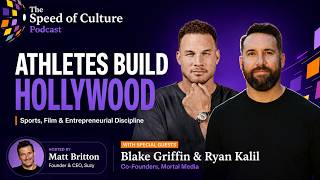
In this Speed of Culture interview, host Matt Britton talks with former NBA All‑Star Blake Griffin and former NFL All‑Pro Ryan Kalil about their joint venture Mortal Media. The conversation covers how each athlete began thinking about life after sports, the founding of Mortal Media in 2015, and the deliberate effort to shed the "athlete‑producer" stigma by approaching projects with humility, curiosity, and a strong work ethic. They describe early mentorship‑seeking, the role of their sports‑derived mindset—conviction, resilience, team‑first thinking—in building a production company, and the iterative learning process of developing and selling pitches. Key milestones discussed include the Apple TV series Hello Tomorrow and the White Men Can't Jump remake, which led to a multi‑year first‑look development deal with Sony Pictures. They also explain their recent investment in the Louisiana animation studio SwayBox, citing a desire to diversify into family‑friendly content and leverage newer, cost‑effective animation pipelines. The duo reflects on current industry challenges such as the writers’ strike, their adaptive strategies, and offers advice to emerging creators: discipline, passion, listening to criticism, and focusing on the process rather than the outcome.
Chapters
Up today, we're going to be speaking with a truly dynamic duo of 6-time NBA All-Star Blake Griffin and former NFL center and 3-time All-Pro Ryan Kalil. They've transitioned from sports into the realm of entertainment with their Los Angeles-based production company Mortal Media. The powerhouse duo is making waves, securing a multi-year deal with Sony Pictures and even investing in the innovative animation studio. Blake and Ryan, so great to see you guys. How you doing today?
Great, thanks for having us.
Doing good, thanks for having us.
Absolutely. So before we kind of dive into what you're working on, would love to hear about the transition from sports into business. Um, I've worked with several athletes who've kind of gotten to the business world. Kevin Durant is an investor in our company, Suzy, and you know, I know that sometimes it can be a little bit of a treacherous transition just from, from all the stigmas and things involved from being in professional sports to business. Would love to hear from both of you individually about kind of that journey, if it overlapped with your professional careers and kind of how it led you to where you are today. So why don't we start with you, Ryan, and then we'll jump into Blake.
Yeah, you know, I think like anything, we all sort of start out as rookies, and Blake and I have had long careers to really reflect on. And even while we were playing, Blake and I, as long as we've been friends, have shared a lot of what we've learned through our journeys and applied that to our own respective sports and really have tried to do that off the court and off the field as well. And so for us, you know, it's something, this, this, um, this endeavor is something that we're very passionate about. And so the first thing we sort of did was sit down and say, well, what made us successful in sports and how can we apply that to this? And really from day one, we've done that. We've, we've, uh, removed all egos. We've, you know, both Blake and I have great work ethics and know that just like anything, it's going to take a lot of work. And really in the early days, we were just sponges running around town trying to meet as many people as we could, you know, successful people, people we looked up to, trying to find mentors and really just learn. And we did that for a long time. So it's funny, you know, we've had some success now and we've been able to get some projects up and running. And we'll have a lot of people come to us and sort of ask us for help themselves and what the shortcut is. But it really, there's no secret sauce. It's putting your head down, it's going to work and doing it to the best of your ability.
Yeah.
And Blake, at what point during your NBA career did you start thinking about, I guess, what was next? And more specifically, the world of entertainment.
Oh man, I started thinking about what was next my rookie year. We do this thing called the Rookie Transition Program and they had at the time, a lot of those documentaries were coming out about broke athletes and everything. They had older basketball players come speak to us about average careers, 3.5 years, you got to do this, you got to do that. And, it sort of scared me in a good way to start looking at stuff like that. That's not to say I immediately applied that, but it was sort of a thought. Ryan and I started talking about this in summer of 2015, I think it was. And like you said, like zero shortcuts. I think one of the best things for us that right away was the one thing we knew was what we didn't know. And we, it just kind of allowed us like on the flip side of also being sort of a rookie in this new space, like it allowed us to ask those questions that some people might not ask. Right.
You didn't have the curse of knowledge, so to speak.
Exactly.
So it was like, and honestly, to that point, it allowed us to sort of innovate a little bit in our methodology and how we went about things because we could We sort of kind of came into it a little bit naive and were able to get away with sort of more traditional or seasoned producers saying, well, that's not how you do it. And us sort of asking, well, why, you know, and then going about it.
Yeah. How do you guys know each other?
We met through mutual friends.
Just kind of through mutual friends.
Yeah. Oh, wow.
Okay. I think we got along like 2000, maybe 2010, I think it was when we first met.
Got it. So I guess walk me through how Mortal Media came to be in 2015. What was the first step you took to launch the business and why entertainment and what was the vision behind the business?
Well, the short of it is, you know, even though Blake and I had been friends for some time, neither of us really knew that the other were pursuing this in our respective off-seasons. And it really The two of us coming together didn't happen until, um, Thomas Tull of Legendary, who knew us both, was sort of really enamored with how we were going about it. And I think, you know, there's a lot of athletes who like the idea of playing in the movie business. And I think for many of them, it's more of a vanity thing and they like the idea of putting their name on a poster, but Rick and I were really spending a lot of time, uh, running around trying to understand the business and, and really figure out how we could best, um, be effective. And, and, um, and so Thomas was the one that sort of suggested, you know, I really like the way you guys talk about it. I really like the way you guys approach it. I think it'd be different than maybe other athletes trying to transition. I think it'd be interesting if you guys did it here at Legendary. And so he sort of gave us our first look deal, Blake and I. Met with them. We had dinner that night and we just sort of, Blake and I just sort of ping pong back and forth, you know, what a company might look like, how we might do it differently. You know, we sort of really laid out a lot of the challenges that were going to be ahead. And one of the biggest ones was knowing that we were going to be fighting a stigma of being athletes and being outsiders. And And so we really kind of put a plan in place and just hit the ground running. And yeah, that's sort of how it came to be.
So, and what is it, what was it about, I guess, the original pitch or vision that was and is different? Like, what are some of the ways that both you guys see the world different when it comes to the entertainment landscape?
Well, I think just For one, like, our biggest thing that we talked about early on was establishing that this was like something that we— I think the way that we got into it was like, hey, for the first couple years, we're just going to be meeting people. We're going to try to get into rooms. We're going to try to impress people with our knowledge and not just, like Ryan said earlier, trying to slap our name on something and media release out there and say, oh, we have a production company. I don't think people really knew we had this publicly until maybe like a couple years ago, or maybe when we started like releasing that we had sold some projects here and there. But even then we didn't do much around it. And for us, it was very important to make sure that people knew that this was something we were passionate about first and foremost. And for us, like a lot of times when we're looking at projects or we come up with ideas, it's, would we watch this? And I know that's so elementary and it sounds somewhat corny, but like it has to start with that because Of course, we haven't— we have not, you know, accepted anything that we didn't feel very, very strongly about. And the beautiful thing of it is if something didn't go early on, we've now been able to come back to some other stuff now that we've had a very small amount of success and got a couple things off the ground. So, um, really, like, it's sort of forever— it's forever evolving, um, just because— you know, after we got these first two things made, Ryan and I are sort of talking and we're like, "Man, like, I wish we had trusted our instincts on this," or, "I wish we had done this." And, it's all just, like, important learning lessons for us just because, you know, when you're making something that you're passionate about, you don't want to cut corners. So, I think, like, at the base of our company's values, it's really, like, having a lot of passion for what we're doing. And, as we gain more and more experience, as we gain more and more credibility, It's about, you know, really, you know, putting our foot down when we see something creatively. Ryan and I met in the beginning of the summer when I first got back, and he was like, I mean, that's like, we have it, we have these instincts, we all have instincts. And if we don't feel like something's working, then like, this be, let's be more bullish about it. And like, let's make sure that we, we voice our opinion. Because for the sake of art, for the sake of making something you know, great. Like you don't ever want to have to sit back and be like, man, I wish I'd said that.
Yeah. You need conviction in what you're doing, right?
Yeah.
And then on the, and then on the business side, I would say, you know, we talk about knowing our challenges of the athlete stigma. And so with the sports background, we, we knew early on we were going to sort of be pigeonholed into only be able to play in the sandbox of sports-related content. And so And true to that, everything we were sort of being sent was the next Rudy, the next Hoosiers, the next, you know, whatever. With the exception of White Man Can't Jump, we've really tried to explore genres and things that Blake and I both love and all the touchstones and things that we, that really inspired us to get into this. But in, in the sports background, we did sort of lean into our experiences and our our strengths and what we've been able to accomplish in that career. And so, you know, when you really look at the entertainment business, there is a lot of crossover. And, you know, ultimately the job of a producer is to sort of be GM. And Blake and I always joke with our respective sports and teams, you know, how we would do things differently if we were GM. And this is the perfect opportunity to do that. And so we are sort of putting the team together, so to speak, and, and, um, And we're managing a long, long season that nobody gets to see. And, uh, and we're having to deal with a lot of different kinds of personalities, which we've done for many years in the sport world. Um, and so it's, it's a grind every single day. It's a grind and it's a long, long road. And, and, um, so there's that. And then also too, you know, Blake and I failed time and time again. This town isn't short of rejection. And so we, there's a resiliency we've built up over the years that we're able to apply to this. So we don't get discouraged easily and we're able to fail and quickly learn from it and push on. And so that's something that I think has been different, and at least I see that we, that has sort of been our strength that maybe the next company might not have.
So the parallels to sports and business are clear, whether it be conviction or resiliency or leadership or building the right team. And I totally see how those parallels really come in handy as you continue to build this business. You'd mentioned a couple of the original projects that kind of got the business off the ground. Talk to me about what those projects were, what you learned from them, and how they're helping drive your vision for the future of Mortal Media.
Well, like Wick said, the first few years we really spent sort of being students again. And so we didn't really, there wasn't a lot of projects that got off the ground. Blake and I really tried to come up with concepts in-house that we could then go out and find those with real skill sets in writing and storytelling to help us build out. And then we also met with a lot of writers and creatives who had ideas of their own that we got really excited about and Matt Britton said, we'll do anything to help shepherd this idea and be a part of it. So again, there's a lot of projects that we sold around town off of pitches, you know, proof of concepts that we built out that we never, you know, we didn't really, we didn't hire a PR firm early on. We just sort of said, we're going to keep our head down and really try to figure this out. And so we thought that was sort of the pinnacle. Once you sold something, which is, which is a feat in and of itself. But then there's the whole development process. There's the, the, the what, what else can you bring to this to make it sort of a whole package that we could then greenlight? Um, so that was a whole nother phase that we had to try to learn that we realized pretty quickly, oh, you don't, you don't just sell a pitch and now you're on a, you're on a golden paved road to production. Um, so yeah, there's a, there's a ton of projects nobody knows about that we set up, stuff in comedy, stuff in sci-fi. TV shows, features with some really talented seasoned veterans. So hopefully one day we can go back to some of those. But those sort of, those projects that no one saw in the trades or that nobody's ever heard of, the town has. And so that allowed us to have more credibility in the next meetings that we got going. And so Um, you know, our first big TV show was Hello Tomorrow for Apple TV starring Billy Crudup. Um, and then obviously with, uh, Kenya Barris and Calm Attic and Jack Harlow, uh, we did White Men Can't Jump. Um, but those were long, long, tedious roads that sort of the projects that preceded that were able to help us get it closer to the next phase of that, which is greenlighting.
Right. They talk about kind of an overnight success, years in the making. And it sounds like it's very much the story here. It's people don't see all the losses that happen that don't make the headlines that lead to a project like White Man Can't Jump getting live. So I'm a huge fan of both the original movie and the remake. Talk to me about White Man Can't Jump and what it was like to be part of that project, why you had such passion for that project and how that project has fared.
Yeah, it was sort of interesting for us. We'd had a meeting with Kenya Barris, just a general meeting with Kenya Barris in 2017, and sort of just like talked about a lot of stuff. But we mentioned the idea of like how much sports has changed. You know, the original came out in 1992. That was before the Dream Team sort of put basketball on the map globally. I mean, we've obviously seen like how fashion has changed. But yet somehow we're still sort of having the same conversations around race and the things that are going on in the world today. That being one of my favorite movies growing up, and obviously because of the basketball ties, it was also very interesting for me as somebody who comes from a mixed-race family, you know, in those conversations back and forth and sort of like always kind of wondering, like, is it really— like, does it really have to be like that? So that was like the original attraction for us. We went through hoop after hoop after hoop. I mean, pitching at Kenya and getting a call on him saying like, I'm doing a deal with Fox and we want this to be our first thing. And then the Fox-Disney merger and Disney acquiring Fox. And you just— it was like such an up and down, just like a roller coaster ride. And I remember like when we were when we— the day we started filming, just kind of like looking at each other being like, wow, I can't believe this is actually like here. Um, and for us, we wanted to put a movie together that addressed all those things, like I said. And, and, um, the great thing about it, whether you're a fan of the original or you're a fan of the remake or not, um, I think that the thing that we're most proud of is like the numbers, you know. The streaming kind of gives you a real idea of how, how something's doing, how many people are interested in watching it, and The streaming numbers have been great, and Hulu, Disney have been very pumped about it. So, all those things, like I said, were big learning lessons for us. And, you know, even when something happens, like Ryan says, I don't know that we necessarily consider it a loss. It's just kind of like, all right, we got to figure this out. You know, as athletes, we've been so used to very direct criticism. You know, you go into a film room after a game and you just get absolutely chewed out. And I think that's something that we always— Or you read the media.
The next day after a game, right?
It's constant. You try to avoid that a little bit more. You can't really avoid the coach, but, uh, yeah, you know, it's just we always tell people like, hey, like, if something's not working, just, just tell us. Like, you're not gonna hurt our feelings. We've heard worse from a 10-year-old kid in the stands than you can ever say to us. So, um, I think that's sort of been a positive for us too, is sort of having that, that, that, that shell, um, that, you know, you're not really going to offend us, but it's just about— it's not about being right, it's about getting it right. And I think that's what we've sort of attached ourselves to when it comes to—
yeah, well, listen, I mean, that was definitely a huge success from, I think, a pop culture standpoint. It's something that, um, you know, the remake I'd heard of over and over and over again. So obviously you broke through and you touched on a nerve of the zeitgeist with that remake. And I think it definitely set you up to what you announced earlier this year, which was a multi-year first-look development deal with, with Sony Pictures Entertainment, which must have been kind of a, I guess, a step back, wow, we've accomplished something moment. I know it's always hard to look at it that way when you're in, you know, in the grind. But from an outside standpoint, it's a huge success. And 0.001% of any production company ever really gets to that type of partnership with such a major partner. Ryan, how did that come about? And what do you hope to build on with the Sony Pictures partnership moving forward?
You know, I think The kinds of projects we've been developing sort of align with some of the brass here. And, and honestly, I would say Why Men Can't Jump is a big driver for that. You know, that, that's such a touchstone in the culture. But it also, it's the Why Men Can't Jump was torn because it was, it was built for a younger audience. And so, and that it was an audience that we, I think, did a good job tapping into. And so younger audiences absolutely loved the movie. Yeah. Um, older audiences were torn and mixed, which we knew going in. Anytime you're gonna touch a classic, it was gonna happen. Of course. And so I think for someone like Sony and, um, um, the success of that at Hulu, uh, I think for them was exciting for us to sort of try to replicate that kind of success and, and do that in other projects here. So, You know, maybe it's the sports in us, you know, Blake and I have been so brainwashed by team first. So, you know, we, as exciting as it's been to have that announcement and to sign, we're also like back in it, back in the grind, trying to do right by the fans and really come up with a big win here. And, and, and so that's what all our energy and focus has been on. So it's been, it's been tough to to sort of celebrate that next jump for us. But yeah, we're just, we're eager to get going and replicate some of that.
Yeah.
And of course, you know, Hollywood right now is in a kind of shaky spot with the writer's strike and all the other complications that come along with it. I imagine that is definitely impacting the way that you're approaching projects right now. Have you thought about going into documentaries or other things that allow you to get around some of those restrictions that come with Reddit?
Yeah, I mean, and even prior to the work stoppage, we were already way delved into all of that landscape. And so obviously our focus shifts to that where we're putting all our attention on that, but there's still opportunity, ability for us to keep Setting things up in terms of getting ready for once, uh, once a deal gets reached, we can hit the ground running and, and get back to some of those other things that have kind of stalled. Um, but yeah, we've been dabbling in it all and, and it's been fun and, and again, similar but two different landscapes. And so we, Sony has an incredible team here, um, that we've been really getting to spend a lot of time with. So as much as. It's been tough to feel like things have been stalled. We've also, it's been nice to kind of have a break from the kind of hustle of running around trying to sell projects and get projects set up to really sit down with a lot of the folks here and, and, and learn a ton. And we've already done that in a short period of time. So it's sort of been a blessing in disguise, at least for us in some aspects.
Absolutely. And earlier this month, talking about keeping things moving forward, you all announced an investment in SwayBox. Which is an animation studio out of Louisiana. Blake, how did that come about and what is it about animation that you thought made sense to add to your overall portfolio at Mortal Media?
Well, animation has been something that we've been super interested in. Ryan and I both have kids, like younger kids, and there's just always like a, there's always a need for things that families can watch together. And Ryan brought this idea, developed this relationship and brought this idea to me. About a year and a half ago. And the first time I saw their capabilities and how everything works, I was like blown away. So this is just sort of a newer, fresher take on animation, cheaper, faster, which is never a bad thing for studios or for people putting in money. So we've developed a relationship with them and thought it was a good idea to sort of put our money where our mouth is a little bit and show, again, show people that like this is something we're all in on. So we're really excited about some projects we have going with them. They have the ability to do something special and we're excited about that.
Absolutely. So as we wrap up here, I mean, one thing that strikes me about both of you is you guys have had so much success in your professional careers, your professional sports careers, yet you both come off as so humble. Even the wins you've bad today, you're like, ah, that's not a big deal, we're focused on what's next. And that is in a world where so many young people who really haven't accomplished anything are flexing on Instagram like they've made it. And I just think it's such a lesson for younger people. It's, it's if you have the drive to create something, you never really feel like you've conquered the world and you can kind of kick your feet up. What— I imagine that's also a great lesson that you're teaching your kids as well. Um, what gives you, both of you, that, that drive to continue to want to build something? Because this doesn't seem like it's a vanity project. This is something— I feel like I'm talking to two entrepreneurs who haven't created anything in their lives yet, and I, I think that's really admirable. I just want to say that. But what gives you, each of you, that drive to continue to push?
I mean, I think for, for me, and I'll let Ryan speak for himself, but I think that just kind of comes from our sports background. I mean, yeah, you know, you can have a good game, but it's Professional sports is so like, what have you done for me lately? Like, right, how was your last game? Your last game is what you're sort of known for. And even season to season, I remember finishing my rookie season and being like, oh wow, I got that done. And then immediately, like, the moment you have time to think, you're like, oh no, there's next year. I gotta, I gotta top last year. I gotta keep going. And if you don't put in the work, you don't have a good work ethic, you don't continue to keep your humility in line with your actual talent, like, you're not gonna truly accomplish what you want. So I think it's just sort of that background of like, there's going to be other people that are hustling, there's going to be other people that have great ideas, there's going to be other people have relationships. So just because you've gotten one thing done or two things done, just because you had one good game, no one's gonna just automatically hand you something. And I think that's kind of how we feel about this company, is like, sure, you can have a win here, but that doesn't guarantee you anything, anything anything else for the future. So, even if you tell us this can't be made, we're not just going to throw that away and forget about it. We're going to keep going. So, that's just sort of been our mindset. Yeah.
Ryan, anything to add on your conviction and your motivation?
Yeah. And Blake and I share the sentiment, but I think the biggest thing is just defining pretty early what success is to you because, you know, life's full of peaks and valleys and, and sort of the arbitrary finish line changes. It changes culturally, it changes personally. And so again, sports has been a great teacher for us. We both learned early on that riding the highs and lows like a roller coaster, it's just not sustainable.
It's just too far.
On you emotionally and physically. And so it really is something that it took a long time. We're both guilty of it, but you sort of fall in love with the journey and fall in love with the process, not the results. And for Blake and I, we get excited about challenges. We get excited about coming to work and meeting new people and finding new collaborators and coming up with new ideas and working through serious and not so serious problems, and doing it to the best of our ability. And so for us, you know, that's what we try to do in the sports world. And obviously, you know, it's different, but it's also the same. And, you know, at the end of the day, if we're doing everything we can and we're using our talents and we're growing our— we're growing our talents and we're learning from our mistakes. And we're enjoying the process. I mean, that's a win for us. And so there really is, there's nothing for us to really kind of plant our flag into and say, that's it. That's the one. It's, it's, it is sort of the next, it's the next project. It's the next day. And just forcing yourself, because it's hard, but forcing yourself to enjoy the process of it.
Absolutely. So to wrap up here, I mean, is there one piece of advice that maybe each of you could share was, our younger listeners here at the Speed of Culture podcast that maybe are getting started at the beginning of their career and professional journey, that they can one day end up in the seats that you guys are today, even given the fact that you feel like that your journey is still being written, which I agree. What one piece of advice would you give? Let's start with you, Blake.
I think for me, and I guess this, this, this, whenever I talk to young kids, youth programs and all that, I talk to young kids about discipline. I just feel like that goes such a long way. Respect and discipline are two things that my dad, like, early on just drilled into my head. I always tell kids, like, you know, it's a very stupid thing, but I always say, like, to young athletes, like, make your bed. Like, making your bed is the very first thing you can do every day. It's a task that you can accomplish that, like, sets you on track to being disciplined throughout the day. And I think that with anything, like sports, The more detail and the more attention you put into like the smallest details, and sometimes that stuff is very minute and very mundane. Sure. The more attention you can put into that, the better off you'll be. And I think it's the same thing when you're creating a project. If no detail is too important, or if no detail is unimportant, then you've sort of thought of everything. You can sort of check that list off. I think that's kind of like a mantra that I use professionally, personally, in every different field is just be disciplined about it. And at the very beginning of that, you have to be passionate about something or discipline comes very, very hard. So make sure you're doing something that you're passionate about. And if you are, like, you don't want to look back and say, oh man, if I just like worked a little bit harder here or there, like, don't let that be the excuse. Let everything else externally be the excuse. So I think just having the discipline and the drive for whatever you're doing.
Absolutely.
Ryan? Yeah, I think I agree with all that. And I would add two things. I would say listen to criticism, listen to advice, listen to opinions, but at the end of the day, nobody knows anything. You know, if you really love something, if you're really passionate about something, you'll figure out a way to go about it. And, um, and yeah, it's, it's, uh, it's, it's a long, tough road. Um, but if you really, really, really truly love it, you'll, you'll figure it out and it won't ever feel like it's a challenge. It won't ever feel like work because it's something that you're very passionate about and and you'll find a way to get it done.
Absolutely, I love that. Well, thank both of you, uh, special thanks to both of you for joining today. It was great speaking to both of you. I have no doubt that you're going to continue to achieve tremendous success, uh, in your professional lives, um, and I'm really excited to see where you take Mortal Media next. So thanks for joining, uh, on behalf of Susie and the Adweek team. Thanks again to Blake Griffin and Ryan Correal of Mortal Media for joining us today. Be sure to subscribe, rate, and review the Speed of Culture podcast on your favorite podcast platform. Till next time, see you soon everyone. Take care. Hey!
More from Matt




MikMak’s Rachel Tipograph on Consumer Spending, Retail Media & Holiday Shopping Trends



Jaguar Land Rover’s Charlotte Blank on Luxury, Purpose & Experiential Storytelling



