Blitzscaling Ventures’ Jeremiah Owyang on AI Agents, Ads & Human Agency
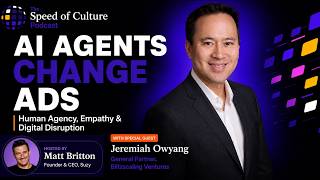
Jeremiah Owyang at Blitzscaling Ventures breaks down the AI wave using a five-question framework and argues that AI agents, not ads, will become the primary decision makers in B2B and B2C purchases. He sees buyer-side agents as the next generation of influencers, with Crew AI already in 50% of Fortune 500 firms.
Chapters
Up today on the Speed of Culture Podcast, we are thrilled to welcome my friend Jeremiah Ouyang, a trailblazer in tech and business strategy, a former VC, founder, CMO, analyst, and public speaker. He's been ahead of every wave from Web 2.0 and Web 3.0 to the sharing economy, and now of course AI. Jeremiah is currently a general partner at Blitzscaling Ventures, co-leading the AI fund to help scale the next generation of AI-powered startups. Jeremiah, so good to see you. I've been really looking forward to this.
I am so excited to be here. Let's hit it.
Absolutely. So, you know, obviously you've had a really prolific career, and as you look back on your journey, what do you think were some of the consistencies that have kind of stood the test of time as you've kind of entered all these incredible innovation cycles?
Whoa, uh, thanks. Let's be retrospective. So tech waves usually have 5 questions to them. Huh? 5 questions. Well, the first question is, what is it? Number 2 is, why does it matter? 3, how do I start? 4, what are best practices? And then 5, how do I integrate it into my business? So I figured this out when I was a Forrester analyst, and because you have to publish certain types of papers depending on what is the number 1 question in the market. So I learned that at an early point in my career about 15 years ago. What is the question the market is asking about the tech? If you know the question the market is asking, then you can provide the answer. And usually that results in business growth or personal satisfaction.
You choose. So what is the question that people are asking right now?
Well, I'm focused on the AI market. I live in Silicon Valley for 28 years. I'm in the heart of AI. We can talk about that. The question right now that people are asking is probably, how do I start? Yeah, that's probably what I'm hearing, both in a personal perspective as well as I hear the same thing.
And so Yeah, so what do you tell them when they ask how do you start?
Well, it depends. So right now I'm hunting for the best startups in the world that are solving these things. And often some of these are enterprise class companies that will help marketers and advertisers. And then sometimes I'm looking at consumers, at consumer apps that are gonna help regular consumers make decisions on what they actually need. And it just depends on who I'm talking to. There's definitely some big changes coming to advertisers and marketers. We can talk about that in a little bit. There's some disruptions and opportunities. So it really depends on who I'm talking to and which corporation I'm speaking to, or if it's to a founder.
Now, what about just employees in general? What are you finding in terms of— because what I'm sensing is just like a lot of fear, fear of the unknown in the workplace. If you're an employee and you're, you know, junior to mid-level and you want to make sure that you're future-proofing yourself for all these changes that are happening, what do you recommend to them?
Yeah, well, so, right, there was actually a study I just saw earlier this week, and it talked that there's a divide between the staff employees, rank and file, versus the executives on their opinions of AI. And executives think it's going great, AI's going great, and organization's behind it, and everybody knows what to do. And then the staff is the opposite. It's actually like a 20-point spread. And the staff is like, it's not going great, we don't know what to do, and we don't necessarily want it. Now, what's interesting is most executives now, don't take offense, you're an executive, I am too, they often actually don't use the tools. So they're probably going to rely on a junior staffer to actually show them how to use it. So that's your opportunity. If you are early on in your career is become a master as a user of the technologies, trying them out, and then publishing your findings on an internal collaboration tool and maybe doing and leading the lunchtime learnings at your company, which will get you into a spot to roll out campaigns. So that's how you need to be, is the hands-on leader that will shift you through your career. By the way, I did that when I worked at Hitachi Data Systems, a 100-year-old company, and we were just learning about the scary technology, blogs. Podcast. And I said, so I, I did that like 20 years ago in my career. So I've been through this. If it's scary, you got to lean into it. If it's uncomfortable, you got to lean into it. So I do this. Um, when I was really fat and overweight, I decided to get fit. So I did the scariest thing I could do. I signed up for a Spartan Race, an obstacle race, and I went and did it. And as a result, I got fit. So you got to lean into things that are uncomfortable.
And in terms of obviously getting your hands on the tool, and I completely agree with you, you know, I find often it also should be contextual with who— what the employee does and what the company does. Not just say, hey, I created a picture of a cat, um, swimming in the middle of the ocean. You know, if you can figure out how to connect what's most important to a business with an AI tool to solve a problem of today, then I think you're gonna have a lot more resonance with the leadership.
You're absolutely right. But I'd say start with the, the area of interest to you and then you move it into business. But Obviously you don't need to show your cat photos to these. Yeah.
So you'd mentioned some, you know, marketing advertising, how it's going to impact the industry to so many people that listen to this podcast are in what, you know, let's talk about that first and maybe some of the other industries where you're seeing disruption and how that disruption you see occurring.
Yes. Okay. So we've already seen the data that people are already turning to GPT or Claude or Perplexity to get answers. Do you use any of those tools, Matt? Of course. Of course. Now, you'll— I'm sure you've observed as a marketing executive, there's no advertisements on there. There's no sponsored sentences. There's no banners. There's no skyscrapers. No, there's no retargeting. None of that. Now, if people are moving to that form to get information where the information is being served up to you in the way that you want, sans advertising, That is a pretty significant disruption. Even Google with Google Gemini is starting to do that right on their own page because they don't want to be disrupted. So if that becomes the de facto standard that people will get information without marketing and advertising being interruptive, that is a big change. And so what we're seeing, it's a huge change. And I—
What are they going to do? Do you think that their core business is going to erode? I mean, there's so many questions about that.
So I spoke about this at the LUMA, like LUMAscape conference in 2023 fall. Like I was early to speak on this and write about this. Like I was one of the first. To talk about this. Like, that's my— that's what I do is I spot the trends and I write about the impact of business. Like, I've done this for 5 tech waves, and this one is a big one. However, we will see many opportunities, right? Because Perplexity has said that they will offer up the ability to have sponsored sentences and sponsored answers.
They're already rolling out an enterprise sales team for that.
Exactly. Also, there are tools out there like Brand Index from Pete Blackshaw. We all know you know, Pete, like legacy CMO, where they try to unravel why did that LLM spit out these particular companies in their reputation.
So like an SEO for LLMs, if you will.
You nailed it, right? It's SEO for AI. So that's— but, and you can also see the sources. You can ask for a source citation of these LLMs and see that. So you can observe which third parties do you need to influence. That's a content marketing and media play in most cases, right? And then we should expect to see this was, and there's even more disruptions coming. So by the end of this year, 2025, I'm expecting to see e-commerce integrated right into LLMs at the bottom. So you say, I'm looking for, you know, a car, right? Or I'm looking for a CPG product. I'm looking for some toilet paper. The e-commerce integration will happen directly in there. It makes logical sense that will happen. So that will be yet another shift down the end of the funnel. So those are the things to think about, that there's been a separation of the content and data layer from the presentation layer, which includes ads. And we're only able to consume if we want the content and data layer and we can strip away marketing advertisements. So good luck, marketers. Yeah, more data.
Interesting. And this will obviously only apply to some business categories, but in the realm of if you're asking ChatGPT to book a trip, which they already have actually with their operator tool. As you know, like ChatGPT could do a deal with a kayak who does the trip booking as part of their platform, or ChatGPT could just book the trip directly to the source. It's gonna be interesting to see if they're gonna create those partners, which they likely will. But I still don't know what that means for people who sell toothpaste and deodorant and shampoo, which, you know, the big CPG spacer or Kraft Heinz or, or, you know, those companies, how they fit in all this? 'Cause they're the ones who typically advertise the most on the Googles of the world and the traditional, you know, digital advertising channels.
That is gonna happen. And, and right now most interactions are happening on the internet are done by humans. I've been invest, I've done 3 investments. I'm, I'm at a VC firm by the way called Blitzscaling Ventures based upon the famous book Blitzscaling by Reid Hoffman, our LP and advisor, and Chris Yeh, my friend for 20 years. So I, I'm very fortunate that actually Reid Hoffman, reviews the deals before I invest. That is a huge advantage because he's the first investor in OpenAI and he's on the board of Microsoft and he made money.
So, so that, that's fascinating. So, so obviously Reid Hoffman's a legend in the tech industry and you're quickly becoming one as well, I should say, Jeremiah.
And, um, I'm just kidding.
So yeah, so, but in your seat and you're, and you're seeing all these new and emerging companies, like what is blowing you away the most here in Q1 of 2025 in terms of the types of, innovations that entrepreneurs are bringing to the table?
Right now, the focus is on AI agents. That's here and now. And the startups that are providing those are growing very quickly. So an AI agent is an autonomous application, like a child, can sense the world around it. It can read text, it can see the video and understand it, it can listen to conversations, and then it can determine its course of action. It actually thinks about what to do, and then it completes that task. The advanced AI agents can self-learn and improve over time, and they can even recruit other agents. Now, what does this mean for marketers? Every consumer is going to have a buyer-side shopper agent that will go do the shopping for them. I've already invested in a company that's doing that, and this means that the decisions are turned over to the AI. Now, the AI agent may have ability to review your personal data, such as your email, social network information, credit card, Amazon purchases. That's like, you can turn the, obviously the level of trust in the business model needs to match. And I realize that tech usually gets this wrong. I totally acknowledge that. They'll start to make those buying decisions for you. So marketers, what I'm trying to tell you is this, the decision maker in the next few years won't be humans. It will be an AI agent representing the buyer. And that applies to B2C and B2B, even for long sales cycles. And that's a wild concept to think about. Now, Well, now hold on. 15 years ago, you and I, we were going through the social media wave where we were telling the world that there's a new influencer town— bloggers, YouTubers, and now TikTokers. And marketers and advertisers had to figure out how do they cater to them, and they figured it out. And what I'm here to tell you, marketers, is there's a new influencer in town, and it's not a human, it's an AI agent. So you've done it before, you can do it again.
Yeah, and of course AI agents won't just be in the realm of advertising and marketing, like That's where we're seeing a lot of the automation and disintermediation of employees, right? Like AI agents are gonna infiltrate the enterprise. What are some of the other ways where you think AI agents are gonna have a big impact?
Yes. So it's definitely happening in the enterprise. We've seen Salesforce rebrand as Agentforce, their big conference. We've seen HubSpot roll out Agent.ai, a marketplace of AI agent functions from third parties. Every enterprise SaaS company's rolling this out and there's a whole fleet of startups out there. I've looked at Lyser and Emergence and a number of other ones. I, we ultimately invested in Crew AI, which is open source. And open source is a wild thing, Matt, because it spreads so fast. The developers are using this open source technology to make agentic systems in, in the enterprise, and they're already in 50% of the Fortune 500. And the company is only 15 months old.
That's fascinating.
I've never seen that level of growth before.
Yeah, we're seeing these companies just take off like rocket ships because they do not have the limiting factors that technology companies have usually had, namely capital and the need to hire a ton of engineers, right?
Because you can— oh yeah, and so Crew has only 20 employees.
Wow. So, and, and what is your take on some of these next-gen coding tools like Cursor and Lovable. Do you think that that is gonna be more of the future, or do you think that's sort of like the, the first step is some of the larger Google, Microsoft type companies are gonna enter that space?
Yes, they will. So I hear about Cursor, Replit, and Claude in that order from developers as no-code or low-code. That's typically what I hear here in Silicon Valley. And those are becoming the de facto standard. And developers are at a very low risk of losing jobs because there's always been such a high demand. It's just that their level of output is becoming so incredible. And so there is a mantra here in Silicon Valley called the AI-first mindset, Matt. And this means if you have a business problem or personal problem, you first check, is there an AI off the shelf that you can grab? Does it already exist? If so, use that. Now, if it doesn't exist, then you try to build it, obviously using low-code or no-code. And if that doesn't work, then you hire somebody. And it goes in that order. So we're expecting to see, and there's already companies getting close to this, like a dozen employees that are, and the company's a unicorn worth $1 billion. Like it's already, there's actually 20 companies in that list already. So it's just like, I've never seen this level of growth happen so fast. And the level of efficiency is incredible. Now this also means that we're gonna see a variety of new marketing apps and advertising apps that will be very fast and efficient. And for marketers, you need to pay attention and lean in on this. You don't want to be caught behind on this because this is your career.
Yeah, absolutely. So you mentioned, you know, the name of your firm is Blitzscaling, and I did read the Blitzscaling book by Reid. And, you know, what is the, I guess, overall thesis of blitzscaling? And obviously you kind of just alluded to it in terms of how quickly these companies are growing, but why is that especially pertinent to AI?
Companies? Yeah, so blitz means lightning and scale means to grow. So lightning-fast growth. Um, and there's two specific attributes— they're actually business strategies or product strategies that we look for. Um, one, does the product have natural growth without marketing, advertising, or sales, right? So we call that viral effects or product-led growth, or they have a strong distribution strategy. So Slack, Box, um, Salesforce have had all, had they spread through the organization or the consumer, Facebook, Instagram, Uber, Airbnb had all those things. So that's first part. The second part is, is a loyalty function. So this is the actual function of loyalty typically is called a network effect, whereas every new user, every new client, if it's B2B, the value increases for everybody else. So social networks, the value increases as more people are on the network. Airbnb, the value increases as there's more, uh, hosts as our guests. So we look for those two features and then we do a scorecard to score the companies and we bring it to Reid for a final review.
Interesting. So I know that in the past you've spoken about how tech companies almost become like digital nations, right? And yeah, yeah. So, so who are the big nations moving forward? Like who are the new superpowers and which empires do you think are gonna crumble? I'm gonna put you on the spot here in terms of, um, you know, and, and who will withstand the test of time.
So in today's political climate, I want to be very cautious about how I position this. So I, I don't want to equate any company to a nation or anything of that level, um, but let's call them, uh, ecosystems. So clearly there's the OpenAI, which used to be tightly coupled to Microsoft, but I can feel them shifting apart now. Um, Anthropic is also a clear leader in that space as well. But then every tech giant um, is also moving really fast into the space. By the way, on freeway Highway 101, which is the main artery connecting Silicon Valley to San Francisco, it's a 1-hour drive. By my count, 1/3 of the billboards are about AI.
And Jeremiah, I'm sure you remember the early 2000s making that ride, and it was, yeah, Alta Vista. I remember flying into San Francisco, renting a Hertz car, going down to eBay trying to sell to those companies and the, the, it was littered. You kind, I just kind of get nostalgic just talking about it and now it seems like it's happening all over again.
So that doesn't bode well, but we do need to remember that there's always, it didn't even short term, but look where we are today. Yeah. Amazon, eBay, PayPal, like definite, like trillion dollar companies popped, you know, out of that. Apple had a resurgence, Oracle, like, you know, it, it happened, right? Uh, but obviously 99% of those companies failed.. And that is also very likely here because there's over 30,000 startups according to the database. There's an AI for that.com, of course. So you can go there and see all the different startups. In our last, like, 20 minutes of talking, 17 minutes of talking, one startup's birth and another one's probably died. So that's just like startup life. But the difference is now, like, the cost, and you mentioned this prior, the cost of starting these startups is very low., you just don't need a lot of resources. So, it is quite the scene here. In Silicon Valley, there are 100 AI events per month. There's 5 per day. And every weekend, there's 2 hackathons. Each hackathon has around 300 developers building. I've never seen this level of—
And you're involved in it, right? You're throwing some of these events, correct?
I do. I run an event called LLAMA, lounge. Only humans are allowed. I've tried to have llamas there, but the city said no. And usually it's 300 developers and VCs and corporate AI leaders that show up. So I've been doing that since May 2023. I like to be early to the market, right? So been doing this for a while in the space.
And, and when you see somebody that's really talented in AI at a high level, like somebody who could actually get in front of your firm, what types of skill sets do they possess? Because What I'm hearing from you is clearly not just being able to code. You obviously have to be somewhat technical, but when, when you see great entrepreneurs in this space, like what do they usually have in common?
Yes. So most of the investment has gone to B2B. So these companies are selling to big corporates, like the people that are listening to this, um, amazing show, and they need to have business acumen. They need to be able to present, they need to show leadership. Some of the greatest, um, entrepreneurs that we're seeing have the ability to command a room or build a community or build an ecosystem. And that is not so much a technical skill as it is a leadership skill. By the way, I'm a father of young children. I'm raising up in this AI world and I continue to try to teach them, or even if they resist me, like, like leadership is going to be important, community and empathy. People say empathy is going to be so important in the age of AI, but they never say why. And the reason is, is because you can influence others and you can build ecosystem around you. That's actually why. So, or at least, excuse me, that's one of the major reasons in addition to being a kind human being. But the point is the best tech leaders, it's just not technical. They are business leaders.
Yeah. And, you know, from hearing from you is also the ability to storytell, you know, piecing together, like all that is really uniquely human and will never go away in the business world.
It will not. And I think there's going to be a premium on humanity. So there's, there's two interesting things happening. So as we shift more to one thing, there's always a counter reaction. That's just— and you track trends, you know this. So we do more AI. People want to be in person more often and people are going to pay for physical services and people will be excited to receive white glove human services. So hospitality industry will only rise, experiences will only rise, luxury products will only rise if everything else is automated. Secondly, and this is a little bit of a dire topic, but as AI starts to automate many positions, the cost of the humans doing the same position drops. So labor costs actually will decrease, meaning you'll have more service providers. So there's no reason for a large company to ever truly get rid of customer care because it just is not going to cost that much money for quality.
Right. What does that mean, that people are going to— that individuals will have to do more with less, or that people are going to be paid lower salaries?
Um, AI will be enabling them in a hybrid way to be more efficient and offer personalized experiences to each client, but the human will probably be paid less because there's going to be higher supply of workers with that type of talent, right?
It's really interesting. I know it's, it's, it is scary to think about. Like, you know, I know that you're on stage a lot as am I, and one common question I get after I speak is, what should I tell my kid? Like, you know, you just talked about your young children, but I'm, I'm talking about parents with kids that are entering college, right? And they don't know what to major in. Like, should they be, uh, an accountant or a lawyer, or is gonna, or is AI going to render a lot of those professional services obsolete? Like, what is your take on where people should be focused right now to succeed in 2030?
So just take, let's just take law for example. We talk about this, we actually debate about this in our firm. So the founding partner Chris believes that there's going to be a decimation or beyond decimation. That's only 10%. Significant amount of lawyers will be reduced. The demand for them will be significantly reduced because of AI, because it's just often matching paperwork and looking at paperwork and cross-referencing data, right? We already use AI at our firm to like look at our legal documents before asking the lawyer. We save— that's $600 saved right there per query, right? It's like, why? However, litigation and strategy, that's still gonna be needed. The human aspect and thinking strategic and logical, and also ensuring, you know, patents, that's still gonna be needed. So it depends what part of law. Obviously I'm leaning more towards leadership, discussion, what's happening in court, the changes in the environment. Like humans are needed for the strategic parts. And the same thing applies in marketing and advertising. Yeah.
What about creativity? You know, obviously, and, and, and we're, we're speaking here at the end of March and, ChatGPT rolled out an incredible image creation tool. Yeah. I think just yesterday where it really, the first thing I saw after I used it is like, well, what does this mean for Canva or like a Photoshop where you, you know, people have had to learn these specific skill sets in terms of editing an image and now you could really just prompt it to get it to almost exactly how you want to. We haven't really seen that yet. We, we, like, it was, it was a year ago we saw it produce humans with 7 fingers on one hand, right? And now look where we are today.
Yes, I saw it as well. And just for those who haven't seen it, you should Google it, but, or Perplexity did, I suppose. And you could have it, it like the copy is correct on an image, labeling, it can start to do taglines, it can do schematics of products. Like it's pretty specific and it's, and this is the worst it's ever gonna be at that, right? So it's only—
I use that phrase all the time.
So that is very scary. What I think what it means is, what I know it means is, is that every advertiser now has the, and marketer, has the opportunity to provide personalized content at every step of the journey for each person. And that's not something we've been really good at in the past and now we can do that. So that's an exciting thing. So I was a speaker at the Creativity Creators Conference in Dubai in January and they're all very worried, but it actually means you can just be more efficient and you can roll out higher quality content. So the personalized content is where we're headed.
Yeah. I mean, a lot of creators are also leaning into, you know, digital twins and cloning their voice and, you know, low tone and feel so they can scale themselves in different ways. Yes. Um, so shifting gears, we wrap up here. First of all, for those who are listening and not watching, Jeremiah is in an Airstream.
Yeah.
Uh, which is a first. And I follow you closely on social media and I know that that was something that you had built during COVID Would love to just hear the story of how that came to be.
So my wife and I were surprised and blessed the same time that we were having twins about 6 years ago. And this was before COVID and I needed a quiet place to work. So we got the Airstream and it is only for business. It stays in my backyard here in the Silicon Valley hills and it is a nice little business write-off and actually appreciated slightly. So it's a really good asset and I have this quiet place to work. So it is a 22-foot Airstream. In my backyard. Yeah, that's over on the property.
So, um, I've known you now, you know, as I was prepping for this interview, I saw that you actually, uh, wrote one of the blurbs for the back of my last book that I wrote 10 years ago. And it's just, it's just crazy how fast time flies. And there's people who you kind of, um, weave in and out of people's lives during business. And you're one of those people. And one thing about you is you always do seem to be jumping on these new changes so quickly. And figuring out how to leverage it in a variety of different ways. And this way you're doing, you know, VC work, you have your Llama Lounge, you're doing your speaking, you're doing consulting, all these different things. What is it about the way that you work, the way that you prepare, the way that you spend your time that enables you to so quickly pivot for these big moments?
Yeah, so I'm not advising right now. I am, my day job is VC and I have a salary. That is my focus.
Well, I guess that is advising startups whether you invest in, but you're not advising.
That is. Absolutely. So that's absolutely true. And I found that out the hard way. It's like, oh man, like I'm on the board of like all these companies now. I didn't know that was gonna happen in this way. So how do I jump on it? Well, being in Silicon Valley has helped me a lot. And so I have a commitment that I attend 3 events per week. I mean, my whole career I've always done that. I just, with the community and I wanna hear what's happening. And there's a certain archetype of a person that I follow. And I watch and it changes per market. It's like not the same individual human, but it's like this early adopter, kind of nerdy man or woman, and they like to try things and I just see what they do. And if somebody else, the second person follows them and I see that adoption, I see that signal and I just figure this out. And so I try to be the second adopter of these trends. And then once I, once I see that, I immediately start writing about it and I host an event and I just grow it and then there's a network that forms. Yeah, so I just continue to do that. Now, in Silicon Valley, I've been criticized as being the late follower. So it's all in context, right? Like, Jeremiah just follows the cool kids. Like, I've heard that a number of times. I'm like, yeah, I do, but now I'm going to give you money, so be quiet. So, so it just depends on like your state, like how you view the market and where do you deploy. So thanks for that question. It's been great to be here.
Yeah, absolutely. So to wrap up here, our guests normally have a quote or mantra that encapsulates their professional journey. What comes to mind for you?
My career mantra for over 20 years has— I want to be in this center of a couple overlapping circles. And so I figured out my career mission when I was 27. I help companies connect to their customers with new technologies. So companies customers, new tech. And I am in the middle of that. I've done that in Web 1, Web 2, sharing economy, Web 3, AI, tech wellness, and now AI. So I've done that over and over and over and over. And I just know that's like how I want to serve and be part of the market.
Awesome. Well, thank you for serving our audience today. It was an incredible—
my honor—
conversation and so great to see you again. And wishing you nothing but best of luck in these exciting times.
So great to reconnect. Thank you all.
Likewise. On behalf of Suzy and I, we team. Thanks again to the great Jeremiah Ouyang, general partner of Blitzscaling Ventures, for joining us today. Be sure to subscribe, rate, review the Speed of Culture podcast on your favorite podcast platform. Till next time, see you soon, everyone. Take care.
More from Matt




MikMak’s Rachel Tipograph on Consumer Spending, Retail Media & Holiday Shopping Trends



Jaguar Land Rover’s Charlotte Blank on Luxury, Purpose & Experiential Storytelling



