BODYARMOR’s Tom Gargiulo on Sports Hydration, AI & Brand Growth
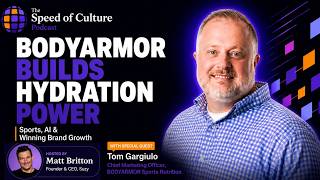
In this Speed of Culture interview, host Matt Britton talks with Tom Gargiulo, CMO of BodyArmor Sports Nutrition, about his unconventional career journey, leadership lessons, and the strategic evolution of BodyArmor. Gargiulo recounts his early start in the NFL’s sponsorship group, an MBA at Emory, and senior roles at Frito‑Lay, Danone, KIND (through its acquisition by Mars), and NYX before joining BodyArmor in 2023. He explains how the brand integrated into Coca‑Cola’s distribution and marketing powerhouse while preserving its unique culture, and how that muscle helped double revenue and push the brand toward a $1 billion valuation. The conversation dives into the competitive sports‑hydration landscape—Gatorade’s dominance, new entrants like Prime and Electrolyte—and how BodyArmor stays ahead through product innovation, limited‑edition collector bottles with augmented‑reality experiences, and AI‑driven content relevance. Gargiulo shares his advice for young professionals on breaking into dream jobs, his hiring philosophy centered on work ethic, self‑sufficiency, and a winning mindset, and his daily CMO routine of bottler travel, team leadership, and executive meetings. He closes with the “Mamba mentality” mantra inspired by Kobe Bryant, emphasizing incremental improvement and a culture of winners.
Chapters
Up today, we're excited to welcome a distinguished leader in the marketing consumer goods industry, Tom Gargiulo, Chief Marketing Officer at BodyArmor Sports Nutrition. Tom brings a wealth of experience from impactful roles at Danone, Kids, NYX, and now BodyArmor, where he leads the charge in sports hydration innovation. Tom, so great to see you today.
Hey, Matt, how are you?
Good, I'm really excited for this chat today. BodyArmor is such an interesting brand and it's been fascinating to see its ascent over recent years. But before we dive into BodyArmor, we'd love to hear a little bit more about you.
Sure.
And your journey in the marketing space and how you ended up where you are today.
Yeah, so I actually have a very, my background's a very non-traditional path to actually where I got to. I went to a very, I went to a small liberal arts school up in New England. And studied political science, believe it or not. I didn't know if I wanted to be a lawyer. I didn't know what I wanted to do, but I was really intrigued by the material. But eventually found myself getting involved in the sports industry, doing internships at a couple of teams, a couple of websites, you know, back when the dot-com boom was going on.
Yeah.
And eventually found myself in sports marketing. And my first real job was at the National Football League. You know, I started kind of answering phones, doing expense reports, doing your typical admin stuff, but eventually, you know, fought my way into meetings and got involved in, in kind of the business dealings and eventually worked on a lot of big accounts like PepsiCo, Campbell's Soup.
Managing sponsorships.
Managing, selling and managing sponsorships.
Exactly. Got it.
And that ultimately kind of gave me the knack for CBG and marketing. So I decided to go back to business school, get my MBA at Emory University where I actually got like formal business training and eventually found my way to Frito-Lay in Plano, Texas. And that's where I really started my brand marketing career. Eventually found myself moving to Danone, you know, 'cause I was getting homesick. Down in Texas. I'm from the New York area and started to do a lot of different experiences, not only in marketing, but also in sales and just gave me a very great perspective around how to manage a business and how to be a general manager. Spent almost 10 years at Danone, had some fantastic experiences there, and then landed at KIND right before KIND actually was acquired by Mars. Mm-hmm. And led marketing function there, led the commercial strategy functions, and ultimately helped KIND get fully sold to Mars, you know, by the time I left for a pretty healthy multiplier, especially during COVID which was incredible.
Yeah, absolutely. I remember that time.
Yeah. So did that and then ultimately landed at another small up-and-coming brand called NYX. Where I actually dipped my toes into being a chief operating officer and kind of learned, you know, how to start a line, purchase a line, you know, do all the— manage a co-manufacturer and did that. But then I got a call from the CEO here at Body Armor, who's a close friend of mine. And, you know, it was the perfect opportunity for me because it marries my passion of brand marketing and sports.
Coming full circle, right?
Exactly. And now I'm on cloud nine. Couldn't be happier to be here.
That's awesome. Well, thanks for running us through that. I want to just double-click on a couple things you had mentioned.
Yeah.
As you were going over your background, first and foremost, you know, getting a job to work at the NFL as a young professional, especially as a sports fan, which it's clear you are after, you know, going through your background, it's probably such an incredible thrill, but it's also probably not an easy thing to do. And then you went on to talk about how, after you got the job there, you kind of forced your way into meetings and, and, and basically took the job versus being asked for it. And for some of our younger listeners, just walk us through that journey and what were some of your learnings in terms of what worked to break into a dream job and not only get the job, but also kind of mold it into your own and, and make it more impactful a— as your job progressed.
Yeah, I mean, to your point, it's, it's definitely, it was a job that was more focused on the passion than on the monetary benefits. I had to bartend on the weekends for 4.5 years while I was working there just to pay my rent and to do the things that typical 20-some-year-olds do.
Right.
But ultimately, I landed there. I knew that's where I wanted to be and I was able to get there. And I didn't care what I had to do. I started it really as an admin for a couple of managers in the sponsorship group, answering phone calls, doing their expense reports, doing the basics. But eventually, my goal was to try to convince them that I had more to offer.
Yeah.
And over time, as I asked for more and more projects, they started to feel more and more confident in my abilities. Ultimately, he gave me a couple of shots and that ultimately got me in the conference rooms and ultimately got me a seat at the table.
Yeah, I think so many people make the mistake of just waiting to be told what to do.
Exactly.
I think that's akin to just coloring just inside the lines when you're a student. I mean, if you follow orders, fine, you might move along, but this world is made for people who go out and grab things and not for people who wait to be told what to do. You also, the other thing that's not lost on me is in this world where so many young people, I think, are just so ready to flex their new watch or a new car. Like, the reality is sometimes you do have to become a bartender when you wanna work your dream job.
Exactly.
And that's okay. That's kind of how you get to where you wanna get to. And I just think it's a, it's a good message. The world was different back then as it is today. We just, we both came out in the workforce around the same time. Now I think there's far less patience. And people want to hit it right away and they don't understand that you have to take your chops along the way and learn your lessons to get to where you want to get to.
Absolutely. I grew up in an entrepreneurial environment. My dad was an entrepreneur and I knew learning from him, hard work is going to get you where you need to get to.
Yeah.
Yeah, you can be savvy, you can be intelligent, but unless you work very hard, you're not going to end up where you need to get to. That was kind of the mantra I always held close to my heart.
Absolutely. So you also mentioned that when you were working at Kind, which, you know, was acquired by Mars and obviously a great success story, you know, they were— it was in the midst of the acquisition. Talk to us about what it's like to work at an emerging CPG startup as they're getting acquired by a behemoth like Mars. Like, what were some of the considerations you had to have as a leader to keep people focused and also deal with, a huge financial transaction at the same time?
Yeah, so during that time, what I loved about my time at Kind was I really got a taste for what that kind of up-and-coming startup CPG experience was like, where frankly, you don't lean on mountains and mountains of research. You don't lean on a playbook of how to do things. You don't lean on a ton of people around you that have, you know, a ton of experience, um, in, in certain functions. So, you know, for me it was, it was a great opportunity to kind of learn skill sets that I didn't have before, um, become much more entrepreneurial, become much more self-sufficient, actually develop the people around me. And in many cases, a lot of those people were, were, were very young, very malleable, didn't have a whole lot of experience. Mm-hmm. And it really kind of tested me as not only a marketer, but also a leader.
Yeah.
But what I love the most about it was, you know, there was a direct correlation between the effort and the success that you had and, you know, the financial results at the end of the acquisition. So, that was one of the things that I love the most. Like, everybody at that company was so focused on, you know, the endgame and getting to that finish line with Mars, we did some extraordinary things launching a ton of new products, you know, expanding Kind to new categories, launching new go-to-markets and doing so many different unique things. And we were able to cross that finish line and show Mars truly what the value that Kind had to bring to their portfolio.
That's such a unique, product the way that it's designed, where you can see the ingredients. No, the way it's packaged and, and merchandised, you know, cuz it's a competitive category and we're gonna get into your category as well, which is also competitive. And event, you know, you need a lot of different things to succeed in terms of differentiation. Obviously the product's gotta taste good and has to have a good shelf life and you have to have a good message, but the packaging and, and the way the product looks and feels I would imagine was a huge part of the success of KIND. Would you agree?
Oh, absolutely.
Yeah.
Absolutely. I, you know, I think, you know, Daniel Lubetzky, the founder of KIND, he's a brilliant entrepreneur, you know, and a little bit crazy at times, but certainly one of the most brilliant people I've worked with. I mean, his whole, his whole, you know, focus was delivering a fantastic tasting product and being as transparent with consumers as they possibly can. Right. And he put a heavy focus also on where the product was sold as well. So getting into airports, getting into bodegas, getting into, you know, not maybe not the most, you know, widely available grocery store, but maybe the most prestigious. So you can kind of carry that premium badge.
Yeah.
And he was ruthless. I mean, down to the point where he would do it himself if he saw an opportunity. And, you know, that, that kind of, that's the kind of culture he built and that's the experience all of us had.
Absolutely. So you went on to join BodyArmor in March of 2023. What some people might not know is 2 years earlier than that, late November 2021, I should say early November 2021, Coca-Cola acquired or finished their acquisition of BodyArmor. It was for $5.6 billion. It was the largest ever brand acquisition. Another quick factoid there is Kobe Bryant has actually made an investment 7 years prior in BodyArmor, the late, great Kobe Bryant in 2014. Obviously, that was a brilliant move by Kobe. And it was in that age when athletes were starting to invest in brands. We know that Powerade was one of the first brands that saw outside investment from— and Vitaminwater as well— from athletes and celebrities and things of that nature. So when you joined BodyArmor in 2023, what was it like? Because at that point, the company had already been acquired by, you know, so, so, so they're acquired by Coca-Cola. Are you operating inside Coca-Cola or are you still kind of a separate entity? And I guess what were some of the nuances given that situation?
Yeah, so it was a very interesting time kind of in the life cycle of BodyArmor where we were going through a bit of a transition, you know, a lot of the old guard started to leave the organization.
As often happens, right?
Post-IP. Yeah, exactly. It's a natural progression. I mean, a lot of people made some really great money and decided that, hey, maybe they either want to do something completely different or maybe try to throw their hat in the ring again.
Of course.
And so it required us to do a lot of recruiting and to start bringing people on into the organization that had different experiences and different skill sets that we didn't necessarily have in the past. You know, this company was born, you know, through, again, the— by a brilliant entrepreneur who, you know, learned so many different things from his experiences at Vitaminwater and Pirate's Booty and a bunch of other companies and built this brand to where it is today. But, you know, now we've grown to over a billion-dollar brand. We have to kind of— it takes a different set of skills and different type of individuals in order to get it to that $2 billion number, $3 billion, $4 billion, etc. You know, so when I joined, we had to fill a lot of holes, and I was very fortunate to keep some of the best that stayed around from the acquisition. and we brought in some really, really sharp people. And over the last year and a half, it's been, you know, slowly but surely integrating kind of into the Coke system in certain places, but still very much keeping our own identity and keeping our own unique culture here in Whitestone, Queens.
And what are some of the benefits to being part of the broader Coca-Cola organization? I would imagine there's many, but You know, like what, what, what are you able to tap into that you wouldn't be able to if you were just a still standalone startup?
Yeah, so there's a, there's a bunch of things. I mean, first and foremost, the muscle that Coca-Cola brings into the store. I mean, it's, it's bar none the best in the business.
Distribution, basically.
Distribution is, is, is absolutely second to none. You know, the thousands of employees that, that, stack the cases on the floor, put the bottles in the cooler, put the cases on the shelf. I mean, we had the best in the business. So having that strength behind our distribution was a huge reason why we went from a $250 million brand to a $500 million brand to a billion-dollar brand in only a few years. Now, in addition to that, Coca-Cola has some of the most brilliant marketers in the world. You can argue that some of the best marketing campaigns in the history of CPG have come out, were born out of this organization.
Absolutely.
So being able to tap into a lot of that expertise, being able to tap into a lot of the resources and insights that Coca-Cola has to offer, It's been just an absolute wealth of resources that we can now tap into that we never had before.
Yeah.
There's certain things that processes and protocols that we have to follow now that we're part of a publicly traded company. But on the flip side, the very much, especially Jennifer Mann and her direct reports and our CEO, Fed, have given us the ability to kind of continue to stand on our own, tap into Coca-Cola in the places where we need it and can leverage it, but still maintain our own unique identity.
Yeah. And when you look at the category, I guess the category is a sports hydration category. I'm sure you probably call it something.
Yeah.
But so what are the major consumer behaviors and trends that are driving the category? That make you continue to have to innovate to stay on top and be in a growth position?
Yeah, so the last couple of years has been really interesting in the category here in the US especially. You know, it's not often that you get to work in an industry where there's this behemoth that has a 65% market share. I mean, I was on the flip side when I worked at Frito-Lay and Salty Snacks. So I kind of got that experience, but I've never been you know, at such a— coming from such a unique place versus a behemoth like that. So you're always going to have Gatorade and the big dollars that they bring to the table and, you know, the expertise that they have in the category and the science behind, you know, the category. You always have to kind of keep up with them. So that's kind of the first area that that, that keeps us on our toes. The second is, you know, we have a lot of players coming in onto the scene, you know, last year or the year before Prime came onto the scene and, you know, basically copied our product and, you know, brought their own spin to it with content creators, et cetera.
Right. That was, um, Logan Paul's brand, right? Yeah.
Logan Paul's brand. Exactly. So, you know, that wasn't necessarily a product fight. It was more of a marketing fight and an eyeballs fight. And now we have brands like Electrolyte coming onto the scene where they're delivering unique functionality that this category hasn't really seen before in terms of rapid rehydration. So, you know, what keeps us on our toes, you know, are those three things. I mean, from one end, it's the science and the mass availability and the support that PepsiCo brings behind Gatorade. It's these up-and-comer, what we call ankle biters, coming at our heels. And a lot of them are just copycats of us. And then we have brands like Electrolyte coming onto the scene and bringing unique and different experiences and functional benefits to the category.
Yeah, and one thing I know that has been a big initiative as of late, we talked earlier about packaging, is that BodyArmor has rolled out limited edition collector bottles.
Yes.
You know, which, you know, obviously you're probably well aware of just the collectibles market right now. The big, you know, collector, collectors conference last week was the National.
Oh yeah.
Yeah. Fanatics has their own conference coming up in August. So, you know, you're well aware of just the fanaticism in the sports space and it seems like you're tapping into that, which I think is a brilliant strategy. Walk me through how, you know, you came to that and how you're activating on that.
So first, I am going to admit I am an avid collector.
Me too.
Of sports cards and sports memorabilia. So I was very, I had a lot of FOMO not being at the National last week. But, you know, one of the biggest, one of the most valuable assets we have within BodyArmor is Team BodyArmor. You know, we have some of the biggest and best stars in their respective sports. And, you know, thinking through our marketing plan, you know, we wanted to find unique ways of us connecting Team BodyArmor with our consumers. You know, so we brought, you know, fresh thinking to the table. We were able to do some unique things on social media. We were able to do some unique things through our field marketing organization. But one of the biggest opportunities that we identified was just how do we start connecting our athletes to our product itself?
Yeah.
And playing off the fanatical nature of fans in certain markets and unlocking the ability to kind of give them something unique. Was really interesting for us. And then, you know, we kind of took it a step further by integrating unique content with each one of our bottles with augmented reality, which, you know, we got some really great feedback from our consumers about. So, you know, more to come in this space. I think maybe this year we were a little bit too aggressive in terms of the number of bottles that we've done, but we certainly got some key learnings and we're gonna be coming out full guns blazing in 2025 and '26.
That's awesome.
Some really exciting stuff.
And when you roll that out, like a collector's edition bottling, like how does that work in terms of like a scalable distribution platform? Because I would imagine it's hard for you to slot in all these limited edition—
Yeah.
—bottling models when you're kind of working on mass scale distribution.
Yeah. So one of the unique, I guess, challenges/benefits of working for a company like Coca-Cola and having the sales organization and the in-store muscle that we have, you're always constantly not only fighting against your competition, you're also fighting against your sister brands.
Right.
Bear in mind. So a lot of it has to do with internal selling and getting our bottling network and our associates excited about, you know, what we have to offer. So we put a great amount of, effort into, you know, internal selling and making sure that we're getting all of the associates super excited about it. Then obviously we have the customer, which is another key stakeholder that we have to, you know, get excited about it. And then the last piece is obviously the, and most important is obviously the consumer. So—
Yeah.
You know, we take this kind of three-pronged approach with every major initiative we do to make sure that we have, you know, a high likelihood of success in the market.
Yeah, absolutely. So moving on to just communications and marketing, obviously the world's changed. We have AI now, which is reframing everything in terms of the way that we go to market. What are some of the tactics that you've used from a marketing and media standpoint to get the message out to your core consumer and break through the, the increasing clutter that we're seeing, you know, in the consumer marketing world?
Yeah, artificial intelligence is certainly a buzzing topic right now. And I think, you know, it's gonna be survival of the fittest of who's gonna embrace it and capitalize on that technology sooner than later.
Uh-huh.
And you're gonna see brands, you know, hopefully like ours, who are gonna kind of take it to the next level and, and exploit some of the greatest benefits of it. And then you're gonna see brands kind of stick to their guns and do what they traditionally do, and they're probably gonna find themselves very far behind very fast. So in terms of artificial intelligence, I mean, our brand is a better for you, real, super transparent brand, similar to what we just talked about with Kind.
Mm-hmm.
So when it comes to, you know, certain marketing tactics and things like that, I don't necessarily know if artificial intelligence is the best way for us to connect with our consumers. But on the backend, when it comes to, you know, making sure that we're serving up content that is most relevant for our consumers, making sure that we're, you know, tapping into conversations that are naturally connected with our product and people's passion points, are great ways for us to leverage this technology. And, you know, from a social, digital, and a media perspective, it's gonna be a big part of our approach in the next few years.
Yeah, absolutely. It'll be fascinating to see how it all develops. So shifting gears, you know, as we wrap up here, Tom, I'd love to hear a little bit more about your day as CMO—
Sure.
—of such a fun brand, how you spend your time, what's the pie chart of your day look like, and what are some of the things that you do personally to make sure that you're continuing to progress and develop as a CMO?
Yeah, that's a great question. I appreciate that. So first and foremost, the one thing that you can ask anybody on my team is that I travel a ton. You know, not only do we have, we obviously report to the Coca-Cola Company down in Atlanta, but we have over 65 bottlers across the country that, manage and service our product on a daily basis. So, you know, a good portion of my time is actually spent on the road talking to these bottlers and trying to communicate the marketing plans that we're putting together and try to create that excitement around the programs that we want to execute. But when it comes time in the office, you know, I spend a great amount of time, you know, connecting directly with my team, my direct reports. So I spend a probably about, you know, anywhere between a quarter to a third of my day, you know, making sure that they have the resources they need, the support and direction and guidance that they need. And then the rest of the day, it's a handful of other meetings, either part of our leadership team meeting with our CEO and his direct reports, or, you know, being in a number of initiative meetings, you know, talking about projects or talking about,, you know, campaigns, things of the like, and trying to, you know, drive the business forward and create that growth that we need.
Yeah. And obviously you wouldn't be able to create that growth on your own. You obviously have to—
No.
—build the team. And so when you look at building a team, what are some of the things that you look for when adding people to your team to make sure that you can compete at the highest level?
Yeah, so I'm a little bit biased in terms of maybe the profile of people that I'm looking for, you know, again, because I grew up with a serial entrepreneur as a father. So work ethic is a big part of what I look for. The people that are willing to put in the time, the people that are willing to put in the hours, obviously not crossing boundaries into personal time and stuff, but—
Right.
Making sure that every minute that they're focused on work, that they're focused and committed to driving what we need. The second is, you know, one of the things that I'm very passionate about is empowerment and making sure that I bring on a team that's, you know, highly self-sufficient. You know, they can obviously tap into me and any of the leaders in the organization when needed, but I'm going to give them the space in order to succeed or fail and then hopefully learn from that. So, you know, for me, it's, it's hardworking, self-sufficient, and last but not least, it's the individuals that just wanna win.
Yeah.
Like you said before, we're in a highly competitive market. We have a massive behemoth as our primary competitor, and we got a bunch of these ankle biters kind of coming after us and trying to mimic a lot of the stuff that BodyArmor has done over the years. And, you know— I— I, I like to surround my, myself with people who wanna win, who aren't afraid of overcoming the behemoth, who aren't afraid of, of leaving those ankle biters in the dust and ultimately winning in the marketplace.
I think it's really well said. So to wrap up here, Tom, I mean, obviously you've had a really exciting career and I can't wait to see where you're gonna take the BodyArmor brand to next. When you look back at your career journey, what were some of the things that you think you did right along the way to put yourself in the CMO seat today?
Yeah, so I, like I told you, I had a little bit of a unique career path, so I wouldn't exactly call it cookie cutter from a seat point.
Most aren't, right?
Yeah, most aren't. One of the things that I did, which I thought really helped me in the long run, was I took on a lot of assignments that, you know, some were unplanned, Some were planned, but that ultimately pulled me out of my comfort zone. You know, I go back to my time at, you know, Denon or even KIND. The business had different needs than maybe what the scope of my current job was. And, you know, I knew that I had value to deliver in other parts of the organization. So I took a leap of faith and, you know, I did a few years in category management and was the lead of the category management organization. Spent a few years in sales planning where I managed a trade budget and built trade plans, spent some time in revenue growth management and figuring out pricing and all these different components. The role I had before I joined BodyArmor, I was a chief operating officer at a small startup. All of these experiences and all of these skill sets that I've kind of built along the way, have given me such a unique perspective and point of view on the business that makes me a business builder versus somebody who's exclusively focused on driving one respective area of the business. Everything that I look at is through the lens of what's going to be the best for the overall health of the business, and that will help guide ultimately our actions.
Absolutely. So to finish up here, Tom, is there a, a quote or mantra that you like to live by? You seem to be super focused on surrounding yourself with winners, and I love that mentality. And it's not lost on me that, you know, you are in an industry that largely plays in the sports world. So, you know, there's a lot of analogies there. I use sports analogies all the time, as I'm sure you do in business. But is there any other mantra that you like to live by when you think about your career?
Yeah, I mean, ultimately, you know, I, this is gonna seem like, like a loaded answer, but I'm gonna say the Mamba mentality. I mean—
Love it.
Kobe was a huge part of how this brand got to be where it was. And a lot of it had to do with the fact that, you know, he was all about making, you know, today better than tomorrow. You know, how can I do the little things better? And over time, those little things add up and ultimately get you to the peak of your game. And, You know, it's truly inspiring. It's a big part of the culture that we've built here at BodyArmor, and it will be, you know, moving forward.
That's awesome. Well, I want to thank you for taking the time out of your busy schedule today to share your journey and the current work you're doing with BodyArmor. It's super exciting, and I've long been a huge fan of the brand and your work. So it's been a great thrill for me to connect today.
Awesome. Thank you so much, Matt. I appreciate the time.
Absolutely. On behalf of Susan and Adweek Keen, thanks again to Tom Gargiulo, CMO of BodyArmor Sports Nutrition, for joining us today. Be sure to subscribe, rate, review the Speed of Culture Podcast on your favorite podcast platform. Till next time, see you soon, everyone. Take care.
Hey!
More from Matt




MikMak’s Rachel Tipograph on Consumer Spending, Retail Media & Holiday Shopping Trends



Jaguar Land Rover’s Charlotte Blank on Luxury, Purpose & Experiential Storytelling



