Burger King’s Pat O’Toole on AI, the Million Dollar Whopper & Personalized Marketing
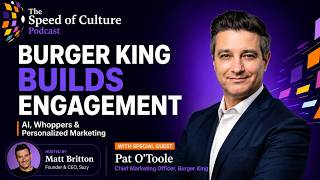
In this Speed of Culture interview, host Matt Britton talks with Patrick O'Toole, CMO of Burger King USA & Canada, about the brand’s flagship "Million Dollar Whopper" promotion, which lets consumers design a custom Whopper using a consumer‑facing AI text‑to‑image tool and generates a personalized jingle. O'Toole explains how the contest ties back to Burger King’s heritage slogan "Have It Your Way," the modern remix of the classic jingle, and the role of earned social media buzz. He then reflects on his 15‑year PepsiCo career, describing the rotational marketing program, the importance of full‑funnel experience, and how those learnings prepared him for a CMO role. O'Toole discusses why he chose to move to Burger King, the added complexity of a franchise‑heavy business model, and how franchisee input sparked the contest idea. The conversation shifts to digital transformation: the integration of the Royal Perks loyalty app into the marketing org, the value of first‑party data in a post‑cookie world, and the need for seamless consumer‑facing digital experiences. He also covers media strategy, balancing mass‑reach TV with addressable CTV and day‑part optimization, and the importance of efficiency in spend. Finally, O'Toole shares leadership philosophy—focusing on happiness for consumers, employees, and franchisees—and advice for aspiring marketers, emphasizing continuous learning, improving weak spots, and leaving every role better than found.
Chapters
Today we're thrilled to be joined by Patrick O'Toole, the Chief Marketing Officer of Burger King. Patrick recently joined as CMO and we're really excited to have him on. Patrick, great to see you.
Great to see you too, Matt. Thanks for having me on. Absolutely.
So let's dive right into it. Today you're, you're out west launching a pretty big promotion called the Million Dollar Whopper Contest. We'd love to hear more about it and what the impetus is behind this promotion.
Yeah, we're tremendously excited. We are just over a week into the Million Dollar Whopper contest promotion, and this is something new for us, but something that is rooted in something that's a big part of our heritage, which is Have It Your Way. So Burger King, we've always been about putting our guests first and allow them to have whether their burger or their meals customized in the way they want it. And Million Dollar Whopper is another articulation on that, a modern take, if you will, on Have It Your Way, where we're inviting consumers to tell us any way they would top their Whopper so they can pick from any ingredient under the sun. It's gotta be edible and it has to be a non-allergen, but they tell us—
I can put gummy bears on it if I want, right?
You can absolutely put gummy bears on it. And that, hey, that actually might be a front runner. So I'd give it a try. Send me the check. You can put, but you, you can, you can put whatever you want on it. And then we're using some pretty cool technology with, with AI to both generate you what your Whopper could look like and then also write you our iconic jingle that's based on the Whopper that you designed. And so it's a great, very cool, engaging, inviting program to get consumers to tell us how they want it their way. We're going to pick 3 finalists. The 3 finalists will be in restaurant in November. So their creations, we're going to make them. We're gonna sell 'em to America, then we're gonna ask America to vote on their favorite, and that's gonna be our million-dollar winner. And even if you're not a winner in the finalist, second place gets $200,000 and third place gets $100,000. So we're really excited about the program.
You know, there's a lot I like about this promotion, the fact that you're doing it here in 2024, because these AI tools really give such creative power to the end consumer in a way that we've really never seen before. It used to be if you had a program that you know, gave consumers the opportunity to create their own content, the content wouldn't really come out so great. But now with some of these AI tools, if I understand you correctly, I can come up with my own ingredients, my own Whopper, and I can actually see what it would look like.
That's exactly right. It's a really cool technology that we've built with our partners that give you an inspiration of, hey, I want to put gummy bears on my Whopper and I want chocolate sauce and I want something crazy like a slice of pepperoni pizza. And what's fun about AI is not only can it do it, it does it with pretty darn good accuracy and it does it really fast, right? So it does it typically within 10, 15 seconds that you can see and you can look at and say, you know what, maybe it's not what I thought it was going to be. And you can go back and change your ingredients. But as we looked at the program and promotion, you know, we wanted it rooted in the brand ethos of have it your way. And then we looked across the landscape of how do we make this as engaging to the consumer as possible. And AI is at a point where we felt comfortable leaning in, putting it as part of this tool. And it makes the experience great. And the amount of time people are spending on our website playing with these tools, looking at their Whoppers, is like nothing I've seen from a brand engagement standpoint. So AI was definitely, definitely the right way to go.
Yeah, a lot of people don't really even know how to access these text-to-image tools. So this bringing it to the consumer in an easy way with a brand they trust, is a great way to just really even teach them about the immense possibilities that are now at their fingertips.
Yeah. And I think we'll, we'll probably chat about it later, but AI, it's just such a powerful tool and we're obviously in its infancy and there's so many different uses for it. But why we, why we liked AI as something to put into a consumer-facing program is, is just what you talked about. It's the ease of use for the end consumer. Consumer. A lot of emerging technology isn't user-friendly. It takes a lot of steps. It takes a depth of knowledge. It takes research. This one, it's as simple as just typing in the ingredient. You can even spell it wrong and we fix that for you. It's incredible. And then it shows you something within a matter of seconds. So amazingly powerful tool. It's so great for how the team's figured out how to use it. And it makes for a really fun 10, 15 minutes that millions of consumers are spending with our brand since the contest launched. Yeah.
And even like when social media first launched and took mainstream popularity, a lot of brands tried to build apps within Facebook and it was just clunky and hard to use. So, and brands kind of got too clever. And the great thing about AI is you don't need to be an engineer. All you need to do is have an imagination. And I think what Burger King's done a great job at over the last couple years specifically, it's really continuing to weave the brand in kind of the lexicon of pop culture and in a really seamless way. And I think now you're able to really amplify that through what I think is a really smart promotion. So I can't wait to see how successful this is. And you mentioned "Have It Your Way," the song. That song, obviously from an outside perspective, just seems like such a smash hit. And obviously the brand continues to lean into it. Talk to me about what goes behind, I guess, producing a song like that, which is the brand anthem. How do you know it's right and how do you know when to step on the gas to really make it so closely connected to the brand ethos like it is today?
Yeah. And you know, it's funny you talk about being a smash hit. I think when the Spotify, I'm forgetting the name, but the end of the year results came out of Spotify Wrapped.
Yeah.
Rap. Thank you. I was blanking on it, but Spotify Rap was over 5,000 people. That was their most streamed song of 2023 was our Have It Your Way jingle, which was pretty cool. And our creative agency, OKRP, did an amazing job of looking at the brand heritage and a brand like Burger King that's been around as long as our brand has. Coming on 70 years is we've taken consumers on a journey. And sometimes when you're the marketer in my chair, you forget about that journey, that journey that's been built over decades and the story that we've been telling consumers for decades. And this was a part of our story that came out in the '70s. There was this iconic jingle around Have It Your Way that supported the tagline. And what the team did with, with OKRP is they looked at it and said, hey, there's something to this. How do we modernize it and make it relevant to today's guests? And how do we evolve it to what our strategy is now? And they did that. They had a great earworm jingle. And then the amazing thing about being a marketer today is with social media that consumers take things and make them their own. And that's also was an insight that we took to Million Dollar Whopper, but people just started remixing it, right? It was in their head and they thought, let's have fun with this song. And so some amazing remixes came out of our jingle and it just took off from there as to where it was one of TikTok's top hashtags for the first quarter of last year was a brand jingle. So the amount of just earned media and just being top of mind that the brand is, the brand that needed it quite quite candidly, that over the past couple of years that we haven't been top of mind with, especially younger guests, massively accelerated that. So just shows what leaning into the heritage with a powerful idea in today's world and feeding it the right way, what it can do for a brand like Burger King.
And was it one of those things where you and the team heard it, or the team that was there? Were you there when it was first presented?
I wasn't there. I was actually in Asia.
Right.
You're interviewing.
So, but when the team heard it, were they like, yes, that's it? Or is it one of those things where it took a lot of convincing to get the team to even run with it to begin with?
So I just hear the stories that I asked the exact same question. And I said, how'd you guys land on this? And there was just like any brilliant idea, there was some debate. It was, hey, is this right? Do we want to lean into this? Your lyrics are, wait, let me get this straight. Whopper, whopper, whopper, whopper. Like that's, that's what we're gonna sing. And, but I, I'll give credit, you know, my, the Marcoms team here is, is just exceptional and they had conviction. And the leader of that team, Zara, she fought for it. She said, look, this is a, this is a great creative idea. It's what the brand needs. Our insights and analytics leave us on the same page. And you know, we, we have franchisees that have been with the brand for decades and some of them are like, yeah, hell no. And some are like, yeah, I think we should. And so yeah, the, the story is, is I know it is, is there was a good amount of debate. There was a team that stuck to it. And our CEO, Tom Curtis, who's, who's been leading the brand for a couple years now, Tom said, hey, the team's got conviction. It, the agency has conviction. We're going to lean in. And, and obviously the rest is history. Yeah.
So let's kind of wind back the clock a little bit just into your career because, you know, before joining Burger King, you spent 15 years at PepsiCo. And, you know, it's definitely a common theme here at the Speed of Culture podcast that some of the most prolific and successful marketers either started their career at Procter Gamble or PepsiCo, and they really cut their teeth there. If you had to zoom out and look at your 15 years there, What were some of the key learnings and what is it about that company that you think breeds such great talent and future leaders in the marketing field?
Yeah, it's a really good question. And I showed up at PepsiCo on the bottom floor at the time. So at the time, they hired out of graduate school. I came in with a class of just brilliant people. So I think it actually starts with how they recruit. And what they look for in candidates. And they, they brought in a great group of talented people. I was at the Frito-Lay division down in Dallas, but they were doing the same thing in Chicago with Quaker, and they were doing the same thing in New York with their beverages business. They brought in a lot of talented people. And what drew me to PepsiCo was it was a rotational program through marketing. So everybody had to go through all of the disciplines, and at the time there were innovation, shopper marketing and brand marketing. They've since added food service marketing, which is really interesting based on where I've ended up. And actually a lot of my peers have ended up, if you look across the landscape of CMOs at, at QSR and restaurant, there's, there's a lot of people who, who also came up at PepsiCo. But when they do that, you know, they teach, right? They, they do a lot of really teaching the fundamentals of marketing and making sure that the teaching and coaching is there, but they also lean heavily into on-the-job experience. And so As you rotate through these disciplines, you're picking up these skills and then you start connecting dots. And I always talk about when I was in shopper marketing, I was actually, I had a knack for shopper marketing. I tended to like it more so than a lot of people that were going through the rotation. And there was a point in time where they're like, hey Pat, like, do you want to just stay in shopper marketing? I said, no, you know, I want to have a chance to run the brands and My first big brand assignment was being a director on Cheetos. And when I got to Cheetos, because of the time I had spent in innovation, because of the time I had spent in shopper marketing, I actually could connect the dots in a way that if I didn't have those experiences would not have landed the way they did. It was like, hey, I see an idea coming from Goody Silverstein and I automatically take it through to in Kroger. In Columbus, Ohio, how in the world is this going to show up to consumers? And I think Pepsi just does such a good job of ensuring that people learn the full funnel. And then it's, it's a culture thing too that they build. It's an affiliative culture as to where, yes, you've got these brilliant people that you're kind of moving through the ranks with, but we all know we have to lean on each other and our success depends on working well with each other. And that's something that's embedded in and it creates great leaders. It creates great marketers and, and obviously it, it's put a lot of industry leaders out of these programs. Yeah.
And then after that much time and obviously working your way up from the bottom to the CMO title at Mountain Dew, which was, I believe, your last title before you left PepsiCo, like what goes behind the decision to make that leap and to come over to a company like Burger King? Because many people, they either stay at places for 3 years or they're there forever. And you kind of staying for 15 and making the jump, I'm sure it wasn't an easy decision. Talk to us about what's behind a decision like that.
Yeah, so I had a mentor at PepsiCo. Actually, his name is Ram Krishnan. He just got named the head of North America Beverages over there. And Ram was always, he always put people first. And Ram and I were having great conversations and he said, hey, make sure when you leave PepsiCo that you get one chance to leave, make sure you go to the right role. And the right company. And so he always kind of planted that, like, don't jump just to jump and maybe you're in a bad role or you've got something where things aren't working out. It was always, hey, see the bigger picture. And so as I went through PepsiCo, I had no intent of being a CMO at PepsiCo or at Burger King. And so I just kept going through the ranks. I love what I was doing. I love learning. I love the culture. And as opportunities came up, I always had that in the back of my head of, is this the right jump or is there a better future of PepsiCo? And so as I took on a lot of brand roles, I went from Cheetos to Tostitos to Doritos, and then it was like, wow, I've looked after all the, all the O's. What's next for me at PepsiCo? And it was the chance to go international. And I thought, hey, going somewhere else is not going to give me the experience of going international, which then translated the ability to move to beverages, which ultimately led to me being CMO of Mountain Dew. But during that time I had a food service role and I was just so intrigued by this industry and I loved Burger King. So as a, as a kid, like Burger King was my brand. As I grew up, there's a lot reasons that, that I loved this brand. I obviously saw the amazing work that the teams were doing at Burger King. And so when this opportunity came up and, and it wouldn't have been the same for a lot of other QSR restaurant brands, but this brand in an area of the country that I, I grew up an hour away from Miami. So there were so many things that came together and I kind of checked the box and I actually talked to Ron and I'm like, this is it. This is the one. And so that's how it came. But, but obviously PepsiCo was a great place to be and a lot of people have an amazing full career there. And I think for me, it was like this is the time to spread my wings a bit and try something different. And I couldn't be happier with my decision to come to Burger King. Absolutely.
And moving to Burger King, it's obviously, obviously it's tangential to a lot of the brands that you worked at PepsiCo, but it's primarily a franchise model, correct? So it's a completely different business model. So I, as a CMO, how does that make your role maybe different than a traditional CPG or food and beverage company, given that you do service the franchisees and you touch the end consumer as well?
Yeah, it, it, it's an added layer. And that was honestly the biggest fear that I had coming over is that Pepsi Beverages in North America has a franchisee model. It has a bottler model, but it's a small percentage, right? And it's a different type of franchisee. It's, they're bigger corporations, not your individual owner that you sometimes get here at Burger King. And so when I came over, it was like, well, there's probably some kind of give and take, right? You pick up franchisees, but you do less of the internal or you do less of something else. It's not, it is just an, it's another layer. But what it also does is as a marketer, it, it's another stakeholder that makes you want to do amazing work, right? Because you've got consumers that you want to love your brand. You've got a team that's, that's working their tail off to ensure that we're doing the best marketing possible. But then you've got this group of hundreds of franchisees, a lot of them who started working in our restaurants as teenagers and they loved the brand. They had the opportunity to buy into the brand and now have their entire livelihood based on the success of this brand. And so I came in and I thought, this is an area that's an outage for, for me personally where I don't have a lot of experience. And so I overinvested. I was working in restaurants, I was flying around the country. A Million Dollar Whopper actually was an idea that came from a franchisee, like the infancy of it came from a conversation with a franchisee. As did a couple of our pieces of innovation that, that came out, like they're great stakeholders, they're invested in the business. It gives me an extra gear, gives the team an extra gear of, of wow, we are also trying to serve this community of entrepreneurs who are putting their faith in us and wow, what an amazing responsibility that is.
Yeah, for sure. And now that you're there and you, you know, you're still getting your feet wet, but you know, you're obviously up and running with, with great promotions like Million Dollar Whopper. More broadly, when you look at the category and you look at some of the opportunities for Burger King, obviously one of the first things that comes to mind for me is just continued digital transformation, right? Like your Gen Z customer has an expectation when it comes to how they interact with your brand, both online and as they go through the drive-through or even in store, that is, is much more rigorous than it used to be, right? It used to be, oh wow, cool, they have an app. And that, so how much time are you spending thinking about that digital experience and, and where does that fall in your pecking order in terms of things that you're focused on?
It was, it was a big focus right out of the gates and continues to be a major, it's marketing. Like you can't, it's, it's not its own thing anymore. And actually structurally when I came in, it was a bit of its own thing. It was under our Chief Digital Officer who he and I are, we're tight. We're very close. And part of, you know, his role is, hey, how does that come to life in restaurant back of house? And part of his team was consumer facing. And we talked about it and we said, hey, it actually makes a lot of sense because of how the world's transformed that everything consumer facing needs to be part of the marketing strategy. And so We brought the CRM app loyalty team over into marketing, and quite candidly, if we didn't make that move, Million Dollar Whopper wouldn't have happened right now. It's like that team has led this entire experience that you're looking at. They took their technical know-how, put the consumer hat on, and joined in with the marketing team and had been able to create really engaging programs that Like you said, Matt, we're not going to win with today's consumer if we treat digital like its own thing and it's just kind of a bolt-on. It's the, you know, Mid Dollar Whopper is digital ground up and most of our things are going to be that way because it's not just for young consumers. You know, like my mom on her iPhone, she was like one of the first people to build a Whopper. You know, she can't win. But she, I mean, she does that. She mobile orders, she shows up to her Burger King in Denver and they all know her, but she's like, she's a Royal Perks member. Her friends or her family is, and that's kind of how consumers are going today. Not just Gen Z, but obviously they're in the vanguard.
Yeah. And Royal Perks is of course your loyalty program. And you talk about how the loyalty team had sort of disproportionate digital chops that allowed them to help be a driver of the Million Dollar Whopper contest. Your ability to have that loyalty program and collect that first-party customer data and mine that data and understand who your customer is and what they like to order and all the personalization that comes from that, you know, that really is mission critical right now, especially with all the changes that we've seen with the Google cookie crumbling and the Apple privacy changes. So is the aggregation of that data a big part of how you're looking at kind of deploying personalization for the brand moving forward?
Yeah, it's, it is a tool that we have that if we are not maximizing it, we're leaving things on the table. CPG companies like a PepsiCo would kill for the amount of first-party interactions that we get as a brand because of our app and the type of business that we're in. And so, yeah, as, as we look to design what the user experience is like, we want it to be amongst best in class. And a lot of reports are telling us actually we have a really good app. We do acquisition programs at $9 Whopper. There is definitely an acquisition element to it, but then it's how do you use the data for the things that you're talking about around having these one-to-one interactions with consumers, obviously. In a cookieless world, if you have a more robust first-party data set, you're going to be able to more accurately market and have less waste to consumers that where you typically use cookies for targeting, you can now use one key lookalike, other kinds of things. So it's, it is such an important part of our strategy moving forward. And we also find, as everyone else does, and I won't get into exact figures, but if people in your loyalty program, they visit more often, they tend to spend more with your brand. And so It's just such a critical part of how we're going to grow in the future. Yeah.
And Burger King, I mean, like many other iconic American brands grew their brand on the back of really like the TV industrial complex where there at first there was only 4 or 5 channels and you guys could own the airways and more successful you got, you wrote bigger checks and you were able to get that reach and frequency. And now we all know it's a different world. At CES last month, there was so much talk about, you know, addressable television and CTV and the shift to streaming. So in order to be a marketer of an iconic brand like Burger King, you really have to understand the importance of data and all these new channels so you can still create that scale, but do so in a way that's efficient and that lands the plane in terms of the right message for the right customer at the right time.
Yeah, it, It is so exciting to be able to be in this period of time where, yeah, the industry is changing and evolving and we need to make sure that we are on top of it. But it's also a time where scale does matter, right? We're just, you know, the Super Bowl was last week and, you know, our sister brand Popeyes did an ad there that got amazing reach, amazing earned media, and is doing great things for a big launch that they had. And a lot of brands can't do that. We could do that. Sure. And we can also do the very targeted tactics that you're talking about. And so we're trying to figure out, hey, how do we best place our bets within that? And sometimes having the budget that we have, it can drive to a little complacency. It can drive to a lack creativity, or it can drive to, hey, we're going to go try all of these new things because we have the ability to do that. And, you know, if we fail, it's not going to, it's not going to have as big of an impact and you can get distracted. And so we have a philosophy of making sure we're spending the right amount of time on what we know works well and drives the business, but also the right amount of time and resources on what's next. How do we learn and how do we become as efficient as possible so we can be in a leadership position and be ahead of the consumer? Or be probably ahead of the consumer, with the consumer as they're starting to change, we can be as efficient as we can with every dollar that we spend.
Yeah. In terms of efficiency, I know one strategy you're also focused on is just driving more volume during weaker day parts where maybe you don't have as much volume. So you can kind of fill those slower hours and continue to drive essentially the revenue increase and growth that you're trying to unlock.
Yeah, you can get so targeted and so smart with how you do it. And so that's what we're looking at. So day parts is a part of it. Guess where we're underindexing is a part of it. There's a lot of ways that we're using that data to help continue to grow the brand.
Yeah. So shifting gears as we wrap up here, Patrick, I mean, you obviously, you have an awesome job. You're out in California right now overseeing a very cool promotion that deals with the Whopper, which everyone loves, and AI. And it's, you know, but we all know it's not all fun and games and you also have a very high pressure, high stakes job as well. Obviously you had to have made a lot of right decisions along your journey in your career to put you in a position you are now. What do you think some of the decisions you made right along the way that maybe we can impart to some of our younger listeners so they can kind of maybe one day end up in the CMO seat as well.
Yeah, and I said it earlier is I didn't have an intent to end up in this seat. Like when I started at PepsiCo, it's because I liked marketing and I really wanted to work on brands that made people happy. And when I looked across, you know, as I was going through school and doing all the cases, There are certain brands you use because they're solving a problem for you, a problem that, that you don't really want, right? Like you spilled something and you have to clean it up, or you have a medical condition you need to get fixed, or you got in a car accident and you need help. Our brands at PepsiCo and Burger King, nobody has to consume them. They choose to because it makes people's day better. It brings joy, it brings happiness. And that's something that I, I constantly remind the team of. And so from, from my perspective, as, as I went through my career, I was driven by the fact that, hey, I get to work on these brands that people are choosing to bring into their lives. And, and how do we, we continue to, to meet, meet people's needs to bring more joy to them. And so as I went through my career, it wasn't until I was director level that I realized like, hey, maybe there is a bigger leadership opportunity for me either at PepsiCo or outside of PepsiCo. And from that point on, I just approached every job very simply to try to leave it much better than I found it. And as I became a people leader, I looked at and say, how can I make my team— how can I actually ensure that they're getting what they want out of their career and life in general?, but also how do we make sure that we're all collectively working to make this brand or this shopper marketing program better than we found it? And as I did that, it continued to put the right types of results on the board that helped me move up. And I always wanted to learn on how I could be better at areas where I had outages. You know, we talked about the franchisee piece, but I'm always looking at, hey, when I'm in these conversations, where am I not bringing as much value as I would like to? Right? So if there's conversations about an area where I'm weaker, I go try to get strong and I'll listen to podcasts of, okay, we had a metaverse program as a Mountain Dew. I'm like, I don't know what they're talking about. And I read every single thing that I could on it to try to figure it out. And same thing with kind of functional avenues, like whether it be in finance or in operations, I sit in meetings, I'm like, geez, I'm not as good as I want to be. And so I'm going to try to strengthen that. And the combination of those things for me personally got me to a place as to where others saw it in me before I saw it in myself. Others said, hey, like, you actually, you could be a CMO. And I'm like, well, you know, I actually really just enjoy being the Tostitos guy. This is great. But When others started giving me that confidence, I took it as, hey, this is real. And how do I actually try to prepare that if and when I do get to that seat, I can make as big an impact as possible, both to my teams, my organization, and to consumers.
That's awesome. Well, I appreciate you kind of going through that. So to wrap up here, is there a mantra or quote that you like to live by that kind of maybe sums up your journey in your career and maybe the way you approach every day in your current role?
Yeah. And I hinted at it a little bit in my last answer. And there's a quote or a story that's attributed to John Lennon about when he was a kid and his teacher gave him the assignment of, you know, tell us what you want to be when you grow up. And his answer was, I want to be happy. And his Teacher said, no, you didn't understand the assignment. And his response was, well, you don't understand life. And the key to life is happiness. And so I look at that and by the way, the internet has told me that John Lennon didn't say that, but I always thought he did. It sounds like—
You should just go with it at this point.
Go with it. But when I look at, again, why I like to work on brands that consumers choose to have in their lives, And why I look at, you know, kind of my team, it's really around everyone with one that I have. And, and, you know, we're having end of year reviews. I'm looking at it as, hey, how, how can we unlock happiness with, with this person, with this employee? How can we unlock happiness with our franchisees? How can we unlock happiness with our consumers? And I look at it and sometimes it's, hey, the person's not in the right role or the person's not being challenged. Or, hey, we're actually not thinking about ultimately why people come to Burger King and how do we actually drive a result that will make them happy, whether it's giving them a crown, whether it's helping with friendliness, whether it's having innovation that, that really makes them a hero at home. All of those underlying are like, hey, are we actually making people have a better experience? And so when I look at every touchpoint I have, whether it's at work, in life, or as we do marketing. And even when you look at Million Dollar Whopper, like, I love reading the comments of like, this was fun. This was a fun 15 minutes that I had with my daughter, and it brought a little moment of joy to people's lives. And when you look at the world today, we can use a lot more of that. So being able to impact that at scale is super cool.
Awesome. Well, this interview was super cool, and I cannot wait for our audience to here and congrats on the relatively new role at Burger King. And I can't wait to see what you're going to continue to do to build the brand. So really appreciate you taking the time. On behalf of Susan Adweekian, thanks again to Patrick O'Toole, CMO of Burger King USA and Canada, for joining us today. Be sure to subscribe, rate, and review the Speed of Culture podcast on your favorite podcast platform. Till next time, peace and everyone take care.
More from Matt




MikMak’s Rachel Tipograph on Consumer Spending, Retail Media & Holiday Shopping Trends



Jaguar Land Rover’s Charlotte Blank on Luxury, Purpose & Experiential Storytelling



