Caffeine’s Ben Keighran on Live Broadcasting, Gaming & Interactive Sports Media
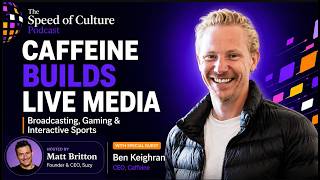
Ben Keighran, CEO of Caffeine, built two startups before Apple acquired Chomp in 2012. After five years at Apple, he launched Caffeine, a free live-streaming platform for niche sports like action sports and pickleball, now doing $40 million in annual revenue with just 60 people and no marketing team.
Chapters
Up today, we're going to be speaking with Ben Kieran, an Australian-born technology entrepreneur and the CEO of Caffeine, a groundbreaking social broadcast platform. Ben, so great to have you on The Speed of Culture. Thanks so much for joining today.
Thanks for having me, Matt. I'm excited to be here.
Absolutely. So we have all different types of people on The Speed of Culture podcast. We have people that work for major brands, and we've had our fair share of entrepreneurs and Those are always some of my personal favorites because I love the, you know, the, the journey being an entrepreneur myself of how to get a product from early, you know, inception to, to a full-blown company. And you've done that many times over. And would just love to hear from you, what do you think you experienced during your upbringing that enabled you to be an entrepreneur?
Hey, that's a, that's an awesome question. Thanks for asking it. Um, look, I, I think just Growing up, I always just loved building things that other people could use. And it's, look, I grew up by the beach in Australia, like surfing, that was my jam. But yeah, you know, just loved building computers, working with computers. Actually was like a self-taught programmer at 10 years old. Wow. And yeah, just really got super passionate about the idea of making things that other people, you know, could get some use from. I just thought it was the coolest thing ever. And feel really fortunate that I gravitated to that at such a young age.
So you just had a calling that technology was something that interested you. Was there anything that initiated that, or is it just sort of something that you feel like is— it was in your DNA?
Uh, you know, so I'm, um, in my early 40s now, and so it was like, you know, really kind of early '90s where, you know, Yahoo and the internet and all these things sort of taking off, like We're talking like 386s and 486s and XT computers, like they were before those, you know, that kind of time. And I just love it, you know, similar to maybe building like a Lego set or something. Like it was just so fun putting a video card in and installing RAM and then like the chipset and then building software on the computer. And like my mind was just so blown away as just a little kid on like the, as a creative outlet. And then when I saw that you could make things that other people could use and hopefully get some value from, I just was drawn to it for sure. And then, and like, you know, as I said, from like 10 years old, like, I mean, one quick side story is like you're at school with like doing like the yearbook for like grade 5 or something. And it's like, who's your hero? And everyone else is writing like, you know, Michael Jackson and all this kind of stuff. I'm writing like Dennis Ritchie, like the founder of C++. So yeah, there was something in it, something about it that I just was so excited about and clearly am even, even today. Yeah.
And in 2003, you founded your first company, BluePulse. Tell us about the impetus behind that company.
Well, yeah, sure. So, I mean, I haven't told the story in a long time, but when sort of wireless technologies like 802.11b Wi-Fi started to emerge. Bluetooth was another sort of technology. I became so fascinated with the capabilities of those technologies and actually built this little remote control out of my Bluetooth mobile phone, one of the first ever Bluetooth mobile phones, the Ericsson T39. It was in Tomb Raider. Do you remember like the boom headset in Tomb Raider?
Sure.
Like the Bluetooth thing. Anyways, I thought it was super cool, so I got my hands on that. and I ended up making like a, a remote control for my mobile phone. So you could like come into my apartment, which was about the size of a shoebox, and, uh, the playlist on Winamp, the MP3 music player, would like appear on the screen of the phone and you could use it to change tunes. And so this got me like really into sort of mobile application development and ultimately led to me building BluePulse, which was a Java application that gave people these really rich messaging capabilities and things that you used to see on the internet, but, um, on desktop computers. But people in South Africa and India at the time had never really experienced that. So when I brought it to like the phones, it just exploded.
Yeah, it seems like it all came from, again, you just having hands on keyboard, so to speak, understanding how to use the technology and really being more of an inventor in some ways, right? Because I think a lot of software or tech entrepreneurs today like myself included, don't necessarily know how to code, so to speak. And I think, you know, there's so many no-coding environments, and what it means to be a tech entrepreneur today is a little bit different than it was back then, because then you really had to be more so technical in order to build things, because there was no Squarespace to build a website, or, you know, no-code environments, GitHub, etc., to put things together.
Yeah, totally, absolutely. And, um, and that's what I loved about it. It was a space that, you know, I understood really well. I'm definitely a play-based learner. I like to just figure things out on my own. You know, plenty of subjects in school that I did not do well at as a result.
Me and you both.
But just really love the freedom and the, you know, what I was able to do with computers and just, you know, keep following your heart, your passion, like keep digging into the problems you're trying to solve and one thing after the next. But yeah, that's where it all started for me.
Awesome. And then you would go on to become CEO of a company called Chomp, which over time would be acquired by Apple. Tell us about Chomp and that journey leading up to Apple acquiring it in 2012.
Yeah, so look, I'd been around mobile phones and mobile apps for a long time. In fact, not a lot of people realize, but Asia, Southeast Asia, was like really ahead of the curve compared to, say, the US. In fact, I remember coming to the US in about 2004 or 2005, and people were just like, what, you're building like stuff on the internet for phones and like Symbian applications and Java application? Like, people were still getting used to text messaging. And I was like, this is odd, because I grew up in the '90s with like a Nokia phone, like, right, school, like playing Snake under the the table when I'm meant to be paying attention in class. Like, I was just really familiar with it. And so as sort of smartphones and iPhone and things like this was sort of coming along, Palm, all these sorts of things, I kept thinking about the people that were successful on sort of desktop web, um, in that generation of the internet, you know, what would be the successful applications and how would they be different in the mobile world. And I had a lot of experience with mobile, and so Obviously content discovery was a huge issue, um, on, on the web with like companies like Google and Yahoo and everybody else solving those kinds of problems. When it comes to apps and media, it's a different problem, right? There's no, you know, TF-IDF, term frequency and document frequency. There's no metadata, anchor text. There's none of this kind of stuff. And so you have to come up with a completely different solution for how are we going to search, um, for like apps and content and those kinds of things. And so I just really felt that, you know, based on the experience I'd had in life, that this was going to be a huge problem. Worked on that, um, the business was going quite well, but, um, Apple ended up stepping in and saying, hey, we could really use that technology over here, and it ended up with them.
So what was that process like to sell a company to Apple? Because that's obviously an iconic company that, uh, you know, puts privacy in the highest regard, design in the highest regard. It's It's not like selling to maybe an advertising holding company, I would imagine. Walk us through like that, what that experience was like.
Yeah, for sure. So, and, and look, at the time I hadn't really heard of too many companies that had ever really sold to Apple. I mean, they didn't really— they've done more acquisitions in the last 10 years than what I'd seen in the previous 10 or 20 years, for sure. Um, and so it definitely was a very unusual thing, I think. So what was it like? Well, what we were doing to get a lot of traction for our sort of content discovery technology was essentially powering other people's app stores and services. And so we would do licensing deals. And so we actually had a really big licensing deal which was beginning to roll out with Verizon Wireless. It was going to power App Search on Android phones for Verizon. We also had a deal with Yahoo where we were powering some of the search results in Yahoo for App Search, things like that. And the process was we were, we were basically trying to work on the same deal with, with Apple. So we were saying to them like, hey, like, we should power content discovery for you guys, um, and like, you know, here's the technologies, here's how it works. And I would say like over the course of 6 months, we just, you know, became really close with the engineering team and different folks, and it was all done in secrecy. And, you know, we couldn't sort of talk about this too much, and— or at all, I should say. But, you know, we became really close with the engineering team, and they just got to a tipping point where they were like, hey, we're not gonna license the technology. And I remember being in the room with executives and everyone else and going, oh man, like, I was really hoping we could, like, do this. And they were like, actually, we'd like to to buy the company instead. And I was like, wow. Well, um, and so it's quite a hard choice, um, believe it or not, because as much as I'm super inspired by Apple and I love the company, I really wanted to build a standalone company that— yeah, so it was a really weird moment, but that's kind of how it came about.
And then you ended up staying there for, it looks like, 3 to 4 years. Um, what was your experience like working at Apple? Were you focused on the product you had built, or did you kind of branch out a little bit to some of the other product lines at Apple?
Yeah, so, um, yeah, I ended up staying there a bit longer. There I ended up staying over 5 years. Okay, um, it might have been 6 actually in the end, but anyway, something like that. I loved it. Like, I loved working out. It's the only time I'd ever had a job. Like, before that it was like my own startups, and, and, and like, it was the only time I'd ever actually worked for somebody else. And the story goes, in the first year, it was really about integrating the technology and figuring out where the team was going to go. Like, you don't get to stay as the same team you were. You sort of get built into the company. And for me, it was really unclear because I'm more— I've become more of a sort of technical product manager or technical product manager type CEO leader. Um, and Apple doesn't really have that kind of, of role. Um, right. And so the thing that was, I think, like pretty amazing of Apple was they allowed me to, um, as long as, you know, the team and the tech was getting integrated correctly and I had all the support from that standpoint, um, really explore, um, Apple and where could I help out. And, um, interestingly enough, even though I have mainly a technical background, Um, I was invited onto the design team to be the design manager for Apple TV. Um, and one of my favorite products. That was an incredible honor because I was like, whoa, like, how do I lead these, the best designers I've ever seen in my entire life as a non-trained designer? Right. Like, don't know that. How's this gonna work? Um, but that's what happened and that's what kept me there cuz I loved it. It was like almost doing a startup in this big company.
Yeah, it's doing a startup, but you're also, I'm sure, learning so much from the people you work with in the organization, which probably set you up for what you ended up doing next.
It totally did. It totally did. I, I, I, it was like, I never got a university degree. I'm a, I'm a dropout. I was there for 6 months doing computer science. Um, here's the closest thing to a university degree for me, like being in a more—
Apple, Apple University.
Apple University.
So after you left, uh, Apple University, you, you, uh, went on to found your current venture, which is Caffeine. Which I really want to dig into because, you know, I did a little research on it. It looks super exciting and covers and overlays a lot of the areas that I pay particular attention to. So tell us and the audience what Caffeine is, what the impetus behind founding that was, and what you're working on today with the business.
Yeah, totally. So Caffeine is a place where you can watch for free live sports, not the major live sports like NFL and NBA. What I would say is the majority of live sports, which is things like action sports and X Games and World Surf League, street league basketball teams, all the way out to like pickleball and all sorts of interesting things like that. So it brings really passionate communities together, creates a home for live streaming of sports. You can watch it on a phone, you can watch it on the web, you can watch it on a couple of connected TVs as well. And it has over 40 million monthly active users here in the US under the age of 35. Um, and so it's an ad-supported thing. You will see some ads on there, um, and it does have some in-app purchase features too, but it's free to watch and a really cool sports streaming service that, um, I think people really enjoy.
And how did you get— how'd you get the idea for, for this concept?
Well, I am, as a, as a hobby, I'm a, I'm a huge gamer, um, and, uh, you know, played a lot, like played in some of the top World of Warcraft raiding guilds and all sorts of things over the years. And, um, I'm a gamer. And so, um, basically when Twitch came along, uh, I was working on Apple TV. They were moving from Justin.tv over to Twitch. Yeah. And, and I'm also simultaneously in all of these executive conversations at Apple talking about the future of TV. And I just really felt that it was pretty clear, like, the way TV broadcasting, live television broadcasting, was happening on cable wasn't going to stay that way. It was— we were going to move to streaming, like movies and TV shows, and there was going to be a new sort of broadcast network emerging. So the question I had was like, um, is Twitch going to do that, not just for gaming but for all of live broadcast TV? Um, or if they don't do it, who, who's going to do that? And, you know, as you sort of play that out, like a big element I think of the future of live broadcast is interactivity, is social, is community, is bringing people together to talk and interact around each other. Um, and at that point in time— and Apple may be very different on it today, this is like 10 years ago— um, they weren't bullish on the idea of going into social and community and thinking about all those aspects of things. But I became kind of obsessed with it, thinking like, wow, whoever does this is going to be new technology and new business models, and it could have a really positive and profound impact on on humans. Um, and so that, that ultimately it was something that I couldn't work on at Apple, and it's, it's part of the reason why I left and part of the reason why I started, um, uh, Caffeine. And so yeah, it's been a, it's been quite a journey figuring out new technology and a new business model, um, and the content rights and all the things that go with building what we're describing. But, um, it's really working and it's on its way now. Um, and it's taken a few pivots to get there, but always with the same common vision of how do we build the future next generation live broadcasting network.
Yeah, I mean, there's a lot of themes in terms of what you're working on, one of which is just sort of the— it sounds like the long tail of sports, right? So you have FIFA and the NFL and the NBA, but, you know, you talk about you being a gamer, and esports obviously falls in that category, or pickleball, which is an emerging sport. So first of all, how do you you find and identify and decide, I'm gonna go after this particular property? Like, is that based upon what your audience wants, or is it based upon what you're interested in and think might be cool to broadcast?
Well, the different phases that Caffeine has been through was— the initial phase was about, hey, maybe this new technology could attract a new kind of content creator. Yeah, um, and it ended up attracting a lot of sort of small streamers, like, and gamers and things like this, um, that were familiar with Twitch but looking at an alternative. And it was growing but not growing quite fast enough. And, um, and it always, as I say, had the bigger, broader vision of how do you build something broader than just gaming. Like, gaming could be part of what I'm talking about for sure, so could news, so could FIFA World Soccer, so could all these different things. But what what's the sort of wedge, like the way to get into this market and really grow and not sort of cap out being just a place for the gamers, which is still big, but there's more stuff than just, just, just that out there. Um, the phase 2 was, um, we had a lot of investment to sort of buy content rights. And as we started to buy sports rights, what I realized was a lot of these, um, non sort of top 100, those major sports— believe it or not, there's 11,000 of of these other— that's why I'm saying like the majority. You could say the long tail niche sports, but I say like the majority of the sports that are out there, like 11,000 of them compared to like the top 100. Yeah, these guys, like, um, they got really passionate audiences and they don't really have a home. And I was like buying the content and really seeing like, hey, it's really hard to reach these audiences. It's really hard to like sort of super serve these communities. Um, there's a lot of problems with it. And, and a lot of these guys, if we don't buy them They're just putting their content on YouTube in different places already. It's really fragmented. It's all over the place. They might build their own website, et cetera. And so in comes kind of like Caffeine 3.0, which is like, okay, how do we work with these guys non-exclusively? Like, what are the people that are already trying a non-licensing approach? And how do we sort of band them together, um, and super star those communities? And that's something that we've been really good at doing over the last 18 months. With new technology in this business model. And so yeah, we have a content team that's looking to add content density but also add breadth of categories, um, focused on, you know, what we think the audience will like. But we're specifically looking for, you know, folks that are out there trying to non-exclusively do things, because we're not buying content rights, we're just working with non-exclusive partners, aggregating them, super serving them, helping them get distribution, right?
All of that.
That's exactly it. Yeah.
And, and in terms of TV in general, I mean, I would imagine you getting exposed to Apple TV, understanding where the TV market was going, you know, and, and understand we are moving to a streaming world, opened your eyes up to the possibility of where this is all headed moving forward. I mean, where do you see TV heading? I mean, do you think linear TV is even gonna exist 5 to 10 years from now? And, and how do you see this current, I guess, progression away from linear TV continuing to accelerate?
Totally. So yeah, I mean, I got, um, just a front row seat at Apple, um, on a lot of the most brilliant people I've ever met in my life, how they think about the market and, and where it's all going. And so even though I have mainly an engineering background with a nice design element there, I also got to pick up a lot of commercial aspects of things that you wouldn't get to sort of see as a, as a just a regular tech entrepreneur. You get to see that. So between that and now having lots of investment from cable companies and Disney and Fox and all these different guys in my board, I, I've seen and heard and looked at the market in a way that not a lot of people probably have seen. So where do I think it's going? I mean, I just give you that, that, that experience, that resume, if you like. Um, Look, I think that linear TV as it stands is kind of going the way of the newspaper, right? Yeah, like it's still, it's still going to be consumed by a lot of people for a long period of time, but it is, it's a, it's as we go into generation upon generation, like the next generation is not going to consume it like the previous generation. It's, it's, it's changing. And so what's it changing to? Well, there's really like two types of things that you would sort of consume on linear TV. One is like movies and TV shows, and the second is live. And that may be an oversimplification, but I'm like, there's like live, which is generally sports and news, and there's— and then there's like movies and TV shows. Yeah, movies and TV shows were the first to sort of go to streaming services like Netflix and other places because they actually got like the smallest share of the cable TV bundle. Yeah, um, it was easiest for them to sort of leave, whereas the sports guys get paid so much money that it's very hard for them to leave. The challenge for movies and TV shows and streaming services like Hulu and Netflix and so on, um, over the long time is that there's just been a real shift towards shorter and shorter form content, like TikTok. And so, so even when you're watching a movie and TV show as a kid these days, you're also on TikTok and Instagram and whatever else you're doing. But you're, you're, there's more of a trend going to for on-demand content, like shorter form, like get me the content. The thing that's interesting about live is I think it's impossible to imagine a world where, um, you don't want to see my family versus your family, or my state versus your state, or my college versus your college, or this person, this friend versus this friend. Like competition brings people together around an outcome that they're all interested in seeing what happens. And even though the behavior is shifting towards shorter form content, live still brings people together for appointments, scheduled events, and for a longer, a longer session, like 15+ minutes, which is kind of crazy. Like, I can't believe long form content's now like 15+ minutes, but that's how it's sort of categorized to stay. That's what I hear over and over again. And so I think for live, you're going to see it fragmented for a bit. So you, so like you've got the NFL Sunday Ticket on YouTube right now. You've got Major League Baseball that Fox mainly handles. You've got MLS that Apple's now doing. You've got on ESPN all the NBA rights and things are over there. And it's going to create quite a fragmented world for people for the next little while. But I think you will see sort of a reshaping and a re— sort of framing of what we had on linear TV, but over streaming services. And I think it's going to get brought to you not just on you know, phones and connected TVs, but I think it's going to be really successful in, in VR as that starts to pick up as well. Um, because the live experience with other people in that is going to be epic, I think.
So yeah, I actually was just talking to the folks from Meta Reality Labs and they were saying the same thing, that they think both gaming and live sports are just huge applications of, you know, all these— I mean, Apple just came out with a new device and that usually means that it's ready for the mainstream if they're coming out with it. So I think that that's a new world. The other piece that I'm curious to get your thoughts on is just gambling, the gambling, fantasy sports. You know, the major leagues are now starting to adopt it and normalize it. And I mean, how far are we away from somebody watching Caffeine and betting on a pickleball game? I mean, do you see that in the future of your platform?
Yeah, I mean, for us, like, we're going to be doing, um, international next year will be a huge focus. On and getting further on to connected TVs. Um, but further out, like, I think that partnering up with, with betting companies would be like phenomenal, especially with the real-time nature of Caffeine. That's a standout technology aspect of Caffeine, is that everyone's seeing it within milliseconds of the action. And so betting would be incredible. I think e-commerce opportunities around it too would also be amazing, right? So you're watching something live and you want to buy, I don't know, a jersey or, or something that you're seeing sort of live and on screen right now. There's a lot of e-commerce type opportunities, I think, around it. Um, I also think that, um, AI to create like shoulder content around it and also use for sort of discovery, um, are all going to be like really interesting things that sort of make this format even more and more exciting and more easy for people to sort of, sort of get into. But yeah, betting I think will be huge, but betting plus these other things are all sort of big areas.
Yeah, it's going to be fascinating. So, kind of shifting gears a little bit just as we wrap up, you know, as an entrepreneur and running a company, looks like you guys have raised over $150 million from venture capital. We're in an uncertain macroeconomic landscape where you're getting, you know, your revenue primarily from advertisers. You're trying to stay relevant with consumers. It's a lot to juggle. I think only the best entrepreneurs will get through times like we're in today, but the ones that do are going to have a huge, you know, business on the other side. What, what do you do as an entrepreneur to, I guess, stay grounded, make sure that you're deploying your resources and your time in the right way so you can execute on the vision that you have for the business?
Yeah, I mean, for me, I'm, I'm always thinking about the long term and I'm thinking about how to build a real business for the long term. And there's choices that were made years ago at Caffeine to keep things lean, right? And to really just focus on our user. And today you've got a business that has no marketing costs, right? I mean, okay, we have a PR firm that we're working with, but basically there's no quote unquote marketing. We don't even have a marketing leader on the executive team. There's no content costs. It's all non-exclusive content. So it's like infrastructure, which we're really good at, and we own the full video stack, and we're actually still driving down cost on that in a fairly small, small team. It's like 60 people, um, and that's it. And so that growth from like $3 million to over $40 million in the last year has all happened, uh, without any marketing, without any content costs. And we're doing it more and more and more. And so as we monetize with ads and also sell in-app purchases Even in this, this market that's really tough, caffeine's thriving and I think it's going to thrive even more. You're right, you know, as we, as we sort of come out of it. And so for me, I'm like always thinking about the long term. I'm thinking about the user and I'm really trying to create a real business out of this. And I've always been that way. And it'll be 8 years in April next year and I'm just super passionate and obsessed with it and just going to keep doing that. Yeah.
And what are you doing to make sure that you're keeping your finger on the pulse of the consumer and the changes? Because we talked about so many different innovations, whether it's, you know, VR or AR or gaming or streaming, the, the world's changing so fast. How are you able to stay, I guess, on top of what's next?
Yeah, so, um, first and foremost, I talk to our users every, like, every single day. Um, it's like I, I literally, like, wake up, I log into Caffeine, I'm, like, talking to folks. I, um, I'm always, uh, sort of trying to have my finger on the pulse of what's happening. I also, um, I'm a— I love the data as well, so I'm always looking at the data and seeing what, what's going on.
Yeah.
Um, but then outside of that, I, I am Um, I'm a real user of like, even though I'm now like 41 years old, like I'm, I'm on all the platforms every day, whether it's TikTok or YouTube or whatever. And, um, doing a lot of work in Hollywood and LA as well and having a lot of sort of celebrity investors and other people, I really try and keep my finger on the pulse of popular culture and what's happening. Um, and it's just life for me, like it's just who I am and what I really enjoy doing. So it's not, it's not really work to talk to users or look at the data or talk to different, you know, famous people in LA about what's going on, or like, look, use all these different sort of social and internet services. I just love it. And, um, it just helps give me a good feel for, for what I think is, is coming and what's happening and connecting it up with sort of the market information and, and the data and what you hear from board members and other, you know, stuff. Yeah. Going on.
Yeah, yeah, absolutely. So, so to wrap up here, I mean, you obviously have had an awesome career and have worked with so many cool companies, and, you know, I definitely get the feeling you're just getting started. Obviously, we never know what we should know when we're young, and we're kind of making up as we go along. But if you had the opportunity to tell 20-year-old Ben something, uh, based upon what you know today, uh, what would you tell him in a way that maybe could help some of our younger listeners here at the podcast?
Yeah, I mean, um, I think that the younger Ben probably wouldn't— like, would hear the advice but probably wouldn't actually be able to do it because I was just always just so in a rush and like just, yeah, just so excited that like I just, I, I wouldn't think about things too much. I'd just go, like, just keep going and just work like all the time and just be like drinking from the fire hose. But I think in the end, like, being strategic and patient is really like the key. And it's something that, and that's what I'm saying, like, if you could think about the long term, think about the user, think about the problem that you're trying to solve. And it's, it's something that you're just super passionate about. Like, it's going to be there tomorrow. It's going to be there next week. It's going to be there in a month. Like, it all doesn't actually have to happen today. What is important is that you're patient, you're strategic, and you're making the right calls as you move through it. I think another lesson is some self-care. Like, I grew up, I mean, in my 20s, like, I would go sometimes 3 days, no sleep, right? Like, a lot of the time, 4 hours. And like that grind, like, I couldn't do that anymore. And that wouldn't be the way to build a company. But it felt like ingrained in the culture of Silicon Valley at that point that that's what you had to do to be hardcore. And I would just say like, you do have to be hardcore and you do have to work hard, but you also have to get sleep. It's your job to get sleep and not look burned out and tired all the time. Exactly. It's your job to stay in the game. And so be strategic, be patient is my quick answer.
And then, and finally here is, do you have a saying or a mantra that you like to live by that helps you get through this rugged journey as an entrepreneur?
I have had written at the top of my to-do list for 8 years, uh, the dream is real, I'll always find a way.
So it's about resilience, right? It's about believing in yourself and being unwavering, basically.
That's it. Like, you— I think you, you have to have a problem that you want to fix, um, a user in mind that you want to, you know, be in service to, uh, you know, a dream for like what that could, could look like. And just know that there's always ups, there's always downs. Like, life can't be like— if 10's like the best moment and 1's a bad moment, most— a lot of people just want to have 5s like every day, every day, every day. Yeah, with an entrepreneur, you're going to have 10s, but you're going to have a lot of 1s to get to those 10s. And, and so you have to believe and have that resilience that you will find a way through the bad times and the good times. Just, just breathe through it. Keep being strategic, keep being patient. And you get there.
I love that.
Awesome.
Well, listen, thank you so much for your time today. It's been really awesome to get to know your journey, and I'll definitely be, uh, cheering from the sidelines and following along as you continue to, uh, build Caffeine and whatever you do next.
Thanks, Matt. Appreciate it.
On behalf of Suzy and I, we team— thanks again to Ben Kieran, CEO of Caffeine, for joining us today. Be sure to subscribe, rate, and review the Speed of Culture podcast on your favorite podcast platform. Till next time, see you soon, everyone. Take care.
More from Matt




MikMak’s Rachel Tipograph on Consumer Spending, Retail Media & Holiday Shopping Trends



Jaguar Land Rover’s Charlotte Blank on Luxury, Purpose & Experiential Storytelling



