Campbell’s Linda Lee on Consumer Insights, Innovation & Iconic Brand Growth
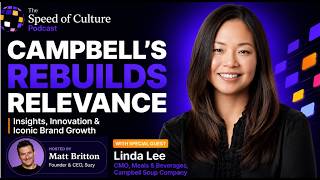
In this Speed of Culture podcast episode, host Matt Britton interviews Linda Lee, Chief Marketing Officer of Meals & Beverages at Campbell Soup Company. Lee recounts her unconventional journey from a chemical engineering background and a product‑development stint at Procter & Gamble to senior roles in consumer insights at General Mills and Mondelēz, and eventually to the CMO role at Campbell’s. She highlights the rigorous talent‑identification process at P&G, the value of deep consumer insights, and how those skills powered a successful gum‑category launch in China. Lee explains why she was drawn to Campbell’s – the challenge of revitalizing an iconic soup brand and the people she could work with. She discusses how the pandemic accelerated a shift toward utility‑focused, agile marketing, leveraging nostalgia and modern packaging to connect with younger consumers. The conversation delves into the balance between data‑driven validation and human intuition, the emerging role of retail media, second‑party data, and generative AI in CPG marketing, and the importance of authenticity when modernizing legacy brands. Finally, Lee shares personal career lessons: avoiding fear, questioning playbooks, betting on herself, and a guiding mantra from T.S. Eliot – “Only those who risk going too far know just how far one can go.”
Chapters
Up today, we're gonna be speaking with Linda Lee, Chief Marketing Officer of Meals and Beverages at the Campbell Soup Company. She has 20 years of diverse experience in competitive industries and a record of achievement in leading large-scale operations for blue-chip companies to unprecedented growth. Linda, so great to see you. Thanks so much for joining today.
Thanks so much. Great to be here.
Absolutely. I was, I was fascinated in reading your background because you started your career as an engineer. And not many people who end up as CMOs started as an engineer. Talk to me about that journey of why you started in that area and how you sort of slowly meandered your way into the world of marketing.
Yeah, I did everything not as books would tell you to do or as mentors would guide you to do, which is to have a destination, know where you're going, you know, how you get there. It was totally serendipity. Um, I loved chemistry and math and sciences, so I studied chemical engineering and just by chance, P&G did their intern recruiting and got into that program and started in product development on Pringles. And that was really the first, I guess, introduction to the world of brands. And I found myself— Got it. Really curious about, wait, I can't get to the development part until you explain to me what the brand strategy is, who our consumer is, the positioning of that.
So before you can put your chemistry knowledge into play, you had to understand the story and the background of what you were building for.
Exactly.
Which I think is an interesting lesson 'cause a lot of people today just wanna jump in and build a brand, but without really the, or build a product, but without a story behind it, you really kind of are rudderless in some ways. Exactly.
And I think that's the, that is the scientific approach. Approach of really understanding the problem you're solving for, understanding the boundaries of that so that you can then find an answer to it.
Absolutely, absolutely. And so many of our guests who are CMOs on the Speed of Culture podcast started their career off at P&G. And I often asked, what is it about P&G that makes it such a breeding ground for future talent? And what were some of the core takeaways you remember from your time there? That really have had staying power?
So I would say, you know, we often say people are the greatest asset, right? That's something that's often said. My experience there, and I was in recruiting, was that they really knew who they were and who would be successful at P&G. And so the rigor that's placed in the recruiting side, the screening side, I think that's a difference that I haven't seen.
The standards they set for the talent they bring in.
Yeah, they just know who they are and what they're looking for, and therefore who is going to be successful long-term there, and both successful in performance, but also successful in satisfaction. You can have a lot of smart people, but if it's not a good culture fit, you're not going to be able to retain them. So I think the algorithm of how to identify talent from the beginning to come into that pipeline, honestly, haven't seen anywhere else. Now, this has been a long time ago. That was in the mid-'90s. Things could have changed since I was there, but that was very unique. And everyone knows the training. It is definitely a build-from-within organization. So just a tremendous place to begin to really learn what gold standard looks like. But then, you know, some people choose to spread their wings outside of P&G.
Of course, many do. Many people we spoke to started at P&G and ended up having a prolific career, as you have, in the CPG or technology or other spaces. After you were at P&G for 7 years, you went on to General Mills and you were in the insights function. And I love that because we were just talking before the podcast started that the tried and true path for many to become a CMO is as a brand manager, is in the advertising function. And you not only spent 4 years at General Mills in the insights function, but then many more years afterwards at Mondelēz, 2 more iconic CPG companies. Talk to us about the leap from being on the product side to, you know, an insights manager and an insights director eventually, and why that was so important to you in your journey.
It was honestly, again, not planned. I knew I was interested in the commercial side, in the brand management path, but for some reason I couldn't fully commit to that, whether it was to go back to business school or— Interesting. Yeah. And I got a call and took the call. It was General Mills. For something that wasn't product development. So I decided to, to go over, interview, meet folks. And I remember leaving that day of interviewing feeling like, I know it doesn't make sense. I don't even fully know what Consumer Insights is, but I need to just go. And it, it was really the people who I met and went there and quickly learned the other aspects of consumer insights that I wasn't familiar with. I was familiar with the products research side, but not the advertising, strategy, communications. All of those aspects I learned really from great, great mentors and managers.
And how formative do you think that was for the marketer you are today? Because obviously when you're in the insights function, you're thinking about the consumer, you're asking the why. And really digging deep. What were some of those learnings and how did that kind of change and evolve your thinking as a professional through those years?
I think, you know, just as I would say Procter is a— it's known, right, for the brand building, for the brand management. General Mills is really known for, at that time, definitely known for its consumer insights function. So I felt like I was learning amongst the best. And back to that gold standard, because now I was no longer in products research and R&D, but rather in consumer insights, the brand building, whether it was Pillsbury, Betty Crocker, Cheerios. That was my lesson, a bit of the rigor that goes into developing the campaigns, the innovations, putting the consumer at that center, but really utilizing the right methodologies. To, to have confidence and validation in the work.
Absolutely. That's everything. And you obviously go on and then spend a decade at Mondelēz as well in the insights function, a company that I know also works very hard at understanding the consumer, keeping their finger on the pulse of where things are going with brands like Oreo. And I imagine your work there only emboldened that overall strategy of understanding the importance of consumer and how you frame marketing in general.
Yeah, when I went there, it was— we were still Cadbury. That then became Kraft, that then became Mondelez. And I, I made that move because I missed being in a global organization. And just when you love understanding humans and what motivates them and drives them, there is a commonality that goes across borders. You know, people are much more similar than different. Yeah, I missed that aspect of it. So that's why I moved over to Cadbury, still in insights. But while I was in that role, we expanded to global categories.
Yeah.
And I was going to apply for a director of insights, global insights. But someone said to me, no, you really should look at applying for the director of innovation. And so that was my shift from insights to innovation. Again, unplanned, right? Someone, you know, planted a seed that I decided to take a look at and and give it a try. And it was another, you know, pivot or a door that opened that I walked through.
And then as part of that role, you were behind an incredible launch for Mondelēz into the gum category in China. Yes. Which I know was incredibly successful. Talk to us about kind of that process of launching, you know, a massive new product category in such a hard to decipher market like China.
Exactly.
That must have been just a wild project to be a part of. Completely. And what goes into something like that?
I would say naiveness, right? Because had I known how difficult it was, there's something about not worrying about knowing.
Yeah, because the curse of knowledge, so to speak.
Yes, completely. And so for me, I had exactly 18 months of being dropped into a country that I had never worked in and having to build everything and launch within 18 months. That is— I'm sure to entrepreneurs that may sound long, but for a large entity, that is actually quite short when you have to build everything, including the manufacturing and the route to market, much less the route to consumer. But when I landed there, my first question to the team was, just give me the last 5 case studies of successful launches, new brand and category launches. And they came back and said, that actually doesn't happen here in China. The last one was a decade ago. I think it was Minute Maid. It doesn't happen in China because of the complexity. People don't launch nationally. You launch in a region and you slowly expand your way. So that was probably a bit of a tip that this was not, not an easy a challenge, but, you know, an incredible team. What I learned from that experience was, because I didn't have it, I didn't know the market, I didn't know the people, I couldn't choose my team.
The culture in China is so different than it is in North America.
Completely. The consumers, the culture, the competitive set, and everything is different. But what I learned was that for the lack of experience and sophistication, passion and fearlessness overcomes it all. That just focus on the end in mind and planning for success and ability to pivot along the way.
Be determined in the outcome.
Be determined, exactly. Rather than, I think here in the States, oftentimes the language is more of go, no-go, should we do it, should we not? It's about passing through things and still at every gate having a chance to say no.
That's, I feel like, a large company. That's why they don't take risks ultimately, right?
Developed markets, large companies, large established businesses. That's the mindset. Well, it's a risk aversion, you know, and you have more to lose than to gain, right?
But that's why comp— that's why a lot of these large legacy incumbents ultimately get disrupted. Because a lot of the leaders there, their whole job is just don't get fired, right? So they're going to take the tried and true path, the easy way. And then there's entrepreneurs who get funded and they see opportunity and they nip at their heels and sometimes they win.
It's back to— it comes down to humans. Yeah. And understanding humans and what motivates them and how do you pull those levers then.
Right. Because I would imagine your time prior in the consumer insights field and really understanding consumers or i.e., humans, helps you in ways not just dealing with your outbound marketing, but how to deal with individuals.
Absolutely. 100%.
Right.
I mean, that is, if you just think about psychology through your day. Yeah, it is psychology, right? Psychology. I'm a practitioner of it. Yeah, but it's that simple. It's that simple. And I think of marketing as my job is to influence consumers' behaviors. I mean, that is it. So what am I doing to be able to shift them from a point to a point?
Yes, absolutely. So for the last 4 years, you served as chief marketing officer at Campbell Soup Company. Obviously, you know, becoming a CMO of an iconic company like Campbell Soup is an incredible achievement. Did you think at all when you were starting back in 1994 at P&G that that's where you would end up?
Oh my God, no.
Right.
I didn't even think that 20 years ago. What did you envision? Right.
You didn't think that far ahead. You were just looking at what was next.
Absolutely. And to be honest, I didn't. So first of all, I mean, back in the '90s, I didn't even know marketing was a career. I just knew I loved brands as a consumer myself. I didn't understand why and how that came about. Of course, now I do. And I would say, you know, even today it is a little— I'm not sure this is my destination either. This is This is not— I don't see anything ever in linear paths. Yeah. And so, no, this was absolutely not part of the plan. And I don't even know if I, you know, meet the, the, what I believe are probably, you know, what you would expect of a CMO. I'm, I'm definitely— I know the feedback I get is very just real, accessible. Not to say others aren't, but I've never seen myself. Maybe as someone that would be in this role that would be qualified. Right. I mean, talk about imposters.
Although looking at your background, I can't think of somebody who's more qualified, but I understand what you're saying. And so why did you decide to join Campbell's? What was it about the company that excited you when you decided to join?
It comes down to two things: challenge and the people who I get to take on that challenge with. And I've always been challenge-driven. There is— some might think, oh, there's more to lose than to gain. Any time you take on something that's high risk or highly difficult, I see it as a lot of smart people have tried. And so in some ways the bar is low and you can only exceed. And I love the ability to look at big problems that have long existed, but put a creative spin on that to unravel it, to then build it back up.
Yeah.
To something stronger. And then though, that on its own at this point in my career is not enough. It really is. If you're— if I'm spending this much time in something that I love to do, what's really critical is I get to do that with people who I respect and trust. And that I don't take for granted. I don't think you can always find yourself in that situation, but certainly in this case, I wasn't looking for a role like this and I wasn't considering Campbell. It really was, okay, I get the challenge, which is how do we win in soup? You know, that shares the company name, long-time challenges, but then to be able to do that with people that I knew and trusted was really the unlock.
Absolutely. And your tenure at Campbell Soup has been anything but boring because the pandemic hit. Obviously, it was a— it was an event that definitely, I imagine, and through seeing what did the stock price provide, a lot of tailwinds for the brand because people were home and soup at home are kind of go hand in hand. And then obviously then the vaccines came out, people started to go out in the real world again, although we're not really where we were pre-pandemic. There's a lot of people working from home, etc. How has all those external changes to the consumer impacted your role and how you look at your future go-to-market strategy?
I would say two things. One is, um, it actually starts internally. And in those first, call it 6 months, 9 months of the pandemic, there was a shared experience that all of us were, were were going through. And there's no question the amount of pride and appreciation for being an organization that is so frontline. Yeah. Our manufacturing, our sales, field sales that brought— and we knew we had a role to play. It brought a tremendous amount of pride and just I think solidification of the relevancy of what drives us.
Right.
And, and so that, that actually was a very important piece to our transformation. But then with the consumer side, the good thing is that we had a strategy in place and we were just beginning to execute that when the pandemic hit. So we knew what the blueprint looked like. It was an acceleration of that. And we quickly went from how do we make sure our brands show up in a modern way to how do we make sure we've got content that is bringing utility and value to our consumers? Because that's the game. Exactly. We don't have a demand problem. What we have are people, humans who are having to cook a lot of meals at home. So what a just incredible way to be able to provide that value, to reintroduce ourselves and make sure that we're providing the utility and value into their lives. That was, I'd say, every 3 months something evolved, things kept evolving. And so we had to be agile in understanding what the needs were of the moment. And where do we actually have a right to show up because we're adding value?
Yeah, absolutely. And I think you think about the difference between advertising, like the Mad Men era, which is like if you can have a check in a checkbook, you write the check and you're, you're gonna be able to force your message down the consumer's throat. To fast forward to today and you have to start with the consumer and say, what do they care about when they wake up at 6:00 AM and what are their unmet needs and where do we fit in? Exactly. And that's the difference between advertising and content. I think a lot of companies lose that and they still think about their unique selling proposition. We're Ultimately, consumers only listen to a unique selling proposition if they have to. Yes. And right now they don't have to listen to anything. Right. So you have to say, what does utility look like? To your point, is that challenging to do in ways that connect with your brand? Because ultimately I, I do see a lot of brands trying to provide utility, but in ways that is really disparate from what their product or service even is. And that disconnect, I think, often means that what they're doing might be great, but it's not gonna lead to business results.
So I will tell you, it's not hard for me.
Right.
But because you got to know who you are.
Right.
You got to be honest to yourself of what do consumers expect from us and want from us and meet them where they are. So I think it's when you have a clear knowledge or North Star of who you are, then it becomes easy. It's just the rigor of filtering of whether or not something is authentic or not. And sure, you know, once in a while you might mess up, but that's how you learn. Right. But I mean, honestly, one of my biggest fears, especially with such an iconic brand, one of my biggest fears is to come across as a poser. I do feel that I've got— I do set a higher bar for some of the brands more than others, like certainly the more iconic you are, I do think coming across as a poser can be problematic.
Absolutely. A challenge being like an iconic brand, like whether it's Campbell's or Chevy or any iconic American brand, is, you know, there's the always, I would think, the fear of we're not contemporary enough. And, you know, now there's the millennial mom and soon it's going to be Gen Z mom. And how do we make sure that we're not left behind? Right.
So, but do it authentically.
Authentically. So how do you look at modernizing the brand and continuing to evolve your messaging, your brand equity pillars to make sure that it can connect with tomorrow's consumer?
So from a metrics standpoint, it's very simple, which is we are growing faster with the younger generations than the older generations.
Why is that?
Well, why that is, is, I mean, it is the reintroduction of the brand and it starts with of the product and the utility of that. And we got that acceleration during the pandemic and it's now continuing that. And I would say it entered through the door of memories. People who had memories of chicken noodle soup.
So like nostalgia almost?
Yeah, nostalgia. You know, we all were in need of comfort and certainly you've got the holidays too as another entry point. But that's what I call memories. Those are from, rituals, and that's where we brought everyone in. But what is growing and keeping it growing becomes inserting it then into your life, making that one more, you know, one additional meal that I call everyday dinners, everyday meal, being a shortcut to preparing a dinner that everyone's going to love. That's the journey that we're now on, what I'll call Chapter 2. This is a long-term investment and evolution of rebuilding the relevancy and being— I mean, in other words, you could call it modernization of the brand. So that's from a usage side. You know, oftentimes I talk about how important packaging is. Yeah. You know, the shelf.
I see you're wearing the shirt of the package. Not everybody can do that, right? It just shows how powerful the packaging is. You wear that You got a t-shirt, it's a cool t-shirt. Most other brands, people can't wear their t-shirts.
And, you know, or at minimum though, everyone that's a CPG brand, right, packaged goods, you're on a shelf though. Yeah, on a digital shelf, right, or a physical shelf. Yep. That is your number one reach. Um, and you need to make sure that is the first place we tackled was making sure You know, you could do all this great advertising that feels more modern, shows up in modern ways, but if how you look—
first impressions, of course, we know what that's like. Interview, it's like the same thing.
Exactly, exactly. So making sure that how we showed up physically through the package, um, that was a really important touch.
So what's that process look like? I imagine it must be like almost like having somebody on the operating table because this brand and the packaging is so iconic and you don't want to mess with that equity. You want to maintain that equity, but at the same time slowly push it forward. So I imagine that must be a pretty intense process.
So funny enough, this is my first major decision when I joined. It was a project that had been underway for about 6 months, I think, and they showed me the latest work, the round of work. And how you just described that fear of, or touching something so iconic.
Yeah.
You could see it in the work. And I had to call a timeout and—
People were being too careful, you mean?
Yes.
Right. Too precious.
And as a result, it actually made it feel older. Right. Then that unwillingness to walk away from the nostalgia. And so the timeout was a complete rebrief of, I know we've spent 6 months on this, but we are not— we need to start all over again. Number one, starting with we cannot have a brief that's 4 pages long with 8.5.
Right. The best briefs are the shortest ones.
Yes. Yeah. And that is, you know, bringing back the what's the problem we're trying to solve? What are we trying to communicate? And it cannot be a kitchen sink of bullet points. Right. And so we rebriefed it and it really, you know, in that very first round since the rebrief, we just saw 3 awesome directions that really pushed the boundaries and And it's the permission, right? The permission that you give the creatives. You can always pull back. Right. And that was it. It only took very few times, actually, do I ever get within the first round a direction that actually ends up seeing the light of day. That's not an easy thing. We all wish for that.
Yeah.
It's not so simple. But it happened. And, you know, the rest The rest is history.
How much testing goes into ultimately arriving at that decision before you actually say, okay, we're going into production?
Of course, a lot of testing. The good news is we have a lot of proven, you know, validated methods. That's actually not the difficult part. What I have found though, because I've done multiple redesigns across very well-known brands.
Yeah.
What I have found is that you should never be testing to see if you should do something or not.
So validation, basically.
You need to believe in it. Right. And it, it really becomes what are the yellow flags, the red flags, the blind spots. That's what that should be for. Not to make a decision of do I do this, do I not?
So interesting.
So I much rather have—
Why do you feel that? Because you feel like if you do that, you're gonna be in a sea of sameness ultimately. That consumers just want something closer to what it is now?
You know, honestly, I feel like if you don't know in your gut that it's the right thing to do, what's the value that you bring?
Well, that's right. And I think in this day and age, everyone talks about data, data, data, and it can be to a fault, right? If you just let the data decide what to do. Yes. Then ultimately, where is it? Where is the human input? Where is the instinct? Where is the creativity?
You don't understand the why. Right. So if you get data that's not good, then why? What do you do next? How does it inform you? What's the actions that need to be taken? You need to go in with a hypothesis. Yeah. Of what's working, what's not. Let me then make sure that the power of numbers helps me know that I'm not just talking to myself, that there is a broader audience. But if you just look at data on its own and you don't have that thought process going in and you don't, it doesn't Doesn't mean you're going to be 100% right all the time. Of course not. But you need to enter into those, being able to articulate that and then use the data to help you understand what's really going on.
Yeah, absolutely. So we've talked about the strategy piece and the insights piece, and we just had a really fascinating discussion on the creative side. The last piece of the overall puzzle is media communications, getting the message out. And the world is so different today than it was when you entered the workforce. We both entered around the same time in the mid-'90s. There was no real internet. There was no YouTube, Facebook, social media, iPhone.
Smartphones.
Yeah. Any of this.
Yeah. Any.
Yeah. I mean, so when I tell my kids, when I first started working, there really wasn't internet.
I mean, there was barely email.
Yeah. Right. There was barely email. So it's, it's such a different world. You've obviously done a great job sort of evolving through all this, but as we're here in 2023 and looking towards the future, what are some of the changes and innovations in media that you think are particularly compelling so you can continue to get the messages that you're building out to the right consumers?
I mean, I think the biggest change is back in the day, all advertising, in my opinion, was very much through the voice of the brand. Yeah, that was it. And you had a few channels to choose from. And now the getting the right balance of messages that are through the voice of the brand versus through the voices of others. That is critical in achieving, building the credibility, the meaning, the awareness. All— it's— they have to work together. And depending on what kind of budget you have, how big is your awareness, how, you know, you got to consider all those pieces. It's not a one-size-fits-all, here's the equation. There's just a lot of nuances. And, and I genuinely believe there isn't one right answer.
Yeah. How are you looking at things like retail media, which I know a lot of the big box retailers are pushing to varying degrees of success right now because there's a whole nother playing field now for CPG marketers.
I mean, I think it's exciting.
Yeah.
It theoretically closes the loop of your collapsing kind of upper funnel, lower funnel. You're collapsing sales and marketing even as functions within large CPGs. It is the theoretical data and optimization efficiencies that can be gained, effectiveness. I mean, all of it for someone who's got an engineering and science background, it's, it's a theoretical playground.
It's mind-blowing what it can do.
Yeah. Of what you can do with it. And then let's overlay, you know, the generative AI and things get really cool. It's so from that standpoint, it, it provides abilities that we didn't have. Not to— and then you have this whole other element of You know, we've got our portals into those datasets. So that ability to really get real-time dissection, data exploration of what's happening at that human level, not just looking at dollar sales, ACV, velocities, but rather segmentation and how are those consumers responding? What does switching look like? There's just a lot of things that we used to need to brief someone to go do the analytics to then come back to you weeks later. It's all at the fingertips.
Yeah. I mean, if you think about CPG marketer for years and many instances is still the case today, you don't really have first-party consumer data. You're end consumer, you're selling through an intermediary, right? Versus other companies that sell direct. And that can make it challenging in this data-driven world. And now some of these new platforms really get you closer. I mean, you take cookies away, right?
You start to look at— because we've always said right now in the short term, we're not a first-party data company. And back to you got to know your strengths and play into those. Yeah. And you also have to say, you know, these are certain things that we're just not going to be great at. So what— by having that understanding of what your boundaries or constraints are, it allows you to then be creative. And how you solve for it. And that's where the second-party data gets to be of real value.
Absolutely. Absolutely. So as we wrap up here, switching gears back to you, Linda, you obviously have had an amazing career, lots of exciting projects, and obviously you continue to make a real impact in the CPG and consumer landscape. If you had to zoom out and think about some of the things that you think you did right along your path to get here, What do you think those things were?
I would say the first is not operating from a place of fear. Yeah. And it just, you know, I don't think through the lens of failure. Now, I'm a perfectionist. I'm an overachiever, as with everyone else, you know, don't want to fail. But I don't beat myself up and I don't believe that there's— that everything ends with a failure. I see it as learning and that's how you get better. So I called it earlier as like naiveness, but it is coming from a place of when you don't worry about failing and you don't come from a place of fear and you look at it through what's possible. That is, that definitely has been important. The second is not subscribing to what has been, what is, you know, the playbooks of career paths, the playbooks within business, within brand building, you know, within whatever that is. I don't subscribe to it. I've always— I'm not very good at following rules.
Right.
But what I do focus a lot is trying to understand the principles of which those rules are built upon and then a different way to that. Or with a career, it has been when doors have opened for me, a little crack that I wasn't expecting, didn't quite understand, didn't make sense. I considered them and chose to walk through many of them that then opened up new doors that I didn't even think would be available to me. And so it's a little of that combination of not being afraid to walk through, to look at something and really consider it, but then the willingness to, to to just not have to worry about, do I have the experience? Do I know what that playbook looks like? The willingness to create.
Well, it sounds like that you're, you're very comfortable betting on yourself because if you don't, if you don't believe in yourself ultimately, yes, I do. Then you don't know how you would.
And you know, good point. I didn't think of it that way, but I always advise people, absolutely feedback that people give you, you have to, it, it truly is a gift. Yeah. And you have to consider it and try to understand what's under— good and bad feedback. Although that doesn't have to be— it doesn't have to define you. And so you've got to start with knowing who you are, believing in yourself, having confidence in yourself. But understand that if there's a gap of who you know yourself to be and how others see you, that's That's the area for insight.
Yeah. The blind spots is often involved.
Why are you showing up the way you are if that's not who you know yourself to be? Right. And I think that's tied to this of betting on myself is it's the what's within.
Yeah. I love that. So finally here, Linda, is there a mantra? You've went through so many great life lessons and I feel much more educated just about your world and the CPG world because of it. Is there a mantra that you'd boil all this down to in terms of how you like to live your life by that comes to mind?
So I have my favorite quote. Okay. It's a T.S. Eliot quote that I've had since 1992. And it was— it's very specific because it was in a college pamphlet when I was applying to colleges, and I remember cutting it out, and I still have it. And it's— the quote is, "Only those who risk going too far know just how far one can go." So I think that that really is the mantra to how I've tried to live my life. Again, unplanned, but I guess it seeped in to, to just how I show up.
Very cool. I love that. I'll have to check out that quote. And I really want to thank you for taking the time today. It's been amazing to go through your journey and all the decision-making frameworks. And I have no doubt that you'll continue to push the limits and bet on yourself and take risks. So thank you so much on behalf of the Suzy and Edwi team. Thanks again to Linda Lee of Campbell Soup Company for joining us today. Be sure to subscribe, rate, and review the Speed of Culture podcast on your favorite podcast platform. Till next time. See you soon, everyone. Take care.
More from Matt




MikMak’s Rachel Tipograph on Consumer Spending, Retail Media & Holiday Shopping Trends



Jaguar Land Rover’s Charlotte Blank on Luxury, Purpose & Experiential Storytelling



