Canva’s Cat van der Werff on AI, Creativity & Democratizing Design
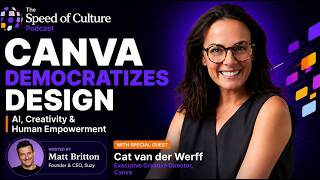
Cat van der Werff, Canva's Executive Creative Director, discusses building the brand from a single logo to leading a 100-person creative team. She explains how AI tools like Magic Studio accelerate design work without replacing human creativity, and outlines Canva's two-step vision: becoming one of the world's most valuable companies, then using that value to do good for the planet.
Chapters
Toddy! Today we're thrilled to be joined by Cat van der Werff, the Executive Creative Director at Canva. Cat's spent the last 6 years working hard to turn Canva from an unknown online startup to an absolute powerhouse in the creative design space. Cat, it's so great to see you. I'm such a big fan of Canva and I can't wait to dive into that.
You too, Matt. So excited to chat.
Great. So why don't we start by getting to know a little bit about your background? Um, what led you to Canva and what were you working on prior to joining?
Yeah, sure. So, um, I was born and raised in New Zealand, which you're going to pick up from my accent as we go along. Um, but I actually, you know, started out right back at university thinking I'd be an artist. I went to art school, and while I was there, I kind of, um, realized that what while I loved, you know, conceptual thinking and all that kind of thing, what I loved the most was actually solving real-world problems. So I switched degrees, and that led me to a career in brand design. So I worked, um, you know, building some global brands and working at different branding agencies. Took me from New Zealand to Paris and then back here to Sydney where I am today. And, um, and then in 2017, I had my son Fern, And so I actually took a full year off at that point. And I think, you know, as you do when you become a new parent, I really started to think about, you know, how can I use my creativity for good and what is the kind of world that I want to bring my child up in? And so, you know, while I was kind of pondering these things, that's when Canva actually called. And so I went in for an interview and when I discovered their mission to empower the world to design and then also to do the most good as they can along the way, I was sold. And so I started as Canva's very first brand designer, and I've been at Canva 6 years now, and now the team is 100 creatives across brand and campaigns and performance and production as well. So it's a mighty team and it's been quite a journey to get here.
Yeah, so let's talk about that journey. So when you joined Canva 6 years ago, you know, they were in an earlier, much earlier stage startup, and they're now, they're one of the largest, you know, private startups in the world and obviously have really been quite transformational in the space that you play in. Talk to us about what Canva was like when you first joined, you know, what it was like working in the earlier days there and what it's been like to have a front row seat to rapid transformation of the company?
Yeah, so I think, you know, as I said, I started as the very first brand designer. At that point, we didn't actually have a creative team or even a marketing department. And so when I asked for the brand guidelines, I was given a logo. And obviously we know that a brand is so much more than a logo. But I actually think, yeah, what Canva did have was this incredible ethos. And so the founders had done such an amazing job of really building in and instilling the mission and the values of the company from the start. And so I think for my first 6 months, I really just kind of like decided to kind of unlearn my understanding of branding from working agency side, 'cause I'd never been in-house and I'd never been at this company that like the community just loved the product and the internal culture was incredible. And so it had all these wonderful values that, you know, often from the outside when you're trying to brand, a company, it can sometimes feel like you're putting a plaster on top because you can't really get inside and fix things. So it had all this amazing stuff already. So I was kind of like, what is the role of a brand in this space? Right.
And when you look at like the role as a brand designer, you know, there's the brand of Canva and there's also the brand of the— there's a design of the all the templates that are within Canva. So are you working on how Canva is branded to the community of users, or are you working on picking the different design aesthetics and templates that live within the product itself?
How it's branded to the users. So like how we really market the brand and bring the values to life through our brand kind of advertising and all of that kind of stuff.
And so I think, yeah, because the platform itself is really robust in terms of you have a, I guess, an affiliate network of designers where a user can come into Canva and choose from a variety of designers when they're making their own designs.
Yeah, exactly. So we have a whole other amazing team that all work on the actual content libraries within Canva. Now we actually have, you know, a full creator marketplace of people all over the world who can actually create templates, you know, in their local kind of look and feel and actually earn money through that marketplace as well, which is amazing.
So what is it about the positioning and the product of Canva that you think has led to be such a smashing success all around the world?
Um, I guess, you know, going back to those early days, um, one of the first things I did do was got into a room with our founders and we spent about the first 12 weeks going, okay, so at the moment we only have a logo, but what do we want the brand to be? And what are your— what is your vision for the brand as we start to, you you know, really figure out what it looks like and how it shows up in the world. So at that point, we kind of got into a room and we did some workshops and we had Mel and Cliff and Cam and Zach, who's our CMO now. And the first thing we did was kind of like say, what are the things over the past 5 years that have really felt true to Canva's brand? And so we pulled up all these different artifacts, like Mel pulled up a, picture of a man in an orphanage surrounded by all these kids, and he was holding a Canva design on his iPad, like looking really proud. And Zach pulled up our very first press release and talked about how simple and clear the messaging is. And so, you know, through those artifacts, what we actually got to were the core brand tenets that we have today. And so those are human and inspiring and empowering. And those are the things that have really kind of like led all of the creative that we do.
Yeah. And in terms of the product itself, obviously, essentially what Canva does is it democratizes design, right? It makes it— I almost look at it like, you know, when Squarespace first came out, it democratized the ability to, to build a website, right? But yeah, Canva really does that in a much bigger way in terms of democratizing designing anything, right? And I think that's really impactful. And I now, we are starting to see that across many different industries where these sort of no-code tools allow people to do things that in the past they would've had to have hired an agency for. It feels like to me that over time Canva has enabled the user to do more and more on their own that they would normally outsource. Is that sort of intentional? And how has that kind of journey went from when you first started with some very basic templates and applications to where you are today?
Yeah, so I think that design journey, like you say, had to be very, very simple from the start. So the very genesis of Canva was Mel was teaching design in university. And she looked and kind of just realized that, man, the design process is like so complex and so convoluted. And if you're a student— and expensive. Yeah, and expensive. And so if you want to design a website, you have to go to one program and learn how to use it and pay for it. It takes a very long time. And to do that, if you want to design a brochure, there's a whole different program you have to go to if you want to design a video. And so, you know, what she kind of saw was that how can we actually bring all these different design types, no matter what you want to design, into one very simple design journey on one single page? And so that's how, you know, Canva's been built from the start. And so that very simple design journey actually doesn't change no matter what you want to design. So at the core, you you have that simplicity and then you build on top, um, with, you know, whatever design type it is, whether it is a website or a video or a brochure.
I mean, and it also feels to me that like platforms like Canva, they really ha— like, cuz there's Photoshop, like Adobe has a great suite of tools, but they're largely for professionals, right? Mm-hmm. They're for people who have that technical skillset that know how to use it. Where Canva, you really don't need any technical skills. You just have to have an eye in terms of knowing what you want to build, and then you can easily build it. So, I mean, do you think design is going to head more in this direction? I mean, I'm sure there's, there's a lot of designers out there that think Canva is not good for them because they're artists and they feel like it's taking what they build and their craft and almost templatizing it. But I think most people look at it as this is an incredible resource, like, How do you feel about, I guess, that overall element?
Yeah, so I think that, you know, the whole mission of empowering the world to design is really important because every single person in the world needs to use design or visual communication at some point in their lives to achieve a goal. And so like, if you're applying for a job and you need to create a resume, or if you're trying to get your small business off the ground, like all of those things, people shouldn't be held back from being able to achieve what they need to achieve because they can't use the tools. And so that's why that, you know, simplicity is so, so important in empowering everyone. And I think when you look at other programs like Photoshop, you know, that we're not saying that Canva is the only tool that everyone should ever use. And personally coming from a brand design background, what I realized when I came to Canva was that I kind of had this light bulb moment where, you know, in the past, building brands, I craft them in whatever programs I like. And then the biggest pain point for me was that point we handed over to a large organization. And so, you know, often, you know, you'd lovingly craft this brand and then hand it over and you would kind of see it suffer entropy once it was out of your hands if an organization didn't have all the resources or an in-house creative team to upkeep it. And so what I realized with Canva is like, wow, we can actually build Canva's brand and as designers craft where we have— wherever we need to craft and then bring all those assets into Canva, build out our brand templates there. And then that kind of like hands over the brand to our organization of 4,000 people in a way that they can all use it, whether they're designers or not.
Absolutely. And as someone who's responsible for the Canva brand to your user base, who is your user base? Like, who are you targeting in terms of your ideal customer profile?
So we have spent the last decade really focused on individual users. The first thing we wanted to do was start with that really valuable free product so that we could empower as many people as possible. And so that's been a really important part of our growth.
It was like a freemium model, right? Where you got to use certain functionality to get them onboard and then they could unlock more by paying.
Exactly, exactly. Right. And, and so I think, you know, today we have pretty amazing community of small businesses, individual users. We've got a a lot of students and teachers as well as non-for-profits, and they can use our subscription model for free. But I guess we're at a big turning point actually for the company where for the next 10 years, we're really wanting to focus on actually empowering enterprises too. Because, you know, like when we look at that mission of empowering the world to design, we literally mean everyone. And so every role in every organization as well. So that's kind of the next step for us is, you know, starting to build our audience into the enterprise space. We actually have 90% of Fortune 500s use Canva in some way in their organizations already. And that's generally through like bottoms-up adoption where people use it for personal use and then bring it into the workplace.
Yeah, and I would imagine one thing that makes it palatable to the enterprise is like the things that your company does around brand templates where the key designers can set this is the font, this is the logo, these are the color schemes that match with our brand. So when they're democratizing design within the organization, they can make sure that it's consistent. And I, cuz that's probably one thing that creative people at large organizations worry about is if they let everyone use a tool like Canva, it's, everything's gonna look disparate and different. And that's, I, I think that's one of the brilliant parts about your enterprise approach.
Yeah, yeah, definitely. There's kind of the Brand Kit and the Brand Hub. And so the team can build really on-brand templates. You can even lock off, you know, if you want, if you don't want anyone moving the logo from a specific corner, you can lock it off so people can't move it. You can also switch off other colors and content libraries if you only want people using like only your brand assets. So there's a lot of level of control and how you can kind of help the brand stay, you know, really consistent across large organizations.
Absolutely. And one place that Canva's made a lot of progress as of late is in the area of AI, which is obviously a huge topic for brands and agencies alike right now. Obviously, it makes so much sense for Canva based upon the text-to-image, you know, functionality that AI has widely available right now, as well as text-to-video. How important is AI to Canvas future story and product and overall roadmap?
Looking at— we're— yeah, we're definitely trying to make sure that AI is really, really integrated into Canva so that, you know, everything you do, AI is really there to actually, you know, when we talk about large organizations, we want to help to empower teams to do so much more. And so with AI, that really helps to supercharge people's workflows. Last year we launched Magic Studio and that's like a whole collection of AI-powered tools that are really integrated into Canva. So you can do things like Magic Design if you need to. You can describe basically any design you want. So if you want an onboarding plan for Valerie, you can pop that in and it'll create an onboarding plan for Valerie in like a couple of seconds. So, you know, you can kind of get from the thing that you need to a template for what you need very, very quickly.
And then you can start to customize it from there.
Exactly.
Yeah. Yeah. That's very cool. And then when it comes to things like writing copy, you know, that's because obviously part of— there's the design and then there's the copy and there's— that's kind of like the two core sides of any asset that you're going to create. Is Canva working within the AI sphere to also enable easier copywriting as well.
Yeah, definitely. So we have our Docs product, Canva Docs, and within that you have Magic Write. And so Magic Write will help you ideate on headlines or summarize a piece of text or, you know, even apply your brand voice. If you've got your brand voice within your enterprise account, it'll actually flow that through any piece of copy, which is great.
Wow. So, I mean, where do you see us all going in terms of the future of the design agency or the ad agency? I mean, do you see a world where just individuals are going to be doing it on their own and companies are going to have to rely less on professional services over time? Do you still see a role for professional services in certain applications?
I definitely do. I think that, you know, while AI is this really amazing tool, it's still a tool. And at the end of the day, you know, it's there to kind of enhance human creativity. And so having— still having experts in the field and agencies is incredibly, incredibly important to pushing, you know, humanity and creativity forward. Yeah.
Yeah. I guess the question is like with these tools now, you know, at the disposal of, of people and these templates getting more and more relevant to their needs because Canvas— what's Canvas so incredible at is the library of templates and applications are so broad.
Yeah.
That there's not many things you could think of that you'd want to create that Canva can't get you, you know, three-quarters or even 90% of the way there instantly. And then it's just all about the customization, et cetera. So I think as, and you know, AI is really in its earliest iteration now. So, you know, the, your ability to command AI with your Magic Studio tool to make something even better and better is going to continually just move up in terms of level of quality, right? So the question is, where does that leave agencies? They're going to have to— I think ad agencies, I used to run an ad agency, they're going to have to work more and more hard and hire much higher, set the bar much higher for talent to compete against these tools that individuals have at their disposal now, which I guess is sort of the natural progression of anything when there's technological innovations like, like Canva in the marketplace.
Yeah, yeah. I think that, you know, when you look at agencies though, one of the big things that we're seeing is the rise of visuals and just how many more assets you have to roll out across any campaign you do. And so, you know, once it was like just a TV spot with some cutdowns and now it's like thousands of assets across all these different platforms. And so actually when you look at the agency, what they get from AI is, you know, something that can actually roll out all the different variations of those kind of outputs they need, a lot of tactical work versus, you know, yeah, AI would never take over the actual ideation in the core idea, but just helping to really scale campaigns is really important.
So when you look at your role, so I think you mentioned you said there's 100 people on your team now. Yeah. So how, how do you go about finding talent, what are you looking for in building out your team and what do those roles entail in terms of building? Because that's a large number. I'm frankly even a bit surprised by that, even given the size of Canva. Like, what do all those people do and what are you looking for for people that join your team?
Yeah, so the team is structured in those sort of 4 different parts. So our brand studio team, they work on things like our actual brand development, as well as helping all of our other in-house departments, you know, build them templates for whatever goals that they have. But they also work on our Canva Create events and the really big branded experiences. And then we have our campaigns creative team who are working on all of our global campaigns. We've got one that's just launched recently, and so that rolled out across 5 different markets. So they're kind of working on that stuff. And then our performance marketing team are doing performance creative in about 40 different countries now. And then we've got a production engine that runs all that. So it sounds like a lot of people, but there's a lot of work.
When you break it down, it makes a lot of sense.
Yeah, yeah. But I guess in terms of things that we look for when people join the team, I think something that, you know, was really important about building an in-house creative agency right from the start was that you know, Canva's brand is so inherent to our DNA. And so what we've been able to do by building an agency in-house is that, you know, you kind of really get to know the brand very inherently and very intuitively. And with every single project we do, we actually get to better the brand because we've learned from the past ones. And so as we bring on new people into the team, what we're doing is like really elevating the brand with every single new hire. So bringing on, whether it's like last year we were really focused on motion because we need to use motion to bring the product to life, obviously. So we really built out our motion powerhouse team and, and hired the best possible motion people in that space. So it's really about like elevating the craft and the expertise as we go and build the team.
Absolutely. And, and where do you hope, where do you hope to see the business overall, I guess, 5 years from now? Because the growth has been tremendous. I mean, what, what's next for Canva in terms of the next phase of, of growth and evolution?
Yeah, I definitely think, you know, we've talked to empowering enterprises. That's definitely a huge focus for the business as a whole, really being able to get to that point of Canva is, you know, valued as a professional tool wall-to-wall in the workplace. And I think from my side, from a branding point of view, what I would love is, you know, I talked at the start about our mission to empower the world to design. And do the most good we can. And we actually have a bit of a two-step plan there. So the first step is to become one of the world's most valuable companies. And then the second step is to shift that value in actually doing good for the planet. And so I think as we build the brand over the next 5 years, what's really important to me is that, you know, it's all about human inspiring and empowering, but everything that we do should really ladder up to, oh, it makes total sense that, Canva has these values and therefore they're doing these acts in the world to kind of help the planet as well. And so really building our values, you know, a bit like Patagonia, I guess, you know, Patagonia for their amazing products. But you also know, you know, what they do for the environment as well.
Yeah, for sure. Yeah, they definitely have a higher calling. And I could see as the brand gets larger and has bigger influence globally, that's very important. To the company to stand for something. And also, I would imagine it's very empowering to your growing employee base as well. Yeah, yeah, definitely. Great. So, um, to wrap up here, Kat, I mean, you obviously are in a very cool role at an amazing company. Um, when you look back at your career and I guess the decisions you've made, what are some of the things that you think you've done right to kind of put you in a position that you are today? Because you wouldn't have gotten here if you hadn't made some, some really smart decisions in her career and hasn't focused in some, some really key areas. So I'd love to know what those are for some of our listeners.
Yeah, I think like, I guess one of the biggest attitudes I've taken to my career is just one of continual learning, actually, and like just this curiosity to figure out what's next. And so taking some big leaps and, you know, maybe moving from a job where I'm really comfortable to one where I'm not. And that really happened for me. I think coming to Canva, I have just in the 6 years of being here, certainly did not know what I know now when I started. And so there's been a lot of times where I'm like, oh my gosh, I do not know how to do this thing. I've got to figure it out. And so the, you know, the level of growth we go through at Canva, you just have to be learning all the way. So that's kind of been really important to me.
So Kat, we normally end our podcast by asking our guests if there's a mantra or saying that they kind of like to frame their careers by. Does anything come to mind for you?
Yeah, so I actually have a Leonard Cohen lyric because I'm a bit of a perfectionist at heart and I really try to like break out of my perfectionism. So this is it. It's, "There's a crack in everything. That's how the light gets in." Oh, very cool.
So true. And I think so many people in business strive for perfection, and when they do that, it becomes the enemy of really progress. So I think you have to embrace the words in business and in life to keep moving. So, um, I love that. And I really am so appreciative of you taking, uh, your time today and, and talking us through your amazing journey at Canva. And I'm wishing you and Canva nothing but success moving forward. So thanks so much for joining today.
Thank you, Matt. So good to chat.
Absolutely. On behalf of Suzy and Adweek Inc., thanks again to Kat van der Werff, Executive Creative Director at Canva, for joining us today. Be sure to subscribe, rate, and review the Speed of Culture podcast on your favorite podcast platform. Till next time, see you soon, everyone. Take care.
More from Matt




MikMak’s Rachel Tipograph on Consumer Spending, Retail Media & Holiday Shopping Trends



Jaguar Land Rover’s Charlotte Blank on Luxury, Purpose & Experiential Storytelling



