Carnival’s Amy Martin-Ziegenfuss on Travel, Creators & Cruise Growth
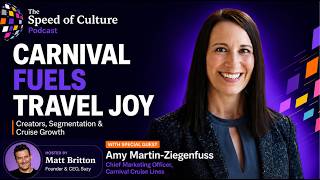
In this Speed of Culture podcast episode recorded on June 15, 2026, host Matt Britton interviews Amy Martin‑Ziegenfuss, Chief Marketing Officer of Carnival Cruise Lines. Amy shares operational nuances of cruise ships—such as the necessity for vessels to keep moving, the balance between speed, fuel consumption, and itinerary planning—and how these constraints shape marketing decisions. She discusses the industry’s post‑COVID rebound, emphasizing the value proposition of all‑inclusive cruises, family convenience, and resilience amid inflation. Amy explains Carnival’s mindset‑based customer segmentation, focusing on the social, active experience rather than strict demographics, and how this informs targeting across its portfolio. The conversation moves to the marketing mix: leveraging a robust first‑party data set and loyalty program to nurture superfans while attracting first‑time cruisers, and the importance of personalized content. Influencer and creator collaborations are highlighted, with examples like the McFarlands, My Rich BFF, and celebrity partners (Guy Fieri, Emeril Lagasse, Shaquille O’Neal) used to convey the cruise experience to niche audiences. Brand partnerships, such as the Dr. Seuss “Green Eggs and Ham” breakfast, illustrate how Carnival borrows equity from beloved on‑land brands. Amy also details content strategies—social media, cabin tours, behind‑the‑scenes storytelling—to fill gaps that traditional TV ads can’t cover. The interview then shifts to her career path: a serendipitous entry into communications, an MBA, roles in healthcare, finance, and hospitality, and how scrappy experiences at Choice Hotels and strategic work at Hilton prepared her for the CMO role. She stresses continuous learning, curiosity, and hands‑on testing when adopting new technologies like AI. Finally, Amy shares her leadership mantra, “We rise by lifting others,” reflecting her commitment to inclusion, mentorship, and community within the hospitality industry.
Chapters
Today, we're thrilled to welcome Amy Martin-Ziegenfuss, the Chief Marketing Officer at Carnival Cruise Lines. Amy is a seasoned global marketing executive with extensive experience across the hospitality industry. Amy, so great to see you.
Thank you so much for having me.
Absolutely. So I've always been fascinated with the cruise line industry. I know you're relatively new to the role, but you're certainly not new to the world of hospitality. What is something that you learned when you took over the role of CMO at Carnival Cruise Line that you didn't expect in terms of maybe some category-specific challenges or opportunities?
Yeah, I think there, there are quite a few, you know, you think, oh, well, I've been in hotels a long time before this, and it's a floating hotel. But that vastly oversimplifies, oversimplifies things. It's really a complex industry, as you might imagine. I mean, There are so many things related to, for instance, did you know that ships can't ever stop? So during the pandemic, for every cruise line, they had to keep the ships moving because if they stop, they start to have all kinds of issues. So you gotta keep 'em running.
Maintenance-related issues.
Right, exactly. Exactly. So they gotta run, they gotta keep moving. The, you know, the speed that cruise ships go is a really delicate balance because you obviously wanna get people to where they're going. But the faster you go, the more fuel you burn. So obviously we wanna be sustainable, we wanna keep costs down. So you have to think very carefully about itinerary planning. So those are some of the things that were, that were really interesting to me. And then as a marketeer, you know, coming from, I spent a long time in hotels, which I know we'll probably talk about.
Yeah.
And then coming to the, the cruise space, you know, we really do get a chance to impact the end-to-end vacation experience in a way that, you know, the hotel space is, is heavily franchised. So you have influence over, the entire trip, but it's harder, right, to kind of influence all of the customer experience throughout. Whereas in the cruise space, that's really exciting. You actually get to really think about it all the way through.
Yeah, absolutely. And speaking of COVID I mean, there were so many people that were saying during COVID oh, the cruise line industry is over because it got so much bad publicity, especially back in March of 2020. And obviously the industry made a thriving comeback now. How did COVID impact the cruise line industry and maybe Carnival more specifically coming out on the other side of it?
Yeah, I think to your point, it was, it was a tough industry. It had a lot of, a lot of things stacked against it. That's for sure. For sure. And it was, it was, you know, literally the cruise lines weren't allowed to sail really late, you know, when, when other businesses were back up and running. So, so definitely it was, it was a tough time. And then, I think though, I think the entire industry and, you know, travel as a whole really benefited from people wanting to get back out there, right? They, they, they felt robbed of their trips, their travel, their leisure, their experiences. And they, man, have they come back in, in droves, which is amazing. And I think, I think the cruise space has benefited too because it's a really great value. You get a lot of things included.
Yeah.
You can plan for that. And especially with economic uncertainties, right? It really—
Inflation.
Yeah. Totally. Exactly. And the other thing is you can come in lots of various shapes and sizes of groups, right? You can go as a singleton. You can come with couple or a couple of couples or multi-gen families, right? It's really easy to kind of be together. I think a lot of people wanted that coming back from the pandemic, be together, but also like do your own thing and then meet up again. So I think there's a lot of factors that kind of play into it.
Yeah, for sure. And especially for families with small children, I mean, good luck. Taking multiple flights to multiple different destinations where you only have to unpack and pack once. I'm sure that's part of your overall positioning in terms of ease for, for families.
Absolutely. Ease for families, ease for, you know, I think a lot of people who just don't want the hassle. So no question.
So let's talk about your ideal customer profile, 'cause you just mentioned a lot of different consumer types. Do you focus on any one type of customer for different cruise lines? How do you look at targeting and, and who you're focused on to drive future growth for the business?
Yeah, we really think of it as a mindset versus a demographic.
Okay.
You know, I'm sure you are very familiar with that, right? If you—
Of course.
If you look at just one age range, you're gonna miss a whole lot of people in that, right? So we really think about it as the type of people who our experience is gonna appeal to, right? We're a very social experience. The Carnival brand is known for, you know, activating, having an activated vibe. Onboard. That's not for everyone, but the people who are looking for that, who love, you know, interacting, like to be part of things, like to, you know, interact with the crew, with each other, right? That is, that is something that, that is, is really appealing to, to our kind of customer. And we see that cutting across, you know, all kinds of demographics, right? From young families, parents in their 30s through to, you know, retirees who—
Yeah.
Absolutely also are looking for that kind of vibe and that kind of experience. So that it's really about the mindset for us. And that's what we're focused on. Our sister cruise lines within Carnival Corp have very different targets and very different customer segmentations that they're going after. So we're not really overlapping, which is really, really helpful.
Yeah, totally makes sense. In terms of the marketing mix, you know, that you need to focus on to drive continued growth for your brand, obviously, customer loyalty is so very important because so many people that go on a cruise line, tend to come back over and over again. And you are one of the businesses that has the benefit of first-party data where you can mine that data and drive personalization. But at the same time, you wanna build your brand. So you're bringing new, you know, younger or, or first-time customers into the portfolio. How do you look at that overall marketing mix in a world where, you know, first-party data is, is so incredibly coveted?
Yeah, it's, it's very true. And, and we are very, very lucky, as you say. So, you know, we have a, we have an incredible base of, of, really engaged superfans. And that was something that was fabulous to uncover when I joined the brand.
Yeah.
Because, you know, our people really do love the brand and almost consider it a lifestyle, which is, you know, just amazing. So that's incredible. We obviously wanna nurture that. You know, we connect with them in many, many ways, you know, through all kinds of channels. Obviously, social's a big one, but lots of different ways and means. And we have a loyalty program for them. And then we think carefully about continuing to keep the pipeline filled, like you said, with more first-time cruisers or those who are looking for our type of vibe and our type of vacation. You know, something that's all-inclusive, it's packaged where, you know, we're offering a variety of experiences, but it's kind of all in one place. That's what we try to kind of help to appeal to first-timers.
Yeah, and most advertising, above-the-line advertising I've seen for cruise lines have focused on the ship and the ship experience, and you see the water slide and the buffet and all the different things. Is that sort of the tried and true motion to build awareness, or have there been other tactics from an advertising and even content distribution standpoint that you have found effective?
Yeah, I think, I think we've all talked a lot about what the experience on the ship is like, and I think there's a need to go deeper.
Yeah.
And I, I think we're trying to do that. And I think, you know, we've, I think we've done it well in some ways. I think we have more to do in, in others, frankly. I think, you know, helping to, helping people to understand what the experience is like beyond the activities is really important. And I think sometimes that has to happen through, you know, through having other people help us tell our stories, whether that's our customers. Word of mouth, right? Right. Whether that's our customers exactly on social and, and we, we encourage that or influencers that we work with. Because, you know, they really help us to reach different audiences and tell that story in a way that, you know, because you can't get people— it's not like a hotel where everybody's been in one, right? If you've never been on a ship, you've never been on a ship, right?
Right.
So then you're probably not going to do it unless you have a better understanding what it's like. So helping us to bring that to life on land, leaning into some of our celebrity partners like Guy Fieri, Emeril Lagasse, even Shaquille O'Neal to help us kind of really tell the story through their lens. Right? And, and help people understand what the experience is like. That's all been really helpful for us. And I think you'll see us doing more of those things as we kind of work through how we, how we really bring that experience to life.
Yeah. I mean, you mentioned influencers and, you know, I have small children, so I'm intimately aware of the fact that influencers in the mom world just have such large impact on consideration and, and preference and purchase and behavior and consumer behaviors, all those things. Have you found that to be an effective channel and, and what are some of the ways that you've activated the creator economy and, and influencers?
Yeah, absolutely. We have, you know, we work with, with several influencers who've really helped us to dimensionalize the experience. Like I was saying, the McFarlands are a family with older kids, for instance, who we've worked with to help us kind of, 'cause you know, we, we had, we found we had a little bit of a perception of being only for families with young kids.
Right.
So, right. So, which is true, but we also have, we have everything for kind of every age range. So we purposely worked with them to have them help us tell the story about how, you know, when you're, you know, you're kind of traveling as a family, but you know, the, the, the kids are late teens, 20s, you know, what is there to do kind of a thing? How does that work for that family? And they've really helped us with that. We've worked with My Rich BFF. She's really helped us tell the story of what a great value it is and how much you get for this experience. In and, and out of a Carnival cruise and how that compares to land-based vacations, um, and all-inclusives. And so that's another angle we've taken. Um, and she appeals to a younger demographic, so, you know, kind of more younger millennials. And, um, so that, that was helpful for us. So we, we, we try to be very, you know, kind of choiceful on how we partner with them to kind of help us reach either niche audiences or speak to a, a challenge where we're finding that, um, that we, we're struggling to overcome on our own.
Yeah, I mean, and the form factor of social media and stories on Instagram and TikTok and Snapchat really does fit well with your offering because it's not something that can easily be told in 15 or 30 seconds, right? There's so many different parts to the experience and you wanna be able to tell a story and—
That's right.
Of what the experience is like from start to finish. And I think social media fits perfectly with that.
Yes, it's true. Even our own content creators that are part of the brand, they do a lot of— some of the things that are most popular are things like cabin tours, just because people want to know, like, what's in here? You're not going to show that in a TV spot, to your point, right? But people want to know, like, what's it going to look like? And where do I put my stuff? And I get it, right?
And also, it's not like they can check out if they don't like it after a day. So it's a commitment as well. So the, the problem, it's almost closer to like a car than it is going to stay in a hotel because you are committing for a longer period of time.
That's right. That's right. You need, you need more of a like build your own virtual tour kind of a situation.
Yeah. Absolutely. So a big thing I've noticed recently in the cruise line industry is a lot of collaborations with brands that would just say are on land. So, you know, you'll partner with a restaurant chain or you'll partner with a retailer. To basically bring some of the beloved brands that consumers have out at sea with them. Is that part of the overall marketing mix in terms of thinking of what, what other brands can— you mentioned celebrities, but obviously what other brands can we collaborate with to, to borrow equity from those brands and round out the experience and allure to the consumer?
Yeah, it absolutely is. And it's something we, we think about a lot and, and making the right kind of collabs. You know, we have one with Dr. Seuss, for instance, which is a really powerful one for us.
Yeah.
And we host the Green Eggs and Ham Breakfast at Sea and, you know, have a Seuss library. And, you know, that's a really, you know, it's important for parents to know, right? They're coming on board, what are they gonna be able to do with their little ones? Are there gonna be things that they know are gonna be tried and true, right? Those kinds of things. So I think that that was, you know, that was a great example of being very thoughtful and intentional. About some of those kinds of collabs. So we definitely look at that across entertainment, across, you know, the children and youth programs, obviously dining and beverage, those kinds of things. I already mentioned some of those. So yeah, it's absolutely part of the marketing mix. We work very collaboratively with those stakeholders, other stakeholders internally who can, you know, we think together about how do we think about this? What is the right partner? How are we going to use it to market? How will it help us with the onboard experience and all of that? Yeah.
Yeah, 'cause in a lot of ways the product is the marketing, right? Especially in a world of word of mouth and the things that people say about their experience essentially becomes the pillars of your brand. So you wanna carefully craft that.
Absolutely.
Correct. Exactly. So let's wind back the clock a little bit to your career journey, Amy, 'cause you spent a lot of time in the hospitality space. I know you played around other categories as well. Why did you enter the world of marketing and how did you end up in the seat you're in today?
Okay, I'll try and give you the high-level version. It was a little bit of a happy accident.
Okay. It usually is.
In that I, you know, I didn't really know what I wanted to do and I sort of stumbled into comms and marketing during my latter half of college. And then luckily had an internship at an agency that kind of, you know, really introduced me to things. And that was, phenomenal. And I really got interested in the psychology of, of it, the consumer, you know, behavioral piece of it and, and branding and how brands, um, you know, can play a role in people's lives. And so that kind of set me on my journey really. Um, and I really wanted to, um, understand more about how that could move a business forward and drive growth. Um, so I got an MBA and then I, as you say, I, I worked in healthcare for a while. I worked in, um, finance for a hot minute at MoneyGram. And then I ended up in hospitality and travel, which has been, you know, kind of has always been a love of mine anyway. So it really suited, it suited me as well as gave me the chance to work with some great brands like Choice Hotels and then Hilton and of course now Carnival Cruise Lines. So, you know, I've really been fortunate. I've had a lot of great opportunities. I've had a lot of amazing mentors and bosses. Over the years, I've worked hard and I think along the way managed to understand how marketing can make an impact, and I've focused on that. So, I think that has really opened doors for me at, particularly at Hilton, you know, working at Choice. It was such a scrappy brand. It's a challenger brand. It's actually, it's changed a lot now, right? It's acquired so many more brands now.
Mm-hmm.
But the time I was working there, it was really a challenger brand. We had to be so scrappy. So smart, our spend was tiny, we used all the tools in the toolbox, and then I was able to bring all of those tools to Hilton because Hilton was a huge legacy brand and, you know, had really kind of done well off the back of that over the years. And so maybe the marketing wasn't as modern as—
Right.
Right, as a brand that really needed to be scrappy. So I was able to bring in things like, you know, marketing mix models and modern segmentation and much more modern measurement and metrics and really thinking about the you know, the, um, the impact of marketing, like I mentioned, and what it drives in terms of growth and identifying growth segments and building brands for those segments. And so that really enabled me to kind of move up the ladder because I think, you know, leaders saw value in what I was doing. So, um, so yeah, so that's kind of how I, how I made my way.
Very cool. So I'm gonna unpack some things, but one just thought I had to hear you talking is a lot of people focused on the title or the next role, but One thing I heard you say is that kind of the skill sets that you pick up and master along the way are so important as building blocks to becoming the professional that you ultimately want to be.
I think that's well said. I think that's very well said. And I think thinking about how what you want to learn and what you're passionate about can intersect with what the business needs. I think when you find that, that's the sweet spot, right? Because that means you're going to grow and you're going to add value. And so suddenly, right?
Right.
You're in a position like you're saying. So I think that's, I think that's exactly right.
Yeah. And I think as you progress in your career, I think when you're more junior, you don't have a big team reporting to you. You're not reporting to the board or other executives. It's easy to have hands on keyboard and maybe tactically understand new innovations in the advertising space. But then the more senior you get in your career, it's often a trap to just become disassociated with whatever is new. And often what happens is marketers lose touch, right? And clearly you've continued to focus on these new innovations in marketing to allow you to put yourself in the position. How do you balance that over time? And when something new comes onto the scene, like let's just say AI here in 2024, what is your playbook to get your hands dirty and truly understand the applications of that innovation to your business?
Yeah, yeah. It's such a great question. I think to me it's all, it's always about really learning as much as I can and, and working with my my team and my agency partners to do so, right? Like really kind of going on a voyage and discovery together, understanding, you know, how other brands and companies are leveraging those things, thinking about what would be the right application for my brand or company, and then testing and learning, right? That's always, it's always about that. So I think that's kind of the way I approach those things and it's served us well and me well in the past. I think you always have to be curious. Yeah. And interested, or you, you're gonna, you're gonna miss something big. And, and you know, that's, that's the death knell.
And you had mentioned, Amy, very early on, you got your MBA. And I'm just curious, like, in retrospect, was it worth it? And was it something you'd recommend to other young people who are coming outta college, or should they just dive right into a professional career?
Yeah. Such a great question. For me, it was worth it because I'd studied, you know, English and comms undergrad. And I really had no, no understanding of how the business world worked. I really didn't. It wasn't, it wasn't natural to me. I had to learn it. So for me, that was really important. I wanted to understand, you know, how companies worked and the financials of it all, and also how marketing could be a driver of that. So that's why I did it. So I always say it depends, right?
Yeah.
If you think it's gonna add something to your knowledge set, to your, you know, to what you need, the experience you need, or, you know, what you need to be able to grow and continue on your path, then absolutely. But I don't think it's a requirement. And I also think you do— I think you do need actual work experience to really make it pay off. So I would never recommend going straight from undergrad to B-School.
Interesting.
Personally, I think one of the big values I got, because I worked for 5 years before I went, and the big— one of the big values I got was my cohort talking about all the, you know, practical things that they'd experienced thus far in their careers, right? And and, and really kind of that, that conversation and, and that real life experience was so added value. So to me, that would, I think you'd miss that.
Yeah. And as you went on, obviously, you know, you mentioned your journey and ultimately you found yourself in the hospitality industry where you pretty much stayed in and you are now. What is it about the hospitality industry that gets you so excited about your job and, and makes you feel like this is the place that you really wanna focus the prime years of your career in?
Well, I think, yeah, it's another great question. I think one of the things that I'm passionate about is the fact that we really are impacting people's lives, right? And maybe not me personally, but the people on the front lines, our teams are incredible. And they're making people's vacations. They're helping them make memories that will last a lifetime.
Lifelong memories, for sure.
Right? Absolutely. And that's the connections that people make with our team, with each other, with peo— I mean, the number of people who, meet cruising friends or cruising love interests, and then they go, they cruise together every year in the case of the friends, you know, they, it's wonderful, right? That's, I mean, that's, it's so heartwarming. So I think, I think, you know, feeling like I'm part of something like that, that adds joy and value to people's lives, I think makes me get up in the morning. And, and I also love travel and I love what it does for me personally. So I relate to it. So I think, I think that's why I ended up staying here. I've been very impressed with the frontline employees across the board at Hilton, at Carnival, in my past. Just, they're people who care deeply about the people they serve. And I just, I'm always in awe of them and everything they do. So, you know, hospitality is, you know, eons old, right?
Mm-hmm.
You know, people have opened up their homes to weary travelers since day dot. So, you know, we're just continuing that tradition and it's beautiful.
Yeah, I mean, it's well said. I think the people are such a big part of the product with a company and brand like yours, and you could have the most beautiful ship and go to the best destinations, but if the people on board don't make the experience memorable and don't make the people feel welcome, it doesn't matter. Right? So I think obviously it's a huge part of, of your offering overall.
Yes, I think that's very well said.
And so, so now here you are in a CMO role, and obviously a big part of your role is how you manage your time and how you work with others. So what does a pie chart in a normal week look like for Amy? Are you always on cruises, just cruising to these amazing places, or are you at an office doing emails, or a little bit of everything?
A little bit of everything. I do cruise quite a bit, which is fantastic. I only have cruised for work so far. I haven't taken a leisure cruise since I started a year and a bit ago. But, but it, you know, look, I'm not complaining. It's an amazing place to, to be doing your job, right? So, so I've, I've done a bit of, you know, we do production cruises. I go on cruises to understand the business and the, and the operations. So all kinds of those kinds of things. So that happens several times a year at least. I think I'm on, this year I'm on my 4th cruise already.
Great.
And there's a, there's a few more to come. So yeah, which is great. We don't always stay the whole time. That's one thing that people probably don't know, but we can get off at a destination and fly home if we have to. So we don't always stay on, so I don't always get to be there for 7 days. But, but yeah, a lot of the rest of the time I'm, I'm, as you might imagine, I'm in meetings, I'm in, I'm in agency world, you know, meetings in New York with agencies or I'm, you know, different, different meetings with work and other stakeholders. I'm talking to my team, my agencies all the time. You know, we're working together with, you know, the guest experience teams a lot just to think about how we're bringing everything together, how we're evolving the experience, working with our partners like Guy Fieri and Omar Libassi. And so, yeah, it's— I mean, it's very interesting work.
Yeah, for sure. So switching gears here as we wrap up, Amy, such an exciting career and you're in such a great role now at Carnival. As you look back and, you know, it was, I really appreciate you walking us through your journey. You probably, it's probably not something you do every day, but no, when you, when, when, when, when you do look back, what are some of the decisions that you think were the right ones along the way? Whether it was at key points of transition or key relationships or things you decided to focus on that put you in the position that you're in today?
Yeah, that's a, that's excellent look back material. I think I probably, I guess I probably, you know, learned early on that my path wasn't going to be linear. You know, I think I, I sometimes, I often counsel my teams and the other, other people I'm, I'm a mentor for that you sometimes have to zigzag, right?
Yeah.
Like, it's, it's, it's not, it's not usual that your next, you know, your next thing is an institute promotion and then you go from there and you go from there and you go, it's, it just generally, you have to look for the right opportunities. That the business has, right? Like where are the hotspots in the business, right? What's going on? Where do they need help? Where is there growth opportunity? That's usually where there'd be growth for, you know, somebody like you, right? So putting yourself forward for special assignments, you know, kind of positioning yourself in those kinds of places, being willing to do some stuff that maybe, you know, isn't all that sexy in the beginning.
Right.
Right? But it kind of, you learn things, you get credibility, and that can open a door. So I think some of those things I did really helped me. And then having the right mentors, you know, learning from people across the business in different parts of the business. You know, I really, you know, there was a guy at Choice Hotels, Mark Paris, he's sadly no longer with us, but he ran the international division. I was dying to work internationally. So I, you know, did my best to support him and he, he made worlds open for me. I mean, he ended up giving me my first job in London.
Wow.
For Choice after, you know, many years working together. And that was phenomenal. That was 'cause of the relationship we'd built, right? So, you know, it's, I think the relationships are absolutely critical to your growth and, and to enjoying it along the way.
Yeah, absolutely. It's so well said. And, and to wrap up here, Amy, is there a mantra or saying that you like to live by that guides your professional career that comes to mind?
Yes. I love the mantra, "We rise by lifting others." Yeah. I think it's so beautiful. And I think in early on, I think I might have thought about it a little bit differently. Like I was in a competition and I had to win. If I had to win, somebody else had to lose. And I just don't believe that anymore. I really believe that, you know, we make space for others. You can make more space if you get a seat at the table, make some more space for other people, right? And, you know, as a woman, as a member of the LGBTQ+ community, I really feel strongly about that. And I feel strongly about advocating for others who both look like me and don't look like me. So I think that's really important.
That's really well said. And I wanna thank you for taking the time today and sharing your journey and your story and your vision with us here on the podcast.
Thank you so much for having me. It's been a pleasure.
Absolutely. I can't wait for our audience to hear this. So on behalf of Susan and the Ivy team, thanks again to Amy Martin-Ziegenfuss, the Chief Marketing Officer at Carnival Cruise Lines, for joining us today. Be sure to subscribe, rate, review the Speed of Culture podcast on your favorite podcast platform. Until next time, see you soon, everyone. Take care.
More from Matt




MikMak’s Rachel Tipograph on Consumer Spending, Retail Media & Holiday Shopping Trends



Jaguar Land Rover’s Charlotte Blank on Luxury, Purpose & Experiential Storytelling



