CEO Reveals: How I Built AI Tools at 32,000 Feet That Would've Cost $3M Two Years Ago
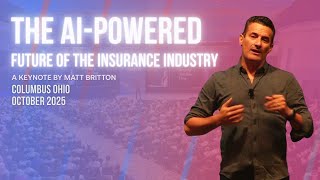
Matt Britton built practical AI tools on a plane that would have cost $3 million two years ago, including a health bot from his medical records and a real estate chatbot for NYC data. He argues AI is now ubiquitous and urges people to build personal projects to stay relevant, while warning about deepfakes and emphasizing creativity and lifelong learning as essential skills.
Questions this video answers
0 to 14
Over $30 trillion
Currently valued over $3 trillion
Demand for data centers forecast to be up 30x by 2035
33 times the power of a Google search query
Chapters
Under a sky of orange and gold, Columbus comes alive Nationwide tech hearts beating, ready to thrive. Matt Britain takes the stage, voice steady and clear talking AI transformation. The future's already here. From data to decisions Automation in the air tomorrow's claims and coverage Handle with care he's painted what's next with the confidence dry because nationwide is on your side. Bad, right?
I made that video on the plane at 32,000ft flying in a tin cube last night. Just think about that. How did I make a song lyrics and a music video and make the cool eagle in your logo fly off the screen? That's the world that we're living in. It all hit so fast. A couple years ago, AI was this foreign thing. And here I am in the airplane building things. I've spent my entire career helping big brands understand the new consumer. And I can tell you, every single time there has been change in the past, there's been naysayers. In fact, we can go long back to well before my career started, when handwriting was first invented. And Socrates famously said, handwriting is bad for humanity because it will not force humans to remember anything. We're seeing this happen all over again with AI. We're seeing fear, we're seeing fear mongering, we're seeing people not understanding what's capable. And what I'm here to do today is give you all a firm understanding of where AI is and more importantly, what each and every one of you in this room should be doing right now to future proof yourself. So as I mentioned, I spent my career really helping brands understand the new consumer. And when I first started in the year 2000, the new consumer was the millennial known as the first generation to grow up with the Internet in the household. When I tell my kids I did not grow up with the Internet in the household, they look at me the same way I looked at my grandfather when he told me he walked to school with no shoes on. But that's true. There was no Internet growing up. I actually remember taking a landline phone with a long, twisty cord and sitting kind of behind in the laundry room so I can talk to my high school crush when my mom would jump on the phone and start dialing and I was like, mom, I'm on. People don't realize that. And the real Flex was actually getting your own phone line, right? Over time, the new consumer would become Gen Z, known as the iPhone generation. Or for those of you who have a child or a kid who's Gen Z as an appendage to their body and all Of a sudden, the power of the Internet was in everyone's pocket. And along with that came the social media era, which changed the way that young people grew up. No longer did they have to kind of wonder how everybody else was living. For better or for worse, it was in their face every single day. And now we have a new generation coming to society. Gen alpha, age 0 to 14. They will be known as the AI generation. They will never know a world where you cannot talk to technology like you talk to people. It will not be foreign to them to have an intimate relationship with an AI chatbot, a concept that will freak out their parents. But for them, they don't know any other way. As AI gets better and understands them and comes to life with voice and imagery, it's going to rewire their brains differently. Now I get a lot of questions when I'm on stage talking about AI around the world in terms of like, is this bad or is this good? Is this taking away artistry? Is this taking away humanity? It really doesn't matter. We are not going backwards. Every company who's spending billions of dollars this year on AI investments is not going to put the genie back in the bottle because people don't like where it's going. We are wired as a species to progress and embrace these new technologies. And this is a technological innovation unlike anything we've ever seen before. So we need to embrace it. We need to understand its path in our lives, in our homes, and to chart our path for our future career goals. And hopefully today you will walk away with an idea on how to do all those things. Another thing I think about a lot with Gen Alpha is how much money they're going to have. We are in the midst of what's called the Great wealth transfer, where over $30 trillion, that's trillion with a T, is going to be passed on from baby boomers to Gen Z and Gen Alpha consumers. My father passed away a couple years ago, lived a great life, but did not live a life of excess. He was actually pretty frugal. Like, he would drive around the block 10 times to save $7 to pay for a parking lot, right? And when I was put in charge of his estate, I was shocked by how much money he'd saved. And I didn't really understand the way he lived, the way he lived, right? And the more research I did, it became apparent that he was a baby boomer. And he grew up during the the shadows of World War II of the Great Depression. His relationship of money was one of scarcity, juxtapose that to Gen Z, when the fiscal stimulus or stimmies came in during the pandemic, was their relationship with capital one of scarcity? I would beg to differ. Right. We had GameStop, GameStonks, NFTs. Any way that this generation could spend money, they would, because their relationship with capital is one of yolo, the complete opposite of one of scarcity. So my question for you is, when $30 trillion gets passed on to people who are holding their money tightly, the people who are going like this and making it rain every day, what is that going to mean for our economy? Just something to ponder as we go through the importance of AI. So I want to talk about my experience with AI, because I think it's unlike most people. I run a software company. We have 300 employees, 80 of which are engineers. And when people first start to adopt ChatGPT in 2023, my first inclination was to give it to my engineering team. And I waited and I waited and I waited and sure, a little bit happened. We had some AI pixie dust on some of our products, but we weren't really seeing the transformation that I had hoped for. And everything I read told me that in order for you to really use AI, it's really not about understanding deep technology, but it's about strategy, it's about problem solving. So I decided to take the reins back myself as CEO to try to figure out AI. Now, everything I had read throughout my life, you know, had taught me that if you really want to be focused on something, pick a topic that's most near and dear to you. And with that, I made the decision that instead of initially just taking AI and diving into the business, I was first going to use AI to help solve a problem in my own life. So I just turned 50 years old. I have two small children. I also have two kids in college. That's a completely different keynote which we're not going to get into. And my goal in my life is to stay alive as long as possible. So I set out to use AI to help me accomplish thus that. And I decided to build my own personal health. Bottom the first step in AI is data. As we'll get into, what is the data to keep me alive? Well, it's the data of my body. So I went through two decades of personal health information. X rays, MRIs, blood test information, notes from doctors, files that were on external hard drives and even actually in file cabinets and scanned them and organized them and uploaded them into my own personal model. I trained a model telling it that you were the leading doctor from Johns Hopkins University with one goal, and you'd get fired if you didn't achieve this goal is to keep Matt Britain alive. It took me about 10 days to pull it all together, and I was finally ready for my first prompt. And what I typed in was, if I'm gonna die in five years, what's the most likely cause? Now, any of us could type that in Google, right? And what you're gonna pull up is WebMD, which is gonna tell you we're all gonna die in five years, right? But this was trained on me, on my information, on my history, and what it told me kind of freaked me out. And of course, I was like, well, why? What can I do about it? I don't want this to happen. And it was pointing to marks in my blood that appeared 12 to 15 years ago and how it's progressed in certain ways and what I can do. And I've lived a healthy life, but we're all just, you know, we're all mortal characters out here, right? And we don't really know what the future holds for us. And it really changed the way I looked at my body and the way I looked at my health. And I started to make habits and decisions differently as a result. And now I talk to this healthbot all the time. If I'm feeling the weirdest thing, I will ask it questions. If I'm going to an allergist and I want a dossier of all the information for the past year, it'll create it for me, and I'll give it to the allergist, and she will have it before I enter the office, which will save me time and give her the information she needs. Going through the step of the. Of building my own personal health bot is exactly the step that I think we all need to go through in order to future proof ourselves for the age of AI. And it all started with me identifying a problem. And in this case, the problem was, I don't want to die, right? But there are so many different problems in our personal lives, in our business, that we really need to focus on. I think that in a world where things are moving so fast, which is what it shows on the screen, such a benefit of what's happening with AI, we can get overwhelmed with the tools and actually lose the script and the first principles of actually what we're trying to accomplish. If you pick a problem and if you start talking with an AI model and tell it the problem, get an understanding of the data that you can aggregate to solve the problem and have a good understanding of the ultimate solution. And you go into something like ChatGPT and say, I want you to give me step by step instructions on actually how to create this. Do not give me step two until step one is done. If you have perseverance, you will be at step 37 and look back and say, wow, I can't believe I actually created this. And along the way you're going to start to see, oh, and I can also do this for this and this for that, and the world will open up to you. The reality is most people are just using ChatGPT to find a good recipe for lasagna, but the reality is it can do so much more. And the steps for you to be able to build an AI are the steps for future proofing. Another thing I've realized, and I'm sure it's the case here in this room, is it's not like you could just download any tool that you want at work and start uploading customer data, right? That's no fly zone for legal data security, your privacy team, et cetera. Totally get it. Which is why I think the best way to train for AI is doing just what I did. Doing it at home. Build a health bot. Build a bot that will help you with health and wellness or your diet. Build something to manage your personal finances, which I also did. Because when you're home and you're using your own personal data and you're downloading the tools that you want, you will be unencumbered to really be able to explore. And then over time, when enterprises catch up, which they will, you're gonna have the skill sets that you need to differentiate yourself. Cause there's really no excuse right now but to dive in. Two and a half years ago, I didn't even know what AI was. Here I am making a music video the night before to present the thousands of people about AI. I don't expect all of you to take that journey, but if you take the small journeys of starting to build, I think you'll quickly see what's possible. So why is AI so magical? Well, it's on the screen first and foremost. It is improving at an unprecedented rate. If you look at the iPhone, it took 18 months from the iPhone One to the iPhone Two to come out. And I would argue there's been more innovation already with AI in the last 18 months than the iPhone has actually had over the last 22 years. Right. The rate of change is so mind blowing that when I get asked to prepare presentations and conference producers Ask me to give them the presentation a week in advance. I say no, because in the case of this week, so many announcements happened in the last two or three days that I wanted to be able to be of the moment on what's happening. The biggest thing about AI that makes it easy to adopt is it is so easy to use. So my mother, who now lives alone is 75 years old in Florida, was texting me three to four times a week because she kept forgetting her Netflix password. And I always gave it to her and I always got back to her, but I ended up creating for her her own bot for her house. I scanned every single appliance and manual, put in every single password, and I asked her, before you call me, although I love to hear from you, mom, just, you know, I put a shortcut on the front of her iPhone. I just asked her to ask questions and it got her the information back instantly. Point is that it's easy to use. Unlike past technologies where you needed some type of specified skill set to understand how to use AI, you really just need to know how to communicate in any language, in any way you choose. If you can text your friend, you can use AI. So it's those two things, the ease of use, the low barrier to entry, and the rate of change, that make this technological evolution unlike anything that we've really ever seen before. And something that makes it hard, frankly, for me to sleep. So, as I mentioned, the length of tasks AI can accomplish is doubling every seven months. And I hear so much people say to me, oh, I actually tried to use AI to create a picture of somebody and he had seven fingers on one hand and six on the other hand. The reality is it doesn't matter what happened four months ago. It doesn't even matter what happened today. Me saying that today would be like me telling you I tried to stream on the Internet in 2001 and it was choppy, so I actually refused to stream my TV today. It doesn't matter where it was, it doesn't matter where it is. Today is the worst it's ever going to be. And if AI can do something okay today, given this rate of change and potency and power, it's going to be able to do things in an incredible, almost unbelievable way before you know it. I think a lot about education and what this means for Gen Alpha who are coming into society. And I stumbled upon this article on Bloomberg that shows that Beijing in China is rolling out AI courses for kids to have AI fluency as early as age 6. I was speaking to the CMO of a toy company who told me that in development right now is a stuffed animal that kids can talk to that knows their name and they can have a relationship with. I don't know how I feel about that. Right. I think there's something to be said for imagination, but you're going to see every single innovation roll out and it's going to surround young people. So I think bringing it to them versus trying to shelter them from it, when it's going to seep into every corner of business, culture and society is really the only way to go. We remember in the early 2000s schools, many schools said they weren't going to have Internet in school and they were going to block it. Which right now would seem crazy because China is really embracing AI with younger people. And I think the US education system is a little bit far behind. You are starting to see a trust gap. 72% of Chinese citizens have trust in AI, while only 32% of Americans do. While most of the largest AI companies, whether it's Nvidia or OpenAI or Google or Anthropic, are actually created here in America. If we don't have trust in AI, if we're not bringing into our kids lives, we are not going to future proof ourselves. And in a globalized competitive landscape, that is a real issue for our nation and for all of us moving forward. So I hate to say we have to trust it because we don't. And there are certain areas that we're going to want to dip into. But if it's going to be driving our systems from defense to the workforce to education, we need to fully understand it. Because a lot of people just don't trust what they don't fully understand. The way education has generally been manifested here in America is the notion of memorization and regurgitation. Now I was a terrible student, right? But what I did really well is cram. So the night before an exam, I would cram in as much information as I could and I'd regurgitate on the test the next day, along with the Red Bull that I crammed in my body as well the night before to stay up, right. And I would deliver all the information and I was seen as a good student, but I wouldn't retain any of the information. But the retention of knowledge made sense as the core educational principle in another time when we were at the peak of the knowledge economy. Let me explain. The knowledge economy is about retaining information and spitting it out to different applications. Retaining information of how to do somebody's taxes and becoming an accountant, retaining information of how to write a contract and being a lawyer, retaining information of how to read an X ray and be a radiologist. But right now, the application of knowledge is slowly becoming commoditized because the power in AI is far less about how to solve the problem and far more about knowing the problem that needs to be solved. Meaning it's about creativity, critical thinking and problem solving. It's far less about retention of knowledge. And in that is the real fear and opportunity that all of us have, because so many people have built their careers in the knowledge economy knowing the specialized skill set and thinking it was going to take them all the way through. And here comes this new technology that all of a sudden is rendering it obsolete. But guess What? There were 38,000 businesses in the horse and carriage space that quickly went under when Henry Ford rolled out the model T. But 64% of all the jobs created in the next decade in America were from the automotive industry. We have seen this over and over and over before. And I think ultimately us moving fast and moving in the right direction is ultimately what's needed. So what are the new workplace skills? Well, this was from the World Economic Forum and it was a future jobs survey. And what it shows is exactly that. Analytical thinking. If you think about the skill sets that I exhibited to build my own healthbot, I first needed to be analytical in understanding what is the problem I need to solve and then be analytical with the data that I put in the model to be able to ask it the right questions. Resilience, flexibility, agility. Things are moving so fast. We need to be resilient. We can't break, we can't complain. We need to move with the tides. Leadership and social influence. Brand is everything right now. And if you have leadership, if you have social influence that has a currency that businesses can take or you can take to drive yourself. Creativity can't stress this enough. The notion of just coloring inside the lines and is going to become less and less important every day. In the age of automation, that's what AI can do really well. Color inside the lines. But show me Jackson Pollock, right? Show me how you can paint outside the lines and see things differently. Where would our nation be without the innovators like Apple and Google and Meta, right? If we just rested on manufacturing from the industrial revolution, where would our nation be? The reason we are where we are is because we're innovative. It's the heart of innovation and its creativity and now is becoming more important than ever before. And of course Curiosity, lifelong learning. You have to want to know more about where the world is headed in order to get your hands on the keyboard and really understand it. But these are skill sets that employers are looking for, and it's a sea change of where you were just five years ago. So right now, what is the new how? And I actually came up with that this morning, believe it or not, and I'm going to kind of describe it. How is how to do things. So let's just take the example of photography right back in the day. Back in the day meeting maybe seven years ago, in order for you to be a truly great photographer, you first needed to know how to develop film and go into the dark room. Remember that smelly liquid that you develop film with? And then you had to know how to operate a fancy DSLR camera with the knobs and the dials and understand ISO and F stop. But now, here in 2025, 99.9% of all pictures are taken on the iPhone. And the people who are seen as the best photographers right now are those that are just adept at where to point the camera to. So that specialized skill set of the knobs and dials is far less important to the problem that the camera solves. Which means different skill sets will make you a great photographer. Now, if you were a great photographer in the past, it doesn't mean you can't be one in the future, but you have to lean into other areas of what makes one a great photographer. And the same thing exists in so many different jobs, many of which I'll get into today. So I'm going to break down the AI value chain into four easy to digest layers so you understand where the state of AI is today. Some of you may know this is commonplace, others maybe not so much. And I'm going to get into some applications that we all should have our hands on, keyboard on right now. And then what it all means for your industry. So infrastructure, not going to spend too much time here. Except to say you all should have invested in Nvidia about five years ago. Nvidia, the company has created the GPU chips originally created to power the graphical demand from video games, was at the right place and the right time, making Nvidia one of the world's most valuable companies, currently valued over $3 trillion. These chips are ultimately what power AI compute. It is driving an insatiable demand for data centers, where the data is stored and where the GPUs run the compute. Deloitte just forecasted that the demand for data centers is Going to be up 30x by 2035. 40% of all the power that's used in the state of Virginia is through data centers. So the demand of AI from data centers is. Is driving a completely new way that we're looking at our infrastructure in the US and around the world. One query on ChatGPT uses 33 times the power than a Google search query. So what does this mean? It means that this is a real issue. And it's why companies like Google, Ear and Amazon are looking into alternative energy sources like nuclear and geothermal to be able to power this demand. But it doesn't mean that the use of AI is going to stop. It just means that our demand on power is greater. And the optimist in me says it's going to accelerate our path towards alternative energy sources. But is the real issue that we can't look over as AI continues to grow? Large language models.
I wasn't prepared to translate that as I was doing that little tease, that little mark with the A and then the ring around it at. See, that's what I said case that she thought it was about.
Yeah.
Oh, but I'd never heard it. I'd never heard it said. I'd always seen the mark, but never heard it said. And then it sounded stupid when I said it. Violence at NBC.
Yeah, it hurt me around in the lunchroom the other week.
There it is. Violence@NBC.ge.com.
I mean, what Allison should know.
What is Internet anyway?
What is Internet? Internet is. That's what Katie couric said in 1998. Laughable. Now, when the Internet first came out, and of course, the next year, America Online came to consumers and brought literally America Online. At which point many people would have said that AOL would have been the dominant tech company of the next century. Right. Wasn't to be. But ultimately it was the crowbar that brought the Internet into American households. Well, ChatGPT did the same thing for artificial intelligence, being the fastest company to go from zero to a million users. And really it's due to its ease of use. Will ChatGPT be the dominant AI company for years to come? It remains to be seen. ChatGPT is a large language model that's created by a company called OpenAI. What is a large language model? It's actually pretty simple and not that dissimilar to how Google search works. There's an input which is known as a prompt. A prompt is getting easier and easier for large language models to understand. So the notion of a prompt engineer is going to become less and less important over time, once a prompt comes in, the large language model goes to work and takes that prompt and goes through its knowledge base to figure out how to respond to that prompt. In the case of my personal healthbot, the knowledge base was just my health information. In the case of ChatGPT is the entire open web. So not all large language models are created equally, and not the data that powers the large language models are created equally. And of course, then it outputs a response, generates a response, which is why it's called generative AI. And the response is multi language and multimodal, which we'll get into. And there is an endless amount of large language models right now, and they keep leapfrogging each other. As the cost of compute gets more manageable, as they unlock more efficiency, the power of these large language models continues to increase its potency. As we spoke about earlier, you don't need to get lost in this, though. You just need to know that betting on the growth in processing power and capability of these LLMs is a pretty good bet to make right now. In fact, in just one year, the smartest large language model improved its IQ score from 96 to 136. Just imagine if your cousin Billy was at Thanksgiving a year ago and he was kind of like, not the brightest guy, and he would always forget things, and then all of a sudden, you know, he was like a Rhodes scholar mit. You'd be like, oh, my God. Well, and where's it going to be next year? That's what's happening with large language models in terms of its rate of change, its rate of power. Many people are questioning what this all means for Google, who developed arguably the most powerful business model of the digital era. And by show of hands, how many people have used a tool like ChatGPT for a search query in place of something you would have used Google for a year ago? Okay, so, ladies and gentlemen, about 75% of people just raised their hand. When I did the same talk a year ago, it was about 20% of people. That is a massive shift. Where have people traditionally going to search for insurance? Google, they say that the consumer's not an idiot. Choose your wife. Right? David Ogilvie said, well, it's kind of the case here. If you're all doing it, your consumers are doing it as well. What are you doing to make sure that your company is the one that ChatGPT recommends? About half of my speaking inquiries this year came from people going on ChatGPT and searching for the leading AI keynote speaker. Which of Course should have been me. But being able to optimize for this is incredibly important and in its own right. Google is not sitting on its hands. They understand that AI is replacing search and they are investing very heavily in their own tools. And why I think Google will be one of the winners moving forward is, is because of data, is because they have historical Gmail data, YouTube data, Google search data that other companies don't, making their large language model differentiated and more powerful than other companies that do not have that same ecosystem. Data. Data is everything. Data is the new code. Right? Because while every large language model can crawl the open web, most of the most important data, that is your customer information, that is my body's health information, is not on the open web. And the real power in AI is unlocking things that aren't on the open Web. So using ChatGPT retail is not really the way that you actually leverage AI. It is all about data. So here's some examples. Reddit is a very popular social network where people talk about very niche topics. There's a group on Reddit on where to hang out with your French bulldog if you live in Duluth, Minnesota. Specificity is what large language models are looking for to train their model. Because unlike Google, which is a one shot question, and you get a bunch of blue links back, large language models are very interactive and back and forth. And in that interaction you start to narrow down what you want. And in order for the large language model to be able to converse in a more narrow and specified way, it needs more narrow and specified data. Which is why large language models like Google's Gemini licensed Reddit's data for $50 million a year to access it for its large language model. Reddit, however, did not receive a check in the mail from Anthropic, which powers a very impressive large language model called Claude, and proceeded to sue them for using Reddit's data. We are seeing a whole new data war happen right now and it really illustrates the power of data and, and it's entering Hollywood as well. We saw this happen with iTunes and YouTube and all the lawsuits that came out in the early 2000s with digital media. It's happening all over again right now. Disney and Universal are suing Midjourney, which is a text to video tool, claiming that their intellectual property is improperly training their model. Now some data is free, some very powerful data is free. So I live in New York City and my closest friend runs a pretty sizable commercial real estate brokerage in Brooklyn and New York. And what he tells me is that when his brokers actually show people buildings and properties, they get asked questions like what's the traffic on this corner, right? What is the crime rate? Is there any new developments that are going up? Are there any new permits that are issued? And obviously the brokers have always had to say the same thing. I'll get back to you on that. But the reality is all that information lives somewhere. And, and in the case of New York, it lives in this NYC open data portal which has existed for a very long time. And it has something called an API which allows third party tools to talk to this data. But most people have no idea how to access this. And sure you could download a spreadsheet with 2 million lines in it, but who's going to look through it? Since I'm such a great friend to my friend Andrew, I took six hours over a weekend and built him a tool which has changed his business. I built a chatbot which taps into NYC open data. And now when his brokers are in market and they're asking for the traffic rates or if a new permit, they could just type in the address and it'll pop up. All the information fed right from New York City. This is a software platform that would have been worth tens or hundreds of millions of dollars three, four years ago. And here I am building it in six hours. That is the world we're living in right now where a light switch is on. And again, it's not really about that. The how, it's about the what. The how was easy. The what in terms of understanding how to plug this data in is what unlocked this incredible new resource for my friend and his business. And there's data sources like this everywhere. And for insurance company which has always been incredibly data driven, tapping into new and interesting sources of data to understand your consumer and their risk profile and their life is a massive opportunity in the age of AI. And because of that, the AI training data set market continues to explode. Applications. Applications is where AI gets served up on a dish to consumers. If you think about it, infrastructure is the raw materials. So if I'm making a burger, you get the bread, you get the meat. You know, large language models is kind of where it's prepared. The data sets, it's where it's seasoned. A little truffle, right? Make it different. And that's why people wait in line at one, at one hamburger joint for, for hours and other people go to an empty place because of how it's seasoned, how it's brought differently with special ingredients. Data is the special ingredient, but ultimately the package of all of it is the application. Now, some people just use the application of ChatGPT's large language model, but what we're seeing right now is an incredible renaissance of innovation with companies building new products on top of the large language models to unlock completely new use cases, just like how I did with my friend in real estate. These new businesses are popping up every single day to solve problems that you and I have to make our lives more efficient, to allow us to spend more time on actually what's important. So I'm going to go through the application layer and some things that I think you really need to consider when you're thinking about AI's impact on your everyday lives. First and foremost, and what you should know about AI applications is it's both multimodal and multilingual. If you look at the progression of social media, it took about eight years for us to go from text, you know, I just had eggs for breakfast, to imagery, Instagram, look at my picture of eggs I'm having for breakfast, to video guys, I just had the best breakfast of eggs, right? And that progression, which started with Twitter and went to Instagram and then went to Snapchat and YouTube, took basically a decade. With AI, it's all hitting us at once. It's a full frontal attack where we have text, video, image, voice, data, visualization, audio. AI can output all of it, and over time it's going to be able to be equally at adept or at parity with developing any modality at the same level. A lot of people still think that text is the best way to get information out. That's changing rapidly. And in the next six months, I think the text output will be equally as good in video and imagery and any other modality. And it's also multilingual, which really brings us together, you know, just having a conversation backstage. That Nationwide is obviously domestic company. One reason that companies don't expand globally is because of the language barrier, because of the cultural nuances. But AI is really a global accelerator. The new AirPods that came out translate different languages in real time. So if you're traveling somewhere around the world, you, you can have a translator in your ear, you can roll out applications, and if people speak any language, it will translate instantly. So multimodality meets multilinguistics really equals an omnipresent platform that can be applied in any way, anywhere around the world. So as I mentioned earlier, a lot of people think that AI can't make imagery. And I would point you to this incredible Chart instead of pictures. V1 was 17 months ago and you can't see it, but that guy did have seven fingers on one hand and six on the other. And he looks kind of creepy, to be honest with you, but with the same prompt. Let's take a look at version 5.1. Version 8 is now in development, ladies and gentlemen. So look at the fidelity, look at the beads of sweat. Look how real that person looks. Where is this going to be a year from now? Well, the fact is, it's going to be indistinguishable and we are not going to know who's a real person and what is AI generated. Big problem, right? Big problem with elections, big problem with fraud, with nefarious actors. It's here. There's also big problems with cybersecurity and people stealing credit cards online. There will be many big problems to handle. The hope is that the power of AI will help the good guys as much as the bad guys. And I do believe that deepfakes should always be disclosed. And I think that the social platform should take responsibility for it, all of that. But the point here is AI's ability to imagine something from scratch that comes out of your brain and bring it to life in any modality, but especially in visual imagery, is already here. It's already at primetime. And so many people tried to create images way back a year ago when we were in version 2 and wrote it off. Don't make the same mistake. ChatGPT recently rolled out an incredible image generation platform called Image Generator 4.0, which allows you to make any image you can dream of. So let's just say that I wanted to make the image of that shirtless man that looks nothing like me or nothing like anyone in this audience and wanted to actually take a photo shoot of him. Well, first of all, you have to find him, right? You have to have a wardrobe and outfit person dress him up and basically get the lighting right and get the right photographer and figure out how to have the fire behind him without burning him. But now you actually just have to come up with the idea that you actually want to create that image. Again, going back to the person that knows that image should be created is far more valuable than the person actually knows how to create that image, because AI is going to create the image for you. You look at graphic design, and to be a good graphic designer in the past, you need to know Adobe Photoshop, but Adobe themselves just rolled out Adobe Firefly, where with one prompt, you can change the shadow behind that cat, you can change that beer can, which that cat shouldn't be drinking because it's driving into a Diet Coke. Right? Just with one prompt, right? So that really opens up imagination in a completely different way. And the thing I just can't get over is that that guy doesn't exist. He is not a real person. You cannot meet him, ladies and gentlemen. He's an amalgamation of trillions of data points that are on the open web that created this person. And he looks damn good. Okay, so Veo Veo is a tool that Google came up with that brings imagery into video and to life. And the ability to actually create videos, not just imagery, but people that come to life and talk in places that don't exist, is now here. This chamber is closed until we agree on something real. You keep saying that, but you won't move an inch because your inch costs a mile.
Order.
Order. Well, sort. I had to explain the government shutdown to my 4 year old and I asked Sora to the latest text to video model and that's what it created. This chamber is closed until we agree on something real. You keep saying that, but you won't move an inch because your inch costs a mile. Order.
Order.
Well, sort. Of news coming out about inflation going from 3.7% to 5.2%, impacting consumer confidence. Want a video to describe that? Sora2 creates it. Making a video about a new TikTok trend where people are doing DIY Halloween outfits. That neighborhood doesn't exist. Those people don't exist. Get my point? Your ability to dream up concepts and explain concepts, whether it's lifelike video or dioramas, can actually happen instantly. This tool, Sora 2 by OpenAI just came out this week. Its ability to create anything you can dream of instantly and have these videos changes what it means to be a human. Because in the past, the gap between having an idea in your head and seeing it come to life involve layers and layers or resources and resources, and now it's just asking for it. Over time you're going to be able to make your own TV show with your dog Charlie starring in it. You're going to be able to make your own video game where you can star in it. Reese Witherspoon is going to be able to clone herself and be in a movie in Japan, even though she never traveled to Japan for it. What this means is that if you have creativity or you have IP value or Witherspoon, you're going to be able to really be able to leverage yourself. But if you are an extra on the movie set. Do you think that a movie producer is going to pay for a set with extras walking around the street when they're getting pressured? Probably not. Don't be an extra in Hollywood. Don't be an extra in the office. That's where we're headed right now. Scary, but also very opportunistic if you can train your brain to think about things. You may think it's Matt Britton talking, but it's really Matt's digital twin. I've been told to speak confidently in front of all of you beautiful people at Nationwide today. Matt doesn't seem too worried I'm going to take his job though. So training my voice. You can clone your voice now easier than ever before. You can clone your look and feel. I run a podcast, as was mentioned during the intro, and now I don't have to read out intros anymore. This does it for me. And of course I can do this in any language to still maintain the fidelity of my voice. Digital Twins is very fascinating. One of these people is real, one of them aren't. And the ability to bring it together in a way that can bring yourself to life in ways that you don't want to be to life. Say you want to create social media, but you're not comfortable on camera. Well, Digital Twins creates great opportunities. I get asked a lot about coding. I've worked with engineers my whole life. I've run multiple software companies. And the fact is that AI is getting better and better at coding. As it turns out, computers are much better at writing computer language than humans are. So what do engineers do? Engineers start to focus on the larger infrastructure. They start to focus on how to manage compute. They. They start to focus on how to push things together. But what companies are starting to find as these tools get better and better and better is that the best engineers can 10x themselves by leveraging this. And those who are still upset because they built their career in a knowledge economy are ones that companies have to reevaluate. And this is. Some people think it's the worst thing that's happened. I understand that. But that's just where these tools are coming to. I believe in a year from now you're going to be able to, with one prompt, create any software that you can imagine and anyone can do it. In fact, and I actually almost decided to demo this on stage, but I also built this on the airplane last night and I thought it was a little too aggressive. I built something for your company that can real time test your pricing against all your competitors. With a real time search interface that your entire company can use. And it looks damn good and it looks like your company created it. And I was able to build that with a couple prompts, something that many companies would have paid an agency $3 million to build a couple years ago. And we're seeing this play out in the economy. Software development. Job postings in the United States are dropping, right? Companies are understanding that AI can develop software, but it needs the people that understand the problem that software can solve. The same thing is happening over and over and over again. And guys, I see it. I see it in running a company. I see it in being somebody who's now a full stack AI engineer. I am not somebody who reads trade publications and comes up here and shouts buzzwords. I've done the work to understand as an entrepreneur and now as an engineer what's possible. And this is what's coming and this is the opportunities that's coming and this is the risks that are coming throughout a variety of different jobs. So where do we go? Where's the adoption curve for AI? Well, we've really seen this progression, starting with tools. When ChatGPT first came to the mainstream, it was AI tools. ChatGPT, what's the best lasagna recipe? Then over time it became AI automation, right? It was, how do we actually stitch things together? How do I, for example, after this, I'm going to put a QR code up here and you're going to give me your information and it's going to understand who you are and send you back information. For me, that's automation going from step one to you enter your email address. Step two, figuring out who you are. Step three, writing and sending an email. Right? And automation is one way a lot of companies are trying to be much more efficient. But where we're headed next, I think probably the biggest opportunity for any engineering or technology organization is in the world of AI agents. Because what AI agents can do is instead of being deterministic, going from step one to two to three, it will take an input and based on that input, decide what the next best step is. For instance, one of you might fill out the form to get information, but maybe I already know you and instead it's going to ask you to get lunch with me, right? It's going to be trained to actually access a variety of different tools, but not in a deterministic way that automation brings to life. That is the power of agents. Just this week, OpenAI announced its agent platform, making agents really accessible to the mainstream. But the Ability to create an agent and arm it with different tools. The tools to create software, the tools to create imagery, the tools to write emails really will make the agent more powerful to accomplish whatever it is that you want to accomplish. If you all have your own agent, you're all going to be far more impactful and the company will explode. It's just the reality. Getting from here to there is the hard part. Understanding the best use cases for agents is the hard part. But we are entering the world of agentic AI. Arguably we're already here, but we're really at the very beginning and we all have the ability to become experts in this again if we just take the time to understand. So what does this mean for your industry? Well, a McKinsey report that just came out in July showed that leading insurers report premium growth of 10% or more within two years by deploying AI solutions driven by better customer targeting and better risk assessment. What that is, is the power of AI and data. Better customer targeting comes from feeding a model with your own customer information and allowing AI to help you understand who are the right people for this product. Better risk assessment is enabling AI in the underwriting process to have faster, more efficient decision making processes and to be much more pinpoint in things like rates and how you actually roll out new products. AI is a massive accelerator for insurance companies if deployed the right way. And I know that your company is really pushing pretty fast in this direction, which is great to see, but we're seeing it across the board disproportionately. The insurance industry is a financial services group that is actually embracing AI the fastest because it is so much about data. 55% of US insurers are now in the earlier full adoption stage of generative AI. So over half are actually already there. So it's an exciting time to be in your industry. You look at so many of the manual processes and, and, and data overload that you've had to deal with in the past at deploying AI for an insurance category. And it's simply not the case anymore, which should allow you to accelerate and enter into completely different realms. So to wrap up here, in my opinion, there are four ways that you can go through a personal transformation journey in AI. It sounds like it's corporate speak, guys, it's not corporate speak. This is where the world is headed. And I do believe that if you can embrace these tenants, you're going to find yourself with a differentiated level of expertise that will power your life forward in a different way. And I know that you'll watch this video a couple years ago and be like, I was glad I was here. I was glad I listened to that. First and foremost, be a problem solver. Understand and write down what are the problems that you want to solve in your life. What are the problems that you want to solve in business? To unlock growth, take your business forward and actually focus on figuring out how AI can actually help unlock those problems. 2. Practice perseverance. It's so easy to try a step and have it break four times and say, see, I knew AI is crap. I knew I couldn't do this. I give up. But if you focus and you persevere and you get to step five, you get through step four, you'll be at step 37 and look back and understand so much more going step by step. 3. Something that nationwide understands well is the power of data. How will data drive this AI journey for you? How will it be able to drive whatever you is you're wanting to build? Because data is the new code. Data is the way that you can unlock the power. And then lastly, be action oriented. Since we are in a world right now where the gap between whatever is living in your head and whatever can kind of come out here on stage or on TV or on somebody's phone screen is near instantaneous, you need to have a bias towards action, a bias towards doing things. Not a bias towards having ideas, but a bias towards bringing those ideas to life. Combine the problem, combine the data and be action oriented and don't give up. And over time, I believe that you're going to be able to progress in a differentiated way, which I think we all need to do right now. As the world changes so fast, I think we're going to have time for questions.
More from Matt




MikMak’s Rachel Tipograph on Consumer Spending, Retail Media & Holiday Shopping Trends



Jaguar Land Rover’s Charlotte Blank on Luxury, Purpose & Experiential Storytelling



