Chime’s Vineet Mehra on Performance Storytelling & the Future of Banking
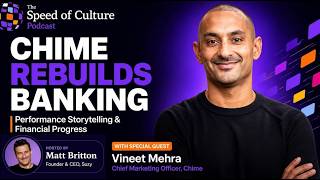
In this Speed of Culture podcast episode, host Matt Britton interviews Vineet Mehra, Chief Marketing Officer of Chime, about his career journey from consumer‑packaged‑goods (CPG) giants like Johnson & Johnson to fintech, the evolution of marketing roles, and Chime’s mission to serve under‑banked Americans. Mehra explains how early experiences at P&G and J&J taught leadership, brand building, and global cultural awareness, which he later combined with direct‑response tactics learned in DTC and tech. He introduces the concept of “performance storytelling,” a full‑stack approach that merges top‑of‑funnel brand narrative with bottom‑of‑funnel data‑driven acquisition and retention. The conversation covers the shifting landscape of media—retail media, first‑party data, and the rise of non‑bank entities (e.g., Uber, Chase) as media platforms—and how marketers must adapt to fragmented attention. Mehra outlines Chime’s product suite (no‑fee banking, early‑pay, Credit Builder) and its target demographic of Americans earning under $100 K, emphasizing social‑first branding, AI‑enabled audience modeling, and community‑driven retention mechanisms like Spot Me. He also reflects on career philosophy, advocating curiosity, “bloom where you’re planted,” and treating a career as a jungle‑gym rather than a ladder. The interview concludes with insights on the future of physical bank branches, omnichannel “figital” experiences, and the CMO’s role as a technology‑heavy, growth‑focused leader.
Chapters
Today we're thrilled to be joined by Vineet Mehra, the Chief Marketing Officer at Chime and one of Forbes recently named top 50 entrepreneurial CMOs. Vineet, it's so great to see you today. I've been looking forward to this. How you doing?
Pretty good, Matt. Long time no see. It's great to talk to you today.
Absolutely. And where does this podcast find you today?
Yeah, so I'm out home here on the West Coast in Silicon Valley. And, you know, it's good to be home after a couple of days out there at the Possible conference in Miami, which was great. But always good to be home with the family.
Yeah. And when we first started working together, you were at Johnson Johnson, I believe working out of the East Coast. What's it like moving from a more established institutional company like J&J to a startup like Chime? Like talk to me about the difference in culture and what your overall day is different now working there.
Yeah. Wow. That's going back some time. I was at J&J, kind of the president of the marketing group there. That was, that must have been almost 8, 9, maybe 10 years ago.
I think it was 10 years ago.
Yep. You know, the truth is, um, I saw the world shifting about 10, 12 years ago and the world really evolving. I was like, I gotta get out to Silicon Valley, figure out what's happening in the world. And I moved to tech in the last decade as being roles in tech, digital transformation, direct-to-consumer, and really kind of living with the times of how modern marketing's evolving and, and where things are headed.
And what kind of necessitates a shift like that? Because obviously, you know, you're on the fast track at a company like J&J and going deep in the CPG world, and you made a decision to just pivot. I know you had some stops in between. You were at Ancestry as well as Walgreens. But like, what goes behind a decision like that in terms of mapping out the steps in your career?
You know, that's really just to have to have the courage of your convictions. And really have the courage to do what you think is happening. I mean, you're right. I think I was 30 years old and a president at J&J at the time. Yeah.
And you know, I remember they're like, you're going to meet Vineet, the president of J&J. And I was expecting some gray-haired person. I had this cool guy walks in. I'm like, oh wow. That, you know, it was, it was impressive. And a company like that, normally it's not even really a meritocracy. It's really just about tenure. And the longer you're there. The higher you move up.
So yeah, it was, you know, it was like I thought it was my dream come true, right? I mean, you work hard. I started my career in P&G. CPG back in the day was the place where you went to, to learn marketing. It was the Ivy League of marketing. And no regrets. I take a lot of those lessons with me. But the truth is direct-to-consumer was emerging. We were in that new era of marketing where performance marketing, direct response, You don't pay upfront, you pay per click. All that world was emerging and I had to get out there, move to DTC, take— use the courage of my convictions. And really glad I did. It's worked out really well.
And what were some of the most valuable skill sets you think you were able to learn early in your career to set you up for where you are today at a fast-paced, you know, uh, high-growth startup?
Well, well, look, those CPG companies are really good at 2 or 3 things. Uh-huh. The first thing is they are leadership academies. Right? The way you learn how to lead people, manage people, develop talent. Those are skills that you take with you no matter what you do. And I'm really thankful for that. Second is, uh, look, I think the big brands know something that the DTC brands don't, which is where I try to merge, which is that, you know, they build future customers. They're doing a lot of brand building. They may not be doing the direct response side. The big brands understand something that a lot of the DTC ones don't. They understand culture and a lot of these brands have stood the test of time and they continuously evolve with culture and the storytelling they put out into the world. The second thing is leadership academies, right? You really learn how to lead at scale, develop talent. And, you know, I had the good fortune of living in 3 continents with these companies, you know, Europe, Asia, North America. And those global experiences teach you how to, you know, lead situationally, how to adjust your style, how to, adjust for culture and it forces you to be a good listener of customers because, you know, when I'm living in India or in the Philippines and I have no idea how that consumer lives, I have no choice but to listen and to pay attention.
Yeah, it's interesting. That's definitely a gap in my career is that I've never worked overseas. I've never been able to really successfully build an international office. It's like something I certainly want to do in the future. What was the most surprising thing in terms of operating internationally that you encountered?
You know, I'm just, uh, I'm just a first-generation immigrant kid from a tiny little blue-collar town in Canada called Oshawa, otherwise known as the schwa. Um, and so I, I didn't know all this stuff existed. You know, the most surprising thing is just how the thing— the way you say things, the way you adjust, um, you know, the way you lead it just doesn't translate easily into different markets. And you have to be a very malleable, uh, person. You have to pay close attention, have high EQ into like what's happening around you. And I always knew that was sort of the case, but it's not until you're immersed that you realize, hey, these, these, these skills I had before to lead actually are not working right now. You've got to adjust. And then I'd say from a marketing standpoint, you know, just assuming that what worked in one place works in another, it's not a cut and paste situation. Insights are different, motivations are different, cultural nuances are different, and you have to be able to adjust your brand accordingly.
Absolutely. And when you talk about just going back to your J&J days in terms like CPGs, like a lot of those big CPG brands, whether it's within J&J or Kimberly-Clark or Procter Gamble, et cetera, they really built their brands during the TV golden age, right? And they were buying 30-second spots, linear television frequency, And now I think it's harder for new CPG brands to really emerge because it's so fragmented, right? And everybody can advertise on Google and Facebook, et cetera. Like, what do you think the future is of those big brands? Because at the same time, CPG has tremendous pressure from private label. You know, the big box retailers really kind of control the last mile, so to speak, as does Amazon. How do you see those companies evolving over time with the new generation of buyers?
Yeah, well, if I may, I just want to kind of maybe modify one thought that you said just a little bit to say that first, I think we're in the golden age of marketing right now. And I'm sure—
Well, I said golden age of television.
Yeah, that was definitely the golden age of television. And the thing I would just modify a little though is that I actually think for a while there, the era of like Facebook and Google coming out with pay-per-click media in a way, actually allowed for these DTC brands to, to go up, show up all over the place, right? Um, you were seeing new deodorant brands, subscription brands, shaving brands. Think of Dollar Shave Club, that— Warby Parker. Yeah, Warby Parker. So actually, the barriers to entry for consumer brands, I think, lowered dramatically, which is a big thing that I saw, which is why I wanted to move over. But as I said earlier, um, A lot of these small brands actually, as they went public, went through SPACs, talk, talk about any way you want, they've actually slowed down dramatically. And the reason is simple. They grew up through a kind of bottom of the funnel direct response method of growing. And at some point, you know, direct response is built to kind of grow CPMs over time, right? You are essentially capturing current intent, and that works really well while there is current intent. But over time, it's like shooting fish in a barrel. You get less and less fish in there. You're trying to cap more, and the barrier to entry is lower, right?
You have more competitors.
Yeah, CAC gets higher, and all of a sudden, um, you know, now you run out of profitable growth runway. And that's what you're seeing. So the big companies know something that the DTC ones don't, which is it's about building future companies, uh, future customers. But again, if you can actually take the best of both worlds and live in a full-stack world, brands like Ancestry and Chime, what I've always tried to do is keep the top of the funnel and the intent and the future customer growth growing. That allows you to operate the bottom of the funnel in the most efficient way possible. And I think it's a merging of these two. I think that's gonna be the future. I think CPG's gotta learn direct, and I think direct's gotta learn how to, uh, build more intent, uh, so that they can sweep that up with direct response.
Yeah, it's interesting you say that because I think one mistake I see a lot of the earlier stage startups make is that they completely disregard brand and, you know, they, they take all their dollars and they focus on bottom funnel performance marketing, customer acquisition. I think what they fail to realize is that a B2B buyer is gonna choose a software company the same way that mom chooses a deodorant at Walmart from the brands that she knows and trusts. And I think ultimately if you don't have brand, you just have such a big hurdle ahead of you in terms of lowering that CAC over time. Because your point, it becomes a race to the bottom with more competitors entering this year.
Yeah, you got— as more competitors enter, you're all competing for the same customers, and you know, you don't have differentiation that you create through brand to kind of create that lower CAC conversion. Um, I, I think this is all like super interesting, but I think this is essentially where the world is headed. Um, I think Um, we've gotta figure out a way to merge these two worlds. I call this performance storytelling, kind of operating. Yeah, I like that. Your brand story from the top to the bottom of the funnel. And I think that's the role of a CMO now. We've gotta figure out how to make all of this work. These things have been divided for too long. I think the direct response brands did the right thing at first, right? By, um, sweeping up current intent. That's a great way to scale a business in the early days, but it's not a great way to build, build a big business over time.
Right. They also have the benefits of cookies and, you know, no, nowhere near as much focus and concern on data privacy as there is today. Right. With the Apple changes as well, it's just a lot harder to perform performance marketing right now than it was 5 years ago.
I think that's, that's right. And, you know, I think the CPG brands, one of the reasons you're seeing the rise of retail media now in the world is because it's the closest thing I think a CPG brand can get to. Sort of direct response in a way, right? And that's why these retail media businesses right at that point of purchase are becoming massive, right? Billions and billions of dollars of value is being created there. And I think you're starting to see this sort of emergence of, you know, the top of the funnel and the bottom of the funnel. And I hope this notion of performance storytelling and CMOs see their job as pulling this all together is gonna take off and frankly give us much more credibility in the C-suite.
Yeah. I mean, interesting you bring up retail media because I read an article that Chase is now rolling out their own sort of advertising platform. Then you have Uber having the same thing. So, you know, there's a lot of fragmentation and competition and what is media is now being redefined as the retailer, as the ridesharing company, as the bank. I mean, what are your thoughts on sort of those innovations and what it means for the future of what it means to be a media platform?
Well, if you think about it fundamentally, what is the role of a marketer? It's to find— is to build your brand, find its differentiated positioning and story, and then ultimately use media with a capital M— we'll talk about in a second— yeah, to connect it to your customer, right? So if your customer is now— attention and time is now going to ridesharing and Uber, well, that's where you got to connect with them, right? If it's in retail and that's where the point of purchase is, and you can kind of use point of purchase marketing much more, much closer to the shelf. If you're CPG, you do it there. And if you're a direct response kind of, uh, CPG business as a direct model, you can convert them direct into your brand and you can ship them your product. So I think what's happening is media has always been about connecting in the best place that makes the most sense to your customer. And I think what we're seeing is that as customers and consumers spend their time in very different ways than they used to be, right? Back in the golden age of television, as you said, there was like, it started with like 5 or 10 channels. Yeah. Everyone would tune in, all customers were in one place. And now, as you said, attention is fragmented. And so you have to adjust media accordingly. And I think the industry's catching up with consumers now.
Yeah. And I also think the common theme between a company like Uber, a retailer like Target or Walmart, a company like Chase is they all had customer data. And I think, you know, as you know from the CPG days, a lot of companies that sell stuff to consumers have not done so direct. They've done so through third-party retailers and they have no data. So it seems that what makes them powerful is the fact that they do have that first-party data.
I think so. I think 1P data and frankly 0P data is like where the world's headed. I do think though some of these companies do have to be very careful, right? Agreed. You know, I'm sure the last thing consumers want to know is that their data is being used in, um, non-private ways. I'm sure these companies are doing it the right way, but there is a balancing act here, and we have to be very careful as an industry.
Yeah, so you had mentioned earlier that you believe now we're in the golden age of marketing. What some people feel like marketing is getting commoditized, the AI is putting pressure on the creative process. There's a case to be made that it's not the golden age of marketing, and it was during the Don Draper era right, where you could create that amazing spot and garner eyeballs. Why do you feel differently?
Well, look, I think as you said, that was probably the golden age of advertising, but probably not the golden age of marketing. You know, the reason I say that is, you know, I would say we've done this to ourselves, right? All this clickbait around the demise of the CMO. We spent the last kind of 5 to 10 years kind of dividing ourselves in marketing. There was direct response marketers and there were brand marketers, right? There were CPGs and there was DTC. And essentially I think we created this divide. I joke about it as almost like this East Coast, West Coast, Tupac, Biggie sort of divide that happened in our industry.
Now you're talking my language.
Yeah, exactly. And that's what happened over the last 10 years. And so when you've got this division, you've got a bunch of, you know, people saying, or CEOs saying, or boards saying, Hey, I want a direct response marketer as my CMO, or I want a brand marketer as my CMO. And a lot of times people don't exactly know what they want, but they kind of try it out. And I think this, like, they try out a direct response marketer and they realize actually that slows down after a while.
It's so true.
We talked about it later. And then they go to a brand marketer and realize they don't understand modern ad tech, martech, direct response. And so I also think there's been a skill gap at the CMO level and very few people in our industry have had the courage and curiosity to go beyond how they grew up and what they know, right? So if you started in brand, you got to go out and learn direct response. If you learn direct response, you got to go out and learn brand. And more importantly, you've got to understand the data, ad tech, and martech infrastructure that is tying all of this together in real time underneath. And if you don't really do that, you know, you don't have enough CMOs that I think truly can operate in this performance storytelling full-stack model. And so I call it the golden age of marketing because it's all there now, right? You have real-time ability to listen to customers, you have immediate response to media, you have, um, measurement tools that are, that are unlike anything we've ever seen before. For CPG, you've got the rise of retail media, and the latest thing obviously that everyone's talking about is AI. And, you know, we've got these copilots to help us do creative at scale with velocity that we never have before. If there's never been a better time to be a marketer than today, we just gotta make sure we embrace all of these tools. Easier said than done, but we've gotta be on that journey. And I think that's how our industry takes the narrative back.
Yeah, you basically just defined the roadmap for a modern day CMO, which frankly, like, you know, I've been, I spent 20 years in the advertising industry before starting a software company and most of the CMOs that I worked with were really top funnel about meeting with big Madison Avenue agencies, big expensive anthemic spots focusing on the brand pillars. But they weren't really focused on the bottom of the funnel and they certainly weren't focused on the pipes and the tool sets that you talk about, which are just so important right now in building the infrastructure because now it's about infrastructure, right? And it's about data and everything that goes behind the data. That's what makes a CMO effective now in terms of connecting their work to the business results.
You got it. And I mean, the numbers speak, right? If you look at the amount of value created in martech, adtech in this XRP environment over the— or software, let's say, yeah, over the last kind of 10 years, it's been hundreds of billions in orders of magnitude. And guess who the biggest spender on technology in their companies were? It was CMOs, right?
Right.
The Salesforces, all of these were the CMOs of the world, the Googles, the Facebooks. And so in many ways, CMOs are now the largest technology spenders in their businesses. We're architects, we're data scientists, we're strategists. We're still brand builders and storytellers. That never goes away. And I think the more we accept that all of this is what encompasses the modern CMO and all of this is what encompasses the golden age of marketing. I think the better off we'll be. But one thing has never changed, right? A CMO's number one language should not be anthems and purpose. I mean, those are good and those are part of it, but a CMO's number one language should be growth. Are we growing our business? And that's how you get credibility in the C-suite. You know, I'm even on a couple of public boards where I sit on an audit committee, right? A CMO on an audit committee. Like, how does that work? And it's just, you know, being curious and being able to get out there and learn as much as you can.. And if you do that, I promise you our industry will, will really take back this narrative. And I think there's never been a better time to be a CMO.
Yeah, for sure. So let's talk about your current role as CMO at Chime. Uh, for those in our audience that don't know what Chime is or just vaguely have heard of it before, what is Chime and what's its vision, um, in the future of, of the financial services space?
Yeah, so Chime is, I guess, what the industry parlance would call a neobank. Yeah, but fundamentally, um, Chime is a fintech company. Um, we are not a bank, uh, we are a fintech company founded on the premise that like sort of basic financial services should be helpful, easy, and free. So if you think about the makeup of America, going back to listening to, to consumers and what's actually happening in culture, um, 60 to 70% of Americans make less than $100,000 a year. And you know as well as I do, um, if you make less than $100,000 a year with inflation and everything happening and the cost of living and housing, it is very likely that you are living paycheck to paycheck, especially in a big city, especially in the big city. And frankly, more and more in cities around the country. I was listening to a documentary on Nashville yesterday, which is like crazy expensive. I mean, it's happening all over the country.
Yeah.
The issue is, and the problem we're trying to solve, which is deeply societal, is the big banks and the incumbents were absolutely not made to serve the zero to $100K customer. People like you and I, and I'm sure many of our listeners, you know, we don't have minimum account— minimum balance issues in our account. We pay off our credit cards, right? A lot of these things are what the big banks were made of— made for. But for the 60 to 70% of Americans who live paycheck to paycheck, make under $100,000, they can't always keep a minimum balance in their account, and so they get charged fees. Um, maybe a surprise happened and their heater broke on Thursday, but they're not getting paid till next week. Now on the weekend, their kid's birthday party is happening and they're in an overdraft situation because just because they wanted to have their kid's birthday because the surprise happened. Um, right. So, um, they'll get charged overdraft fees. So we have, um, come into the world with a couple of innovations. The first thing we did was no-fee banking. Doesn't matter what your, um, bank account balance was. That was sort of Product market fit, year 1. We then went into get paid 2 days early, which everyone's now copying, right? So if you bank with us, give us your direct deposit, we will give you your paycheck 2 days early. They— we then went into, um, easy credit building. So we launched a credit card called Credit Builder that allows you to build credit without any risk or fear of, um, you know, uh, not paying and getting into a lot of trouble. Um, and, uh, you know, we're going to continue to innovate. Um, And essentially with this no-fee model, we're meeting a lot of consumers where they are and we're the most loved banking app in America. We're opening more accounts than just about anyone in America and we're growing like crazy.
And it would seem to me that your brand also is disproportionately impactful to the younger generation who's traditionally underbanked, who has to focus on building their own credit. Um, how would you describe who your ideal customer profile is for, for the, for the company.
Yeah, we're, um, you know, look, it just so happens that, um, a lot of America that are making less than $100K— you remember I started out that way too, uh, you're gonna be younger when you're in that stage of life— but it also extends to a lot of hard-working folks: teachers, nurses, um, delivery drivers, um, just so many hard-working folks that make the infrastructure of America work. Um, and so I wouldn't say it's, um, uh, only for the younger audience. That's certainly a place where it goes, but the way that we define it is, is as people who want to make financial progress. They just happen to be in a spot right now where they're making $0 to $100K, um, or they're in a job where that's where you max out, but they love it and they're really contributing to America. And we just wanna make sure there's a solution for every Americans that work hard and, uh, We just don't want to get taken advantage of by the big banks.
Absolutely. So to apply some of the tenets that we spoke about earlier in terms of what makes a CMO impactful, what are some of the things I guess you're applying to Chime's business specifically in some of the areas we talked about, whether it be CRM and data or, or AI or content and storytelling? What are the areas you're leaning into and what are some of the things you're hoping to accomplish here in 2024?
Yeah, well, look, it still fundamentally starts with listening to your consumer and knowing who they are.
Yeah.
And so I think a big role of any CMO, no matter what bank you're in, and this is what we did at Chime, was we sort of reconstituted the mission of the company a little. We didn't— it wasn't an— it wasn't a revolution, it was an evolution. But we clearly defined our mission as uniting everyday Americans, uh, to unlock their financial progress. And around that mission, kind of, we built out, you know, classic, um, sort of, who are we targeting sort of strategies. So that stuff does never go away. But what we've done is along that mission lines, at the top of the funnel, we really unlocked, um, storytelling telling a narrative through social media. So we built this brand through social. We have 3 times as many followers across social media as any of the big banks who have been around 100+ years. Um, we built out our brand through social. We talk about financial progress and financial concepts and banking concepts in just human ways. If anyone goes through our social channel, it's just fun. It's influencer-driven and it's content that connects. It's content that's relevant. It's content that people actually want to engage in. And that's why we have so many followers. That creates the interest and intent. And then what we do, right, is we employ, um, the most modern direct response techniques possible, right? We have data science models that help us build algorithms that help us kind of go out and find the customers who are going to be our highest LTV-to-CAC-based customers, right? So our LTV customers are our most profitable customers, said another way. So while we're telling the stories, at the same time as I go to performance storytelling and direct response, we are using content there but bidding on audiences that we think have the most intent and highest profitability potential for us. And then obviously once you direct deposit with us, which is a really sticky part of our model, right? We're a primary account model. We're not like a lot of the other fintechs that are sort of transactional, right? Think of how often you kind of shift your direct deposit, right? So once you've got that direct deposit relationship, now you're a customer, and that's where all of the CRM and customer relationship management start. And we're constantly sharing with our customers, um, in a very human way, here's how your balance is going, here's how much progress you're making, your credit score went up, um, and we're sort of building a community around that. And then lastly, you know, I think the best brands and products, the product creates its own viral loop..
And so what we're doing, right?
It has to, right? Yeah. And, you know, and, and retention is actually, it's way cheaper to keep a customer than it is to acquire a new one. And so on the retention side, um, you know, we have a vibrant social community, um, where we're, um, constantly, we have this product called Spot Me where actually we give all of our, um, our members, uh, a certain amount of money every month that they can spot to other members when they need it the most. And all of this happens in social media. So we then create a loop where we connect our members with each other, build community, and that community feeds the social media engine and all the way back down. So it's a bit of a performance storytelling flywheel that we've created that really drives the engine of our business.
Well, I mean, you're ba— it's everything you're talking about today really just connects because basically you just described the output and benefit of having the skill sets that you spoke of earlier that I think that a modern-day CMO needs to have because the application of it is everything you're talking about, storytelling, content, being data-driven to really drive business results as a marketer.
100% is the infrastructure and the tech and the data pipes that drive all of that. And, you know, the other thing is, you know, I talk about that like that's easy, but also the shape of a modern marketing organization has changed, right? If you think of CPG, you are rewarded for being a generalist. Today, I would say I have an organization full of specialists, right?
Yeah.
And so my job is almost— I think of it like almost like a conductor of an orchestra, right? You, if you're a conductor, you have people playing totally different instruments that sound entirely different than each other, but when you get on that stage, somehow it sounds beautiful and melodic and just like it was meant to be in symphony, right? Absolutely. And we are now running organizations of specialists that has impact on career paths, how marketers should think about becoming a CMO one day. Um, and so not only is it the tools, if it, if all of that is sort of modernizing, you also have to think about the shape of a modern marketing organization, what roles you need in an organization, and then how to develop careers within that framework, um, as you move forward.
Absolutely. So, and then the last question I have on the banking space is, do you feel like banks are going to have physical locations in 5 to 10 years? Because I, I see in New York City, like, more of them are just turning into ATM centers because younger consumers, millennials, have no interest in meeting at the bank? Like, do you think that's the future?
Yeah, I mean, I, I, I don't know exactly where it's going to go, but I can tell you that I think in most industries, including ours, I think, um, the world is, um, omnichannel, right? I think this seamless blurring between, uh, the physical world and the digital world— I call that a, a figital sort of universe— I think is where the world is headed. Um, and You know, um, you know, even with our brand, we've been very cognizant. At Chime, uh, we have an amazing digital app software offering, uh, again, the most loved bank, uh, banking app in America. And, um, we've partnered, uh, with a retailer like Walgreens where consumers can do cash deposits and take out cash. Uh, we have a larger ATM network than all of the big banks combined because we do it through licensing and partnerships. What we don't do is we don't take on the infrastructure of all that physical cost, right? So that allows our business model to be much more member-aligned, and that's why we can get away with—
you don't have long-term leases, right?
Yeah, exactly. An agile model with, you know, um, with almost like software-type margins where we can provide all the services and not make money off our members with fees, but through other revenue streams that do not affect a member. And so our business model is entirely member-aligned, and that's why they love us.
It's very cool. So shifting gears as we wrap up here, Vinny, obviously really inspiring story and really motivating, frankly, personally, just to hear how much you've invested in yourself and your career. It's obviously paying a lot of dividends. When you look back on all the steps that you've taken since we worked together at J&J, but even probably before that, you know, put you in the position that you are today as a true leader and visionary in the marketing and advertising space. And I mean that, like, what are some decisions you think you made right along the way to invest in yourself and put you in your position where you are right now?
Look, I think there's— it's not to say you don't make mistakes along the journey, but I think there's 3 key things that I've learned along the way. First is being the generation of first-generation immigrant parents came to Canada actually with just me in one hand and a carry-on suitcase in the other and $300. You know, I've seen the bank account statements, I can prove it. Um, it was a, you know, I just learned the value of sort of curiosity and like always thinking there's another angle, another place around the corner, like finding any way you can to like sort of make things happen. And so you can't replace the value of sort of, um, kind of that curiosity and that sort of courage that you see in your parents who took all these chances on your, on, on your place. So I, I think that's one that you can't replace. Um, I think second though, which is sort of, um, different than that, but equally important is I say to a lot of people when they ask me the best advice I've ever been given, it's bloom where you're planted. Um, and what that really means is, you know, a lot of people are like, sort of, I'm not happy. I want, it's like, no, first job to create Uh, the first job you have to do to create momentum for yourself is to essentially do the best you can in the job you're in, right? Bloom in the situation you're in. And if you do that, people will notice you. You will get sort of pulled into a lot of other opportunities, and that blooming where it planted will beget many, um, um, options for you. And the key is to be in a world where you constantly have options to satisfy that courage and curiosity I talked about in the first place. And then lastly, I would say it's take— you gotta take, um, think of your career as a jungle gym, not a career ladder anymore. Um, I myself have taken literally 3 pay cuts in my life. Um, you know, I do that because I'm so worried about becoming irrelevant at any one point in time. And so I've always thought of my career as a jungle gym. You know, I've worked in retail, I've worked in CPG, I've worked in financial services, you know, I've worked in DTC, I've worked in, you know, um, retail models. I try to sort of learn as much as I can and chase experiences, not titles and pay. So I think the more people can think of their careers as horizontal as long as possible, and then when you go up and vertical, you're gonna draw on all those experiences, is gonna make you much more successful.
Yeah, I love that. It's great advice. And with that, Vinnie, is there sort of like that, a mantra or saying that comes to mind that you like to live by in your career that we could sum, sum everything up that we spoke about today?
Yeah, I, you know, I kind of said it, but all this just goes down to chase experiences, not things. And that's, I think, the ultimate key to success.
Amazing. We're going to leave it with that. It's been such a great interview speaking with you today, Vineet. I'm a big fan and I can't wait for our audience to hear about your journey and your vision. So thanks once again for joining.
Thanks, Matt. And also congrats to you for all the success with Suzy. It's a great product and great to see you thriving in the software world as well.
Thanks, Vineet. On behalf of Susan and I, we team— thanks again to Vineet Mehra, CMO at Chime, for joining us today. Be sure to subscribe, rate, review Speed of Culture Podcast on your favorite podcast platform. Till next time, see you soon, everyone. Take care.
More from Matt




MikMak’s Rachel Tipograph on Consumer Spending, Retail Media & Holiday Shopping Trends



Jaguar Land Rover’s Charlotte Blank on Luxury, Purpose & Experiential Storytelling



