Choice Hotels’ Noha Abdalla on Customer Insights, Loyalty & Travel Trends
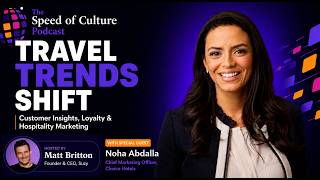
Noha Abdallah, CMO of Choice Hotels, discusses the company's 63-million-member loyalty program and how it uses Amazon partnerships and first-party data to personalize travel offers. She outlines five consumer trends reshaping 2024 travel: rising wages, remote work, reshoring, road trips, and retirement.
Chapters
Up today, I'm thrilled to be joined by Noha Abdallah, the CMO of Choice Hotels, which counts Radisson Comfort Suites and Quality Inn amongst many others as brands. Really excited to dive in amongst this really interesting landscape for consumer travel. Noha, thanks so much for joining today.
Thanks for having me.
Absolutely. We're gonna start by just learning a little bit about your background and the steps that you've taken to land you to the position that you're in today?
Great. So my background is in strategy consulting and marketing. I actually started my career in marketing after 9/11. So I was in strategy consulting when 9/11 happened. And as a result of the catastrophe that happened in our nation, my project was canceled. My office was shut down and I was laid off from my first job. But also as a result of that, the American Red Cross was suffering from a little bit of a PR crisis. People had come out to donate blood and unfortunately a lot of it wasn't used and was being shown thrown away on the news. And so they had a shortage of blood donation. And that's when I started my career in marketing. I joined the American Red Cross so I could create a national blood donor awareness campaign to raise the nation's kind of awareness about why there's an ongoing need for blood. And that's really where my marketing career started and where I really kind of started to understand the importance of customer insight, awareness, marketing, PR, and really where my love for marketing began.
It's really interesting because a lot of people younger in their careers, if they have, you know, a point where they stumble, they hit a roadblock like you did, and obviously it was due to external circumstances nonetheless. You know, they could really get discouraged. And I'm sure you were somewhat discouraged at the time, but, you know, like they say, when one door closes, another one opens. Talk to us about what you remember that experience of dealing with failure or obstacles early in your career and how you're able to persevere through it.
Yeah, absolutely. I think to your point, when you're in it, it's really hard to see the bright side on the other side. But kind of 20-plus years into my career, I can now kind of fondly look back at all of those challenging moments. And think about how I came out on the other side a little bit stronger. The other kind of anecdote I like to share, which is a little odd, is that I was an A student my entire career as a student, high school, college, MBA. I got my only B+ in my life in marketing. And so I don't know what that says, but I think it says that I persevered to prove to that professor that I was going to figure this out and I was going to do really well in it. So.
We'll make sure we set, we send your professor a copy of this podcast.
Exactly.
Exactly. Awesome. And then, and then you spent, um, 7 years at, uh, Discovery Communications, um, which oversees among other brands, uh, Animal Planet, which, um, is a property that I personally love. Uh, talk to us about your experience there in, in diving into the entertainment world.
Yeah, absolutely. So I leveraged my experience in the kind of healthcare marketing space from the American Red Cross to get a job at Discovery. On a channel that was called Discovery Health Channel. And since then it's evolved and I think became the Oprah Network. But while I was at Discovery, I really did start to kind of learn more classical marketing. I worked for a leader who had been trained kind of on the CPG side of marketing, and I worked for that leader for 7 years, both on Discovery Health and then on Animal Planet. And it was a really fun kind of creative environment to be in marketing and to learn marketing, everything from kind of project management to campaign development, media planning, social media started at the time. And so figuring that out, and I was lucky enough to be part of a rebrand project where we were tasked with taking Animal Planet from this like kind of background channel that people watched or just turned on for their cats. Um, or dogs during the day, um, to something that people would actually want to tune in for. Um, and so, uh, we did a lot of customer insight work, which I really enjoyed. Um, and what we found is that people enjoy watching animal programming when they can compare what's happening in animal life to what's happening in human life. And so we use that insight to really relaunch the network and, um, the programming, the marketing, the look and feel to be really more about dramatic storytelling versus kind of background programming. And that really made a difference in the performance of the network and the advertisers ultimately that we were able to attract to the network. So that was a really, I think, cool opportunity and project that helped me understand the value of customer insight, the value of branding, the role that marketing can play in product development and in influencing kind of the product or the programming in this case. And really a transformation of a brand and of the results.
That insight is so interesting and frankly exciting to me because I, you know, I'm sure you're familiar with Planet Earth, which is another amazing show that I think it's BBC. And I was so inspired after watching that, I actually started to write down kind of almost like a thesis for a book called The Nature of Business, which is basically trying to assimilate the way that animals act in the wild to how companies act in the business world, because the similarities are everywhere in terms of the way that animals act with each other and how humans act with each other, both socially and in business. And the fact that that was a core insight of the network is just fascinating to me. So I guess it's not just me that's seeing the power in that.
Yeah. And this was, you know, 12, 15 years ago. So definitely an insight that I think lasts, through time.
Yeah, 100%. So from there you jumped in the financial services world and had a great career and stint at Capital One where you would end up as Vice President of Digital Brand Strategy and Social Media. When you joined Capital One in 2011, it was really at the birth of like the social media era. Facebook had been around for quite some time, but it was until like 2010, 2011 where big brands like Capital One started to see platforms like Facebook and Twitter as something that was more of a mandate that they needed to jump on. And I know there's no shortage of regulations in the financial services industry that also created issues in, in you doing so maybe in the way that you, you might've wanted to. Talk to us about that journey at Capital One and what some of your core takeaways were from that experience.
Yeah, absolutely. So when I joined Capital One, I joined on the bank side of the house. So obviously the company has numerous, uh, lines of business, but at the time they were trying to expand the bank, um, to be a national bank. It was more of a regional bank, um, and, uh, during that time that I was there, the company bought ING Direct and integrated ING Direct, which was an online savings bank. And I helped with the rebrand and the relaunch of that into Capital One 360, which was the online checking platform. Um, While I was there, I was tapped on the shoulder to say, hey, you did a great job with this. Like kind of like as a consultant, come now start this other thing that we want to build, which is social media. And I said to them, me? Like, I don't really know anything about it. And they said, oh, don't worry, you're a smart marketer, you'll figure it out. My other concern with taking it on was really this, the fact that I had come from Animal Planet where there was a small person, I mean a small team, one person on my team who managed social media. But we had a lot of content at Animal Planet. Content was not a challenge. We had a lot of it. At Capital One, my question at the time was, why would anyone wanna follow their bank on Facebook? And that was a question we needed to answer because at the time, Capital One had bought a lot of followers through a partnership with a gaming company called Zynga, and there's a game called Farmville.
Everyone did it. Yeah. I mean, I was involved with the campaign with Bing where they kind of were the pioneers of that. A lot of companies had all these followers that weren't necessarily fans. They joined for the wrong reason. And it was a race to likes and followers back then. I remember it clearly.
That's right. We bought them and I inherited that page and I had to figure out what do we do? Do we fire followers? Do we start a new page? What is the reason for why someone would want content from Capital One and where am I gonna get the content from? And, and that was a really exciting, again, challenge in my career. And one in which I was able to really kind of chart new territory. Like nobody had really figured it out. My peers and my boss were kind of like, you know, this is, you know, open space, figure it out. And so the good news was Capital One had a lot of really strong advertising. And so the first kind of phase of building out the social media presence was around figuring out how to take some of the strong advertising work that was being done around the NCAA and the Venture Card, etc. And bringing that into social. And it really at the time was matched luggage. It was kind of very similar. And then we started to say, well, what if we did some more behind the scenes? And what if we did, you know, outtakes and things like that that were different from what was gonna be in the ad campaign? And that's how it, it started to build. I started it on behalf of the credit card side of the business, and then other lines of business came and said, we want this too. So small business bank came, small business credit card, auto loans, home loans, commercial. Everybody came and said, we want to build this too. And then we had to figure out how many pages does Capital One actually need in order to deliver on all these different business needs and how should we organize ourselves. And so that was again, another opportunity as a marketer to kind of influence the strategy of the company in the platform. It then grew into content marketing as well as digital product marketing and thinking about how do we take some of the innovations that Capital One had and market those to their customers.
Right. And obviously that, you know, you've been incredibly successful at your stint at Capital One. The company has continued to do well, really building a brand that has gotten itself into the cultural zeitgeist. I think they've done a great job at piecing it all together for sure. And what's interesting to me is then you made the leap from the financial services space to Hilton, where you had a short stint before finally settling in at Choice Hotels, which we're going to dive deep into, but before we do so, what's behind your decision? Obviously you're, you're, you're going up the ladder pretty fast at Capital One. The company's doing well. What precipitates the decision for you to say, you know what, it's time for something new. I, I'm gonna join Hilton. Was that a tough decision to make? And how would you, I guess, give advice to other people who maybe have to make a decision like that in their career when they're at a bit of a crossroads?
Yeah, I mean, I think it's, it ends up being a personal decision, but for me personally, I get up in the morning and get really excited about my job when there's something new to figure out. There's a new challenge, there's a new opportunity, there's something I can build. And the moment that the job starts to get a little bit more mundane of like, this is the 7th season of this, I'm going to market on Animal Planet, or, you know, I'm going to build another social media strategy for another line of business. Like, if it's, if it's more kind of wrote, then I'm not as excited. And so for me also as a marketer, what I've learned is that by changing industries, I also learned something new about a new channel or two or three that may not have been part of a previous industry or previous company. So as I got a lot of experience, for example, in TV marketing when I was at Discovery, when I went to Capital One, I got experience with retail marketing in our bank branches. I got experience with direct mail, which we didn't do when I was at Animal Planet. And so I think every time you make a switch like that, if there's an opportunity to learn something new, to tackle a new challenge, it's great. In the case of Hilton, um, I, uh, was approached by a former colleague of mine, a former boss of mine, um, who used to work with me at Capital One. And she said, come over here and build social media for Hilton the way you did it for Capital One. And I said, thanks. Um, but I've already done that, right? And as a marketer, I don't want to be kind of branded as the social media person. I want to go broader. I want to do other things than just social media. And she said, you know what, come over here, teach us how to do this, set it up globally. That will be kind of the new thing in a new industry, which is a whole different ballgame, right? And then you can kind of pick your head up after a couple of years and pick something else. And so for me, again, I was looking for what can I do that's new and different that's going to challenge me. It was the opportunity to do something on a global scale, and it was the opportunity to learn a new industry that frankly I was really passionate about, hospitality, that drove me there, as well as an opportunity to work for somebody who I had a lot of respect for. So that was the decision there.
That's great. And then you would eventually end up in your current role as Chief Marketing Officer at Choice Hotels. You know, what excited you about this opportunity? And tell us, I guess, what are some of your big priorities here in 2024 that you're focused on overseeing their portfolio of brands?
Yeah, absolutely. So the opportunity to join Choice Hotels was one that I jumped at, right? As when I, as I talked to the CEO and the board and understood kind of the transformation that Choice Hotels was looking to make, it got me really excited. So first and foremost, the company is a company that's been around for 80 years. It's a company that's really been focused on franchisees and hospitality and technology. An area that they wanted to kind of really build and grow was kind of the focus on the guest, right? So how can we take a company that's really good at franchising and make us really good at guest strategy, loyalty, and experiences? And that for me was something that I'm really passionate about, as I talked about, as in all of my jobs, I've really focused on the customer insight and how can we use that to really drive the company to a new place. So the opportunity to help with that was really great. The other thing was that Choice Hotels has been kind of known for hotels in the mid-scale and economy space, but over time had diversified into upscale and extended stay and were at the time purchasing Radisson Hotels Americas, which was really an opportunity to grow the upscale business on behalf of the company. And so figuring out how do you not only integrate a set of really well-known brands, but how do you then come out on the other side and have, um, this, the company stand for kind of this broader portfolio again was another opportunity for me, um, to think differently about how to take the brand, um, to a new level. And so, um, those two things alone I think were really exciting, um, and were what ultimately drove my decision to join Choice.
Yeah. And when you look at economy, extended stay, and then upscale, those are very much 3 different types of, I guess, buyers. And there's probably different insights that drive purchasing, but at the same time, you probably want to have a unified strategy, unified loyalty system, et cetera. So is that challenging to balance? Because many brands, if you work for, you know, Mercedes-Benz, you don't really have that challenge. But that's a unique challenge, I would think, as a CMO.
It is, but it's also a great opportunity because as we've learned through a lot of customer research and even just kind of knowing yourself and, and the occasions that you travel, there's different versions of you, right? So there's the version of you that goes on a guys trip. There's a version of you that goes on, you know, a family, um, uh, vacation.
There's a version of you that goes to the family reunion or a work trip, right?
Right? A business trip, right? And so for all those different occasions, you might, you're gonna need to be in a different place and you're gonna probably need a different type of hotel. And so I think what Choice uniquely offers is 22 brands all over the country and the world. And we undoubtedly have something that's in the right place, the right price point for you, depending on kind of what you're looking for and what that trip occasion is.
Absolutely. We'll be right back with the Speed of Culture after a few words from our sponsors. When you zoom out more broadly and you look at the travel and hospitality space post-pandemic, you know, a lot has been written recently of the revenge travel and the travel boom and coming outta the holiday season, you definitely saw it. You saw hotels packed, you saw airlines full, lines everywhere. What are some of the trends that you have your eye on relative to the consumer and the travel space in 2024?
Yeah, I mean, I think what we've learned as an industry is that people took for granted the opportunity that they had pre-COVID to travel, right? And they really didn't want to lose that opportunity again. And so while there may be kind of economic challenges and inflation and things that are making it a little bit tougher, it's one area that, that consumers aren't really willing to give up. And so they're thinking creatively about how can I still make the trip, but do so in a more kind of economical way? How can I make a smarter decision about how I'm going to get there, where I'm going to stay? And the good news is that is a great place for Choice to play because we have hotels at every price point. And so if you are looking to kind of still make that trip, but just do it in a little bit more of an economical way, we probably have a hotel for you.
Yeah, for sure. Another big change we've seen in the advertising and marketing industry is the, the crumbling of the cookie, so to speak, and the really power of first-party data. And I would imagine given your portfolio of brands and the fact that you serve the consumer direct, that your ability to aggregate first-party data creates a real advantage for you in terms of delivering contextual content for the consumer. Can you talk to us a little bit about your thinking and maybe some of your work in that area?
Yeah, I think this change in the industry, if you will, is going to be an opportunity for brands to drive an even deeper direct relationship with our consumers or our guests. We have a loyalty program, Choice Privileges, that has over 63 million members. And our opportunity is to use the data that we have about them in conjunction with other data to get to know who they are, what their passions, interests, likes are, to try to see the signals of when they might be in the market for travel and leveraging that relationship that we have with them in order to make a suggestion, a recommendation, an offer that's going to meet their needs. We have been working very closely with partner Amazon to help with customer identity, right? So when you come to our website, for example, or we see you on a, you know, a digital platform, how do we put together the right pieces of information to identify who you might be and to put in front of you the right offer? And so that's an area of focus for us. But, but to your point, I think this direct relationship and loyalty that you can build with your customer base is going to be really critical in the, in the future.
Yeah. When you talk about a profile of the consumer and you were talking earlier about, about the different versions of you, you know, it's kind of a marketer's dream to have both a portfolio of brands that could kind of match up to the different versions of you and then have the first-party data that the context to deliver that. I mean, it's pretty, it's pretty cool opportunity, I would think, and unique for sure.
That's right. On our website, we have proprietary technology that we use, for example, that takes thousands of data points to make a decision about how, for example, to order the hotels when you do a search based on what we know about you and, and a number of other factors to see, to, to increase the likelihood that we're gonna present you with a hotel that you'd be, be likely to, to, to book at.
Absolutely. And just, you know, as I hear you talk about this technology you're deploying and I look at your background, I mean, when you started, you know, in your career, much like myself in 2001, 2000, there was no Facebook, there was no YouTube, there was no Snapchat, there was no iPhone, right? And now we live in a world of big data and AI, and it's so much more sophisticated. And you've been through all these tectonic shifts in the marketplace over the last 20+ years. How have you been able to keep your finger on the pulse of the industry, these technological advancements to make sure that you remain relevant as a professional so you could continue to lead it within your field?
Yeah, absolutely. I mean, again, it's an area of kind of passion and interest of mine. And so not only has it been helpful in my career to work at different companies that are at different stages of this technological evolution and kind of bringing that along in each place that I've been. But also, I look for opportunities to connect with peers, former colleagues and bosses to kind of share best practices and insights. I join industry groups, whether it be within hospitality right now or also just more globally, marketing kind of leadership groups that allow me to continue to kind of push my thinking and make sure that we're not kind of getting stale in how we're approaching things. And so, lots of reading online, lots of podcasts and things like that, but also going to these industry events and making sure that I'm leveraging the network that I've built over 20+ years to ask questions. How are you challenging? How are you attacking this challenge? How are you dealing with this? And I do think looking across industries is often really helpful because probably within your industry, the companies are probably doing things pretty similar. It's when you kind of look outside of industry that you can say, you know what, there might be an opportunity for us to think very differently.
Absolutely. I also saw that in doing my research that you are a global board member at MMA Global. So being involved in those big industry, um, consortiums, et cetera, also allows you to get touchpoints, I would imagine, with people across a variety of industries.
Yeah, the, the Global MMA Board, um, is a great opportunity. I think, uh, what it allows us to do is, um, get in a room and talk about what are some of the similar kind of challenges and opportunities that we're facing and how has one company started to solve it. How do we partner together to kind of think differently and potentially, you know, come up with a solution that multiple companies could use? And so again, it's a really good place to kind of workshop, if you will, AI. How do we handle AI, you know, personalization, like all of the kind of buzzwords, but in reality they're all part of what we need to do as marketers today. And so that's been super helpful.
Absolutely. And going back to the travel industry as well and, and some of the trends, I noticed that you and your organization talks about the 5 Rs as kind of 5 key consumer trends that are really shifting the face of the travel and hospitality industry. I'd love you, if you don't mind, for our audience to kind of go over what those 5 Rs are and why they matter to your organization.
Yeah, that's right. Thanks for bringing that up. So we at Choice Hotels have identified these 5 long-term trends that are really impacting our business and that we think Choice Hotels is well positioned to take advantage of. So the first one is around rising wages. We know that the average American's wage has increased by over 6% since 2020. That means there's kind of more money in their pocket to spend. Now, obviously there's inflation and whatnot that comes with that, But, but coupled with that, many, many surveys have shown that Americans want to continue to travel. They're just going to figure out how to do it in a little bit more of an economical way. So rising wages, I think, is an opportunity for choice because it means that people have a little bit more money to spend and we know that they've prioritized travel. The second thing is around remote work. And so we all know that with COVID it brought this kind of new appreciation and ability for people to work from anywhere. And so we've seen that in our data. We've seen that people tend to now check in on Sunday or they stay through Friday or Saturday. They don't check out on Thursdays. And so there's this blend that happens between the workweek and the leisure. And Choice again is well positioned to take advantage of that. The reshoring and rebuilding of America. So more and more of manufacturing is happening in America. And when that happens, the— there is more investment in construction of, for example, these factories, roads. And a lot of those workers who are involved in those projects stay at Choice Hotels given where some of— where we're located. And so again, that's another trend that we think we're well positioned for. And then you've got road trips. So nothing like COVID to kind of really make people think about how they're going to get from A to B. And a lot of people jumped in their cars and we have over 4,000 hotels that are within 1 mile of an interstate. That's kind of one of the, you know, key benefits of where we're located. And so with this kind of increased trend in people going on road trips, we've seen an increase in bookings for our roadside hotels. Then there's retirement. So more and more people are becoming of retirement age every year. And those people have money and they have time and they wanna stay at hotels. And so again, that's a really important trend that we are well positioned for. So those are the 5 Rs. And again, they continue to, you know, ebb and flow a little bit in terms of the metrics and how they show up. But we were early in kind of identifying that these things were happening and we've been continuing to refine our strategy to make sure that we can continue to take advantage of them.
I love that. Some of them are super unique, those insights and ones that I would think that provide you with an advantage that you've dug into them. You've seen these new markets emerging and then I would imagine that drives your messaging and your targeting and all those things you could take advantage of, of growth opportunities and Speaking of messaging, I know that Choice Hotels has a new campaign actually coming out on January 8th, which is, I believe, your first campaign since completing your integration with Radisson. So really excited to hear about what you're doing and why it's important to the company.
Yeah, absolutely. So we have a campaign launching on January 8th that we're super excited about. It will feature Keegan-Michael Key. Who we selected as our spokesperson based on the fact that he's got this really kind of approachable, charismatic nature. He's also got a really great sense of humor and has often played the role of many different people. So the customer insight that we built this campaign off of is that there's very— there's a lot of different versions of you and different reasons that you might travel. And Choice Hotels has a hotel brand for you no matter what occasion you have. So the campaign's launching, I think, at a perfect time. It's post kind of holiday hangovers. People are looking for where am I going to kind of plan my next trip for? And so it allows us to kind of be top of mind and potentially that kind of go-to place, ChoiceHotels.com, that people want to check out first as they're planning their next trip.
Very cool. Very great way to kick off the year with big new messaging campaign. I'm sure it's really exciting to the company to get that across the finish line.
Yeah, we're, we're really excited about it. I think it gives us an opportunity to showcase the new brands that have joined Choice as part of the Radisson integration. So in the campaign, we highlight 4 of our 22 brands. We highlight Radisson and Cambria, 2 of our upscale brands. As well as comfort and quality to our mid-scale brands.
Awesome. Well, we'll definitely be looking out for that for sure. So shifting gears to you as we wrap up here, Noah, you've obviously had a really exciting career, worked for some prestigious, well-known brands, not just worked for them, but led them. What would you tell 20-year-old Noah when you were first starting out that maybe you wish you knew based upon what you've learned throughout your career? Which maybe some of our younger listeners can take who are at the beginning of their career journeys and hope to end up in the CMO seat themselves one day.
Yeah. So I think to the 20-year-old marketer that's starting off, my piece of advice would be to try as many different things as possible, right? You're not going to know what you like, what you don't like until you try it. And so whether it's raising your hand to take on a new project or try a new channel or try a new role, even kind of trying different companies. Like, I do think that there's a lot to learn earlier in your career about what you think you might like versus what you actually like. And so before I started to really focus on marketing as a career, I had had internships in finance, in international affairs, in law. Right? I tried a whole bunch of things before I landed on marketing. And then in marketing, I also tried a variety of roles and brands to really get to a place where I started to understand this is what gets me excited and what I'm looking for in my next step.
I love that. And, you know, is there a, with that, is there a mantra that you kind of like to live by if you had to pick one for your career that maybe has stuck with you throughout your career that gets you going every day? Does anything come to mind?
Yeah, I, I, I got, um, some advice early on that I've kind of stuck with and, and given to others, which is when you're at kind of a crossroads, um, in your career and you're trying to decide, should I go left or should I go right? Oftentimes there's not a right and wrong answer. It's just a different path. Um, and you're gonna learn and, uh, grow from whichever path you take. Um, so I think once you kind of realize that it's not that big of a deal what decision you make. It can be a little easier to just go ahead and make that decision and you learn from it and you grow from it.
Yeah, it's liberating in some sense, right?
Yeah, for sure.
Absolutely. Well, I wanna thank you for joining today. I have no doubt that you're gonna see nothing but continued success here in 2024, and we'll be looking out for your campaign that's launching with Choice Hotels in the weeks ahead. So thanks again, and we'll definitely be in touch on behalf of Susie and every team. Thanks again to Noha Abdallah, the CMO of Choice Hotels, for joining us today. Be sure to subscribe, rate, and review the Speed of Culture podcast on your favorite podcast platform. Till next time, see you soon, everyone.
Hey!
More from Matt




MikMak’s Rachel Tipograph on Consumer Spending, Retail Media & Holiday Shopping Trends



Jaguar Land Rover’s Charlotte Blank on Luxury, Purpose & Experiential Storytelling



