Claire’s Kristin Patrick on Gen Zalpha, Loyalty & Phygital Retail
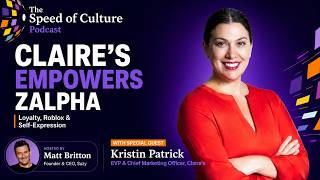
In this Speed of Culture podcast episode, host Matt Britton interviews Kristin Patrick, EVP and Chief Marketing Officer of Claire’s (referred to as Klairs in the transcript). Patrick shares her unconventional career path—from Disney’s storytelling and brand‑building roots through roles at Pepsi, Revlon, Gap, NBCUniversal, and other fashion and beauty brands—highlighting how her eclectic experience shaped a mindset focused on cultural relevance, CRM, and content creation. She discusses the motivations behind taking the Claire’s turnaround in 2021, describing the brand’s post‑bankruptcy challenges and the untapped equity she identified through consumer research. Patrick defines “Gen Z Alpha,” a combined cohort of Gen Z (13‑24) and Generation Alpha (under 13), emphasizing their fluid digital‑physical identity, entrepreneurial spirit, and desire for self‑expression. She explains how this insight drives the “Be the Most” brand platform, which empowers consumers to be their most authentic selves. The conversation covers Claire’s phygital strategy: expanding beyond owned stores into partner retailers (Macy’s, Walmart), strengthening e‑commerce, leveraging TikTok, Roblox (Shimmerville), and upcoming character merchandise. Patrick details the 16 million‑member loyalty program as a first‑party data engine, its role in content creation, and the integration of creator‑economy tactics such as a college‑intern TikTok program. She also touches on gaming partnerships, social commerce (“Instagram brands”), AI‑driven creative experiments (AI‑generated store visualizations), and the potential for a retail‑media network. Throughout, she reflects on personal leadership principles—trusting her gut, curiosity, networking without burning bridges, and balancing internal commercial duties with external cultural scouting—providing advice for emerging marketers.
Chapters
Up today, we're going to be speaking with Kristin Patrick, EVP and Chief Marketing Officer at Klairs. Kristin was recently named in 2023 as one of Forbes' Top 50 Most Entrepreneurial CMOs. Kristin, so great to see you. Welcome to the Speed of Culture podcast.
Oh, thanks so much for having me. I'm happy to be here.
I'm thrilled to have you, um, on today. I've been following you for a while, and I'd love to kind of start by just diving into your background. The first thing that stood out to me is, you know, your initial career steps were at Disney, which I imagine contributed a ton to your professional growth. What were some of the lessons you took away from that experience so early in your career?
I learned so much from Disney. You know, I was at the company during a really, really special time, and I learned everything about building a piece of intellectual property and a brand and then extending it out into different businesses and using content and storytelling as a force in marketing. And, you know, I was a bit, I would say, of an oddity in terms of marketing executive. You know, I think that there's a pedigree in terms of learning about marketing. And a lot of, I think, great marketers come from the Unilevers and the Pepsis of the world and the P&Gs and the J&Js. That was not me. I came up through, you know, the entertainment industry and Disney, and it was just a very different, you know, mindset. And lucky enough for me, like now I think that there's two things going on. And one is that, you know, brands have had to become publishers of content to keep up with all of the social needs going on. But also, you know, I think storytelling has become more important than ever. So that was always like at my root and my core.
Yeah. And there's no better storyteller than Disney. Yeah. So I think learning that in the early— you're right. And it was sort of, you know, ahead of its time in so many ways being in a company like Disney, because back then when you were at Disney, it was still, you know, the mid-'90s. There was no social media, there was no YouTube. If brands want to build their brand, they would just have to write a check and advertise during, you know, an episode of Friends and they'd be able to build their brand. And as we all know, that's no longer an option, and you really need to be able to connect with your consumers through content. Um, and on top of, you know, that exposure to Disney, you know, you have worked at so many great brands, you know, diverse experiences across fashion, entertainment, uh, beauty, even CPG. Do you think, you know, your ability to touch so many different industries has also made you kind of more well-rounded as a marketer? Because one thing we also see in interviewing so many CMOs is that to your point, often they have a linear path. They're at CPG or food and beverage all the way across. You're quite unique in that you have a very eclectic background, and I just want to know how you think that may have shaped you.
I think that it has made me incredibly open to and responsive to change, and I take learnings from every single company that I've been at. You know, like, I think certain industries are really, really good at certain things. Like, I think the D2C companies and the fashion companies that I've worked at where they have their own credit cards, they're amazing at CRM. And I think some of the entertainment industry positions that I've held are, listen, they're amazing at creating cultural relevancy and really sort of tapping into the consumer zeitgeist. And so it's like you combine all of that together and it is actually, you know, I feel lucky to have had that experience. But I'll tell you, Matt, it's not been always easy for me because I am, right? I'm like an odd bird a little bit. I think that oftentimes when you're trying to fit in the perfect position where you've got the general management skills and the operational skills, and that came later for me. So it hasn't been this like super easy road because I am a little bit of an enigma.
Yeah. How did you know when it was time for you to leave one position and go to the next? Because, you know, at any one of these positions that you were at throughout your career, you know, whether it be Revlon or NBCUniversal or Gap, they could have been sort of your lifelong career. Many people have stayed there for their entire career. But you, it seems like you've also often taken an opportunity to say, you know what, I've done what I can here. It's time for the next leap. What gave you the courage to do that and how did you have the intuition to know where to go next?
Oh gosh, I wish I could tell you that I was super calculated about the whole thing. You know, I think it's funny because I watch— I've been watching lately people who manage their careers really well, and it feels like it's always good to leave when you're at the top of your game and kind of move on to your next thing. I wasn't that calculated, to be honest with you. I think life circumstances in terms of family. And, you know, I've been lucky enough to have people from my past sort of pluck me up and take me to the next opportunity. You know, case in point, the woman who mentored me at Calvin Klein asked me to come to Revlon. She left the company. You know, I was asked by somebody from my past at Disney to come to Gap. And so it sort of went like that. So I think that's a good lesson for lots of, you know, people starting off in their career, like never burn bridges. Like totally never burn bridges because I think people show up again and a good reputation. And, you know, I think that goes a really long way.
I couldn't agree more. I think so many people make the mistake of focusing on those who can help them the most in the moment. So, you know, you want a promotion, you want a new customer, you know, you want a new job. So you just focus on those people who can help you. And there's all these other people who might not be in the position at that time, but how about 2, 3, 5 years from now? And it seems like you, you've really focused on the power of a network where people remember you're keeping in touch. Is that hard to do in terms of balancing the future and the things that are maybe important but not urgent as you're going through the urgent tasks of everyday life?
You know, it, it's funny because I'm notoriously an introverted extrovert, right? So what does that mean? I, you know, I— it's like I have these very public-facing jobs and I really have to like be on top of culture, but I notoriously am really introverted. So the relationships that I develop, I nurture. I really do. Like, there's, you know, a handful of people that I'm very close to, and they mean the world to me, and I, I take them with me from company to company oftentimes. Or there are people who, you know, I'll seek their opinions in terms of career moves. And, um, so, so I definitely nurture, I would say. But, you know, I'm not out there like working the system. Like, it's not right who I am.
You're not a career networker, right? Yeah. Well, it seems like—
yeah, I wish I was, but it's just—
it's— well, I think there's, there's— yeah, there's drawbacks to that too, right? If, you know, because sometimes that, that could make your relationships quite transactional. Yeah. So if you're building the relationships on the back of great work and great shared experiences, I think that's where you create the strong connections, which will lead people to want call you and bring you along for their ride and open up new opportunities for you along the way.
Yeah, I think that's true. And I think, like I say, you know, this idea of like leaving a company and scorching earth and like, you just— if I had to give anybody advice around that, I just, you know, including my own daughter, it's like always like handle yourself with grace.
Yeah, incredibly important. So in 2013, Kristen, you were named the first global CMO of Pepsi, which I remember when you were appointed that role because I've worked with Pepsi throughout throughout my career. What did that mean for you? And did you look at that as sort of like a kind of watershed moment for your career, getting into the CMO seat at such a prolific global brand?
It's interesting because, um, I did. I was like, you know, this is, this is like the apex of, you know, marketing careers, and this is like the best and most important thing I could ever, ever do. And, you know, I think a lot of people, when they leave those companies, they go on to do great things. And like, I feel like it's just beginning for me, you know. I, um, while there was amazing things we were able to do, you're able to do at a company like that because of its global reach and its budgets. I think sometimes the positions where you're instituting like real sort of change and impact and it's, and it's, you know, completely dependent on your shoulders. Like there's beauty in those roles too. Yeah. You know, like, I never thought that there would be this much interest in the turnaround of Claire's, to be honest with you.
Let's get into that. Yeah, for sure. So why, why were you interested in Claire's, and why are you interested after all the kind of prominent roles you had? You joined Claire's in 2021. What attracted you, uh, to the opportunity as CMO of Claire's?
I am a person who loves, um, you know, to be in the midst of either a turnaround or a company that is going to be experiencing explosive growth. Like, you know, I I took the job at Pepsi when sugar was becoming the next tobacco. And I took the job when they really needed to move from media that was really based on television advertising and into more digital prominence. And if I look back at my career trajectory, it was that type of situation in every role that I've held. So this Claire's thing came up and, you know, it is a 60-year-old brand. It's a global brand. For many, many years, they owned a fleet of retail stores, a very successful fleet of retail stores. But I really saw the opportunity to connect with the generation in a new way. And I am, you know, as the mother of a Gen Zer, I am really interested in, you know, future generations and the impact that they can make. And so, so that's what interested me about this brand. It was sort of twofold. It was one, it is a It is a turnaround. And I think this is one of like the coolest generations that we've had in a long time.
So what do you think led to Claire's needing to be turned around? Like what happened in the marketplace that created some headwinds for Claire's where maybe they had a little bit of a dip which precipitated that need?
Yeah. So Claire's was taken out of bankruptcy about, you know, 3.5, 4 years ago and a new leadership team was put in place. And I think that in retail specifically, you sort of market according to traffic and signage, and it was kind of an antiquated model. So really, I started off the journey by talking to consumers, and what they said was, listen, we love Claire's brand and we actually want more from you. And when I really dug into it and started talking to, you know, millennial moms and Gen Gen Z, and then the generation after that, Gen Alpha, um, there was this real love for the brand. And oftentimes in retail, you focus on your doors and driving traffic, but because of my background, I understood that there was like a tremendous amount of equity that, you know, it could be sort of unleashed, um, on this business. And that was kind of the place I started, like, what does the Claire's brand mean? And then based on my Disney experience, like, where are all of the places that you can take it and where will the consumer let you go?
So, you know, based upon where you think you can take it, what are some of the things you have your eye on here in 2023 in terms of how the consumers evolved and the Claire's brand to allow you to take advantage of more growth opportunities?
Yeah, so, uh, you know, it sort of begins and ends with the consumer and what they want and need. Like, you know, where are they shopping? So wherever they're shopping, we're going to be there. Um, and that, that means obviously our owned and operated stores, but, you know, I'm really thinking about the digital ecosystem. And while we have claires.com, it's like they're shopping in their organic social platforms, um, they're shopping on TikTok. And so it's like, how are you there and ready to, um, you know, service them in, in those different locations? We took the brand out of our owned and operated stores, and, you know, we're being sold in everywhere from Macy's to Walmart, Gallery Lafayette in Europe. And so, so we're also sort of expanding the footprint there. One of the things that consumers told us is like, we want more from the brand and, you know, we want more from a content and information perspective from you guys. Like, you can, you can tell us definitely about style, but also like we see you guys as a leader in terms of like the voice of the generation. So that's another territory that you'll start to see coming up from us. And then they also talked about other product categories that they want to see from us. So they, they talked about, you know, the need to have apparel to go along with the accessories. And, you know, to decorate their dorms and their bedrooms. And so those are just some of the, you know, new business segments that we'll be venturing into.
That's interesting. I honestly had no idea until I prepared for today's interview that Claire's was sold and their brand was sold in other locations outside of Claire's, which is interesting. My perception of the Claire's brand, having a teenage daughter myself, was it's the place you take your young daughters to get them ears pierced.
Yeah.
And I'm sure that's something you've heard a million times before. Is that a good thing? Or is that something that you've worked hard to try to, I guess, diversify away from as the business continues to evolve?
Oh my God, it's a great thing. Like, first of all, I think that, you know, your first ear piercing is such a rite of passage. Like, you remember it. And everywhere that I go, it's like, you know, I'll speak to a 45-year-old man or woman. They'll be like, oh my God, I got my first piercing there. So I think that there's sort of a nostalgia and you know, something, something that stays dear to your heart about the brand. And I think that that's a really cool place for a brand to be sitting in consumers' lives.
Absolutely. It creates a trust and a place in people's hearts that other brands can't easily occupy. Yeah. And the big question is, how do you parlay that into something bigger, which it sounds like you're trying to do? And the generation now that you're going after, you know, it's not the 45-year-old, though maybe they're shopping for one of their children, but You guys have coined it Gen Z Alpha. Yeah. Which I thought was very cool. So what is Gen Z Alpha and why is that core target different and how is that maybe driving some of your current marketing strategies?
So Gen, you'll see Gen Z Alpha is a combination of two generations. It's Gen Z and then Gen, Generation Alpha. And you'll see a lot of different perspectives in terms of the age range that they both sort of occupy. For us, you know, we consider Gen Z to be 13 to 24-year-olds. Year olds, and then 13 and under are the Alphas. And I mean, they are such a potent generation, um, in, in the best ways. They are highly, highly creative, uh, very entrepreneurial. They live— they think in a very fluid manner, both from a, um, their view of the world in terms of the merging of the physical and the digital, which is one reason that we actually went into the metaverse with our Shimmerville game, because it's like the connection connection and fusion of those are almost seamless to this generation. And then they also, like, they really care about the world, and they care about humanity, and they care about the Earth. And, you know, they, they really want to be changemakers. And I think that that is something that, um, is really important. This is also a generation that, um, never lived in a world without Alexa. Or touchscreens, you know. So, um, so, so that, that fusion between the digital and the physical, that digital world is really, really important. And so it's like, how do you take the best of this 60-year-old brand and, um, find the connection point between this generation and next generations? And, you know, there's— I think that we're lucky in— two things happened when I I sort of took over the helm, it was the fact that like there was another rejuvenation of the '90s and '90s design and styles. And Claire's was so, so important and prevalent in that, I would say. And then, you know, there's something very human about what Claire's has stood for over the years. And that is about self-expression. I think that everybody around the world wants to sort of be their true, be their own sort of individual and person. So I think that that is a very rich territory that resonates with this generation right now. And I think, you know, generations to come.
And I imagine that's what inspired your Be the Most brand platform.
Yeah.
To be your best self and self-expression. I guess talk to us about how that's coming to life and the manifestation of what you're seeing.
Yeah, it's really interesting because the idea of, you know, it's really about giving the brands to the consumer and letting them leverage our platform. And you'll start to see like more content and social programs coming up around that idea. It's turning the, I would say, the microphone or the megaphone over to our consumer base. Yeah. And I think that that is a really powerful position for Klairs to be able to sit with their consumers. But this idea be the most. You know, when we talked to consumers, they told us that they could walk into Claire's and sort of be anything that they wanted to be. You know, you could have purple hair one day, wear polka dots the next. It's like, whatever it is, have at it. Like, we should be sort of the base to give them that and not form judgment or, you know, tell them that what they're doing is bad or wrong. So, you know, it's kind of like, be the most intelligent, the most versatile, the most creative, but whatever it is, like, just be the most you. And that really resonated with, um, consumers.
I'm sure. I mean, it's interesting as I hear you talk because you talk about generations, you talk about Gen Alpha. Just kind of to oversimplify it, Millennials were really the first generation to grow up with the internet in the household, right? Then you had Gen Z, they were the first generation that grew up with the mobile phone in the household. And I would say Gen Alpha, they continue in that thread, is really the first generation to grow up really with a megaphone in the household. Because now when you talk about the creator economy and all these tools available, you know, they feel not just the ability to consume any type of content at any time, but also create. And they feel empowered, whether they have 10 followers or 10 million followers. There's so many tools out there, whether it be Canva or TikTok or any of these tools that allow them to express themselves. That really is a big shift. And I know you guys are really leaning heavily also into the creator economy and working with influencers. How does that sort of all tie together?
So incredibly important. You know, I don't presume to always know the right direction, right? Like, I really do listen to what consumers are saying. We actually started a college intern program and they're helping us create content. And I have to tell you that that has been one of the most valuable programs for Claire's. And I think, I think the kids that are involved in it too, but One of the best performing TikToks that we had was done by a student. And, you know, they really guided us and led the way in terms of how we should be thinking about the channel. And, you know, Lord knows, like, we've had the best agencies working with us as well. But, you know, there's something about the, I think, authenticity of that, that voice and, you know, and tapping into that, that's been really, really valuable for us. So we've got constant feedback loops going on all the time with consumers. And, you know, one of the things that's cool about working in retail is you've got your own lab in a sense. We have, you know, 2,800 doors around the world. And so we firsthand are hearing how consumers are feeling. And of course, you get that through your social feeds. But there's something really special about having, you know, your own doors that you control.
Absolutely. And on top of that, I read that you had 16 million loyalty members as well. So I know in this world, first-party data is everything. And the other thing having your own retail channel has— gives you the ability to do is collect that first-party data and build kind of loyalty programs and mine that data to gain deeper insights. So how have you leaned in and leveraged that loyalty program? Because that's definitely unique, even relative to, you know, the diverse career and experiences you've had prior.
Oh my gosh, the loyalty program is sort of everything. Like, there's 16 million captive eyeballs. So we are constantly talking to them, you know, both from a like, where do you see the brand going to, you know, they get special offers and discounts and of course they do. But it's, it's just such a valuable tool. And, you know, over time, as we start to get into content, like having 16 million eyeballs at your disposal is so incredibly valuable. And I think that there's, you know, there were— there's so much data that we've even yet to tap into with that audience. Our program is still fairly new, Matt. So, you know, it's about 2 years old. And over the 2 years, we've, you know, really collected a ton of information. And, you know, we really use it, I would say, to the benefit of the consumer.
Yeah, I mean, it's unique because you have partnerships with companies like Walmart and Macy's. So you have that wide-scale distribution, but you also have your own doors that you've spoken about. And I would think connecting the two gives you really a huge opportunity to create some type of retail media network like you've seen other, uh, you know, merchants and manufacturers create to really allow you to work with your merchant partners to allow them to reach your audience anywhere. Is that something that you guys have given thought to?
I would— I wouldn't say it's a media network necessarily, but the idea of content creation Claires and a distribution channel using our socials and, you know, streaming. I think that's really interesting to us.
Yeah.
And something that you'll start to see us, to see us doing and obviously using those 16 million eyeballs will be really important. But you know what is interesting, like we are experts right now in the Zalfas. And so I think that that's really valuable to some of our retail partners. And so, you know, the ability to watch trends, you know, we can see what they're buying, what brands they're interested in. They tell us, um, and, you know, something really interesting that came up a while ago was, uh, we were talking to them and we were, you know, trying to understand, like, where are you shopping, what are you interested in? And they kept saying, like, they're interested in Instagram brands. And I was like, what, what the heck are Instagram brands? And really what they meant was the idea of shopping within your social platforms. And it seems just completely organic. Social commerce. It seems organic to them. Like sometimes they'll watch, you know, it almost like a mini infomercial. They'll click to buy, particularly around cosmetic brands, and they're just— they're not even looking at the brand. So I thought that that was really interesting in terms of, you know, how they're thinking about brands and buying. And so, so I think that all of that information is really useful. I would say the other thing the company's been really good at is picking pop culture trends over the years. And, you know, I think that that comes from studying the generations, really understanding, you know, where the zeitgeist is going. But all of the information that we collect from loyalty and also the feedback loops is valuable in making those decisions.
Anything come to mind in terms of pop culture trend that's really taken off for you guys, either currently or in the past?
Listen, we always watch like lifestyle verticals, I like to call them. Right. And so by lifestyle verticals, I mean I mean, obviously teens are always interested in music. Gaming has been really, really good for us. We were watching, we did a partnership with Avmount. Of course we put ourselves into Roblox. So we've been doing a lot of connections with Roblox gamers and anything related to that is really big for us right now.
Absolutely. No, I mean, gaming is huge and a lot of people have the misperception that, it's predominantly male, but it's a very fast-growing vertical for the female generation.
Yeah, for sure.
Especially Gen Alpha target. Cool, so to kind of shift gears a little bit, what are you seeing with the consumer? You know, 'cause obviously being in your category, it's been such a slingshot in terms of COVID and people not going out. And now the experience economy's ramping up. You have this crazy Taylor Swift tour that's going on this summer, which I'm sure a lot of your customers are going to. What are some of the major trends you see looking forward here in 2023 and beyond in the spaces that you play in?
I think that so there's— I think that there's like things that consumers are interested in. And I think there's some of the things that we talked about. It's the merging of the physical and the digital and how brands are tapping into the digital connection. Right. So, you know, our loyalty program will be connected to our Roblox game. And how are you sort of merging and collecting?
Very cool.
And then later on, we're going to have We're actually going to be creating and selling characters from the game in our stores. So that's something that will be, that'll be coming out. And I think that gaming as a platform for us is going to continue to be important. I'm really interested in AI from a creative perspective as a brand. Now, I think that, you know, consumers are starting to just get into it. I know that there's been a lot of negative commentary about it, but there's something you know, when you are sort of about self-expression, I think that there's something really interesting for us in how we're, how we're sort of showing that world and getting into it and we're treading lightly. But I don't think that, that we can ignore it. You know, I don't think we have the comfort of not being a first mover in new technology because I think that the generations that we sell to demand it.
You know, yeah, they're going to be there no matter what.
100%. When it was the millennials, it's like you kind of had to track them. And now, you know, these next two generations, I think, are, are sort of guiding us and pushing us.
Yeah. I mean, it's crazy. I read articles how, you know, some schools are being pushed to ban ChatGPT, which I just don't think makes sense because tools like that are not going away. Yeah. And, you know, as somebody who runs a software company, I can tell you that we're mandating our employees understand how to own and operate these tools. So if you are a future employee and you're going to be left in the dark, then you're just becoming disadvantaged. So I think having this education system be too romantic to where we were is not going to be in the best interest of the future. But obviously it's a balancing act because you don't want kids thinking that they never have to learn how to write, right?
Yeah.
So what do you know? That's the question ultimately.
I know, and I do worry about that, especially having a— you know, you said that you had a daughter, and I have one as well. And so it's like, I do, I do want them to learn from an education perspective, um, you know, how to write. But you know, it's interesting, we did, um, we opened a store in Paris, and we did sort of an AI version of the store before it was opened and before the facade was even done. And it looked like there were kind of things moving in the store, and it was all done, um, you know, with, with AI. And wow, uh, yeah, and it was actually one of our best performing sort of Instagram posts that, that we've done. So I just think it's so cool and imaginative, you know, and I think that, um, I think that this generation is going to really kind of tap into it.
I 100% agree. So as we wrap up here, uh, Kristen, you know, a couple questions for you in terms your role and, you know, some of the things that got you to where you are today. First and foremost, what's the pie chart of your day look like? Because it seems like you have your hand in so many different places as the CMO of Claire's and you're in such an interesting position right now as a brand. How do you know how to spend your time on a week-to-week basis?
It's a combination of like inside the company and outside the company, quite frankly. Right? Like I always feel like I have to be super tapped into the consumer and where the consumer's headed. And I spend a lot of time like tracking popular culture and sort of trying to figure out where that's going. So it's a combo of like driving the commercial business for me, you know, talking to the merchants just day in and day out, bottom of the funnel marketing. But then it's like you also have to think about, you know, from a, from the perspective of the brand and the consumer, like kind of where is it all going and where is it all heading? So that's how I split my week up. And so I spend, you know, I spend time, a lot of time talking to people outside the company, like in AI, I really want to understand what's going on there. Like, what are the issues? What should we be concerned about? What are the legal implications around that? And just trying to understand like, what are the films? What are the things we should be reading? And I think that, That's kind of how I divide my time.
Yeah, yeah, I can imagine every week it kind of creates its own unique story in terms of where to focus, especially with a company as dynamic as yours is right now in this period of its evolution.
I also feel like right now I'm really— so I just inherited the e-com business and it sort of deserves a reinvention because I think that we're at this sort of crossroads in terms of companies and managing their .com homepages because as we as you said before, consumers are shopping across this digital ecosystem. So there's, there's, you know, I always think go where the consumer is. So wherever they're shopping, like, we should make our brand available there. So what does that look like? And then, you know, from a capabilities perspective, what do we need to build in the company to be able to do that and respond to that?
Absolutely. Totally makes sense. So to wrap up here, Kristen, I mean, you've obviously, you've had an amazing career and an exciting career, worked for for so many different cool brands across so many different categories. As you look back on your journey to date, and I agree with you, you know, you're just getting started, but to take a step back as of where you are right now, what were some of the things that you've done right? You talked about the power of a network and how that's been sort of a core driver as you've transitioned from one role to the next. Are there any other things that come to mind that you think that you've done particularly well to put you in the position you are now?
I think for me it's unbridled curiosity and the ability to create a vision and not be afraid to like state the vision, even if it is either controversial, seems far-fetched, or, you know, it's something that you don't know what kind of reaction you're gonna get. I mean, listen, you don't want to walk in there and tell everybody the world is going to become pink and we have to, you know, it needs to be based and steeped in reality. But when I look back at like times when I sort of did that, took a risk, went out on a limb to talk about opportunities, like it served me well. To be that person in a company is really hard because you do have to balance the, you know, financial ramifications, right? Kind of being that person. But I don't know how to be any way else now. And And so, you know, if there's anything that I would love for young people to learn, it's like, trust your gut, believe in your voice, and take measured risks.
I love that. I love that. And with that, is there a mantra or something that you like to live by that you like to speak in your mind every day before you go and continue this career journey?
Oh my gosh. I have "Trust your gut" on a Post-it note on my computer. I love that. And it's always there and it's been there for like the last 10 years. So, because like I say, the person that I am, I am that person. Like I have, I'll get feelings about things and then, you know, I'll go and back it up with data. But it often starts with like something deep inside of me that I'm seeing or observing or watching or a consumer will say something. And so, you have to figure out when the right time is to like bring it up in certain company within an organization.
Absolutely. It's interesting because in a world where everyone's just searching for data to help you make decisions, sometimes your gut is, is the most important data point you can have, right? Um, and there's not always data available to help you make those decisions. So I think trusting your gut is something that over time will probably never lead you in the wrong direction.
That's true.
Awesome. Well, thank you so much, Kristen, for joining. This has been a tremendous podcast, and I have no doubt that our listeners are getting so much value from hearing about your journey and what you're currently working on at Klairs. So on behalf of Susie and the Adweek team, thanks again to Kristen Patrick, CMO of Klairs, for joining us today. Be subscribe, rate, and review the Speed of Culture podcast on your favorite podcast platform. Till next time, see you soon, everyone. Take care.
More from Matt




MikMak’s Rachel Tipograph on Consumer Spending, Retail Media & Holiday Shopping Trends



Jaguar Land Rover’s Charlotte Blank on Luxury, Purpose & Experiential Storytelling



