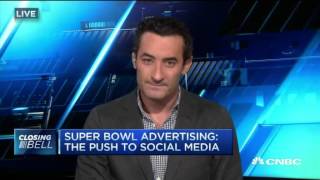
A CNBC "Closing Bell" interview (Feb 5, 2016) with Matt Britton, CEO of marketing agency MRI, discussing whether Super Bowl TV spots (a 30-second spot costing about $5 million) remain worth it versus targeted social-media advertising. Britton argues it depends on brand goals—mass-reach brands benefit from the Super Bowl’s ~117 million viewers, while others gain better ROI from platforms like Facebook. He also notes brands amplify TV spots via social sharing (pre-release buzz for ads like Heinz’s "Wiener Stampede" and Mountain Dew’s highly tweeted spot) and stresses the NFL’s central role in sustaining live-TV viewership.
Questions this video answers
$5 million
117 million
"Wiener Stampede" (dogs running in hot dog buns)
A spot referred to as "Space Monkey Puppy" (as quoted in the transcript)
The calls for one 30 second spot will run advertisers 5 million bucks this year. Is the price really worth it or are companies better off pushing their super bowl ads to social media? Let's ask Matt Britton. He's CEO of marketing agency MRI and coming to us from the west coast, probably not far from where the super bowl is going to happen. Matt, so what would be your advice to companies here? Go social or traditional?
Well, I mean, it really depends on who your brand is and who you're trying to target. You know, there are certain brands out there, like the Pepsi to the world, there's to have just a mass audience. So for them, sort of a monolithic 18 to 49 demographic makes sense. With 117 million people watching the super bowl, there's really nothing else like it to reach a mass scale at once in the days when live TV viewing is really kind of waning down. But for other brands that want to get more targeted and pinpoint with their efforts there nothing can reach sort of the ROI and effectiveness of platform like Facebook, where you can target somebody within 100 miles of a store that likes certain hobbies. And you know, a lot of brands are now looking at Facebook as sort of their de facto marketing spend and figuring out what they should spend around that. And that used to be tv, which is really reflected in the growth of Facebook's stock price.
Well, Matt, you know, these two things aren't really mutually exclusive anymore. Right. I mean, we're seeing right now in the lead up to the super bowl, the companies that have already booked an ad are sharing it socially and they're basically kind of getting a magnification effect off of that.
Correct. I mean, one of the best ways to market the consumers right now is not really to market to them, but to market them through them. So if you can reach influential consumers and then they get and then get them to share some of the ads in their newsfeed, you're going to have exponential reach. It's going to show up on people's mobile devices through the feeds of the friends that that those consumers follow. So a lot of brands, more than ever before actually this year, are taking advantage of the ability to see these spots before it actually airs. Heinz, for instance, has one with dogs running in hot dog buns called the Wiener Stampede, which is really exploding. I'm going to butcher this one. But Mountain Dew has one called the Space Monkey Puppy or something which is the most tweeted about hashtag right now on social media. So some brands are indeed taking advantage of the pre game buzz to distribute their spots.
Matt, it's Evan. I have a question. Is there a future outside of the Super Bowl? It's a one off thing. It's a big event outside of that. Maybe like these, you know, Greece Live or whatever NBC has been doing in political debates. Peter no, no, no. Is there any future in this kind of advertising or is everybody just not? There's not, there's no, there's no future, is there?
Well, so here's the thing. So there's the Grammys and the Oscars and then besides that, it's really the NFL. The NFL controls the future of American media. What a lot of people don't understand is pre preseason football games get a higher rating than game seven of the World Series. In baseball, the NFL is the most watched live television program amongst male and female viewers. And right now the NFL obviously has deals with major TV networks, Fox, ABC, NBC, etc. But if a company like Google with much deeper pockets or Apple should come in and buy the rights to stream the NFL, I think that's going to be sort of the straw that breaks the camel's back in terms of cord cutting in the United States. It's really the only reason why consumers have traditional broadcast TV is they can tune into the NFL. That's how powerful it is. And obviously the super bowl is sort of the culmination of that effect.
It's incredible. We saw it with a deal that NBC and I think CBS struck for the Thursday football games next fall. You know, prices keep going up. Matt, thank you. And we'll see if we remember any of these all important ads from the game this time around.