Coca-Cola’s Islam ElDessouky on Creative Strategy, AI & Global Impact
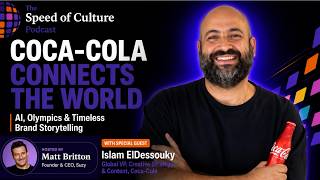
Islam ElDessouky, Global VP of Creative Strategy at Coca-Cola, talks about turning local store owners into brand ambassadors through the "Wonderfully Wonky" campaign, how AI enables rather than threatens creativity, and why culture now emerges from the streets instead of boardrooms.
Chapters
Up today, we're delighted to welcome Islam El-Dessouky, the Global VP of Creative Strategy and Content in the Coca-Cola Company. With a distinguished career in brand management and marketing communications, Islam has played a key role in shaping Coca-Cola's global strategies. He also serves as the Middle East and North Africa Chairman of the World Federation of Advertisers, highlighting his industry influence. Islam, so great to see you today.
Happy to be here. Thank you for having me. Absolutely.
It's interesting 'cause a lot of times in this podcast, we will interview executives who start off in the US and then end up branching to some foreign territory to drive their business. And you kind of took the inverse strategy where you started off, I believe, in the Middle East, and now you find yourself out of Atlanta in this obviously really critical role. Tell us about your career journey and kind of how your road ended up leading Atlanta and Coca-Cola headquarters?
That's a great question. So I started actually, funny enough, I graduated computer science and electronics and math. So I was like a geek of science, if you will. And I wanted to join my father. He had his software engineering firm and I had great ambitions to be super rich at the age of 28, 29. Obviously this plan failed with great success because I'm no longer in that branch. But I graduated, worked with my dad a little bit, and then pivoted to advertising. So joined actually Leo Burnett, Starcom, and all of that. All of that, worked at Procter Gamble and got super interested in marketing.
Where? Where were you in—
That was in Cairo. So my hometown is Cairo, I'm originally Egyptian. So I did that in Egypt, and then from there I got into a company called Henkel. You might know the products here as Dial and Purex and all of that, where I learned actually product management, not even brand, product management. Henkel is a very technical company. You manage the P&L, you manage the production cycle and all of that. That was also in Cairo. And then I started pivoting into soft drinks and I got into Coca-Cola in the Middle East, to your point. So I joined Coca-Cola first in the Middle East division in a little island called Bahrain. Beautiful place, super inspiring. This is where the headquarters used to be, and I went there as a brand manager. And I think part of maybe the journey that I'm really proud of is that I started as a brand manager first. So I really started on the business side of things, not the creative side of things. So I went into brand manager. Senior brand manager, group brand manager, so I stayed a lot in the brand management cycle to see all about like the business, the insights, the strategic frameworks that we build brands around and so forth. And then I had also some chapters in Turkey and Kazakhstan in between, also in brand management. And then the company decided to set up what is called Integrated Marketing Communications, IMC back in the days. Today it's called IMX, but IMC back in the days.
Yeah.
And I set up the IMC because I had big affinity also to build brand love, not just brand value. So the value was clear, how you manage the P&L, how you get revenue and growth and margins and all of that. And then I started the IMC function in Middle East and North Africa. And from there I started growing into the ranks and it led to also Middle East and Africa and whatnot. And then I got the first global role right after COVID to lead the hydration, sports tea, and coffee portfolios. Given that I did IMC for like 5, 6 years, so then they were like, okay, and I led global charters in between. The beauty of the Coca-Cola system, you could be positioned in the Middle East, but you could work and handle projects all around the world. We're very networked as an organization. So location, yes, shapes a little bit of the environment that you operate in, maybe the insights that affect you and so forth, but we're always very connected. So I got a lot of visibility while there, leading a lot of projects on music, football, and whatnot. And then I got to lead the global role for hydration, sports tea and coffee. And from there, I got the role of leading it for Coca-Cola trademark, which is the most exciting thing that ever happened to me, to lead such an iconic brand. Like, I think there isn't a marketing book that doesn't have Coca-Cola in it mentioned in some shape or form. So that's very shortly— What a journey. Like, yeah, that's the journey.
So I've been in marketing my whole career, about 25 years, and I've always primarily been focused on US brands. And I'm very well aware of the fact that it gives me a little bit of a provincial outlook because I haven't worked overseas and I haven't really been focused on customers all over the world. What can you tell somebody like me who doesn't have that experience on the nuances of the consumer around the world in terms of how they interpret brands and messages? And how have you gone about being able to do that successfully across all the markets that you just named?
100%. I think you really get to learn what does think global, act local means when you work in the other markets. So when you are in Middle East or Africa or even Central Asia and Turkey, like some other places I've been to, I mean, we're a company that really pushes global brands. We have a global agenda. It's not that we're going to have a lot of local brands wherever you go. So when you get a global brand, I think where it becomes really interesting is how do you learn to find this local nuance and connect it with the global kind of positioning that is coming to you.
Right.
Especially when, if you are in the US, end of the day, the US is such a cultural center, the gravitas is so strong from the US perspective across the board. So I'm Egyptian, I didn't grow up in the US, but I'm very familiar with American sports, with Hollywood, with this. So the exportation is so big. So I think when you are at the receiving end, you really push much harder to understand how you take the local nuances and shape the global agenda with it. So I think now that I moved into the global role, it becomes also a bit of an advantage for me that I know this position well.
Yeah.
So if China talks to me or Indonesia talks to me and they're like, "Hey, but you know, the market here has these differences," I can guide in the sense of open up your mind and find the new ones instead of trying to find the difference. Because I can do the same. I could come and tell you, "Oh, but Egypt was such an ancient civilization. You bring this to me, we're not big fans of it." Sure, but there is always a glass half full and a glass half empty. We should always try to look at the nuance and try to connect it. So I think that was— a superpower that when you work in that part of the world, you build subconsciously. Like, I didn't know that I had it, but then you come into these roles, and then you see that you're navigating this with ease.
Right, and in that regard, I was reading about a campaign that you'd launched earlier this year that was based on the Wonderfully Wonky approach. I hope I pronounced that the right way, which is about kind of unpacking those nuances of how local vendors sell the product in local markets. Tell us about that, 'cause I thought it was really a fascinating platform for storytelling.
So we were looking at reinventing how you go about the influencer model or the creator model, if you will.
Right.
And usually people go to like social media platforms. Oh, let's look at TikTok, let's look at Instagram and all of that. And we started with the thought of, okay, but who are really the ambassadors, people who really are proud of having our brand? And then one person in the room said, 'By the way, guys, I know this store in Brazil, and the guy takes a lot of pride in how he took our brand identity and interpreted it his own way. And this guy's in São Paulo and this and that.' And he started showing us images. And then we started thinking, 'Okay, can we actually take this with more depth?' And because originally we would go and say, 'Hey, our brand should look like this,' because, I mean, the brand is what it is because of how meticulous we were in building it, the Spenserian, the Contour bottle, like we have a lot. But then the deep insight that we found is that this is a message, this is a manifestation of pride, that when a store puts our brand in their own manifestation, they are proud to serve Coke. In their hustle, in their daily struggle, they want to tell people, "Come to my store because I am proudly serving Coca-Cola products." And that was an aha moment that changed everything for us, because then we took it from, okay, how do we go to these then local communities and really use these store owners and put them as our actual ambassadors? Because they interact with their communities in real life.
Yeah, I mean, they are creators, right? They're creating relationships, they're creating impact. It broadens the definition of that.
100%. And then we topped it with the notion of, okay, like, again, I'm gonna go to American sports, but if you're in the NBA, you feel that you made it as a player if you have your signature shoe. If I am a LeBron or if I am a KD or whatever, like, I have my name and signature on the shoe of Nike, That for me is, oh, wow, I've made it. So we decided to take their art and put it on our cans and hand it to them as a signature shoe kind of concept. Hey, your community is going to see Coca-Cola with your design on it. You're proud of serving us and we're proud of you holding our hands and serving us to your community. So I think when we unlocked it this way, it went like wildfire everywhere, like we had cases in India. So it started in Latin America, then we have— India. India joining in, we had Africa, we had again Indonesia and whatnot, and it became such a sensation that probably you've heard about like a few months ago or so, especially when it got such spotlight and recognition in Cannes Lions. A lot of people also started paying attention to it.
Interesting, 'cause it's really emblematic of how marketing has changed. You know, you joined Coca-Cola almost 2 decades ago.
Correct.
And when you joined Coca-Cola in 2006, there was no iPhone. Yet, right?
100%.
So not to date you, I mean, we both came into the workforce at the same time, and it's just so much has happened in the last 20 years. And obviously the iPhone brought on a revolution of mobile content consumption and, and so many other things that we don't even need to get into. But also it opened up the dawn of the social media era. And now here we are in 2024. I think the biggest way the world has changed in terms of what you and I do is that We used to live in a world where culture was really dictated from the boardrooms, and now it's really driven from the sidewalks or the street corners or the bodegas and all the places you just spoke about. And that changes marketing a lot. It makes it a lot more exciting in my opinion because it's not this linear TV message where you just have to write a big check, which frankly is how a lot of brands, including Coca-Cola, were built. But now you have a much greater challenge in building it from the bottoms up through these creators. Mm-hmm. How can you do that? I mean, you just gave a great example, but how do you look at storytelling in this new creator-driven world? And what's your, I guess, process when you go into a storytelling process like the campaign you just spoke about?
I think two things really come to mind, Matt. One is the realization that creativity has been democratized, I think.
Right.
And like you talked about two decades ago, I still remember the first day people told me about Facebook and I kept going to walls. I don't know if you remember the wall, the posting, all of that. I think today we're really living up to the truth that all of us are creative. The DNA of humanity has creativity right embedded into it. So the minute you realize that is the minute you start also losing control when it comes to let me work with creators, let me work with these shop owners, let me go to a TikTok person and say, "Hey, this is what I stand for. Can you communicate it in your own way?" I think once you realize that and you lose control, you'll be able to navigate with a lot of authenticity. Otherwise, you're just trying to get the '80s, '90s model or playbook and try to just force fit it into—
That's right.
Today's world, which doesn't work. And that's why people talk about, hey, there's a lot of marketing waste. Yes, because when you try to put something that is not for it, it doesn't work. Like you go to sessions, they tell you, hey, do TikToks, not ads on TikTok. That's correct, because this is why people are consuming it. So that's number one. I think the minute you realize that creativity has taken a lot of shapes and forms and that you need to lose control. You should lose control, but the second point that I have, do not lose identity and foresight of who you are. So I think why people really appreciate Coca-Cola through the years is that we're so grounded in our famous tripod. The brand stands for authenticity, for connection, and uplift. We've never changed. That's the ground rule. Now, can we connect people on a TikTok? Yes. Can we connect people in a football stadium? Also yes. So that's who the brand is and how we operate. So I think, losing control and realizing creativity is absolutely belonging to everybody. And second, do not really get dragged into losing sight of who you are.
Absolutely. And I would imagine at Coca-Cola, it's such a big brand that has touched so many different passion points over its vast history. It's probably challenging for you to figure out how to continue to evolve the brand and push it forward and not make it seem stale. You have new competitors entering the space. Because there are new generations entering the Coca-Cola relevance. At the same time, you don't want to disenfranchise the core tenets of the brand. So it must be a challenge and a balance for you.
1000%. And that's why we always put the statement in every brief, timeless and timely.
Right.
I think because the brand is almost 140 years old, so there are many things about it that are timeless. If you look at our bottle, next year we're celebrating 115 years of the Contour bottle. Look at that. And then it's the timeless aspect, but then how can we timely celebrate it is another aspect. So we're like, this is an iconic piece. What are the opportunities out there that could— but they have to be timely because people move so fast.
Yeah, and one element of culture and society that seems timeless as well is the Olympics. And I know we're just wrapping up what seemed to be a very successful Olympic Games for the sport itself, and also I would imagine for Coca-Cola and your activation. Talk to us about your experience in activating the 2024 Olympic Games and what were some of the successes that you think are worthwhile sharing?
When people talk about career highlights, I think the Olympics was a career highlight for me. Like, I had so much joy, pride, and fun working on this. So first of all, the partnership we have with the IOC, with the Olympics, is probably the longest in sports. It's 96 years today, and hopefully in LA '28, we're going to celebrate a century of this partnership. So 100 years of partnership with them. Because we started in 1928. Now, in the Olympics, we knew that after COVID, because Tokyo got affected significantly by COVID, like the fans were not allowed—
Right.
And like, it was a very difficult Olympics environment to operate in. We knew that the world today needs a big celebration of humanity. There needs to be a stage where we try to really bridge the divides and come together and celebrate that unison. And we felt that Paris 2024 was absolutely the best stage for that. Because it's going to be everybody from all around the world. Everybody's coming together, an opening ceremony on the River Seine and whatnot. Like, we knew that all the ingredients are coming together and we worked very hard to bring a key message to everybody that it's magic when the world comes together. As simple as that. So I think that resonated very, very well. And we decided to give it a lot of shape and form. So we took the packaging and we've been always famous for doing limited editions during the Olympics and whatnot.
Yeah.
So we took our packaging and we wanted to show that when they come together, you have a better picture. So we put this beautiful hug with the hands kind of notion that you take two cans, you put them next to each other, and you have a beautiful hug and a beautiful two people coming together so that we celebrate that. We worked with a lot of artists from France to really also manifest their expression of this. And like the point of lose control, we let them, we're like, listen, this is the brief, just go and create. Yeah. For us, and we're going to honor it and put it on our cans, which we did. We had like 5 beautiful designs here and there. And wherever you went in Paris, I don't know if you attended the Olympics.
Unfortunately, not this year.
Maybe next time. LA, maybe we'll go together.
Oh.
Everywhere, the cans were so beautiful. People were sending us photos and pictures and all of that. So I think it was such a great celebration of that human moment that really is anchored in the brand belief. Like we said, connection. So we were very much about connecting people. Uplifting the human spirit, we felt that we did that with great success. And the third one, which is the authenticity, where we came up with an idea, but then we gave it to everybody to really create on it. And we left it live on social. People went on TikTok, shared the hugs between athletes, between people, between fans, between all of it.
Awesome. So looking ahead, obviously, and I see that you're also an adjunct instructor at the Miami Ad School, and I'm fascinated with the whole notion of, education here in 2024, especially when you look at it in conjunction with AI, because what we're teaching kids of all ages, in a lot of ways, I question its relevance moving forward. And you'd made a statement earlier that all of us are creative. And I personally believe that that's gonna be more important than ever before because a lot of the things that maybe people used to get jobs for are gonna be automated and AI's gonna kind of take care of those things, which means I would think creative even gets more valuable moving forward, but there is sort of this murky line in terms of like what creative is needed by the industry, what creative should be automated. And that's a big question. I'm just curious to you, like where do you see this all going and how does that manifest into what you tell your students at the Miami Ad School in terms of where they need to focus to be successful in sort of this uncertain future that we're entering?
That's a strong question and I appreciate it. I'll tell you my views. I do not claim to have the answer.
None of us do.
Look, I think the world needs to embrace all the new technologies with open arms because what it gives us is a lot of possibilities and a lot of opportunities. I think we should not keep pushing ourselves into the corner of, oh, I used to draw this, now AI is gonna do it, I'm gonna be out of a job. That's not true because I think we need to go deeper into why do you draw? You draw because you want to express yourself in a certain way. You have a certain thought that you're trying to get out. Now thoughts, feelings, manifestations, expressions, and all of that, this is not machine. This will always be human. So you're gonna always have something to say, something to share. What AI or even laptops or Photoshop or even, I don't know, Flash in the past used to also be presentations and whatnot. Like whatever tools that are out there are to help you really get these feelings and these manifestations out to the world. Maybe in a faster way, cheaper way, better way. So I think you should look at it as an opportunity instead of looking at it as a threat. And we try to do this as well at the company. Like, guys, like, we ask questions. It's not that we want to just do AI for the sake of AI, but what does it offer to us? It offers X, Y, Z. Then let's harness it and let's see how we can bring it. My role is Global VP of Creative, so I'm still here. I'm not replaced with an AI machine or machine learning or whatnot. But I actually have sessions continuously with our AI folks, and I'm like, "Hey, can you do this for me? Can we take this? Can we try? Can we play with this?" I think this should always be the case. We should not create ghosts that just scare us for no reason. I think AI even— I don't know if you tried Copilot on Microsoft Teams that summarizes your meetings.
Yes.
Okay, that's beautiful. That gives you time to think more of these feelings and manifestations you want to go for instead of trying to "Look at your notes and try to summarize this meeting that you just had." So that's my humble point of view. It's just big vehicle to enable a lot of opportunities and possibilities for us.
Right, and if I believe like looking into the future, if you wanna be successful, you either need to go deep into the arts or deep into the science, right?
Correct.
So deep into the science is operating these machines, and then otherwise you need to go deep into the arts to do things that the machines can't do. And there's always gonna be ways, I believe, humans can evolve to do things that the machines can't do. And to your point earlier, if AI replaced your role, then eventually Coca-Cola would just look exactly like its competitors. What's gonna differentiate the direction you go into is your human intuition.
So I have two Gen Alphas at home. So not Gen Zers, the Gen Alphas.
Yeah.
And I did not know that Amazon's Alexa can actually rap with you. I didn't know that. And all of a sudden I see my son goes to one of these Echo speakers and he's like, Alexa, "Rap song number 1." And then Alexa starts rapping and then she stops in a moment where he raps with her. And this is exactly the, he wanted to rap. He wanted to create a song and he used Alexa.
Did anyone teach him that or did he just figure it out?
No, he just figured it out. He has a tune and he keeps trying. He gets into something and then he shows off when I'm at the house and they start rapping.
It's very cool.
And I'm like, "That's sensational." So that's precisely it. He is creative. He's trying to manifest something and he used Alexa.
Yeah. Gen Alpha, what's gonna differentiate Gen Alpha is they're the first generation to grow up with AI in the household.
100%.
So Gen Z was the first generation to grow up with the mobile device. But if you look at Gen Alpha, like they are never gonna really know a world without AI. And to take part in activities like the one you just described is really intuitive to them. Where so many of us, it just wouldn't be. And how's that gonna impact them in the workforce when your kids enter the C-suite and how are they gonna look at decisions for a company is what's really fascinating.
Absolutely. No, absolutely. Yeah, absolutely.
Very cool. So let's shift gears a little bit to your current role. So you're Global VP of Creative Strategy and Content for Coca-Cola. It's obviously, you know, Coca-Cola's iconic brand. How do you spend your time driving the business forward, both with learning about where culture and the consumer is headed, as well as on activations like some of the examples that we've spoken about?
I think 3 parts really for the job that I think will always remain there, and they're big on the agenda. One, you mentioned it, culture. Culture relevance is key because today consumers really look at brands and they're loyal to them because they're expanding on their identities. It's no longer the previous marketing mix. It's no longer just the offering. It's no longer just that the product needs to deliver. All of that is true, but today people look at it as, okay, I want to be associated with that brand because it expands my identity, it expresses me, I want to be part of that tribe. So I think for you to weave it into the right way, you need to build creative cultural relevance into what you do. And that is hard when you say the planet. Hey, we have global roles. How do we manage this on the planet level? So there is a lot of work that we do with Human Insights, with creators, with— we have a lot of panels of experts to talk to, and we do a lot of human-centricity design thinking and all of that. So that's level 1 of a lot of the work that comes in. Level 2 is learning. I think that the marketing industry and specifically the creative industry needs to do a stronger and better job in learning because we have done a lot of work. So what is the learning? What did we capture? How do we get better? Instead of going each time and try to reinvent it all over again.
I see that all the time. It's like, it's sexy to do the next project, but what about optimizing or taking insights from the project you just executed? When I was in the ad agency world for 15 years, I saw with my own agency, We would do something, it's like, "Oh, on to the next one." You don't get better that way. Google gets better by over time refining their algorithm, but what's the version of that for creative, right?
Absolutely. That's big on the agenda. And the third one, when you have such an icon on your hands and with so much success from the past, how do you keep what worked really helping you, but at the same time, how do you unlearn from it so that you can do fresh stuff? Because you wanna go and try new stuff like everybody else, but when you have such an icon on your shoulders, People are like, "Oh, but that worked for us in the past. Let's just keep doing it." And I think the company is in such beautiful marketing transformation journey that it's enabling all of us to really learn and unlearn, and how we can keep progressing doing fresh stuff, and how we can keep doing, sorry, what worked for us in the past. So this would be like the three dimensions really, or the three spaces that occupy a lot of my thinking at least. Like, of course, there's the day-to-day, the projects, the this, the that. Of course.
And obviously, in order for you to be successful in rolling out any activation, you need to understand the consumer. And where they're headed. And with that, more broadly, what are some of the major consumer trends that are impacting the beverage industry that you have your eye on heading into 2025?
I think you already touched base on it. I think that the whole notion of how do we manage technology with authenticity is such a big trend that I'm seeing. To your earlier example of the stores, discussion with people when we were in Cannes Lions and people came to me and they're like, We've never seen a brand today with the day and age of technology celebrating imperfection, which is a very big quality of humanity. They're like, humans are imperfect. And you just showed us how your brand has been imperfectly personated in all of these stores and you celebrated it. So I think how you find that and you weave it into technology to stay authentic, but also leverage technology is the brands who will be able to—
Totally.
Unlock this will win. A lot in the future.
And any other trends in terms of, I guess, habits or behaviors of the consumer relative to the products you sell that you think maybe changed the messaging or strategy of the brand over time?
I think the company pivoted maybe a decade ago to total beverages. I think because beverages, that's from a very functional perspective at least.
Sure.
There is a lot of abundance of choice out there. There's a lot of products coming in and out. And I think from that perspective, like, how do you maintain, specifically on Coke, I think on other brands, because they are in, I mean, segments or in categories that they have a lot of innovation, for example, happening. How do you keep Coke so fresh while staying true to the original taste and all of that?
So—
Yeah. We've had a lot of platforms, we've had a lot of innovation. So I think the trend of making sure that you cater for a lot of changing dynamics and functional needs is very important. Especially with personalization coming in as well and so forth. So, that is something, I mean, we have an innovation team, so they keep working on that. But from a trend perspective, I see that they really work with a lot of trends to see what's going in there, what's happening. And we've launched a lot of stuff, a lot of it successful. And like, for example, I don't know if you've seen this recently, this is—
I have not.
So, this is our—
Oreo Coca-Cola, wow.
Oreo.
So, we did—
How is it?
How's it taste?
Beautiful, it's so delicious, so delicious.
I would— Zero sugar too, I saw.
Yes, sir. And it's not only beverage, it's also the cookies. So you've put Oreo into Coke and we've put Coke into an Oreo cookie, and then you can go and enjoy both at the same time. Such a beautiful collab.
Yeah, and it's a great example of innovation and collaborating with another iconic brand to bring something new to life.
100%.
Very cool. I got to check that out. So shifting gears as we wrap up here, Islam, I'd love to hear about when you reflect on your journey, and you look at all the different places you've worked and all the different interaction relationships that you've made over time, what were some of the core things you can extract from the right decisions you've made to put yourself in the position that you're in today? 'Cause obviously you didn't just end up where you are by accident. And over time, if you look back, there were probably a couple things you've brought to the business or you've brought to other people that have unlocked the potential that you're realizing right now. Yeah.
I love that question. I'm gonna refer, like I started with you saying that my mom, bless her soul, her name was Susie, so I was super excited to be with you. I'm gonna refer to her as well because—
Very cool.
She gave me some tips like 15 years ago that really grounded me and helped me really navigate my journey. One is always be driven with a growth mindset. Do not ever victimize yourself. Growth mindset, learn. You can have downs, I mean, you're gonna have ups, but learn, get better, push yourself today. Work harder to be better than yesterday and so forth. That is one. Two, she always pushed me to have standards. And she's like, your standards are what people are going to refer to you for. So a standard of you always finish the race or a standard of you're always kind. Like I learned kindness from my elder son. And that's why I've put even on my, my profile on LinkedIn, you'll find that I'm Kindness Ninja because I promised him that kindness is such a superpower. So these are standards that you need to keep embracing and people are going to know you for them. And the third, really have a very clear value system because it grounds you and it makes your decisions super clear and super grounded. I think those three help me really navigate any situation, whether professionally or personally, so to speak.
Yeah, and I like how you frame that entire answer just around being authentic to who you are and what you believe. 'Cause when you do that, it really makes those decisions easy 'cause you're doing them from really a place, like you said, of authenticity, and it's coming from your heart, and I think Too many people try to engineer decisions based upon what they think other people believe they should do, and that's when you get yourself into a situation where you're maybe not living the life that you feel that you're supposed to.
Agreed.
Absolutely.
You said it better than me.
Thank you. Oh, thanks. I'm just taking your wisdom and trying to sum it up in a way where maybe our listeners can take action as well. This has been a great chat. So to wrap it up, is there kind of a mantra or saying that you like to live by professionally you think has helped guide your journey?
Yes, I think the mantra is love always wins. So I think I learned to be driven by the things I love, but people I love, but projects I love, but ideas that I love. I think when you're driven by love, it's such a positive force that it becomes so contagious and so powerful that nothing can stop that.
I couldn't agree more. And that's a fantastic way to end our chat today. So I've loved our conversation and I know our audience audience will too. So thank you so much for taking the time and share so much about your journey and your wisdom with us today.
Thank you, Matt. I enjoyed it a lot, and thank you for having me.
Fantastic. On behalf of Suzy and the Adweek team, thanks again to Islam El-Dessouky, Global VP of Creative Strategy and Content for Coca-Cola, for joining us today. Be sure to subscribe, rate, review the Speed of Culture podcast on your favorite podcast platform. Till next time, see you soon, everyone. Take care.
More from Matt




MikMak’s Rachel Tipograph on Consumer Spending, Retail Media & Holiday Shopping Trends



Jaguar Land Rover’s Charlotte Blank on Luxury, Purpose & Experiential Storytelling



