CoinDesk’s Jennifer Stranzl on Web3, NFTs & the Future of Crypto
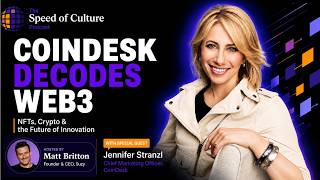
In this Speed of Culture podcast episode, host Matt Britton interviews Jennifer Stranzl, Chief Marketing Officer of CoinDesk. Stranzl recounts her career trajectory—from studying cognitive science at MIT, a stint in investment banking, early roles in consumer goods (P&G, L'Oréal), a music e‑commerce startup, and leading digital media at the Wall Street Journal—highlighting a consistent focus on innovation at the cutting edge. She explains why she was drawn to the nascent crypto and Web3 space and describes CoinDesk’s three‑pronged business: a media platform (news, podcasts, TV, newsletters), the flagship Consensus conference, and an indices/data arm serving traditional finance. Stranzl discusses audience segmentation (traditional finance, retail, mass consumer) and how content is tailored for each, especially during market cycles like the current crypto winter. She details the recent transformation of Consensus into a large‑scale festival in Austin, surpassing its goal with 20,500 attendees, and outlines future plans including a Money Reimagined Finance Summit and a Web3 Creator & Brand Summit. The conversation moves to marketing tactics, integration of media, events, and data, the launch and expansion of CoinDesk TV, and the importance of partnerships and advertising. Stranzl shares how she stays informed on crypto trends—daily consumption of CoinDesk content, other podcasts, competitive events—and offers insights on emerging use cases for NFTs and Web3, citing examples such as Starbucks Odyssey, brand‑driven NFT communities, and creator monetization. She reflects on the broader crypto market’s funding, the potential for mainstream adoption, and the need for simpler user experiences (e.g., wallet usability). The interview closes with a personal note on mindfulness, forest bathing, and the value of slowing down to foster creativity. Throughout, Stranzl emphasizes a bottom‑line‑focused, movement‑driven approach to innovation, positioning CoinDesk as a synergistic media‑event‑data platform driving growth in the evolving crypto ecosystem.
Chapters
Up today, we're going to be speaking with Jen Stranzl, Chief Marketing Officer at CoinDesk. Jen, great to see you. Thanks so much for doing this in the heart of a very busy fall, I'm sure, for you at CoinDesk. We're going to first start to get by knowing a little bit more about you. You've been really in so many different cool places throughout your career and would love to know the road that you took to where you are today.
Absolutely. Thanks so much for having me, Matt.
That's right.
I am a marketer, CMO, and I have been in the media industry and both US and internationally in consumer and retail. And I actually think I got my innovation bug, as I call it, early. Even before I was a marketer, in a way, I sort of wanted to get into marketing in the sense that in college, I wanted to study a very innovative cutting-edge science called brain and cognitive science. I was at MIT. And that was such an interesting sort of how people think and how their brains work was very interesting to me. And to me, that's kind of what marketing is. So, years later, looking back, I was like, "Oh, that's why I studied that." And so, from there, you know, I did a very quick stint in investment banking at Goldman, which gave me a very broad overview across industries. And we helped raise money across retail, energy, real estate, you know, all sorts of industries. And I realized, "Wow, I want to go and help build and create and be part of it, not just raise money." And so, when I went back to business school, I jumped into marketing. And that was sort of a combo of creative with analytical quantitative, but also, you know, how do people build and how do they innovate and how do I jump in? I started off in CPG, classic marketing schools like P&G.
Yeah. L'Oréal.
And that was a lot of fun and I learned a ton. I felt like I was at marketing school. But I took that and looked at what the innovations were going on in the industry and jumped into this music e-commerce startup that was a little bit before iTunes. So, again, at this cutting-edge innovative place and trying to understand how customers would think about it. What would they do with digital streaming, digital products they could listen to? And that eventually took me into digital media and the Wall Street Journal. They pulled me out and hired me to help build the Wall Street Journal Online. That was the largest paid news e-commerce subscription site in the world. It was also the very first to ever charge for content. And so, we had lots of—
Wow!
Yeah, lots of companies and industries asking us, how do you do your shopping bag? And what does it mean to charge for content? And so, that was great. And I took that to many other places. I I joined some startups. I tried to help a retailer reinvent themselves with e-commerce first. And I finally, you know, one of my old bosses at Wall Street Journal introduced me to the CEO and the president over at CoinDesk who were looking for a marketer. And that is a really innovative space again. You know, I went from nascent digital to nascent crypto Web3. CoinDesk is the most influential and trusted information platform for the emerging global crypto Web3 economy. And that's a really innovative space. So I'm quite happy to be there and I'm leading marketing for them.
That's awesome. I mean, hearing your story, I think, and you talk to it, the common thread is really about innovation, being at the cutting edge, cutting edge of streaming music, cutting edge of publishing, you know, at Wall Street Journal and now with crypto amongst so many other things. What draws you to innovation and the new? And, you know, do you ever struggle with what's, I guess, cutting edge versus bleeding edge in terms of pushing things too far out where maybe it doesn't have as much of an impact? 'Cause one thing I've seen throughout my career is A lot of times clients are gravitated towards the bleeding edge stuff that's going to get them in the trade publications, but sometimes it can be disconnected from business results. So, you know, a lot of times when I speak to people in innovation, they're not as grounded in business results. You do not strike me that way at all. So I guess, you know, what does draw you towards innovation?
No, I think that's a really, really interesting question. And I think the bleeding edge I'm absolutely fascinated with, not because it's shiny, but for this sort of power to, you know, what's going to help make the world better and what's the newest thing. And I think that's really exciting. Sometimes being too early, people say, is just wrong. And, you know, sometimes in my career I've been too early. I've been at these places that were a little too early for it.
Right.
So that gets at what you're saying, you know, to these business results that aren't there. So I think you try to be it. As I've gone on in my career, because I'm so bottom line focused and I want to drive revenues, that's what marketers want to do. They want to bring the customer in but drive business. I've tried to pick innovations that I think are really movements. And I feel very passionate about innovation. I know you've talked about this with others on your Speed of Culture podcast. And innovation can be many things to many people. But I think innovation is what humans do best when they're imagining. And so, like when they invent something entirely new, I get most drawn when it becomes the best innovation in business that really is going to drive a movement forward. Something huge is happening, something that is existing that's going to impact everyone, either for a whole industry or for the mass consumer. Yeah. So to me, I mean, just coming back to my current job, crypto, blockchain, Web3 technologies, I feel like are those things. They haven't worked out all the use cases, but the, the places that they have and what you can see in the future, I think are that big movement. And I just always have gravitated, I guess, toward that innovative side. It's been a thread in my career.
Can you tell us and our listeners a little bit about CoinDesk for those who might not be as familiar with it?
Oh, absolutely. And I think I said it before, CoinDesk is the most influential and trusted information platform platform for the emerging global crypto Web3 economy. So what does that mean? It means we are, we're actually 3 things. CoinDesk is a media platform, an events business, and an index and data business. So back to the media platform, it is a media business that has, it's a news site. It's got podcasts like you do. It's got a TV station that plays on our site and on YouTube. It's got newsletters. And then we run the most influential event in the entire industry that's all about crypto and Web3. That's called Consensus. We've been doing it since 2015. And then we bought an index and data arm, CoinDesk Indices, and that's sort of a financial piece that, that sells and licenses indices and data to what I call trad fi, the traditional finance market.
Right. So let's dig into the media piece first. So is your audience, has it become much more mainstream, especially as crypto has exploded in popularity during the pandemic? Have, have you found maybe you have to change the content or the way you're positioning CoinDesk as it's gone from more of a niche offering to obviously something now that is on Saturday Night Live and front page at USA Today, et cetera?
You know, it's a really interesting question. Like the Wall Street Journal, we have always been B2B and B2C, and we are the trusted financial media. In fact, we were quoted almost daily in the Journal and the FT and other top-tier financial media. So I think we have always been— when the Bitcoin price goes up, we have these huge numbers of people come in. We had 190 million visitors last year, and our visitors can range from sort of 40 up to that huge number. I think as, as a marketer, we think about the segments and who's coming in and when and how do you tailor the right content. So trad fi, traditional finance folks, we need to make sure we have the right content for them. And of course, whether we're on TV, like, like the big guys like CNBC in the market, you know, CoinDesk also has to have that. But yes, we do have to have stuff for the mass consumer. We have an entire learn it was called Crypto Explainer Plus section on our website. And we have to make sure we have the right content for the right segment.
Yeah, and I would imagine crypto is so polarizing. You have people that obviously say it's the future, it's everything. You have people that say it's a bubble, it's a fad, it's going to go away. Some in the middle, but, you know, most people I talk to really sit on one side or the other. And I'm not sure if it's an echo chamber or not. But does that echo chamber reverberate back to the editorial calendar? Like, is it a completely different publication when crypto's down 50% versus maybe last year, or do you kind of try to stay the course?
Yeah, I think it's actually a little bit, it's almost a little bit different from what you're saying. What we are there to do is to report the news and to do it in the most appropriate way. And so when you think about what we're reporting on, when the news goes south, that actually creates a lot of news for us.
Yep.
And I think, you know, we recently made a sort of statement. We said the shakeup in the market has created rich opportunities. To set the industry on a path for mass adoption and weed out unsustainable projects built on hype rather than substance. And we talk about that when we're putting on our events. But I think the news reports on the news happening in the industry. What we are seeing and what we also report on at the same— like we're in the midst of this crypto winter, right?
Yeah.
So the price is down. We have an impending global recession. TradFi is still very deeply interested in investing in the space. They're not walking away. Brands are still investing and heavily leaning into, and the crypto-native builders are still building.
It's really the retail investors, right, that are, I guess, shifting so quickly.
Absolutely. It's really the retail investors. You're absolutely right. And so, you know, we see this as a really interesting time for builders and the investors and the TradFi folks, you know, are pouring in. I think the most fascinating thing, you know, BlackRock partnered with Coinbase right after crypto winter happened. Yeah. And so we're giving asset managers access to crypto. That means it's not going away. And so, you know, it's this indicative commentary. And yet as a news organization, we're supposed to report on all the sides and we do.
Yeah.
But that's just sort of my own personal opinion. And then Starbucks talked about a Web3-based reward system they were working on for months and they were gonna announce this fall again in the midst of crypto winter. And yet, and And they actually, I believe, announced today that they're going to call it Starbucks Odyssey. And they're actually launching it again in the midst of crypto winter and a recession.
Right.
Right. You know, I think you can only go by what you see. And to me, that trend is despite winter, people are still building.
Absolutely. As a marketer, you know, who's in charge of essentially building the CoinDesk brand and essentially the audience, what are some of the things that you're focused on? Right now to kind of build and expand the overall base?
Absolutely. I think, look, over the past year, CoinDesk had what I called internally a big hairy audacious goal, a BHAG. I think I learned that term from P&G back in the day, but it was literally—
Propaganda.
Yeah, totally. It was to take the most influential event in the crypto blockchain industry for years since 2015, Consensus by CoinDesk, and pivot it to be a fully fledged festival, moving it from New York City to Austin. And do it in a much bigger way. And our goal was to get 15,000 people there in June. We ended up with 20,500 attendees in June. And we had this incredible variety of experiences that expanded massively into Web3, NFT. We had an NFT gallery. We had something we called the DAO House, a sport court where we had programming about everything going on in esports and NFTs with sports, et cetera, and hearing from brands who are moving into Web3.
Mm-hmm.
I think that's a real focus for us. We know events worldwide are a big business and there are an absolute ton of crypto Web3-focused events, but we have always been the world's longest running and the most influential gathering in the market. And we bring together all these silos of ambition and innovation together across the blockchain and Web3 communities. And we have always been that and done so. And so The focus next year is really to, you know, and over the coming few months is to go back to Austin. We'll be there next April 26th to 28th, 2023, and work with the current environment and take all this interest in the B2B community and all the builders and all the trad fi and the brands, the non-endemic, non-crypto brands that are pouring into the space and have them come and be part of that gathering. Continue to do our Money Reimagined Finance Summit. We're adding a Web3 Creator and Brand Summit. You know, so that's sort of the main focus making Consensus as big a success as it was this year?
I mean, that's an incredible number, 20,000 people. I mean, I think it was 45,000 went to CES, which is sort of known as the de facto technology event. And here you have this new emerging category, where you have nearly half the amount of people come. And CES has been going on for, I think, 20, 25 years. So it just shows the overall interest in the space and You know, if I'm hearing you correctly, do you feel that it's going to be kind of like— I don't want to say a tail wagging the dog, but you have this huge event. Is that going to be sort of the driver of CoinDesk? Like, is that going to be the big event you think that aggregates your community and then you take that year round and continue to grow and build the publication from?
I think that the two of them work synergistically together. You know, media platform is also a platform on which I can help promote the fact that Consensus is happening. I can also show all the important news that broke at Consensus. And Consensus also can remind people, and we have very well branded that Consensus is by CoinDesk. We have our CoinDesk TV there front and center who's live broadcasting from the area. So I feel like they're complementary and they help each other grow. And we do that on purpose. We try to integrate everything.
Right. So I mean, that's a lot. So I mean, you have the event component, you have the media component, and obviously you have this data. Component driving the business. What does that mean for your time as CMO? Describe maybe the pie chart of your day because you're not necessarily the traditional old-world publisher like Wall Street Journal anymore. You're at this kind of new, fast-growing, emerging startup, but you have that, you know, traditional legacy experience. What does that mean for how you spend your time and the pie chart of your day?
Absolutely. I mean, I do have to portion off my day and make sure I'm focused on both media events and the indices and data business. And the other important piece is it's a very small company. And so we've had to carefully build up what are the resources you need. You know, there's the work and then there's the people who have to do it. And so I try to split my time into making sure we have the right leaders. You know, we have someone who's, who's really a leader on the events and media side and someone who's a leader on the indices and data side. And I try to make sure I spend enough time across all three to make sure one, everything's integrated. Yeah. To our understanding our segments and that we're, we're sort of looking across the businesses and leveraging each piece to help the other. And I would say I probably spend a lot of my time doing that.
Gotcha. And does that also involve working with customers and agencies? Ultimately, I imagine it's an advertising-funded model, largely. So is that a big part of the overall remit?
Absolutely. We work with customers, we work with the consumers, we do market research to understand the different segments. You know, our trad-fi segment is very interesting for the indices and data business, our trad fi segments very interesting to consume our media and to come to our events. So, you know, there are certain segments that cut across all three, and I have to make sure that I'm understanding the customer and helping provide advertising support, as you mentioned, sponsor support for the events, and then of course actually selling the products that we have on the indices and data side.
And I imagine moving forward, there's, there's, we talk about OTT, you know, and consumers consuming different types of content on all these new platforms. You know, I see CoinDesk potentially down the line being more of a larger scale platform. You know, you look at CNBC, you look at Bloomberg. Have you guys had discussions about that moving forward?
Yeah, of course we have. I think we launched our TV, I'm trying to remember, I guess it was last year, and we actually have the woman running as one of the top TV people who actually came from the Wall Street Journal.
Wow.
There you go. And so we have our own studio in the office. We do both remote and in studio as well. And alongside our events business, we're very focused on how do we expand that TV? How do we think about, you know, it's on our platform, it's on YouTube, it's on others. How do we think about who can we partner with or what are other platforms we can think about in order to— in my book, you know, I'm a marketer— how do we get our brand out there? Because the more the TV is everywhere, the more my brand name gets out there. And so it's both advertising for my brand, but it's also building our TV platform. And so that sort of expands our reach, especially into sort of the B2B finance realm, if that's the key target in all sorts of other realms.
Absolutely. And I mean, being in this space, I would imagine, I mean, it's intimidating to me and I'm, you know, I consider myself a business leader, an innovator, and I imagine it must be then to most consumers. It's just most people can't even describe what crypto is or, you know, in layman's terms, what Bitcoin means, et cetera. How do you personally keep your finger on the pulse of the space? Where do you get your information from so you feel like you're well-rounded in the space as it continues to evolve over time?
I love that. I mean, first of all, I read CoinDesk every day. I listen to our podcasts, I watch our TV. So, you know, I have to push ours first.
Of course.
Absolutely. But, you know, I listen to other podcasts out there. I go ahead and look at all the top-tier media and what they're doing. And I also attend competitive events because I have to understand what's going on in other realms. And then even spending time at consensus and listening in. What's interesting is we actually had an entire sort of learn portion of that where people who didn't know or were intimidated could go. And this year we're looking at even expanding it and segmenting it out. You know, we have all sorts of ideas for how we can help with that, not just on our site, but at events as well.
Sure. And like, I mean, I guess, where do you see it all going? I mean, where do you see the crypto space going personally? I mean, I know you're not talking on behalf necessarily of your employer, but, you know, just given everything you've consumed, is this something— how big is this going to get? You know, have we peaked already? What do you think?
So interesting. I was just looking at sort of venture funding in the space over the last 5 years. In the last 2 years, there was literally more than $60 billion, like, put in the crypto Web3 space, which is this enormous amount of funding. And I know that That's a big piece of fintech now. I think that the use cases are starting to emerge. I actually think the rise of NFTs and Web3 use cases using blockchain are going to be a really important trend to watch.
Absolutely.
As a marketer, I think that what's fascinating about those is it's a way to build community and fan bases. It's a way for visual artists to get paid the way musicians could get paid with digital and it's a way to create loyalty and rewards programs for brands.
And I just— And authentication, right?
And authentication. Yeah, there's authentication, there's making sure it's the right person who owns the right thing, but it's also this concept of creating a community. So Mila Kunis, who has her Stoner Cats show, we actually had a viewing at Consensus of it, but the only people who could watch it were people who had bought her NFTs. And the people who bought the NFTs paid for her to produce the show. It was like a fundraiser.
Right.
If you bought an NFT. And I found that so fascinating that they were fundraising to produce a show before it existed and buying these NFT characters. And it gave them access to like a membership to her fan club where they could then tell her what they might wanna see in the show. And then they could meet each other, you know, on Discord.
Yeah.
And they could get together and meet each other. And I just don't know that that's ever happened. And technology's allowing us to do you can just imagine brands and marketers like salivating over this stuff.
Absolutely, especially as you talk about like a Mila Kunis or any personal brand. I mean, I think that we now as consumers follow individuals much more than traditional notions of brands and the way that those personal brands, whether there's influencers or reporters or celebrities and athletes, the way that you're gonna interact with them, this kind of platformizes it in a lot of different ways and allows the creator to monetize and allows them allows the community to become much more deeply engaged. What's interesting to me is, so I, you know, was around like you were when the dot-com crash happened. And I remember working at this company, it was my first sales job, and I had just won a piece of business from a digital startup, a dot-com startup. And my boss was like, "Stop selling in companies on the web. That's all gonna be gone in a couple years anyway." You know, because it crashed in the market. So it was this huge run-up and then the whole, obviously, dot-com bubble burst and you had, the Pets.com types companies that were on the headlines, and then the real work began. And companies like Amazon and eBay never went anywhere. And then, you know, when the world was ready, all these new entrants came, and now we are where we are today. And I look at this space very much the same, where, you know, I think that when you had this type of crash that happened, it shook out a lot of the opportunity seekers and people that were there for short term. But to your point, the builders are there, And once the consumer understanding of all this and really the applications catch up to existing consumer behavior, I think that's when the magic happens. And I think the question is when and how, et cetera. No one can quite time the market, but the brands that get it right are gonna be ones that really create transformational businesses.
I completely agree with you. And I think, you know, I keep saying Web3, that is of course inclusive of everything going on in the metaverse. And I think that, you know, all the brands are trying to figure this out. I completely agree with everything you said. I think once, they figure it out, it's going to be exactly as you described. The internet had this crash and then people actually, the real people actually started building.
Yeah. And a lot of it, you know, part of it is the rails, right? In terms of, you know, with the web, it was people didn't have fast enough internet connection, right? It's the interface. Like you couldn't stream video, it looked very choppy. So people never thought that you'd be able to watch TV over the web. So a lot of it is the rails and then the consumer interfaces and the form factors they really need to catch up to how consumers behave. I think one thing I've learned throughout my career is it's very hard to change consumer behavior, right? Consumer behavior is really reflective of culture.
Agreed.
And that's gonna evolve over time. But once the applications actually are aligned or kind of fit into consumer behavior, well then there you go. I mean, look at the iPhone. Everyone was used to the BlackBerry. So at first, business people was like, I'm never gonna have an iPhone. I need to type. I miss my BlackBerry. And then over time, consumer behavior caught up and now everyone's using it. So I do think for everyday consumers, are there things that you're seeing that you're like, wow, this is gonna be something that more and more people are gonna be able to get their arms around?
Well, I think, you know, what Starbucks just announced where they're not even calling it an NFT, they're calling it a journey board.
Right.
They're trying to hide the backend. That may be it. And I think, you know, Gucci and Nike and Adidas all playing in the metaverse and Web3, they may also have an angle there. You know, once the consumer actually, like you said, once it becomes easier to use, then people will just jump in and they'll have been building for so long. They'll be like, oh, of course I'm gonna do this. So—
I think that's a profound insight with Starbucks Odyssey, which is that could be something where people just look at is this is my rewards program. And if they're just interfacing the same way on the Starbucks app that they do with the current rewards, and then one day, 3 years later, they find out this entire thing's on the blockchain, that's versus we're in a blockchain. Sign up, set up your MetaMask, do all these things that people don't understand. Maybe just the company needs to do all that for you and then your interface is the same and then they can unlock all the benefits for the consumer without them having to figure it all out. I think that's ultimately probably where—
Or maybe we need to make wallets easier to use. I mean, we're still—
Right. Well, that's a perfect example.
Yep. Absolutely. No, it absolutely is. It's so interesting.
Yeah. The best technologies are obviously ones that are simple, easy to use, intuitive. To consumers and require the least amount of steps possible, you know, and the quicker companies can get there, I think the more effective they're going to be. So this has been great. I think, you know, I think there, again, there's such a, there's a stigma. There's a lot of misconceptions about the space right now. And I would definitely urge our entire audience to check out CoinDesk, and I'm definitely going to try to put ConsenSys on the calendar as well. But curiously, what made you guys choose Austin? I mean, I've been there for South by Southwest so many times. What about it made you select that destination?
I think we wanted to have a really interesting festival model that would allow us to showcase all sides and all areas, and we needed enough space. And Austin, you know, the conference center is front and center in the entire city. And then there are a bunch of buildings that are literally less than half a block from it. And it allowed us to do that, plus also have music performances right next door. And it just made it into the festival that we thought it ought to be given all of these interesting sides.
Such a great talent, for sure. Awesome. Well, to wind things up, Jen, obviously you had an incredible career and you're obviously juggling a lot right now. What do you think is worth slowing down for personally? We're talking about the speed of culture, but you can't just be speeding as fast as you can at all times. You need to slow down sometimes personally. What does that look like for you?
I love that question. For me, it has to do with mindfulness and being present. You know, I have yoga and meditation on my list of things to do, but there's this concept I believe it's from Japan in the '80s called forest bathing. And so I try to go into the woods and into the forest and do as many walks as I can. But for me, the forest bathing is when you stop for a moment, whether you're with people or alone, and you just have this microfocus on breathing, sights, sounds, smells, just for a moment. What colors do you see? And you just take it all in. And I think that combo of nature and just noticing what's around you for several minutes, it it literally changes everything. I feel like there's something about the brain and the way it works that when you stop and you just look at those seconds around you, it allows you to reengage and come up with new connections.
I read recently that getting children in nature at a young age is incredibly transformational for them as well. So totally makes sense it would have the same impact on adults.
Definitely.
Absolutely. Well, Well, Jen, thanks so much for joining. This is incredible. I can't wait for our audience to check this out. So on behalf of Suzy and Adweek team, thanks for Jen Stranzl from CoinDesk for joining us. Be sure to subscribe, rate, and review the Speed of Culture podcast on your favorite podcast platform. We'll see you soon, everyone. Take care. Hey!
More from Matt




MikMak’s Rachel Tipograph on Consumer Spending, Retail Media & Holiday Shopping Trends



Jaguar Land Rover’s Charlotte Blank on Luxury, Purpose & Experiential Storytelling



