Complex Networks’ Rich Antoniello on Media, Culture & Building a Brand
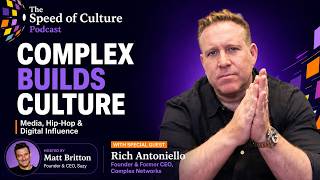
Rich Antonello founded Complex in 2003 by treating hip-hop, sneakers, and design as a bridge to mainstream culture rather than isolated verticals. The magazine broke even in 3.5 years by intertwining editorial and sales, then pivoted to digital through a curated ad network. He sees media's future as creator-centric partnerships, not traditional publisher structures.
Chapters
Up today, we're going to be speaking with a good friend, Rich Antonello, the founder and former CEO of Complex Network. Rich, how are you? So good to see you.
Very good to see you as well. And pretty much couldn't be better. So, okay, great timing.
Yeah, good, good. Always like catching up podcast guests when they're in a good mood. So for those of you who don't know about you and your journey with Complex, Why don't you give us a little bit of background on how you got started and how you ended up founding such an influential media company?
Yeah, honestly, I wish I was more deliberate about it. I'm kind of what I would call the accidental entrepreneur. I was going to Binghamton and I was lucky enough in 1992 to get an internship at BBDO. And work on General Electric, who at that time was a monster advertiser. Yeah. And I fell in love with advertising. I fell in love with media. And I turned from a finance focus to a media marketing focus. And then luckily enough, even though it was— and Matt, you know, you're familiar with this— the job market in 1993 was not exactly what I would call friendly. And what's interesting is I was able to get— very lucky— able to get a job at the largest advertising agency in the world at that time, Saatchi Saatchi, and not only get a job but then work on their flagship. So I came right out of school, ended up working on Procter Gamble and Procter Gamble's major number one brand, Tide. So right out of school, working with, with the best, the best brand managers in the world, the smartest brand in the world.
That's the best experience you can get working with P&G and Tide.
Yeah, I basically got grad school— I got paid to go to grad school. Exactly right. And, um, that was back in the day also where, you know, you didn't— you weren't able to send flowcharts. This— I'm really going to date myself— you weren't unable to send flowcharts via email, uh, it was— they were too big.
So you'd have—
we would have to fly out every Tuesday to go to Cincinnati to get our ass handed to us by some of the smartest people in the world. So, uh, I was really lucky. Like, that was amazing. Um, and I, I fell in love with media and marketing. Um, and I realized, uh, and I was getting pushed by a lot of people I worked with to get into the sales side of, um, uh, of our, of our industry because I was in love with brands, I was in love with narratives. I would make big differentiations between not just the reach and scale of magazines or television programs, but I was very in love with this kind of deep narrative. And a lot of this sounds done now, but I've realized looking back, this is what drove a lot of things. So I was able to make a transition and get a job very young to go over to Men's Journal magazine at its almost origination. They were like a year or two old when I first got over there, so it was almost like a startup. Uh, fell in love with like the Challenger brand aspect of being like a third in the category but the highest quality, and then like building that differentiation. And then I was lucky enough to be an intrapreneur after that. I transitioned to National Geographic and launched Adventure magazine for them in 1999, very successful launch. And you get the opportunity to get very aggressive from an entrepreneurial perspective, but both the budget and the protection and the brand overhang of a, of National Geographic, which is an international brand that was unheralded at that time, incomparable basically. So if you think about, That was like the— it was like training wheels for then being able to go and do something like Complex, which were all my— growing up in Brooklyn, all my passion points were hip-hop, style, art, design, sneakers. And I had all this corporate experience from Procter Gamble and Sochi and WenerMedia and National Geographic, and I was able to apply the corporate experience to my passion points and launch a magazine called Complex in conjunction with Eko Unlimited, the Rhino. Sure. Large-scale retail brand at that time. Yeah, about $700 or $800 million of revenue when we first joined, got up to about $1.2 billion at its height. And that's kind of the quick narrative of the whole—
so, so Mark Eko hired you to launch Complex? Is that sort of how it worked?
Well, It, um, Mark was the kind of like the design guy, and there's a guy named Seth Gersberg. Yes. Um, who was like running the business. Um, and then, uh, I met both of those guys at a— actually, we won a National Magazine Award for, uh, Adventure Magazine, and I met this guy Rob Weinstein, who I've known for a long time, who was the VP of marketing, and he's like, you got to meet these guys. And we go meet them, I go meet them, and we start talking about like concentric circles, all the stuff that is so duh now, but nobody was doing. If you think about the magazine landscape back then, you had GQ, which was hardcore vertical fashion.
Esquire was like older gentlemen, super linear, right? Right. Sports Illustrated.
Yeah, like Thrasher was hardcore skater. And I was like, none of this makes any sense to me because I love all these things, right? And we were like, why don't we, why don't we put out something in a very unique format, a very unique presentation? We did the two-sided magazine, so we brought— we, uh, took some influence from like Japanese style, Tokyo style, and basically presented the, the, the culmination of all of the commonality that was the throughline between all of the verticals that were out there.
Now known as like lifestyle marketing, right? Instead of starting with the vertical, you're starting with the consumer.
Well, you start with the consumer and even more so like what— well, there's one level of nuance there. There were a lot of people and people continue to do this. They instead of chasing any of those categories, our whole philosophy was very deliberate and intentional. We were always like, let's be the prism in between the most vertical and the mass, and the mass and the vertical. And a prism was working both ways. So whenever we would take something hyper, like, vertical, like a super, like, skate story, we would look at it from a mass market angle to educate the large scale, but still be authentic and credible. But then what we would do is take mass stories and add a very in— like a very specific vertical angle to it to make it relevant to the virgils and the hardcore consumers. And that's where most people go wrong in lifestyle, is they are— they get diluted and are just vanilla ice cream. We're like the most specialty— we've always been the most specialty-oriented flavor that has still had wide-ranging appeal because of the manner in which we presented it. Does that make sense?
100%. And early on, after you got this magazine going, did you spend most of your time on the editorial or on the business and sales side? Well, Both.
I mean, we were— they were hand in hand. I mean, and that's another thing that was very different.
Church and state now, right? It's completely different.
We'll just continue to date ourselves through this conversation. But it's— back then they were very church and state. And I just never believed in that. Not that you would go to an advertiser and be like, let's write a story about somebody we just— that wants to write us a check. That level of church and state is not what I'm talking about. However, it is insane to not take your best editorial ideas and try and monetize them, or your best monetization partners and try and frame them appropriately from an editorial perspective. Like those, those can't be in and of themselves isolated and then think that you're going to be able to optimize your business. Yeah, it just makes no sense whatsoever to me. I know that sounds done now, but that's not the way people were looking at things back then.
Yep, absolutely. So, and you know, obviously launching a magazine in 2003 was sort of at the, at the very peak before, you know, we start to see the downfall of print. At a certain point you had to make that transition to digital, right? 'Cause you first had a physical magazine. Tell us about that because that, 'cause not many people, younger people understand that there was a pre-digital world that we operated in and then this huge tidal wave of the internet came on.
Not just the pre-digital world, I think a lot of people think print, like, as a vehicle, especially magazines, um, were always this, like, secondary or tertiary thing, when literally magazines were the definers of culture. Of course, like, if anything that became cool or was driving culture or driving style, or it came from magazines, it was, it was where every one of the influencers, originators Like that's, they were participants in this category and they were the definers of what was gonna be amazing. So I always believe disproportionately in that quality and that depth of connection to the consumer. So my viewpoint is instead of like allowing, and I'm gonna be very aggressive about a lot of our peers at that time. My viewpoint is the value of print and Complex, Complex specifically, but print in general, the value was not the physical unit, like even though they were big and glossy and beautiful and whatever, the physical value was the fact that we had the deepest connection to the most influential and affluent-oriented people, and we would start every meaningful conversation would come from magazines. It's why even like if you look at the news shows from the '90s, it was always magazine people that were on starting all the conversations, not cable people, right? So if you think about like, to me, the biggest mistake the magazine industry made is they allowed themselves to be defined by their distribution platform rather than what their real product and unfair advantage was. And we never did that. I looked at our unfair advantage. I'm like, We have the coolest people in the world. We'll distribute it. We're distributed at—
It's platform agnostic, right? Doesn't matter where you distribute it. It's about the value you're creating.
Not even, not, yes, but it's a layer past that. It's like going, wait a second, this has to inform the way we think about what we're doing. And I was like, okay, we're gonna make a transition. In the end of '06, we broke even. So, After 3.5 years, we broke even as an independent magazine. And I don't know how much you know about publishing, but that's— to say that's Herculean is the understatement of the year. But I was like, look, let me take the profits of what we were going to make in '07 and put it into digital. And I don't know if you remember the digital landscape back then, is you had, ironically, AOL and Yahoo as large-scale portals.
Yeah, Lycos too. There was Lycos and MSN. That was it.
Right, exactly.
Right.
Yeah. And then you had shitbag ad networks. Those are your two lanes. Yeah. My viewpoint is there's a lane right here instead of trying to be everything to everybody or quote unquote a vertical ad network, which was hysterical back then because it would be like, like Glam is like, we're the female ad network. Oh, you mean half the planet?
That's vertical, right?
Right. I mean, come on. So the, the, the theory was, is let's go into digital heavy But instead of spending a whole bunch of money the way a lot of other people did on— and I don't know if you remember this, but like if you wanted to go build a website back in '07, I mean, it was like $1 million.
Yeah, right. Yeah.
So I was like, wait a second, this is going to eat up all my profits and whatever. Like instead of spending like building this crazy fancy feature-oriented website, let's do a bare bones play, but then let's do an aggregated curated, tightly held, exclusive ad network of not the biggest sites in the world, but the most influential voices in those categories that literally we— that Complex was birthed at.
So the ads you sold were able to be distributed on all these partner sites, so it expanded your reach.
Yes, it wasn't just the ads, but we were a little ahead of our time. We were like, let's do cross-promotion of editorial, like So when we would do like an album review, like when Kanye's new, you know, like when, um, uh, like, uh, not Dropout, but when, uh, um, I'm just trying to think, like any, any one of the album, like whether it was Heartbreak or whatever, but OutKast, that was a good one during that time, right? What we would do is get like, um, our editor-in-chief would sit with, um, Nah Wright and sit with 5 other music sites, all of the most influential music blogs at the time, which really are the creators of today if you really think about it, right? Like the people who now have big followings on social media platforms were the bloggers of the 2000s, right? So they were just individual reach, but they didn't have the scale of these platforms yet. So what we did is we aggregated best-in-class sneaker sites, music sites, art and design, shopping. Again, all this sounds duh now, but nobody was doing that back then. All with a through line of like kind of hip-hop as this default and backbone of the whole thing. And then Complex was the hub and everything else was the spoke. And what we were able to do is get to mass scale from an advertiser's perspective, but stay very focused from a demographic and a qualitative narrative, right?
Instead of going too broad to try to bring as many eyeballs as possible but losing your soul along the way, right? So, I mean, you can have your cake and eat it too.
So we were able to do that, and that's literally why we had a ton of scale in a very specific category that really nobody was playing in. And then when, when the shit hit the fan in '08, um, we had made a very successful transition. Digital revenue was just about to pass the magazine, believe it or not, which enabled us to go raise, me to go raise capital. And we were able to put a deal together for Accel Partners and Austin, Accel Partners, Facebook, Groupon, and Austin Ventures, Angie List, Angie's List, and like two AAA firms to come in, even though the world was falling apart and put money into Complex. That enabled us to kind of accelerate through a recession versus a lot of people who stagnated and struggled and kind of cut, cut their way through that timeframe. We invested our way through that timeframe.
And over time, as the business grew and grew, obviously, you know, it was about your ability to scale and delegate and hire great people, obviously. And you talk very vocally about this, that, you know, I thought that your post that you made in December when you left Complex, it really Touch Me because it's all about we, we, we, we, we, we. It wasn't about me. So I know that you value, as do I, you know, your team. Tell us about building that culture and how you did it and how you identified great talent along the way.
Oh, wow.
That—
you got an hour and a half. You know, I mean, look, the net is, is I have never believed— I don't have any really strong individual verticalized talent. Like maybe I was really good at math. Okay, fine. But like really, I'm not the best content guy, but I'm very good. I'm not the best video guy, but I'm very good. Like I'm not the best sales guy, but I'm pretty good. I'm not the best packager, but I'm pretty good. And so I was able to go, all right, I can help if I find really talented verticalized people in each of these things. Um, once we started to establish ourselves in each of those areas, we went to the expert level. Like, you go from generalist to specialist, right? Like, that's the only way to scale as the company. Like, in the beginning, you need jack of all trades. You need people who really understand how to do everything because everything is so integrated at that point. And then as you scale, each individual discipline, whether it's a revenue line item or an audience development or a content initiative, you need more verticalized specialty.
And you also have to trust them, right, Rich? Like, because you're turning things over that maybe you did in the past and let them do their thing.
There's— the trust comes from, from a good manager understanding, am I here to make a story better, or am I here to make this person better? Like, I would never allow myself to get that deep like we would use things as like individual tactics as references to have conversations. But you hire really great people, you push them on the thought process and the strategy, and that's where you dig in and spend your time. You don't spend the time on individual tactics, like you let them execute and improve those tactics. You push them really hard and hold them super accountable for the strategy and the thought process. And to me, that's a great way to delineate, right? Like, it would be like, uh, it's a football coach, and there's a reason why really good quarterbacks— there are some people who are really good the whole game, right? Like, when it's like, go execute this game plan, and that— and if someone's a game manager as a quarterback, and then you have people like Tom Brady or Pat Mahomes who are like, I'm creative. The 2-minute drill, the coach doesn't have time to call the plays. You're out there, you know the team. Like, my viewpoint is I want to be Bill Belichick for 58 of the 60 minutes, but I want to do so good with the 58 minutes to— for them, from a thought process perspective, then when it comes down to the 2-minute drill, they know, they know, they're confident in the thought process to be creative.
I love that. It's a great analogy. That's a great analogy. I might have to steal that one. I love that.
It's okay, I trademarked it already.
Oh, good. So as going back to complex, so, you know, you over time, obviously you shifted from print to digital and over time you built— you would end up building more of a platform. You got into events, you got into video. So what was the thought process behind that and what were the challenges in executing that transition?
What's interesting is instead of like, let's talk— instead of talking about the individual strategy of launching each one of those things, let's really think about why. Right, more so than how. And my viewpoint was always, not to go back to my point before of never allowing ourselves to be defined by print, well, it's not just print, it's never allowing yourself to be defined. If you're a brand play, and I am all about the depth of connection and the amount of impact and influence I have on an unfair basis with my audience versus everybody else, which by the way is the definition of brand, if you really think about it, brand and that level of influence. So it's a combination of reach and influence, right? Impact and influence. And I was like, okay, if, if we're going to own this audience, then the portability of that audience will be the definition of the strength that we have. Like, if you can't take a conversation on TikTok and bring it back to one of your other platforms, then honestly, your brand doesn't mean anything to anybody. It's just that piece of content that did well on one of the platforms. But what we always concentrated on is that depth of connection. And then combining that with the fact that we never got romantic about formats or distribution platforms. So the one thing we never changed is our tone and the categories we covered have been the same for 20 years. Right? The style, sneakers, art, design, hip-hop, like all those things were things that we brought from niche to the mainstream. So we never changed those. But what we never got romantic about was the format. We went from print to text to video to long— short-form video to long-form to events to in real life to, to a metaverse. We launched Complex Land during the we did the first kind of metaverse brand play in December of 2020. And my viewpoint is the reason we're able to not only get people to do that, and when I say that, I mean that internal people to get motivated to do that because we've been consistent about the way we've operated and then have sponsors and brands come along for the ride as well. Because we've been— our batting average and success of going into different formats and different distribution channels has been off the charts in comparison to other people's batting averages. And when you look at that, it's because we don't get romantic and we're about being— bringing a different take to our audience. And the other thing that's a little different than us, for us, is our audience and, and the brand and our partners expect Complex to be first with everything. They expect that from us. Okay, they're gonna come into this category and they're gonna do it very Complex-like and very different and they're gonna make a splash and because that's our track record and we've done it irrespective of format or distribution channel. So it's more of the thought process and then it's how do you bring something very unique on the brand side on a differentiation basis rather than check a box the way most people when they When they go and do brand extensions, people are like, oh, let me slap my brand on this and then wonder why my festival doesn't sell anything.
Right, right, right.
So look, no shots, but a lot of people have done that and a lot of people have tried. And it's two things. It's lack of differentiation of your brand and the respect that you have for your audience. And two is it's really It's a real-life reflection of the fact that you really don't have as many hardcore fans as you think you do.
Right, right. It all comes to bear there, doesn't it?
Right. And that's where brands need to pay a little bit more attention. There's a reason people fail, and it's not because the execution was poor or they didn't sell enough this. It's the fact that that brand should not be having conversations on a more distributed basis with their audience because they don't make that much of a difference to their audience.
They haven't earned the right to do that, right?
Ultimately, they have a dotted line relationship rather than a very deep straight line relationship. Yeah. And that delineation doesn't get made enough.
So for those of you who don't follow Rich on Twitter, you definitely should, because Rich is somebody who is not self-congratulatory, super honest. I really appreciate it. It's quite motivating just to hear your thoughts. And you strike me as somebody who has a chip on their shoulder, which I do as well. You talk a lot about not being given a chance and you kind of had to go through a lot of adversity to get to where you have. You talk about some people who, you know, pat themselves on the back when they really haven't accomplished anything yet. You know, I definitely get down with a lot of what you say. Where does that come from? What in your background has given you that chip? And kind of how would you describe your sort of attitude towards entrepreneurship?
I mean, look, and this is— I grew up in Brooklyn. I'm a public school kid, state university. Went to Binghamton. And when I got into advertising, when I got my job at Saatchi Saatchi, I was an aberration of aberrations. You know, back then Saatchi almost exclusively hired from like Brown, Yale, Harvard. Yeah. You know, my, my starting class was not a whole bunch of state university people. And then I quickly realized also that— and it's going to sound it's not bitter at all, it's just a fact, is that most of the advertising industry back in like the mid-'90s when I first started, the early to mid-'90s, was like, did you know I could tell you if you got a job or not if your dad played golf with the right guy?
Right.
I mean, and like, and my dad not only didn't play golf, I mean, my dad was a UPS guy. He delivered packages, right? And I don't— it's not about like angry chips. I have humongous chips on my shoulder because I know for a fact that if I'm on equal footing with anybody else, I don't give a shit where they came from, I will eat them for lunch. Period, end of story. Like, it's just— it's not— I will bring more effort, better thought process, more unique thought process, and a level of confidence and conviction that they have— they have no idea how to bring to the table because these people have never been challenged one iota, one second of anything in any respect of their life.
And my— so is it about your adversity that you went through, you think? Because like, I want my son to have, and my daughter to have, your conviction, your confidence. Does that mean they need more adversity? Like, like, what— where does that come from?
I don't think it needs to be adversity in every single respect. Um, look, I struggle with it too. I have my two— I have two daughters, they're 14 and 12. 12. And, um, you know, they've had a very different life than I had growing up. Um, and I mean that not just from, uh, um, like where they've gone, who they interact with. Um, but the one thing that we go out of our way to do is anytime you have to, I let them— I mean, literally, I'm saying this in the most expansive way possible is we let our kids fall. The biggest problem that I watch is a lot of people who come from different things, who've kind of built a lot of these, they want it— we want to go the opposite way. We want to make things as easy as possible for our kids. Now, you can do that on a large-scale basis of like who you know and some of the introductions, but you have to make them earn that introduction. They have to show you that they're not going to waste that introduction. They're not going to waste that opportunity, and they have to earn that opportunity. And my viewpoint is, is, look, my kids started working at a horse farm, like shoveling shit and cleaning horses at like 9 years old and doing pony rides. And people like, people were like, wait, your kids like work? And I'm like, uh, yeah, and they always will. Like, you know, I don't want them to have any idea about that. I want them to understand that they have a great privilege in what they're going to be— what door I can open for them, but they have to walk through on their own, right? I will never, ever, ever, ever help them walk through that door. I will not. And they, they— and, and hopefully we do a good enough job, my wife and I, and disproportionately my wife does a good job preparing them to always stand up on their own, be proud of who they are, bring it, bring and be very aggressive as well in who they are and how they want to be heard. And, you know, that, that's— there's no perfect formula. But there's one other thing, and I know you're like this as well, is it's not just that there's a lot of people with chips on their shoulder that only look out for themselves.
Yeah.
Like my— the real bitterness for me doesn't come from myself because I've been lucky enough to be successful. My bitterness comes in that the world has not changed enough still. You still have— why should it? Why should a Stanford student, as smart as they are, be able to write an idea down on a napkin and raise $25 million when you have kids who not only will put in more effort, will die before they let their business fail, and might have a better idea coming from a different school who doesn't have an exposure and can't even raise $50,000 to start their business or create their MVP. To me, that's the chip on my shoulder. When I wrote the— my exit letter from Complex, a lot of that was the, the, the staff of all of our 19 and a half years at that point embodied what we were birthed out of, which is hip-hop. And hip-hop didn't miraculously just But like, it didn't come around, it didn't become relevant accidentally. It forced its way in. And that's the way all of my staff and a lot of the most effective people and myself have actually put ourselves forward. We made it happen. A lot of people are just along for a ride. And you— we know lots of them, dude. We know lots of them. And I mean that category-wise, sector-wise, as well as individual company-wise. And my viewpoint is I want to— I have this attitude because I want to do as much as I can to change and give more and different people the spotlight and opportunity that they deserve.
I mean, I love that. It's about empowering people. It's about giving people initiative. It's about really scaling yourself, right? That's ultimately what you need to do to be a CEO. So, and you did that.
The other thing is, yeah, like You know, you give me somebody who thinks a whole lot of themselves before they've done anything, and what is that? What kind of level of creativity and then insane level of execution do you think that person's going to get versus giving somebody who's never had any opportunity in the world guidance and support and then the opportunity to get creative?
Yep.
You know why is Complex where it was and we were able to build a company as big as everybody who raised $400 million of venture on $31 million? We raised $31.5 million and built a massive company and had—
Over 2 decades.
Correct, over 2 decades. But why? It's because we, those people, we supported people who'd never been supported before and gave them opportunities to be creative. Who would never have gotten that shot in other places. And that, like, I'm not saying that's the only reason, but that is a big tip of the spear driving force of it.
Absolutely. I want to get to the more modern-day Complex and then kind of end with where you see things going in the future. So at a certain point, the business continued to grow and it was acquired by, I believe, Verizon, correct?
So no, in July of '16, we sold to a joint venture, right? Verizon and Hearst. Verizon at the time was very active in media. Remember Go90?
Of course.
Or I should say Go90, right? And we had cut a big deal with them on a content output basis, and Hearst was very involved with them as well. So as a JV, we were now owned, we just switched venture investors for ownership. But the beautiful part about doing a 50/50 JV is it enabled us to continue to run as an independent. We didn't integrate into Verizon, we didn't integrate into Hearst. So our level of creativity stayed very high, but we were able to kind of navigate our way through some very challenging situations in media. And, you know, much like AT&T just recently, Verizon got a little distracted and uninterested in media like content on an outright basis. Yeah. Which enabled us to have an opportunity to have a creative conversation about how to exit again. And that's when, like during COVID we were able to start some interesting conversations with some other people who, you know, and then SPACs came along, which were very interesting vehicles to go public, you know. And by the way, like in the beginning when SPACs launched, they got too much credit and now they're getting beat up too much. It's because everything in the world has to be an extreme.
Well, that's kind of the tech— that's kind of the tech space overall. Yeah, 100%.
But, you know, like we were our The level of influence our executive team and control our executive team has always had over our asset and our brand enabled us to probably successfully navigate some very challenging circumstances that most people have not been able to get through.
Yep. I mean, just think about the journey you've been through from, you know, starting with like, you know, a couple of people to being part of this huge conglomerate. Spinning it back out of that conglomerate and then ultimately doing this merger with BuzzFeed, which kind of facilitated your exit from the business. So talk to us about that process and kind of how you felt overall with that.
That actually facilitated, ironically, like I was looking to do that already. Regardless, right. This was the last enablement for me to be able to go do it. Yeah. Because I couldn't leave my baby in an uncertain circumstance.
Why did you decide to leave your baby?
Um, look, you've been an entrepreneur twice over, right? Um, but let me ask you this: if you were still doing Mr. Youth, um, at this point, would you have killed yourself?
Maybe. Maybe. Yeah, exactly. I know the answer, Rich, but not everyone else does.
That's why I'm asking. Like, I understand. Look, 19 and a half years— media is hard. Right. Like, you know, technology and media are, from a compounding perspective, are 24/7 businesses. And to be on and fully responsible the way I think a CEO should be in it, to do 19 and a half years of that is— was a lot. I mean, it was like 50 years worth of normal operating, right? And, and it was— I, was no longer effective. And when I say that, I don't mean for my— for my team. Like, I was, you know, killed, like killing myself, literally, like, right, having health issues. And, you know, right, like, it was— it was time.
It's taxing. A lot of people from the outside don't understand it. They don't understand how it consumes you.
I wouldn't wish it on my worst enemy. I really wouldn't. Right. And it was, it was time to make— for me, I had to be— I don't— I love being creative. I still love being involved on a strategic basis, but I was done dealing with day-to-day operational BS. Yeah. And I couldn't do that anymore. I was becoming ineffective because of it. And it was time for me to turn to focus on my family, my health, as well as But I couldn't do that until I knew that my baby was in a great spot from a funding resource perspective, from a creativity perspective. My people were in a situation where they would be elevated. And no shots at anybody at BuzzFeed, but if you look at a lot of the key spots, those are my people. The COO is Christian Basler, who was my president. Justin Killian became the CRO. Edgar Hernandez became the CRO of the whole entity. A lot of the key positions were— came from Complex people, and to me that's a huge sense of pride, but also that was very important to me that everybody— I put everybody in a position to be able to continue to be as successful as absolutely possible, as well as my brand. And you know, that's not the way it usually works. So to say I had to be very creative and very strong-willed about, I'll leave that one alone, but about what needed to happen and how it needed to happen. You know, it made me, it allowed me to go out on my terms and put my business, my brand, and my people in as good of a situation as possible.
Yeah, absolutely. You should be proud of that. So, you know, you kind of exit operating in the publishing industry at a really interesting time. You obviously have the duopoly of Google and Facebook. Interesting or best time ever. Right, right, right, exactly. Well, you know, there's always a future and, you know, there are people entering now at the bottom, like you did in 2003, and are gonna have upside. And, you know, the question is what's the future? Because, you know, I happen to believe that the next big class of publishing companies are gonna be based upon creators and people versus brands. I think that, you know, you look at like what Bill Simmons did leaving ESPN and he created a podcast that's bigger than any of ESPN's. And Spotify went and bought them, and there's so many examples of that. Where do you see the publishing industry going? Obviously companies like BuzzFeed and other of their counterparts are really struggling in the public markets, as are most tech companies. Where do you see this all headed?
So, well, first of all, the stock price or the financial performance is very different than the true actual value.
It's disconnected, of course it is.
It's irrelevant, right? So let's make that as one caveat. This, because let's not blend— because it's too hard to blend those two things and have one correct.
The same with most technology companies that are killing it right now in their stock. Yeah, the market is very— is in a historic time right now.
Yeah. So let's talk about though the relevance of these companies, right, on short and long term. I've been saying this honestly since 2014 that the entire media space is moving. And I'll, I'll send you a, uh, a, a video thing that I did a long time ago in '14 where I was like, every— there is no middle anymore of anything, right? But there's definitely no middle of publishing and content. You're either, you're either super— like, you have a whole bunch of, like, verticalized audiences that are specialty-oriented, or you have, like, the Amazon and Walmart of media that are super dotted line, just mass scale.
Barbell.
And, and, yeah, but, but now hold on, here's the difference. Is one side create— to me has a very big opportunity is, and not just like from an operational construct perspective, but if you think about what we did with the Complex ad network in 2006, 2007, and what could be applied to these creators now is put together related creators, right? Not just Oh, I'm gonna put an operational platform where I have the best social editors, the best lawyers, and the best IP sellers and BD guys. Like, that's all part of it, but it's really more like finding key creator groups that are related and complementary vertically and super complementary on an aggregated basis. Right. And putting those together enables you to potentially have the scale of the ubiquitous play, but retain the vertical nature and depth of connection to the audience. And sorry to be painfully consistent, but if you notice, that's— we've been doing that for 20 years, right?
Right, right. Same strategy, just manifested differently.
Strategy applied in, in today's world on an executional basis. Not being romantic about the old execution platform. Again, I'm not that smart, I just try and make things very simple. And if you really think about the opportunity to do that, is to me, that's the way to construct this. And the big miss is people are doing it operationally, whether it's Spotify or Pantheon. What's it?
Yeah.
Yeah.
Yeah.
And, but they're doing it in a very ubiquitous way. There's no real curation and then there's no qualitative crossover. And to me, the big winner is someone who's going to put together the qualitative crossover, the operational best-in-class expertise with— and one different caveat is instead of doing it rev-share oriented, it's someone who's going to figure out the right type of ownership structure that is ready for today's creators. So qualitative—
so they have a skin in the game, right?
That's right. And every— and, you know, and you're Instead of like worrying about what's the most used word when you're raising capital is, oh, I need to find investors who are aligned with me on, on everything. Well, why forget about investors? How about a business partner who's gonna be with you forever, who's aligned in the tactics of day-to-day and the long-term strategy as well? And to me, that construct is the way to think about how to be massively successful stay relevant to the audience and really put more people on. And when I say put more people on, I don't just mean from an audience perspective. Is how about putting them on and showing them how to be more successful from a business perspective and not as a paid manager, but as a business partner? Right. That's the differentiation from the CAs.
That's a huge distinction.
So to me, and I think the world is changing, to me, I think that's so obvious it's not even funny. But that's the way I look at it.
Right. And the obvious path doesn't always play out in this world because, you know, some people chase the short-term money, some people chase the short-term dollars. It doesn't always work out that way. But Rich, this has been amazing. I think for people—
the lack of— the lack of intellectual honesty of the people who have the ability to look to launch these things correctly you have to have some semblance of almost like— I don't want to get into like large-scale, like long-term moral issues, but like, isn't it better? I know you reacted to a tweet that I put out. I put it out every year for the last 10 years, and I always say I'd rather get 90% of the way to the target together than 100% alone.
I love that.
Yeah, my viewpoint is bring everybody along. And you, when you construct a business and a business structure and a partnership structure, you can be a selfish prick and take more of it, or you can create something that has long-term viability and helps everybody be more effective. The latter is much harder, but the latter is worth doing.
100%.
Like, I'm not trying to get up on a soapbox, but that's important.
No, that's why we had you here. I wanted to give you this soapbox. But, uh, we're out of time. I just want to tell you, I think this was such a valuable conversation for both people who are in the media industry and people who want to start their own thing or even who want to be great leaders. So I got a ton out of it. I'm so glad we had you on. Just on a personal basis, what slows you down? Or I guess now you are slowing down because you're moving out of operations. What's that been like for you personally? And what do you think is next for you? You know, from a career perspective, are you consulting, advising? Where were you headed from here?
So, so You know, I was supposed to— I promised my wife I was going to take time. We did our deal and then went public on December 6th.
Yeah.
By March 1st of this year, I had 3 board seats and 7 consulting gigs. Not surprised me so much. Yeah. Taking it.
Although you do look a lot more relaxed, I must say.
Oh my God, dude, it is. Well, here's the difference, right? I have— I'm doing more strategy and more and overcoming more creative challenges across more sectors with more people. But what I've done is, is completely extract all of the operational stress. Yeah. So it's not the problem. I love problems. I love like the challenges don't stress me out. It's the ex— getting people like rowing in the same direction to go execute and having them be consistent about it. And that's right, whether it's through lack of effort or terrible execution, fail. That's where the frustration comes, right? So for me, like, and I love, by the way, like, I love all the lawyers I've worked with and the HR people, but for me never to have a— I don't have to have any conversations with legal or HR, and all I get to do is have conversations with creative or partnership and business-oriented people who are trying to overcome and build new beautiful things. Do you know how energizing that is? It's Amazing. I could not be enjoying myself more.
Yep. Well, that's amazing to hear. And, uh, I, again, I think that most people can only hope to have the type of career journey that you've had and are still having. So, um, it's been amazing. So I wanna thank you, uh, Rich, uh, for joining the show today. I, I know that our audience will get a ton of value out of it. Um, and on behalf of Adweek and Suzy, uh, we wanna thank everybody for joining the Speed of Culture podcast. Please rate and review us on your favorite podcast platform. You sure can, Rich.
Of course. I want to give you the props that you deserve. We were talking about this beforehand, but for everybody and anybody who looks at this, what I like about what you're doing is there's, there's not a lot of— there's a lot of redundancy and there's not a lot of differentiation in the podcast world today. I give you massive props, not just for the depth and the originality of the conversation, but the kind of aperture that you've opened up for who you're bringing on. And I hope the audience really understands how important that is. There's never— it's never been more important to have a different perspective than today. Do not compound like the same view, the same idea, the same level of execution. That's a great way to not to lower your batting average and likelihood for success. Look to the contrarians, look to the people who go really deep. And I think you're doing a great service, not just for Adweek, but for the consumers as well. So I just wanted to say thank you for that.
Thank you so much. I think that's a great place to end it. Having somebody like Rich endorse me, I should just drop the mic right now. So thanks everyone for joining the Speed of Culture podcast. Until next time, we'll see you soon. Take care, everyone. Awesome. Rich, that was so good. Hey!
More from Matt




MikMak’s Rachel Tipograph on Consumer Spending, Retail Media & Holiday Shopping Trends



Jaguar Land Rover’s Charlotte Blank on Luxury, Purpose & Experiential Storytelling



