Crunchyroll’s Gita Rebbapragada on Anime, Fandom & Global Storytelling
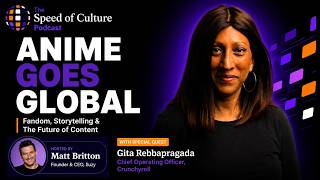
In this Speed of Culture podcast episode, host Matt Britton interviews Gita Rebbapragada, Chief Operating Officer of Crunchyroll (a Sony Pictures Television subsidiary). The conversation covers four main areas: (1) why anime has captured a massive U.S. audience—its century‑old Japanese roots, manga‑based storytelling, flawed heroic characters, and the medium’s ability to explore narrative territories Hollywood often avoids; (2) how COVID‑19 accelerated discovery via streaming, expanding anime from a niche to a mainstream demand driver, and how the genre’s breadth (shonen, slice‑of‑life, arthouse, fantasy) widens its appeal; (3) Crunchyroll’s business evolution—consolidating Sony’s disparate anime assets under one brand, leveraging Sony’s ecosystem (music, PlayStation, film, gaming) to create a multi‑service platform that includes ad‑supported and subscription tiers, e‑commerce, games, and licensing; (4) the economics of a subscription model—focus on LTV:CAC, demand creation costs, early‑stage user engagement, community‑driven acquisition, and the importance of first‑party data. The interview also touches on emerging technologies (AI‑driven content creation, text‑to‑video), the growing influence of Gen Z short‑form platforms, piracy challenges, and Gita’s personal leadership philosophy—empathy in change management, a puzzle‑oriented career path, and the mantra “Be the change you seek.” Throughout, Gita emphasizes fan empowerment, international IP (e.g., Korean‑origin Solo Leveling), and the collaborative committee structure of anime production.
Chapters
Today, we're thrilled to be joined by Geeta Reproghata, the current Chief Operating Officer at Crunchyroll, which is part of Sony Pictures Television, one of the largest anime media content libraries and distributors around. Geeta, so great to see you. Thanks so much for joining today.
Thanks so much for having me.
Absolutely. So anime is an interesting thing. Growing up, I remember there was a point, probably when I was in college, when a lot of people started to talk about it, and it became super popular. I guess it came overseas because it originated in Japan, if I'm not mistaken. For somebody who doesn't know anything about anime, how would you describe it and why do you think it's kind of captured such popularity here in the US?
Yes. So happy to talk about that. Anime is an art form that is over 100 years old. It is from Japan. You're correct. A lot of anime, which is the series version or the video version, is based on essentially Japanese comic books that are called manga. And these stories are really rich with artistry and characters. And what people are drawn to oftentimes is the unique story arcs and narrative territories that a lot of entertainment, especially Hollywood or globally, doesn't cover. So it's always felt like it's had a distinct sort of flavor to it, and it's sort of started to gain popularity in the '80s and '90s because a lot of anime was on Cartoon Network in the US, for example. Started to travel internationally, but it was really with streaming where content discovery just became that much more touch of finger, to say, that anime really started to have this accelerating exponential growth that we're seeing today. And then with COVID on top of that, pulled forward a lot of trends that we saw in terms of anime discovery. And so post-COVID, we have not seen any retraction. If anything, all of that discovery has created quite a bit of demand for anime, and we don't see that slowing down anytime soon.
So when you say anime can cover stories that kind of traditional Hollywood mediums can't, is that because it's the form factor of it? It's animation, so by nature, it can kind of extend the boundaries of storytelling. And are there other kind of limitations that you think anime is able to break through to make it so unique?
Actually, Hollywood has a great— canon of characters. So it's not that Hollywood or other global entertainment can't do it. It's just that the types of stories that are told in anime are just much more common with certain things. So for example, you will see many more flawed heroic characters in anime. Every single character has some sort of flaw or adversity that they're overcoming. And personally, I have found that incredibly relatable.
Yeah, it's vulnerable, right? Because no one really associates with people who are perfect.
Yeah, and they're vulnerable. They're oftentimes outsiders, and that can be very, very relatable. And what we find, which is incredibly fascinating to me, is that there's a certain moment in time when fans connect to anime. So when they discover it, it's a very visceral, instant reaction. Like when they discover it, they love it. And there's this period of time when people tend to discover it, and it's a lot of times in your sort of tween teenage years. And I think part of that is because the relatability of these characters— everyone's going through a life transition, and the relatability of these characters is really kinetic during that time of your life, which obviously I am way past that. But I see that connection every single day at work when I'm talking to fans, and it's really quite remarkable. I— that's the only word to describe it.
Absolutely. And with some of these amazing new AI-driven technologies, I imagine the future of anime is gonna be a much different world than what we see today. How do you see anime itself evolving with all these technological advancements when it comes to content creation?
Well, I think the biggest thing that's gonna drive, or one of the things we'll see, maybe not the biggest, but one of the things we'll see is that, you know, anime has been historically Japanese stories that are now being launched to the world. And for a while, the Japanese anime industry was much larger than any other territory. Now you're seeing much more balance. Between what is consumed globally versus purely in Japan. And what that means is that a lot of the stories may not be rooted in Japanese manga always. So for example, we just launched a show, Solo Leveling. I highly recommend it. It is based on Korean IP. And so you're gonna start to see the art form in terms of like the characters always rooted in that anime style that is very much rooted in Japan, but potentially the stories being relevant to more international territories.
Got it. And I guess you talked earlier about COVID being a great accelerator. So I imagine— and like, for me, I have a block with anime because I just have never really consumed the content. So just like anything that— whether it's a type of food you've never tried or a place you'd never travel, you just have your perception of what that thing may be. And I guess COVID, people were home. They had so much more time to consume. So you gained a lot of trial opportunities, I would imagine. And you were able to take that. And bring more people into the franchise and the fold.
Yeah, we did. And I think the benefit of people having more time in Discovery is that I think what they came to realize is that anime is a medium and not a genre. And so maybe what they had been exposed to before, which they had an opinion on or before, wasn't the full suite. People a lot of times think of anime as like sword fights and what we call shonen content, but it's act— you know, there's comedy, there's slice of life, there's arthouse. And so seeing the full breadth, I think, really widened the aperture for the types of people that would consume it. And we just released a beautiful film, Suzume, and it is a fantasy sort of incredibly beautiful artistry-based film. And for the first time, this film and another anime film were nominated for a Golden Globe, which is the first time it's happened in anime history to have two anime films. And so we do feel like it's kind of having a moment. Right now, and it's really, really fun to be a part of.
Absolutely. So let's move on to the business side. So you are the COO of Crunchyroll, which is part of Sony, huge entertainment company. And I guess what Crunchyroll does is it's focused on the vertical of anime, is essentially a streaming platform, correct? How did this platform come to be and how has the platform evolved over time?
If you even go back 2 years ago, um, Sony had a lot of different, what I would say, assets working in the anime space. So a couple of different brands. And so what we've done, when we've worked to do over the last, you know, several years is to bring those all together and roll them up under the Crunchyroll brand. And so huge win for fans because if you love anime, you are subscribed to—
Way more value, right? Yeah.
Yes. Now you can just have one service. And we're sort of end a lot of that integration effort and we've consolidated our library. We've exposed that to fans. So it's great to be able to deliver that kind of value. And I think now it enables us to focus on a couple of things. One is taking advantage of the international opportunity. So there is still massive room to grow across the world. And so in many of our territories, we feel like it's early days. And then the other is that we're not a general entertainment streaming service. We do have a focus and our model is to be everything to someone, not something to everyone. And being everything to someone means that sure, we're a streaming service. We have an ad-based and a subscription-based model, but we also have e-commerce. We also have games. We also have films, a licensing business. And so we're just trying to super serve, uh, core set of fans, which is, while core sounds maybe a misnomer, 'cause there's casual fans, it's anyone who loves anime. I don't wanna put a label on, but with all the ways that they want to consume it in the language that they want to consume it. Absolutely.
And some of the streaming platforms have had some challenges over time, obviously over the last couple years post-COVID, making the economic model work. The ones that have been able to be successful despite these headwinds, I believe, are companies that have some type of ecosystem. So Apple has a broad ecosystem, Amazon has a broad ecosystem where the platform, the streaming platform, is either a loss leader or it can be subsidized in some way. And what struck me as you were talking about Crunchyroll, that it is part of Sony and Sony has a gaming division and it has motion pictures. How is fitting Crunchyroll within the broader Sony ecosystem kind of give you a competitive advantage to maybe hedge against some of the broader streaming challenges?
A great question. One thing I will say is we're so fortunate to be part of the Sony family. I mean, it is a company that is obviously a Japanese company and gets anime in a way that I think is very unique to them. They also do have an anime ecosystem. And so think about, for example, a lot of the music that is beloved in anime shows is Sony Music Japan, for example. Makes a lot of that music. And so there's a lot of connection points there. A lot of anime is consumed on a PlayStation, and they are in the family. So we do have a very fortunate— a lot of brothers and sister companies within the Sony portfolio that create a lot of incredible partnership opportunities for us. I'll give you an example. Every year, we throw an awards show, and last year, we brought it to Tokyo for the first time. And we had a Sony— one of our Sony sister companies produce the show for us, provided a lot of the musical acts for us. So there's just a lot of collaboration that happens in our Sony family that is truly advantageous to us.
I'm sure. And as you look to the future to drive growth, I'm sure there's no shortage of pressure on your organization, just like any other, in this new economic reality we're living in. How do you look at customer acquisition? How do you look at customer retention, reducing churn so you can make the math equation of a streaming platform work? In a world where many others I think are challenged to do so right now.
Yeah. I mean, this has been the existential question I've had throughout my entire career. Oh, sure. Is that whole lifetime value to CAC ratio. Like, how do you create the right economics for sustainable growth?
Which any subscription company has to look at.
Yeah. And that is actually a through line in my career cuz I have worked at many continuity models and sort of, it's the same whether they may be in fashion or entertainment or mobility services, it's really the same method and the same math equation you're trying to deliver.
And it could be a wonderful model if you crack it. Running a subscription software company myself, but as good as it is, if you can't keep customers, if you can't grow them and your costs rise to acquire new ones, and all of a sudden, you know, it becomes really hard to solve for.
Yeah. So I think one thing I will say that is a through line from Crunchyroll, but also through other jobs that I've had in this similar role is that demand creation is incredibly expensive. So if you are in the business of having to create demand for your product or service, that makes it a lot tougher. And this is also a through line in my career of being a part of fandom or community-based organizations. If you can empower your fans to drive the conversation for you, or they're doing that anyway, I mean, you may be the most brilliant marketer.
Demand versus creating, right?
Then it's actually a lot different. The equation looks a lot different. And I think one of the things that is helpful for us is that a lot of anime is based on manga and we know who's reading the manga, right? There are very strong digital signals already around a certain many of the titles that we bring to market. So we're constantly learning to be smarter. And there's also a baseline level of demand. And I think that's also incredibly helpful.
Right. You have tailwinds in the category itself.
It's reducing the cost to acquire, but also getting the lifetime value up higher. And in other companies that has looked a lot of different ways, right? But there are certain very common things about continuity models in terms of how important it is to have your customer do certain things very early on in your journey together, whether that's in entertainment, any company I've worked at, the more that they discover your product and understand the value, the more likely that they are to stay And so those first, whether it's 45 to 90 days, are incredibly important in terms of what you're putting in front of them. And sometimes it's the first 7 days, right? Every business moves at their pace. And so that's also, you know, one of the commonalities of continuity models. And then also meeting people where they're at, right? You're gonna have customers that are going to your platform every day, and you're gonna have some that are more intermittent. And to actually understand. What their behavior patterns are and pivot accordingly.
We'll be right back with the Speed of Culture after a few words from our sponsors. And as you look at Gen Z, which I would imagine is a growingly important part of your overall consumer segment, and you look at the way that they're consuming content on platforms like TikTok, super short form built for the swipe, so to speak, do you see that trend being a threat or an opportunity for Sony to get into that space or maybe extract some of the demand that can be created in that space and channel it to, to your platform?
Yeah, for us, I think it's just opportunity. I really do. And I think probably a lot of CMOs have a different answer to this question. For me, the shorter the content, people are consuming so many more messages, which makes their ability to absorb it in this like meta way where it's in their hearts much harder. But you have the ability to get your message in front of millions of people in days.
But so does everybody else. So I guess that there lies the opportunity and challenge, right?
Exactly. And so. The way to crack that is to really know who your aspiring customer is. It's not who your customer is today, cuz that's not who your customer is tomorrow. It's to be really smart about where the trend lines are going in your business so that you know, okay, this is the group that's gonna be 50% of my customers in 3 years or 5 years, and be really forward-thinking and predictive about it. Because then if you can build that relationship early on with that cohort, it takes a while, right? 15, 20, 30 times someone has to see the same thing even for it to register. That's the trade-off.
Absolutely. We just did a round of interviews at CES, probably spoke to about 15 different CMOs. And the one thing that kept coming up over and over again is obviously first-party data with all the changes we've seen with the crumbling cookie at Google and before that, you know, Apple's changes. So when you talk about signals and understanding who your customer is, I imagine Understanding, obtaining that first-party data, analyzing it to dictate where your customer acquisition reach strategy is gonna go to is everything for your organization.
It is actually, and we're no different than deeply understanding how this is gonna affect our program. But again, our program is very grassroots, so it is different.
Just given the category, the fandom behind anime allows you to go at it a different way.
That's the way I would characterize our program. Most of our time and energy and our people are very much around community management, which I think is a slightly different model than some of the others.
Absolutely. So let's shift gears a little bit to you and your career. So you started off at Zipcar kind of in their heyday and over time kind of gravitated towards the entertainment space. What is your role currently? If you describe kind of the pie chart of your day and how you're spending your time and what success looks like, and how do you think some of the experiences that you've had in your career leading up to your role at Sony have helped you with being so successful in your current remit?
Sure. So if I look at the pie chart of my day, I probably should go do the exercise of pie charting my day. But I mean, I have 3 sort of main sets of activities underneath me as CEO. One is marketing. That's, let's say I spend about 30% of my day on that. One is the operations of our streaming service specifically. So the marketing team support all of our lines of business, the operations team. This is specifically for our streaming service, and I spend about a third of my time on that. And then a third of my time is I also oversee our strategy and planning function. So a third of my time, but 100% of my time is thinking about how to grow the business. We're in a really privileged position where that's our focus is to take advantage of this opportunity. And I think that has been a through line throughout my entire career. When I was a marketer, I was a growth marketer, so always looking about exactly those metrics. It's LTV to CAC, but also how to bring people in, how to keep them, how to engage them, how to make them promoters for your particular brand. And I think what I've learned over having worked in a number of continuity models or subscription businesses, but also community-based businesses, is that things can change very quickly. So for example, when I started at Zipcar, Uber had just launched its black car service. It's just like very much dating me. I mean, you can imagine the world of mobility was transformed within a 2-year period. And similarly, when I was in athleisure, athleisure was still a new thing. People were still wearing jeans back then, and then there was a market opportunity, but those windows can be really, really small. And so I think one of the biggest lessons I've learned from, I think maybe the through line here is I look magnetically drawn to a market opportunity that hasn't existed, something new, building something new. But those windows can change very, very quickly. And, and I mean, entertainment is no stranger to that, certainly.
And one thing, you know, I see it with my company, with all the changes, but AI, it's like we have 300 people, not probably nearly as much as you have your organization, and just getting people to wake up and change the way they're doing things because if you don't, someone else will. I imagine at a large organization, that isn't a dynamic category, it's not always easy to kind of drive that type of change. You know, and as COO, I would imagine change management, getting people to change their behaviors, evolve with the changing pace of the industry is something that is a challenge and something that you, I mean, I would imagine is a big part of your role.
It is a big part of my role, and also doing it empathetically is something I aspire to do, right? Because not everyone embraces change right away. Different people have different journeys that they're on to get from point A to point B. Some people are linear, some people are circuitous, and change management's just incredibly nuanced.
I feel— yeah, I mean, but is that your problem, Gita? Like, it's interesting 'cause I get what you're saying in terms of being empathetic, but you're not imparting change on people. The broader markets are. So is it up to the leader to be empathetic and to kind of go down people's personal change journeys, or is it up to the individual to adopt change in order to remain relevant in this changing world?
Yeah, I think that I would say being empathetic can work in concert with driving results, and it's not a trade-off. People think, oh, I'm doing it empathetically, it has to take longer somehow. I actually don't think that's true. I think being transparent about what be looks like is empathetic, and acknowledging that it might be harder for some than others is also empathetic.
'Cause people aren't robots. You can't just say, do this and expect them to do things differently just 'cause you say it.
For some people they will, they'll be like, I get it, makes sense where the market's heading. Some people need to understand the context a little bit better. Different people have different ways of processing change. And I think that's one lesson I've learned having gone through so many rapidly evolving industries is that the sort of like the logical do this by this date isn't always gonna win everyone over. Sure. And the power of why you're doing it can make you get there faster.
Yeah, 'cause I would imagine that's sort of like a two sides of the coin of somebody like yourself. And I totally empathize with it being attracted to innovation and innovative categories, innovative models. And at the same time, the innovation hits you as much as you hit it. And in order for you to impact your business around the innovation, you need to drive change and your people need to innovate or evolve. And that's often the hard part, like knowing what to do. I think a lot of people think is, oh, they should do this. It's like, okay, well I know we should do this, but getting 300 people to march in the same direction is a whole different story.
Yeah, I completely agree. But I also think as leaders, any, anyone who's working on any business who is influencing other people's lives, you have to challenge yourself to ask yourself the question, If I started this business today, what would it look like? Yeah. Right? Because someone will, if you're not thinking that, I guarantee someone else is thinking, what is today's version of this business look like?
Yeah. And they're not gonna be saddled with your legacy decisions, your legacy infrastructure or cost basis. And that's why you see upstarts coming in. That's why you see the Ubers of the world coming into a category because they build a company based upon mobile adoption and they were able to build a platform that wouldn't have been possible before the iPhone, which was just 6 years prior, right?
Exactly. And also a lot of these innovations, like there's room for a lot of different players, but also knowing where your space is gonna be in the evolved ecosystem is super important.
Yeah. And I mentioned AI a lot, but I think one of the big innovations in AI you're gonna see here in 2024, which wasn't really possible in 2023, is text-to-video. You see platforms like Pika Labs and Runway where you can essentially say, make a video about this and it'll make it. And right now it takes 15 minutes to render, et cetera. But with the chips getting better and quantum computing and all this new technology, in fact, companies like Qualcomm are now building new chips for laptops that can have more processing power in the hands of that treated device. So I would imagine when you talk about innovation and disruption and opportunity, in anime, can consumers create their own anime? And is that an area for you guys to get into?
Well, they're doing it right now.
They are.
Okay. I mean, there's fan subtitling and fan dubbing. When you have the highest avidity fandom on the planet and craving the next episode that's coming out of Japan, you see that. And it is a big issue for us. Piracy is a big issue for us. Like it is for almost any entertainment company. And so that is a pretty formidable competitor, I will say.
Right. But unless you can acquire IP and create IP and then you can own it and put it in the hands of consumers and then it becomes a big opportunity, I would imagine at the same time.
Yeah, it's an opportunity and it's also anytime something's public, that's the risk that it's pirated. And so we're always thinking, how do we deliver value that if you're pirating content, that there is a reason to believe that Crunchyroll is for you. And it's a really complex thing. There's time to market. I mean, there's a million different— of course, a lot of people don't even realize they're pirating, you know, some of these services and look very professional and you would never know. And so it's something that obviously is very top of mind for us.
Absolutely. And a company like Disney, I would imagine Sony, it kind of— now I think about it in the same sphere, like Disney leans into its own IP. Right? So they have Mickey Mouse and they have Moana and this IP, which really kind of creates a moat for them versus other platforms that don't have to. So what does IP look like in anime? Are there brands that you can own or is it just more about new things coming out all the time? Or are there kind of staple or pillar brands that are very important that give you a distinct advantage in anime?
Yeah, it's a little bit of both. The anime ecosystem, something that we're incredibly committed to as a company, is supporting the anime ecosystem in Japan. A lot of anime is made by a committee structure, so it doesn't have one outright owner, like in the way that a Hollywood studio might own 100% of one IP. Typically there's a number of players that come together to form a committee and then they make a show. And so it's a slightly different structure and it's something that's incredibly unique and not probably well understood outside of Japan, but that is how we participate. So we participate oftentimes on the committee as a committee member. And that supports the anime ecosystem and we're sort of directly involved with the creation of the show to some capacity and it differs for every show.
Makes sense. I imagine space is ever evolving and these decisions are complex as the category continues to grow.
It is. And it's also, you know, there's something really amazing about partnering together with a number of people to create something, but then also being held accountable to all of your partners to make it a success. And I think that there's, something very special about that.
Absolutely. So wrapping up here, Geeta, just back to you. I mean, you obviously are somebody who really career-focused and has become kind of a master of her craft when it comes to direct-to-consumer. And as you mentioned, kind of all the unit economics behind building a subscription business. And you're in a really exciting role now, a Crunchyroll. As you look back on your career and decisions you've made, what do you see in some of the things that you've done right to put you in a position that you are today to be at the helm of such an exciting organization and obviously many more opportunities in the future?
I'm not sure if I did them right, but I think one thing that I would say has served me well is I haven't overthought my career. I think that's why it's taken me in so many twists and turns in different industries is because I didn't have a set path in mind. Like, I wanna be at X time at X company. I've sort of just looked for the next good puzzle to solve. And that has been honestly just kept me very engaged at work and own energy to work just 'cause I've been so intrinsically engaged. And I think that obviously, I think always brings out someone's best work, but it also has taken me down a really unexpected path. I mean, if you had told me, I remember sitting in Tokyo last year in March at the Anime Awards and watching this amazing show with this incredibly talented group of creators in Japan. And if you told me 10 years ago I would be sitting there doing that, I think I would've said no way.
You know, that's— of course. Yeah. That's a crazy thing.
Even, you know, something that would've been possible. So I think just my advice to people who, especially ambitious ones, is like, think about the puzzle, think about the problem that you're solving, the titles, all of the recognition that all comes later. Just follow your brain and your heart in terms of what is actually gonna be super interesting to you. People who love their jobs are, I think, are just better at them.
Yeah, I couldn't agree more. And with that, Geeta, is there sort of a mantra or saying that you like to live by that maybe helps drive the way that you approach your career?
One of my favorite quotes, which a lot of people use, is, "Be the change that you seek," the Gandhi. And it's like really something I've taken to heart, right? If you wanna change things, if you wanna make them better, if you want to do something new, just be that person who's doing it and set it by example, I think is— I have worked for leaders who have embodied that so beautifully and they have been so inspirational to me.
Yeah, and it's interesting, we were talking earlier about change management and ultimately the best way to get people to change is to change yourself and show them you can change.
Exactly. And to lead by example as well.
Exactly. Well, we're gonna leave it with that. This is fantastic getting to know about you and your journey, Geeta, and I'm definitely gonna have to check out some anime. Sometime soon on Crunchyroll to see what all the fuss is about. So thank you so much for joining.
Thank you so much.
Absolutely. On behalf of Susie and Adweek Keen, thanks again, Nagita Reprogata, Chief Operating Officer for Crunchyroll, for joining us today. Please be sure to subscribe, rate, and review the Speed of Culture podcast on your favorite podcast platform. Till next time, see you soon, everyone. Take care.
Hey!
More from Matt




MikMak’s Rachel Tipograph on Consumer Spending, Retail Media & Holiday Shopping Trends



Jaguar Land Rover’s Charlotte Blank on Luxury, Purpose & Experiential Storytelling



